June 2, 2010
How much of a debacle will the implementation of Obamacare be? Here’s an indication: the Department of Health and Human Services has already missed four deadlines.
It gets worse. HHS says it’s only missed three of them. The one they say they’ve met:
She defended the administration’s approach on one of the missed deadlines – a requirement under the health-care law that HHS publish “a list of all of the authorities provided to the secretary under this act” on its website.
Santillo pointed The Daily Caller to a page listing the names of sections in the law, such as “Sec. 1562. Conforming amendments.”
Republican critics say the list, which links to parts of the actual bill text, doesn’t meet the letter or spirit of the law’s requirement, which is included in a section of the law titled, “Transparency in government.”
“Now it looks like the simplest job assigned to the Obama administration – outlining its own new authorities and responsibilities — was so daunting that HHS decided just to reprint the table of contents from the new law until they can sort things out,” said Lisa Miller, a spokeswoman for Rep. Joe Barton of Texas.
They literally printed the bill’s table of contents and said that satisfies the transparency requirement. That gives us a lot of confidence in the care they’ll put into running health care.
POSTSCRIPT: One of the deadlines was actually mathematically impossible to meet. I suppose HHS is off-the-hook for that one, but it sure doesn’t make the bill sound any better thought-out.
(Via Hot Air.)
 Leave a Comment » |
  Political |
  Permalink
 Posted by K. Crary
June 2, 2010
Mark Tapscott’s latest column warns us of a new publication from the Federal Trade Commission proposing to “reinvent journalism”. The FTC notes that the news industry is in trouble (no argument there) and looks for ways to save it.
The document gives away the game on page 4, where it claims that news is a public good. There are two problems with this:
The first problem is it just isn’t true. The definition of a public good is a good that is non-rivalrous (one person consuming it doesn’t reduce its availability to others) and non-excludable (no one can be excluded from consuming the good). Public goods are interesting because they suffer from the free-rider problem in which they are underprovided because no one will pay for them. One solution to the problem is for the government to pay for the good.
The non-rivalry condition applies, but the non-excludability condition does not. A journalist who gathers news and writes a story can sell it only to those who pay for it. No one else can sell the same story without infringing the author’s copyright. It’s true that someone else can read the story and incorporate its facts into a new story, but second-hand reporting is a very different (and less valuable) product than first-hand reporting.
The second problem is what it implies. When the government calls something a public good, it does so to lay the foundation for government taking charge of that good. And the FTC certainly does propose to take charge of journalism. Here are a few of things they propose:
- “Hot news” protection: A journalist who discovers a fact is given a property right in that fact itself and not just on his story reporting it. Other journalists would be barred from reporting that fact for a time.
- Limiting fair use.
- Licensing the news: The media would not sell stories but license them, using a restrictive license to limit what the consumer could do with them (as is commonly done with software licenses).
- Remove anti-trust restrictions and allow the media to engage in anti-competitive practices. (Yes, this is the FTC talking!)
- And of course, the one you’ve been waiting for: direct government funding of the press.
To be fair, they also include a few proposals that are non-horrifying, but these are enough. Any one of these would severely damage our free and independent press. If most or all were implemented, we would be left with a government-funded (and therefore government-controlled) media cartel controlling all discussion of the news.
The good news is this is just a discussion draft. It specifically disclaims being the position of the FTC or any FTC commissioner. So there’s still time to nip this thing in the bud.
2 Comments | Political | Permalink
Posted by K. Crary
June 2, 2010
President Obama is speaking at Carnegie Mellon at this hour. The White House said the speech “will discuss the state of our economy, the future we need to seize, and the path we choose to get there. He will talk about the progress we’ve made in building the New Foundation he discussed at Georgetown last year, as well as the work we have left to do.”
The live stream melted down, so I only got to watch about a minute or so, but that was enough to see that, in fact, this speech is just about attacking Republicans.
UPDATE: Apparently this was an “official” event, not a political event. You couldn’t tell from the part I saw.
UPDATE: From Politico’s account, I pretty well got the gist of it. There’s also this:
Obama, who plans to stay in Pittsburgh for only a couple of hours before flying back to the nation’s capital, said most Republicans “have sat on the sidelines and shouted from the bleachers.”
Just a few hours. So he comes to CMU, shutting half the campus down and snarling traffic, just to deliver a partisan speech to a handpicked audience (no tickets were available to the campus community). He says nothing of any particular relevance to Pittsburgh or CMU. Then he turns around and goes home.
Use the Rose Garden next time, Mr. President.
Leave a Comment » | Political | Permalink
Posted by K. Crary
June 1, 2010
President Obama will meet with Arizona Governor Jan Brewer after all:
President Obama intends to meet with Arizona Gov. Jan Brewer on Thursday, a White House official told FoxNews.com, after criticism mounted over reports the president wouldn’t be able to meet her while she is in Washington this week.
Brewer had requested a face-to-face meeting with Obama and Homeland Security Secretary Janet Napolitano, the former Arizona governor, as tensions rise between his administration and the Grand Canyon State over its controversial law clamping down on illegal immigrants.
The White House denies that Obama snubbed Brewer, saying there initially were some scheduling issues this week that have been resolved.
(Via Hot Air.) (Previous post.)
Leave a Comment » | Political | Permalink
Posted by K. Crary
June 1, 2010
Victor Davis Hanson puts it well:
There has been a lot of noise about the oil plume and the proper responsibility of government, but the real lesson is that, during Bush’s two terms, the media began to hold presidents culpable for many things that used to be attributed to tragedy, and also for things that are in large part the proper domain of local and state governments.
After Katrina — in which the mess was attributed to Bush rather than to the mayor of New Orleans, the governor of Louisiana, the miscalculations of generations of hydraulic engineers, and local communities’ lack of initiative — we were indoctrinated into the notion that “he,” the president, either fixes things or pays. The media, hurting after the 2004 election, either figured that a Democrat would not be president for a long time, or that nothing like Katrina would happen again, or that they, without much shame, could simply rewrite the rules of attributing culpability.
(Previous post.)
Leave a Comment » | Political | Permalink
Posted by K. Crary
June 1, 2010
Reuters reports:
Soaring costs force Canada to reassess health model
Pressured by an aging population and the need to rein in budget deficits, Canada’s provinces are taking tough measures to curb healthcare costs, a trend that could erode the principles of the popular state-funded system. . .
“There’s got to be some change to the status quo whether it happens in three years or 10 years,” said Derek Burleton, senior economist at Toronto-Dominion Bank. “We can’t continually see health spending growing above and beyond the growth rate in the economy because, at some point, it means crowding out of all the other government services.
“At some stage we’re going to hit a breaking point.”
(Via Corner.)
Leave a Comment » | Political | Permalink
Posted by K. Crary
May 29, 2010
Interesting:
Americans are increasingly optimistic about the economy, but that brightening outlook hasn’t softened their outrage over the country’s direction and its political leadership, a USA TODAY/Gallup Poll finds.
Two-thirds of those surveyed this week describe themselves as “angry” about the way things are going in the USA, the highest percentage in the decade the question has been asked. By nearly 2-1, they would rather vote for a candidate who has never served in Congress over one with experience.
(Via Instapundit.)
Leave a Comment » | Political | Permalink
Posted by K. Crary
May 29, 2010
President Obama is willing to meet with the leaders of Iran, Syria, Venezuela, Cuba and North Korea, without precondition, because “the notion that somehow not talking to countries is punishment to them . . . is ridiculous”. In fact, “it is a disgrace that we have not spoken to them”.
But he won’t meet with the governor of Arizona. Some regimes are simply beyond the pale.
Leave a Comment » | Political | Permalink
Posted by K. Crary
May 29, 2010
In Peggy Noonan’s latest Wall Street Journal column, “He Was Supposed to be Competent”, she channels public dismay at the Obama administration’s lack of competence, most recently in regard to the Deepwater Horizon spill. She makes a good point here:
His philosophy is that it is appropriate for the federal government to occupy a more burly, significant and powerful place in America—confronting its problems of need, injustice, inequality. But in a way, and inevitably, this is always boiled down to a promise: “Trust us here in Washington, we will prove worthy of your trust.” Then the oil spill came and government could not do the job, could not meet the need, in fact seemed faraway and incapable: “We pay so much for the government and it can’t cap an undersea oil well!”
She’s right that Barack Obama promised that, under him, government could do pretty much anything. Merely by nominating him for president, “the rise of the oceans began to slow and our planet began to heal”. He could not deliver on that promise.
But I’m with John Hinderaker in wondering why the public bought that Obama messianic nonsense in the first place. He was supposed to be competent? Why would we think that? This is a man who had no experience running anything before he was elected to the White House. His sole government experience was four years as a back-bencher in the US Senate, preceded by seven years of voting present in the Illinois Senate. His main qualification was delivering riveting speeches from the teleprompter.
The irony to this is that the discontent with President Obama’s performance is somewhat unfair. True, there are legitimate questions about why the administration exempted BP from environmental-impact analysis, how booms are being allocated, and about Obama’s strange disengagement and cluelessness. But ultimately there’s little that the federal government can do in a disaster like this.
In a different situation I would be defending the president, but in this case, Obama has made his bed. He over-promised what government can do, and he joined his party in shamelessly demagoguing Hurricane Katrina. In at least one speech he combined the two:
As we rebuild and recover, we must also learn the lessons of Katrina, so that our nation is more protected and resilient in the face of disaster. . . In Washington, that means a focus on competence and accountability – and I’m proud that my FEMA Administrator has 25 years of experience in disaster management in Florida, a state that has known its share of hurricanes. And across the country, that means improving coordination among different agencies, modernizing our emergency communications, and helping families plan for a crisis.
Now he is reaping the whirlwind.
(Previous post.)
Leave a Comment » | Political | Permalink
Posted by K. Crary
May 29, 2010
The AP breathlessly reports that James O’Keefe has pled guilty to a misdemeanor:
Four conservative activists accused of trying to tamper with the phones in Sen. Mary Landrieu’s office pleaded guilty Wednesday to misdemeanor charges of entering federal property under false pretenses.
We all know that criminals who plead guilty to lesser charges are very often guilty of the more serious charges. That certainly seems to be what the AP is trying to insinuate by leading its story with the original charges against O’Keefe. Would you guess from this story that O’Keefe was actually exonerated of trying to tamper with the phones?
O’Keefe has always maintained that he was trying to orchestrate a conversation for a new hidden camera video, and had no intention of tampering with the phones in any way. What the AP doesn’t want you to know is that the government’s investigation confirmed O’Keefe’s story. The Assistant US Attorney, Jordan Ginsberg, conceded in court that:
In this case further investigation did not uncover evidence that the defendants intended to commit any felony after the entry by false pretenses despite their initial statements to the staff of Senatorial office and GSA requesting access to the central phone system. Instead, the Government’s evidence would show that the defendants misrepresented themselves and their purpose for gaining access to the central phone system to orchestrate a conversation about phone calls to the Senator’s staff and capture the conversation on video, not to actually tamper with the phone system, or to commit any other felony.
Again, O’Keefe was exonerated in court of any intent to tamper with the phones, or commit any other felony. But the Associated Press doesn’t think the reader need to know that.
And it’s not just the AP. Despite signing the document, Ginsberg tried to avoid reading the key paragraph in court. O’Keefe’s attorneys were forced to insist. And Ginsberg also left out of his press release the minor fact that O’Keefe had been exonerated of all the serious charges.
Why don’t the AP and the US Attorney’s office want the public to know that O’Keefe was exonerated? (Yes, that’s a rhetorical question.)
UPDATE: O’Keefe gives a full account of what happened.
Leave a Comment » | Legal, Media Failure, Political | Permalink
Posted by K. Crary
May 28, 2010
The New York Times seems to know more about how the administration is handling the Deepwater Horizon spill than the president does, despite it being his “top priority”.
(Previous post.)
Leave a Comment » | Political | Permalink
Posted by K. Crary
May 27, 2010
When Tea Party protesters gather in a public place to protest government overreach, it’s dangerous latent terrorism. But apparently it’s fine when the SEIU buses 500 protesters literally to the front doorstep of a bank executive’s home.
But here’s the particularly sinister aspect of this protest: it was not intended for media consumption. It was purely for intimidation:
Sunday’s onslaught wasn’t designed for mainstream media consumption. There were no reporters from organizations like the Washington Post, no local camera crews who might have aired criticism of this private-home invasion. With the media covering the conservative Tea Party protesters, the behavior of individual activists has drawn withering scrutiny.
Instead, a friendly Huffington Post blogger showed up, narrowcasting coverage to the union’s leftist base. The rest of the message these protesters brought was personal-aimed at frightening Baer and his family, not influencing a broader public.
(Via Power Line.)
Leave a Comment » | Political | Permalink
Posted by K. Crary
May 27, 2010
The problem with an official policy of ignoring criminals is some criminals are actually dangerous:
In an alarming example of how sanctuary cities can protect terrorists, a Pakistani man arrested for the Time Square bombing admitted on a city license application that he entered the U.S. illegally and authorities took no action.
That’s because he applied for the cabbie license in a state (Massachusetts) that openly protects illegal immigrants from deportation. Local law enforcement agencies throughout Massachusetts have don’t-ask-don’t-tell policies regarding illegal aliens and in this case the Boston Police Department has for years known that the terrorist, So Pir Khan, was in the country illegally.
Khan was recently arrested in an FBI terror sweep for his involvement in the Time Square bombing earlier this month. The Boston cab driver is one of three men who funneled money to the fellow Pakistani terrorist (Faisal Shahzad) who tried to blow up New York’s Time Square with a series of bombs hidden in a sports utility vehicle.
The Boston Police is lucky that Shahzad’s bomb failed. If he had succeeded in his plans, heads would be rolling in Boston over this. As it is, it’s a non-story. Until the next time.
(Via Patterico.)
Leave a Comment » | Political | Permalink
Posted by K. Crary
May 27, 2010
If the definition of a gaffe is when a politician tells the truth, Paul Volcker committed a major gaffe in a recent speech. Volcker (one of President Obama’s chief economic advisers) cited Hauser’s law and compared it to the current rate of federal spending. He noted that the federal government always collects about 18.5% of GDP in tax revenue regardless of tax rates. When spending was around 20%, this meant a modest deficit, but spending is now around 25% or more. That means enormous deficits.
Hauser’s law observes you can’t get tax collections to 25% by tinkering with tax rates or adding a few new taxes; we need a different system to fund today’s government. And that, Volcker concludes, means a VAT. He says there is no prospect of getting government spending back to 20%. (Well, he is a Democrat.)
POSTSCRIPT: I actually understood Hauser’s law to say that government collected 19.5% of GDP, but that difference doesn’t matter to Volcker’s point.
(Via Instapundit.)
Leave a Comment » | Political | Permalink
Posted by K. Crary
May 27, 2010
The Agriculture Department used to maintain a database of recipients of federal “farm subsidies” (payments to owners of arable land for not farming). No more. The information in the database was consistently embarrassing, so the Democratic Congress eliminated it in 2008.
(Via Instapundit.)
Leave a Comment » | Political | Permalink
Posted by K. Crary
May 24, 2010
The Boston Globe reports:
Governor Deval Patrick, even as he decried partisanship in Washington, said today that Republican opposition to President Obama’s agenda has become so obstinate that it “is almost at the level of sedition.”
I guess that we are supposed to take comfort in the “almost”. The current level of dissent is okay, barely, but any more and it will be time for a crackdown.
(Via the Corner.)
Leave a Comment » | Political | Permalink
Posted by K. Crary
May 24, 2010
Thomas Friedman continues to fantasize about fascism. Well, at least he’s consistent.
Seriously, why do people pay attention to this guy?
UPDATE: NBC’s Andrea Mitchell agrees that we should be China for a day.
UPDATE: By the way, how on earth does Friedman think that limiting our dictator to a single day is going to protect democracy? One day is enough. The first time the Venezuelan legislature made Hugo Chavez a dictator, he issued all his decrees in one month. The second time he issued all his decrees in a single day.
Leave a Comment » | Political | Permalink
Posted by K. Crary
May 24, 2010
Rasmussen reports that opposition to Obamacare is nearing two-thirds:
Support for repeal of the new national health care plan has jumped to its highest level ever. A new Rasmussen Reports national telephone survey finds that 63% of U.S. voters now favor repeal of the plan passed by congressional Democrats and signed into law by President Obama in March. Prior to today, weekly polling had shown support for repeal ranging from 54% to 58%.
Currently, just 32% oppose repeal.
Interestingly, strong support for repeal is holding steady at a near majority (46%). Weak opposition to repeal is also holding steady at hardly anyone (7%). The shift comes from a big drop in strong opposition to repeal, which fell from a third to a quarter, and a corresponding rise in weak support for repeal. Thus, it seems as though the key support for health care nationalization is eroding.
The shift could be explained by some major recent revelations that Obamacare is even worse than previously thought. On the other hand, it could be just a polling blip. If opposition falls back into the 54-58% range, you can count on the media reporting it as softening opposition.
Leave a Comment » | Political | Permalink
Posted by K. Crary
May 23, 2010
In my last post, I argued that the network-neutrality proposal being pushed by the FCC is deliberately vague, and would give the FCC the power to do whatever it feels like. Consequently, to avoid costly litigation, ISPs would find it necessary to treat all packets identically, despite claims that the proposal would not do so.
I framed my post as a response to an open letter to the FCC written by Vint Cerf (often called the “father of the internet”) and others. Yesterday, Cerf (or someone identifying himself as him) wrote me to say:
Your blog offers nothing constructive. Have you a proposition?
Thanks for asking! Yes. I have two proposals. The first one will be no surprise to regular readers of this space, but I suspect that Cerf is not, so I’ll go through that one first.
My first proposal is: let people do what they want. The broadband providers own the wire/fiber; let them use it as they see fit. If they do something stupid, like block access to certain sites, allow the market to punish them accordingly. This proposal is very easy to implement, as it means preserving the status quo.
As I’ve written before, the threat of broadband providers shaking down content providers and blocking their sites if they don’t pay is entirely hypothetical. (The threat of government overreach, on other hand, is not.) No broadband provider is doing this now, and I see the likelihood of anyone doing it in the future as very slim. One reason providers are unlikely to try such a thing is the history of the Comcast incident. Some people suggest that the incident proves that the broadband companies are a danger to the free flow of information. Actually, the incident proves just the opposite. (First of all, Comcast was trying to improve user performance, and was simply doing it in a stupid way, but that’s not the point. The market does not require that participants be angels, which they most certainly are not.) Customers got angry when they found out that Comcast was throttling BitTorrent, and Comcast was forced to back down. The market process worked exactly as it is supposed to.
I don’t personally see the need for more than this, but many people do. Some simply want to extend government control over the internet, but others are in earnest.
For people in the latter category, I have a second suggestion: Use the power of the market to force broadband providers to commit to neutrality. The best way to do this would have been to trademark the term “internet” and not permit a broadband provider to use the term unless they abide by standards from some established body like the IETF. That way, network neutrality could be enacted by that standards body. Its decisions would be unlikely to stifle innovation because (1) it’s an open body, (2) it’s not run by the government, and (3) any future standards for Quality of Service would probably go through that body anyway.
Importantly, any broadband provider would be free to ignore the standard, but then they would be unable to market their product as internet service. In order to make a profit, they would need to convince customers that they were offering something better. If they were blocking sites that refused a shakedown, they would have a hard time making that case. On the other hand, if they were providing a new innovation forbidden by an ossified standards body, they probably could make the case.
It’s much too late to trademark the term “internet” now, but we can still do something similar: Have a standards body offer a network-neutrality seal-of-approval to providers that abide by neutrality. Customers would have to be taught to look for the seal, but I don’t think that would be a problem. If Google and others were to take the money that they are spending to lobby the government and instead spend it to advertise a neutrality seal, I think they would have a very easy time making the sale. (And if they couldn’t, that might just mean that the public doesn’t care about network neutrality.)
The broadband providers would be delighted to cooperate because (1) currently they would all receive the seal, and (2) it would lift the threat of government action.
This model has succeeded in the past. For example, Underwriters Laboratories is a private organization that has been certifying products (mostly electrical) for safety for over a century. No one is required to abide by their standards, but those denied the seal have a hard time selling their products.
So that’s my proposal: let free people do what free people will do, and leave the government out of it.
(Previous post.)
Leave a Comment » | Political, Technological | Permalink
Posted by K. Crary
May 21, 2010
I was surprised to learn of a letter that Vint Cerf and others wrote to the FCC in support of network neutrality last October. Cerf wrote:
One persistent myth is that “network neutrality” somehow requires that all packets be treated identically, that no prioritization or quality of service is permitted under such a framework, and that network neutrality would forbid charging users higher fees for faster speed circuits. To the contrary, we believe such features are permitted within a “network neutral” framework, so long they are not applied in an anti-competitive fashion.
I was surprised by this, because my understanding is that’s exactly what network neutrality is. But rather than argue semantics, let’s go to the FCC’s proposed rules and see what they say. How do you write a rule that dictates that all traffic must be treated equally, while still allowing you to treat some traffic differently than other traffic where appropriate?
You can’t. So here’s what they say instead:
Subject to reasonable network management, a provider of broadband Internet access service must treat lawful content, applications, and services in a nondiscriminatory manner.
There are two keys phrases here, “reasonable network management” and “nondiscriminatory”. The latter is not defined at all. The former purports to be defined, but the definition is circular and in any case it leaves open the definition of “reasonable”:
Reasonable network management consists of:
(a) reasonable practices employed by a provider of broadband Internet access service to:
(i) reduce or mitigate the effects of congestion on its network or to address quality-of-service concerns;
(ii) address traffic that is unwanted by users or harmful;
(iii) prevent the transfer of unlawful content; or
(iv) prevent the unlawful transfer of content; and
(b) other reasonable network management practices.
So we can see that the FCC’s rule is no rule at all, because it never defines “nondiscriminatory” or “reasonable”. So how is the FCC going to enforce a policy that is ill-defined? The rule doesn’t say, but the FCC’s chairman Julius Genachowski explained at a speech at the Brookings Institution in September 2009 (page 13):
I will propose that the FCC evaluate alleged violations of the non-discrimination principal [sic] as they arise on a case by case basis, recognizing that the internet is an extraordinarily complex and dynamic system. This approach within the framework I am proposing today will allow the Commission to make reasoned, fact based determinations based on the internet before it, not based on the internet of years passed or guesses about how the internet will evolve.
Here’s the rub. Genachowski recognizes that there is no way to make a rule that ensures the good intended consequences of network neutrality while averting the bad unintended consequences. It’s good that he recognizes that, since legislators and regulators typically don’t, but what he proposes is even worse. He proposes, essentially, that there be no well-defined rule at all. Instead, the FCC will decide what’s okay on a case-by-case basis, using nothing but vague principles as a guide.
Returning to Cerf’s letter, he writes:
Many now-successful companies have deployed their services on the Internet without the need to negotiate special arrangements with Internet Service Providers, and it’s crucial that future innovators have the same opportunity. We are advocates for “permissionless innovation” that does not impede entrepreneurial enterprise.
I wholeheartedly agree with the principle of “permissionless innovation”, but that’s exactly not what the FCC’s policy would ensure. It does require that future innovators negotiate their innovations; it just makes the other party to the negotiation the FCC rather than ISPs.
Moreover, while the prospect of an ISP standing in the way of innovation is purely hypothetical, the prospect of a government regulator standing in the way of innovation is nigh inevitable. Those with political connections will have their way and any innovation that threatens them will be stamped out. Today’s innovator is tomorrow’s entrenched interest.
A few brave innovators may try to run the FCC gauntlet, but, for the most part, technology companies will avoid costly battles with government regulators. Rather than innovating, they will simply adopt a policy that they know will pass muster. And that means treating every packet the same.
That’s why Cerf is wrong. His internet expertise is unquestioned, but his faith in government regulators is naive. Empowering a government agency to pass judgement on future internet innovation is a terrible idea.
(Previous post.)
UPDATE: Cerf responds.
Leave a Comment » | Political, Technological | Permalink
Posted by K. Crary
May 20, 2010
Tax cuts for business tend to be pro-growth, but it’s not hard to imagine one that would be anti-growth. For example, you could offer a tax cut for refusing to hire more workers. That would be stupid, right? No one would ever do such a thing.
Well, yes, it’s stupid, but that hasn’t kept Democrats from doing exactly that:
Zach Hoffman was confident his small business would qualify for a new tax cut in President Barack Obama’s health care overhaul law. But when he ran the numbers, Hoffman discovered that his office furniture company wouldn’t get any assistance with the $79,200 it pays annually in premiums for its 24 employees. “It leaves you with this feeling of a bait-and-switch,” he said.
When the administration unveiled the small business tax credit earlier this week, officials touted its “broad eligibility” for companies with fewer than 25 workers and average annual wages under $50,000 that provide health coverage. Hoffman’s workers earn an average of $35,000 a year, which makes it all the more difficult to understand why his company didn’t qualify.
Lost in the fine print: The credit drops off sharply once a company gets above 10 workers and $25,000 average annual wages.
A tax credit you lose if you hire more than ten workers, to encourage people to keep their businesses small. Brilliant!
The real problem here is nomenclature. In truth, tax cuts and targeted tax credits are entirely different things. Tax cuts are modifications to general tax policy. Targeted tax credits are government spending concealed in the tax code. It doesn’t even matter if the targeted recipient pays no taxes; usually they make them refundable.
Democrats are putting their payoffs in the tax code more and more often because it sounds better to the public to call them “tax cuts” than “government spending”. We need to stop letting them get away with that.
(Via Hot Air.)
UPDATE: More here. (Via Instapundit.)
Leave a Comment » | Political | Permalink
Posted by K. Crary
May 20, 2010
An example of the high principles with which financial regulation is being considered:
Dan noted yesterday that Sen. Chris Dodd snuck in a (literally) eleventh-hour amendment to the Senate’s financial-regulation bill which would have allowed a group of federal officials who oppose Sen. Blanche Lincoln’s derivatives amendment to quietly “study” it to death.
Dodd apparently thought he could safely do this without affecting Lincoln’s chances in her primary race, but Lincoln failed to win outright and must win a runoff. So now Dodd has pulled a double reverse and issued a “nevermind” via Twitter: He will not bring up his amendment to Lincoln’s derivatives bill after all.
This is all about election posturing.
Leave a Comment » | Political | Permalink
Posted by K. Crary
May 20, 2010
Steward Baker writes:
Imagine that data from your unsecured wireless router has been mistakenly collected by a Google Street View car as it trundles down your street. The company admits that it shouldn’t have done that. In order to cure the privacy violation, you want Google to:
(a) Destroy your data
(b) Turn all your data over to German government officials
You can learn everything you need to know about the European privacy bureaucracy from the answer to this question.
Leave a Comment » | Political | Permalink
Posted by K. Crary
May 18, 2010
Massachusetts’s health care law is destined to be a case study in Economics 101 textbooks:
- Massachusetts passes a law that mandates coverage of pre-existing conditions (and also institutes other expensive mandates).
- Adverse selection: People learn to game the system, by purchasing coverage when they need expensive treatment and dropping it immediately afterward.
- Prices skyrocket.
- Massachusetts imposes price controls.
- As always, price controls create shortages. Insurers refuse to issue new policies at the mandated rates.
- Massachusetts forces insurers to resume issuing new policies, at the mandated rates.
- Insurers post huge losses.
That’s where Massachusetts is now. In part 8, insurers stop doing business in Massachusetts. In part 9, Massachusetts institutes a public option. Since there is no private insurance, the public option is de facto single payer. In part 10, Massachusetts’s deficit skyrockets. In part 11, health care rationing is instituted.
Massachusetts could turn back at any point. But if they don’t, each step in this progression is inevitable. It’s basic economics.
The United States is still at step one. Let’s turn back now.
Leave a Comment » | Political | Permalink
Posted by K. Crary
May 18, 2010
Richard Blumenthal, the Democratic nominee to succeed the corrupt Christopher Dodd in the Senate, lied about serving in Vietnam. The surprising thing is the New York Times reported it.
(Via Hot Air.)
UPDATE: Blumenthal’s effort to play this off as a misunderstanding of ambiguous statements isn’t going to wash.
UPDATE: More. Blumenthal is violating the first rule of holes.
Leave a Comment » | Political | Permalink
Posted by K. Crary
May 17, 2010
The Economist reports:
ON A recent trip to America, Nicolas Sarkozy, France’s president, could not resist the temptation to needle his hosts. Just before the visit his American counterpart, Barack Obama, had secured Congressional approval of a plan for a dramatic expansion of the country’s health-insurance market. Observing that America is the only wealthy country to lack universal health coverage, Mr Sarkozy sniffed: “Welcome to the club of states who don’t turn their back on the sick and the poor.”
Look here, Monsieur Grenouille Président. America does offer treatment to the sick and the poor through hospital emergency rooms. (And despite the new law, that’s where their treatment is likely to remain.) If you want to see what it looks like to turn your back on the sick and the poor, I suggest looking a bit closer to home:
The death toll in France from August’s blistering heat wave has reached nearly 15,000, according to a government-commissioned report released Thursday, surpassing a prior tally by more than 3,000. . .
The bulk of the victims — many of them elderly — died during the height of the heat wave, which brought suffocating temperatures of up to 104 degrees in a country where air conditioning is rare. Others apparently were greatly weakened during the peak temperatures but did not die until days later.
The new estimate comes a day after the French Parliament released a harshly worded report blaming the deaths on a complex health system, widespread failure among agencies and health services to coordinate efforts, and chronically insufficient care for the elderly. . .
The heat wave swept across much of Europe, but the death toll was far higher in France than in any other country.
How did it happen? Neglect:
The immediate flush of media attention last week centered on the sexier political debate over the slow and initially dismissive reaction by the conservative government of Prime Minister Jean-Pierre Raffarin, much of which was on holiday as the death toll mounted. Raffarin has refused to accept any blame, while President Jacques Chirac was bizarrely silent — and on vacation in Canada — for the duration of the heat wave. When he finally addressed the crisis in televised remarks last Thursday, Chirac avoided finger pointing, instead emphasizing that “family solidarity [and] respect for the aged and handicapped” are necessary to avoid future tragedies. Doctors and health experts, the people no one listened to during the heat wave, are telling a larger, darker story. The heat wave only made visible, they say, a crisis that had been under way for years: a chronically under-funded and understaffed elder care system combined with a national habit of shutting senior citizens out of sight and mind. . .
The majority of this summer’s victims were found dead in homes they occupied alone — or were brought to emergency rooms too dehydrated and weak to be saved. The August vacation period had lowered the staffing levels of rescue squads and hospitals. And well before that, many elderly people had already become cut off from regular human contact.
I hope we’re not joining Mr. Sarkozy’s club. I fear we are.
Leave a Comment » | Political | Permalink
Posted by K. Crary
May 17, 2010
Sheesh:
The United States and China reported no major breakthroughs Friday after only their second round of talks about human rights since 2002. . .
[Assistant Secretary of State Michael] Posner said in addition to talks on freedom of religion and expression, labor rights and rule of law, officials also discussed Chinese complaints about problems with U.S. human rights, which have included crime, poverty, homelessness and racial discrimination.
He said U.S. officials did not whitewash the American record and in fact raised on its own a new immigration law in Arizona that requires police to ask about a person’s immigration status if there is suspicion the person is in the country illegally.
This is appallingly stupid in at least three different ways:
- If they want to cite some fashion in which the United States violates its people’s rights, they have plenty of opportunities. Instead of any of those, they reached for the Arizona law, which merely requires that authorities check suspects’ immigration status when they have a reasonable suspicion they might be illegal aliens and it is practical to do so. (And checking immigration status is accomplished simply by asking for a driver’s license, which authorities do all the time already.)
- Even the ways in which the United States does violate its people’s rights bear no comparison to what China does.
- Suppose we pretend that the Arizona law actually is a human rights violation, and suppose further that we pretend it is a violation on a par with harvesting organs from political prisoners or various other atrocities regularly perpetrated by the Chinese government. How on earth does it benefit us to raise the issue?
I think there must be something in the water at Foggy Bottom that causes brain damage.
(Via Power Line.)
Leave a Comment » | Geopolitical, Political | Permalink
Posted by K. Crary
May 16, 2010
Wait, this isn’t what Democrats said would happen:
The new healthcare law will pack 32 million newly insured people into emergency rooms already crammed beyond capacity, according to experts on healthcare facilities.
A chief aim of the new healthcare law was to take the pressure off emergency rooms by mandating that people either have insurance coverage. The idea was that if people have insurance, they will go to a doctor rather than putting off care until they faced an emergency.
People who build hospitals, however, say newly insured people will still go to emergency rooms for primary care because they don’t have a doctor.
“Everybody expected that one of the initial impacts of reform would be less pressure on emergency departments; it’s going to be exactly the opposite over the next four to eight years,” said Rich Dallam, a healthcare partner at the architectural firm NBBJ, which designs healthcare facilities.
“We don’t have the primary care infrastructure in place in America to cover the need. Our clients are looking at and preparing for more emergency department volume, not less,” he said.
This is not a hypothetical; it’s exactly what happened in Massachusetts:
Massachusetts in 2006 created near-universal coverage for residents, which was supposed to ease the traffic in hospital emergency rooms.
But a recent poll by the American College of Emergency Physicians found that nearly two-thirds of the state’s residents say emergency department wait times have either increased or remained the same.
A February 2010 report by The Council of State Governments found that wait times had not abated since the law took effect.
Obamacare is a catastrophe in waiting. Fortunately, it’s not too late for us to repeal the thing and avert the catastrophe.
(Via Instapundit.)
Leave a Comment » | Political | Permalink
Posted by K. Crary
May 16, 2010
I agree with Weasel Zippers that the best explanation for this story is President Obama is losing ground with American Jews:
The Obama administration has “screwed up the messaging” about its support for Israel over the past 14 months, and it will take “more than one month to make up for 14 months,” White House chief of staff Rahm Emanuel said on Thursday to a group of rabbis called together for a meeting in the White House.
The administration is obviously not concerned with Israeli opinion. Israeli opinion on Obama fell to within the margin-of-error of zero nearly nine months ago, but that brought about no effort to improve the “messaging”. In fact, Obama delivered his most overt slight yet to Israel just two months ago.
Leave a Comment » | Geopolitical, Political | Permalink
Posted by K. Crary
May 15, 2010
The Finger-Pointer-in-Chief says:
“I will not tolerate any more finger pointing.”
I suppose he means finger pointing by other people.
Leave a Comment » | Political | Permalink
Posted by K. Crary
May 15, 2010
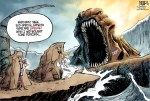
(Via Hot Air.)
Some more serious thoughts along these lines here.
Leave a Comment » | Political | Permalink
Posted by K. Crary
May 15, 2010
Nancy Pelosi says the health care nationalization bill is “entrepreneurial”, because under it you can quit your job and still have health care.
Being a real entrepreneur is much, much harder under Obamacare because of the strangling web of regulations, mandates, and taxes. But to Nancy Pelosi, an “entrepreneur” is anyone without a real job.
Leave a Comment » | Political | Permalink
Posted by K. Crary
May 15, 2010
Google has been collecting data on internet traffic passing over personal wi-fi networks:
Google Inc. said an internal investigation has discovered that the roving vans the company uses to create its online mapping services were mistakenly collecting data about websites people were visiting over wireless networks.
The Internet giant said it would stop collecting Wi-Fi data from its StreetView vans, which workers drive to capture street images and to locate Wi-Fi networks. The company said it would dispose of the data it had accidentally collected.
Alan Eustace, senior vice president of engineering and research for Google, wrote in a blog post that the company uncovered the mistake while responding to a German data-protection agency’s request for it to audit the Wi-Fi data, amid mounting concerns that Google’s practices violated users’ privacy.
Google had previously said it was collecting the location of Wi-Fi hot spots from its StreetView vehicles, but not the information being transmitted over those networks by users.
“It’s now clear that we have been mistakenly collecting samples of payload data from open (i.e. non-password-protected) Wi-Fi networks, even though we never used that data in any Google products,” wrote Mr. Eustace. “We are profoundly sorry for this error and are determined to learn all the lessons we can from our mistake.”
They say it was accidental, and maybe it was (although we have no way to know). But that doesn’t let them off the hook. Even in the most benign reading, this is a company that collects so much data that it can accidentally spy on you.
I also think they need to explain in greater detail how they are going to dispose of the data.
Leave a Comment » | Political, Technological | Permalink
Posted by K. Crary
May 14, 2010
In the Obama administration, knowing what you’re talking about is optional:
Attorney General Eric H. Holder Jr., who has been critical of Arizona’s new immigration law, said Thursday he hasn’t yet read the law and is going by what he’s read in newspapers or seen on television.
Mr. Holder is conducting a review of the law, at President Obama’s request, to see if the federal government should challenge it in court. He said he expects he will read the law by the time his staff briefs him on their conclusions.
“I’ve just expressed concerns on the basis of what I’ve heard about the law. But I’m not in a position to say at this point, not having read the law, not having had the chance to interact with people are doing the review, exactly what my position is,” Mr. Holder told the House Judiciary Committee.
This weekend Mr. Holder told NBC’s “Meet the Press” program that the Arizona law “has the possibility of leading to racial profiling.” He had earlier called the law’s passage “unfortunate,” and questioned whether the law was unconstitutional because it tried to assume powers that may be reserved for the federal government.
The law that he hasn’t had time to read is all of 18 pages long.
(Via Hot Air.)
Leave a Comment » | Political | Permalink
Posted by K. Crary
May 12, 2010
AFP reports:
The US government suffered a wider-than-expected budget deficit of 82.69 billion dollars in April, the Treasury Department said Wednesday. It was nearly four times the deficit chalked up a year earlier and the largest ever recorded in April. Most analysts had expected the April deficit, the 19th consecutive month of federal red ink, to be about 52 billion dollars. . .
“The federal government normally runs a surplus during April because of personal income-tax payments but is running a deficit now because of the recovery from the recession and the policy response,” said Augustine Faucher, director of macroeconomics research for Moody’s Economy.com.
That’s 59% higher than projected, and what’s particularly appalling is April includes tax day.
Leave a Comment » | Political | Permalink
Posted by K. Crary
May 12, 2010
Over a year after President Obama disbanded the CIA’s interrogation program, we still have nothing to replace it:
In February 2009, after two wars and years of confusion over the best way to interrogate a terrorist, the U.S. created a special unit called the High Value Detainee Interrogation Group (HIG) to relearn how to get critical information from suspects in custody.
Fifteen months later and in the wake of the failed car-bombing in Times Square, the question now is: where are they?
The HIG was supposed to bring together all that the U.S. had learned about getting prisoners to talk, the intent being to make the nation’s intelligence sector more effective. Based on a recommendation by a fact-finding intelligence panel, it was to be an interagency group staffed by the best interrogators in government — with broad powers to travel and decide interrogation techniques on a case-by-case basis.
More importantly, the HIG was to report directly to the National Security Council — ending a longtime bureaucratic war between the CIA and the FBI over who would control interrogations, a battle that had damaged intelligence operations.
Now, after a rocky start, sources say the secretive unit is almost up and running. But just how functional it is remains a matter of some dispute.
Five months ago, after the Christmas Day arrest in Detroit of the alleged “underwear bomber” Umar Farouq Abdulmutallab, intelligence watchers were stunned to learn that the HIG not only didn’t participate in his interrogation, but it was not yet operational. And now, despite reports that the HIG has been involved in the Times Square bombing case, intelligence sources say it is still a work in progress.
(Emphasis mine.)
Marc Thiessen’s book explains how dangerous and inexcusable the administration’s failure is.
Leave a Comment » | National Security, Political | Permalink
Posted by K. Crary
May 11, 2010
New York Governor David Paterson (D) doesn’t want to hold a special election to replace Eric Massa (D), who resigned in disgrace in March. In case you couldn’t guess, NY-29 is a Republican district (R+5).
UPDATE: Oh geez. Paterson is going to schedule the special election for November, keeping the seat open for 240 days.
Leave a Comment » | Political | Permalink
Posted by K. Crary
May 11, 2010
Surprise! The CBO now says that the health care nationalization bill will cost much more than it projected when Congress passed the bill:
Congressional Budget Office estimates released Tuesday predict the health care overhaul will likely cost about $115 billion more in discretionary spending over ten years than the original cost projections.
The additional spending — if approved over the years by Congress — would bring the total estimated cost of the overhaul to about $1 trillion.
The Congressional Budget Office expects the federal agencies to spend $10 billion to $20 billion over 10 years on administrative costs to implement the overhaul. The CBO expects Congress to spend an additional $105 billion over 10 years to fund discretionary programs in the overhaul. . .
The CBO estimated in March that the net cost of the overhaul would be $788 billion over 10 years, but cautioned that it couldn’t make an estimate of the discretionary costs without more time and information.
That’s 15% more than its earlier projection. And note that the new estimate still doesn’t account for worst of the gimmicks: the Medicare reimbursement cuts that will never happen, the double-counting, and the back-loaded spending.
Yep, we had to pass the bill to find out what was in it.
(Via the Corner.)
Leave a Comment » | Political | Permalink
Posted by K. Crary
May 11, 2010
Another $8.4 billion, in addition to the $76 billion it has already received. That will bring the total bailout for the two Democratic darlings to $145 billion, easily the most expensive part of the bailout. And Fannie Mae says (p. 13) that things will not turn around in the foreseeable future:
Given our expectations regarding future losses and draws from Treasury, we do not expect to earn profits in excess of our annual dividend obligation to Treasury for the indefinite future. As a result of these factors, there is significant uncertainty as to our long-term financial sustainability.
(Via Reason.)
Thank you Barney Frank! Well, at least the Democrats have learned their lesson.
Ha ha! Just kidding! President Obama last year pledged to cover any and all of Fannie and Freddie’s losses through the end of his first term. Also, the Wall Street “reform” bill does nothing at all in regard to Fannie and Freddie. With a blank check from the government and no government scrutiny, Fannie and Freddie have absolutely no reason to get their ship in order. But that’s okay, because Fannie and Freddie shower Democrats with campaign money.
Leave a Comment » | Political | Permalink
Posted by K. Crary
May 10, 2010
This story might be about an outrageous violation of freedom of religion, but it’s definitely an example of bad journalism. Read the story and try to figure out exactly what actually happened. Were individuals at the Port Wentworth Senior Citizens Center being forbidden to pray before meals (Ed Morrissey reads it that way), or weren’t they? The story certainly implies that they were, but it never comes right out and says it.
It seems pretty clear that something is wrong there, but it’s hard to comment without understanding what exactly happened.
Leave a Comment » | Media Failure, Political | Permalink
Posted by K. Crary
May 9, 2010
I don’t usually play the Imagine-if-a-Republican-had-said-it game, because frankly it’s usually just too obvious. But occasionally something really stands out: Can you imagine the outcry if a Republican had proposed revising Miranda?!
Attorney General Eric Holder said that Congress should “give serious consideration” to updating the Miranda warning which requires law enforcement officials to inform suspects of their rights – including the right to remain silent.
In an interview on “This Week,” Holder said that the U.S. needs to exam whether the current rules regarding Miranda warnings give law enforcement agents the “necessary flexibility” when dealing with terrorism cases.
Holder’s proposal is both right and wrong. I think it’s right to revise Miranda, because it goes much too far. For example, under Miranda, if you fail to read a suspect his rights, it’s assumed he doesn’t know them and any questioning is assumed coercive, even if that suspect is, say, a criminal law professor. That’s just silly.
But that’s an argument for revising Miranda in general. Revising it in the manner that Holder seems to be proposing is a very bad idea. Law enforcement personnel should not be able to set aside constitutional rights (and that’s what we’re assuming Miranda is, if we aren’t willing to revise it in general) in certain sorts of cases. That’s the sort of reasoning we see in the UK, where Parliament has been whittling away citizens’ rights to the point where they have hardly any left.
We can obtain the information we need while protecting the integrity of law enforcement by recognizing that there are two different sorts of agents: law enforcement and intelligence. Law enforcement abides by rules to ensure that the rights of suspects in civilian court are not violated. Intelligence obtains the information we need to protect the country, but that information might not be admissible in civilian court.
When the terrorist in question is a US citizen (such as Shahzad), there are still some problems, to be sure. These are matters that Congress needs to take seriously and try to craft a solution to. One idea would be to establish a “Chinese wall” between intelligence and law enforcement in such cases to prevent the proceeds of interrogation from tainting a prosecution. But we have to concede that we might sometimes have to forgo prosecution in order to protect innocent lives.
Unfortunately, the Obama administration can’t contemplate a course such as this, because they are fully invested in applying the law enforcement paradigm to terror cases. Holder’s own proposal implicitly acknowledges that the law enforcement approach is inappropriate for terror cases, but unfortunately he is compounding the problem by compromising the integrity of law enforcement rather than reversing his fundamental error.
(Via Instapundit.)
Leave a Comment » | Legal, National Security, Political | Permalink
Posted by K. Crary
May 8, 2010
A new Fox News poll shows significant support the Arizona illegal immigration law: 61% of those with an opinion supported the law, against 38% opposed. (That’s from the poll numbers; I’m not sure where the story found the number 27%.) More significantly, the public believes by a wide margin (64%-15%) that the Obama administration should wait and see what happens, rather than try to block the law. Even Democrats share that opinion (52%-26%).
Glenn Reynolds explains why this is so significant:
Forget the Arizona bill itself. What this poll says is that despite weeks of national-media coverage that was unrelentingly negative, calling the bill racist, drawing Nazi analogies, etc. — only 15 percent are really against it. Sorry guys — you’re still talking, but people aren’t listening.
POSTSCRIPT: Another interesting tidbit from the poll: The public feels that the main concern about illegal immigration is burdening public services (44%), not taking jobs from Americans (19%) or changing the culture (3%), etc. As I’ve said before, my only objection to unrestricted immigration is that it is incompatible with the modern welfare state (and I’d rather fix the welfare state). The tenor of reporting on the issue certainly gives no hint that a wide plurality agrees with me.
Leave a Comment » | Political | Permalink
Posted by K. Crary
May 8, 2010
The Detroit News reports:
In a development described as “unprecedented,” a federal court official in Detroit filed an affidavit today with the U.S. 6th Circuit Court of Appeals, saying he wanted to correct claims made by prosecutors in the Hutaree militia case.”This affidavit is being submitted to correct the record, and any misunderstanding (Assistant U.S. Attorney) Mr. (Ronald) Waterstreet had about our conversation,” Chief Pretrial Services Officer Alan Murray said in a court filing.
“Contrary to Mr. Waterstreet’s belief, the court-ordered ‘home detention’ does not allow unmonitored release the entire day,” Murray said in the affidavit. “The Global Positioning Satellites System allows a defendant to be monitored, at all times.”
Murray also said his office has forms and procedures for assuring someone else takes possession of firearms belonging to third-party custodians assigned to the defendants, and his office “has a safe with the capacity to handle the third-party custodians’ firearms, if necessary.” . . .
“The type of electronic monitoring imposed is wholly inadequate to effectively supervise the defendants,” Waterstreet said. “Moreover, there is no requirement that third-party custodians turn over any firearms they have to a law enforcement agency, and no means of verifying that they have removed firearms from the home.”
(Via Instapundit.)
Leave a Comment » | Political | Permalink
Posted by K. Crary
May 7, 2010
Are stupid TV people really as stupid as they seem? In the case of Rick Sanchez, yes.
POSTSCRIPT: Sanchez is a bad guy, so go ahead and indulge the schadenfreude.
UPDATE: More.
Leave a Comment » | Political, Recreational | Permalink
Posted by K. Crary
May 7, 2010
We are being told that today’s jobs report is good news, and that the uptick in unemployment (to 9.9%) is okay because it’s being caused by people re-entering the labor market. Even some on the right are saying this.
But that story doesn’t seem to wash. If it were true, you would expect to see some improvement in the broader “U-6” measure of unemployment. U-6 includes “marginally attached” workers (those who would like to be working but aren’t looking right now, which includes but is not limited to discouraged workers) and those who are working part-time because they couldn’t find full-time work. In fact, U-6 worsened for the third straight month. U-4 and U-5 (measures in between the official rate and U-6) also worsened.
(Via Instapundit.)
Leave a Comment » | Political | Permalink
Posted by K. Crary
May 7, 2010
While Congress debates a financial overhaul bill that is supposedly going to put an end to the bailout culture, let’s remember the one-year anniversary of the $108 billion IMF bailout:
Congressional leaders agreed Tuesday to calculate the cost of a new U.S. contribution to the International Monetary Fund in a relatively inexpensive way, paving the way for possible Congressional approval within weeks.
The Obama administration has pledged a $108 billion contribution to the IMF, as part of a $500 billion global boost to IMF resources. The White House has argued that this is a necessary contribution to global financial stability and would send a signal that there is enough money to help prevent struggling countries from becoming further enmeshed in economic crises. Congressional approval would put pressure on European nations, China, Brazil and others to increase their lending to the IMF.
The bailout didn’t pass until later in the year, but one year ago Congress made the key decision to keep the bailout off-budget:
But the U.S. contribution became entangled in arcane — though politically important — budget math. The White House had argued that the action shouldn’t be characterized as a $108 billion expenditure, which would make it difficult to sell at a time when Congress has recently passed a series of multibillion-dollar spending bills.
The U.S. wouldn’t provide a lump sum, but would essentially make a line of credit available to the IMF, which the fund could draw on when it needed to make loans to other countries. In theory, the U.S. would hope to get the money back. So the White House argued that the budgetary impact should be calculated at zero.
That’s right, the Democrats decided that the IMF bailout didn’t cost anything because we were supposed to get all the money back. (And these people want to regulate risk on Wall Street?!)
Good grief. The IMF is sending $40 billion to Greece. (Our share is about $6.8 billion.) Whatever you think of the chances of Greece righting their ship, you have to imagine there’s at least a decent chance that the IMF is never going to see that money again. Our risk is not zero. Not even close.
POSTSCRIPT: One might have thought that a $108 billion off-budget bailout of foreign countries would have been a tough bill to pass, but the Democrats thought of that. They voted to attach the bailout to the troop funding bill.
Leave a Comment » | Political | Permalink
Posted by K. Crary
May 7, 2010
If I’m understanding this WSJ story right, the FCC really is going to go ahead and claim that the internet is a telephone system so they can regulate it.
(Previous post.)
UPDATE: More here.
Leave a Comment » | Legal, Political, Technological | Permalink
Posted by K. Crary
May 6, 2010
Another hidden provision in the health care nationalization bill adds a massive new tax compliance burden:
An all-but-overlooked provision of the health reform law is threatening to swamp U.S. businesses with a flood of new tax paperwork.
Section 9006 of the health care bill — just a few lines buried in the 2,409-page document — mandates that beginning in 2012 all companies will have to issue 1099 tax forms not just to contract workers but to any individual or corporation from which they buy more than $600 in goods or services in a tax year.
The stealth change radically alters the nature of 1099s and means businesses will have to issue millions of new tax documents each year. . . Under the new rules, if a freelance designer buys a new iMac from the Apple Store, they’ll have to send Apple a 1099. A laundromat that buys soap each week from a local distributor will have to send the supplier a 1099 at the end of the year tallying up their purchases.
This is so costly, and so unnecessary, it’s doesn’t seem possible for it to be in good faith. Mark Tapscott’s theory that this is a first step toward a VAT seems plausible.
(Via the Corner.)
Leave a Comment » | Political | Permalink
Posted by K. Crary
May 6, 2010
A Rasmussen poll finds that the public is wise to the debt commission:
Only 18% of Americans are willing to pay higher taxes to lower the federal budget deficit, according to a new Rasmussen Reports national telephone survey. Sixty-nine percent (69%) are not willing to have their taxes raised to deal with deficits that are projected to rise to historic levels over the next decade. . .
But most voters think President Obama’s new bipartisan deficit reduction commission is more likely to recommend tax increases than spending cuts to meet the growing deficit, and 78% expect Congress to raise taxes if the commission recommends it.
Even if the president and Congress raise taxes to reduce the federal deficit, 58% of voters think they are more likely to spend the money on new government programs.
(Emphasis mine.)
I find that last finding interesting and a little surprising. A majority understands what is going on here: the purpose of the commission is not to cut the deficit; it’s purpose is to get a VAT in place to fund a further expansion of government.
(Via Instapundit.)
Leave a Comment » | Political | Permalink
Posted by K. Crary
May 6, 2010
The Washington Post reports:
The Interior Department exempted BP’s calamitous Gulf of Mexico drilling operation from a detailed environmental-impact analysis last year, according to government documents, after three reviews of the area concluded that a massive oil spill was unlikely.
The decision by the department’s Minerals Management Service (MMS) to give BP’s lease at Deepwater Horizon a “categorical exclusion” from the National Environmental Policy Act (NEPA) on April 6, 2009 — and BP’s lobbying efforts just 11 days before the explosion to expand those exemptions — show that neither federal regulators nor the company anticipated an accident of the scale of the one unfolding in the Gulf.
For the record, the Obama administration was in office on April 6, 2009.
Cheap shot? Well, yes. The regulators probably had a good reason for exempting BP, and this certainly was a very low-probability event. (My understanding is we still don’t know why the oil rig exploded.) But if our national practice is to blame the president for everything that happens under his watch, we have to pin this on President Obama. After all, President Bush was held responsible for a hurricane and faulty levee construction in New Orleans.
POSTSCRIPT: Glenn Reynolds notes that the Post has spiked this story.
Leave a Comment » | Media Failure, Political | Permalink
Posted by K. Crary
May 6, 2010
I like Joe Lieberman and Scott Brown, but their Terrorist Expatriation bill is a very, very bad idea. It would allow the government to strip Americans of their citizenship if it can show by a preponderance of the evidence (not beyond a reasonable doubt) that they provided material support for terrorism.
To lower the evidential bar is a terrible idea on general principles (and is certainly unconstitutional), but it’s particularly troubling in light of the government’s recent behavior in the Hutaree militia case. In that case, it appears that the government arrested several people for nothing more than discussing their fantasies about overthrowing the government. Unless the government has more evidence in reserve, this people will probably go free. But, if the government needed to show only a preponderance of the evidence, that would be another matter entirely. They might be able to make their flimsy case stick.
As Glenn Reynolds argues,
We need a bright-line distinction between citizens and noncitizens to reduce the temptation of political abuse. This blurs that distinction, which is a bad thing.
Leave a Comment » | Legal, Political | Permalink
Posted by K. Crary
May 6, 2010
CNN reports:
The recovery is picking up steam as employers boost payrolls, but economists think the government’s stimulus package and jobs bill had little to do with the rebound, according to a survey released Monday.
In latest quarterly survey by the National Association for Business Economics, the index that measures employment showed job growth for the first time in two years — but a majority of respondents felt the fiscal stimulus had no impact.
Actually, calling it “a majority” is lowballing the finding. In fact, 73% said the stimulus bill has had no impact to date. Further, 68% say that the second stimulus bill (the one called the “jobs bill”) will have no effect either.
Leave a Comment » | Political | Permalink
Posted by K. Crary
May 5, 2010
The Dodd-Shelby amendment to the financial overhaul bill actually sounds reasonable, so I suspect I’m misunderstanding it. Is that overly cynical?
(Via the Corner.)
UPDATE: Stephen Spruiell agrees that it really is pretty good. Way to go Shelby. It’s a pity he couldn’t fix the rest of the bill.
Leave a Comment » | Political | Permalink
Posted by K. Crary
May 5, 2010
Freddie is asking for $10.6 billion, on top of the $50.7 billion it’s been given already. Thank you Barney Frank!
(Via Hot Air.)
Leave a Comment » | Political | Permalink
Posted by K. Crary
May 4, 2010
ABC News reports:
Three days after he decried the lack of civility in American politics, President Obama is quoted in a new book about his presidency referring to the Tea Party movement using a derogatory term with sexual connotations.
Once again, the Tea Party people are much more civil than their critics.
(Via Instapundit.)
UPDATE: Robert Gibbs refuses to comment.
Leave a Comment » | Political | Permalink
Posted by K. Crary
May 3, 2010
Am I the only one that thinks jokes about your own misconduct aren’t really funny? For example, President Obama:
Of course, that’s not the only thing that we’ve been accused of socializing this year. You might have heard we passed a health care bill and — (applause.) Is that Roger Ailes applauding out there? (Laughter.) Some Republicans have suggested that the bill contains a few secret provisions. That’s ridiculous. There aren’t a few secret provisions in the health care plan — there are, like, hundreds. (Laughter.)
(Via the Corner.)
UPDATE: On the other hand, the Washington Post gives Obama grief about how he broke the etiquette of the function by using his routine to mock his opponents, rather than poke fun at himself:
Barack Obama, the Insult Comic President, was up to his old shtick Saturday night. Breaking with presidential punch line tradition for the second consecutive year, Obama dropped zinger after zinger on his opponents and allies alike at the annual White House Correspondents’ Association dinner. . . Except for a mild joke pegged to his falling approval ratings, Obama mostly spared Obama during his 14-minute stand-up routine. . .
Obama’s derisive tone surprises and dismays some of the people who’ve written jokes for presidents past.
“With these dinners you want the audience to like you more when you sit down than when you stood up,” says Landon Parvin. . . “Something in [Obama’s] humor didn’t do that,” he said Sunday.
Parvin advises his political clients to practice a little partisan self-deprecation when they make lighthearted remarks: “If you’re a Democrat, you make fun of Democrats and go easy on the Republicans; if you’re a Republican, you do the opposite,” he says.
Barack Obama takes himself too seriously to poke fun at himself. Even his one self-deprecating joke (about his falling approval ratings) was outward looking, not really about himself.
Anyway, just to be clear, the hundreds-of-secret-provisions joke isn’t at his own expense, it’s at our expense. He’s saying “Look what I did to you! Ha ha.” It’s like Homer Simpson laughing about his latest cruel prank against Flanders, or Ted Kennedy telling Chappaquiddick jokes.
(Via Hot Air.)
Leave a Comment » | Political | Permalink
Posted by K. Crary
May 3, 2010
The Telegraph reports:
Dale McAlpine was charged with causing “harassment, alarm or distress” after a homosexual police community support officer (PCSO) overheard him reciting a number of “sins” referred to in the Bible, including blasphemy, drunkenness and same sex relationships.
The 42-year-old Baptist, who has preached Christianity in Wokington, Cumbria for years, said he did not mention homosexuality while delivering a sermon from the top of a stepladder, but admitted telling a passing shopper that he believed it went against the word of God.
Police officers are alleging that he made the remark in a voice loud enough to be overheard by others and have charged him with using abusive or insulting language, contrary to the Public Order Act.
Mr McAlpine . . . was taken to the police station in the back of a marked van and locked in a cell for seven hours.
Sadly, this happens all the time in today’s UK: 1, 2, 3, 4. It’s sad to see the society that invented individual liberty abandoning it.
(Via Hot Air.)
Leave a Comment » | Political | Permalink
Posted by K. Crary
May 3, 2010
Another power grab:
The Federal Trade Commission could become a more powerful watchdog for Internet users under a little-known provision in financial overhaul legislation that would expand the agency’s ability to create rules.
An emboldened FTC would stand in stark contrast to a besieged Federal Communications Commission, whose ability to oversee broadband providers has been cast into doubt after a federal court ruled last month that the agency lacked the ability to punish Comcast for violating open-Internet guidelines.
The version of regulatory overhaul legislation passed by the House would allow the FTC to issue rules on a fast track and permit the agency to impose civil penalties on companies that hurt consumers. FTC Chairman Jon Leibowitz has argued in favor of bolstering his agency’s enforcement ability.
(Via Hot Air.)
Leave a Comment » | Political | Permalink
Posted by K. Crary
May 3, 2010
Supporters of Obamacare are not so confident of its constitutionality as they pretend:
A”tell” in poker is a subtle but detectable change in a player’s behavior or demeanor that reveals clues about the player’s assessment of his hand. Something similar has happened with regard to the insurance mandate at the core of last month’s health reform legislation. Congress justified its authority to enact the mandate on the grounds that it is a regulation of commerce. But as this justification came under heavy constitutional fire, the mandate’s defenders changed the argument—now claiming constitutional authority under Congress’s power to tax.
This switch in constitutional theories is a tell: Defenders of the bill lack confidence in their commerce power theory. The switch also comes too late. When the mandate’s constitutionality comes up for review as part of the state attorneys general lawsuit, the Supreme Court will not consider the penalty enforcing the mandate to be a tax because, in the provision that actually defines and imposes the mandate and penalty, Congress did not call it a tax and did not treat it as a tax.
2 Comments | Legal, Political | Permalink
Posted by K. Crary
May 3, 2010
A Treasury Department press release on GM’s supposed repayment of its bailout debt gives no indication that it paid off only a fraction of its debt, and did so using untapped bailout funds:
The U.S. Department of the Treasury today announced that General Motors (GM) has fully repaid its debt under the Troubled Asset Relief Program (TARP). GM paid the remaining $4.7 billion of the total $6.7 billion in debt owed to Treasury. The repayment comes five years ahead of the loan maturity date and ahead of the accelerated repayment schedule the company announced last year. . .
“We are encouraged that GM has repaid its debt well ahead of schedule and confident that the company is on a strong path to viability,” said Treasury Secretary Tim Geithner.
In fact, GM “repaid” the $6.7 billion loan using other bailout funds in an $17.4 billion escrow account. Remarkably, the New York Times is on the story:
AS we inch closer to a clearer understanding of the products and practices that unleashed the credit crisis of 2008, it’s becoming apparent that those seeking the whole truth are still outnumbered by those aiming to obscure it. This is the case not only on Wall Street but also in Washington.
Truth seekers the nation over, therefore, are indebted to Senator Charles E. Grassley, Republican of Iowa, who in recent days uncovered what he called a government-enabled “TARP money shuffle.” It relates to General Motors, which on April 21 paid the balance of its $6.7 billion loan under the Troubled Asset Relief Program. . .
G.M. also crowed about its loan repayment in a national television ad and the United States Treasury also marked the moment with a press release: “We are encouraged that G.M. has repaid its debt well ahead of schedule and confident that the company is on a strong path to viability,” said Timothy F. Geithner, the Treasury secretary.
Taxpayers are naturally eager for news about bailout repayments. But what neither G.M. nor the Treasury disclosed was that the company simply used other funds held by the Treasury to pay off its original loan.
Those are strong words from the NYT in favor of a Republican and against a Democrat.
But there’s more. Reading Grassley’s letter (at the bottom of the first page), it looks to me as though the scam is even deeper than reported. If Grassley has the facts straight, by “repaying” the $6.7 billion loan from escrow, GM unlocked another $5.1 billion in escrow funds which will now be turned over to GM. So after the whole money shuffle, not only has GM not repaid a cent, but it actually ends up with more money in the bank.
So this is actually the exact opposite of what GM and the Treasury claimed. GM wasn’t repaying $6.7 billion; it was actually drawing a new $5.1 billion bailout.
(Via Hot Air.)
Leave a Comment » | Political | Permalink
Posted by K. Crary
May 1, 2010
Obamacare is going to cost people their health insurance:
Documents unearthed by [Waxman’s] investigation highlight companies that are considering dumping employees from their current health-care plans in the face of new costs from the health-care law. President Obama repeatedly promised his health-care law would let Americans keep their current insurance if they’re happy with it.
A March 3 internal Verizon memo on the impact health-care law said new taxes on insurance companies and health-care equipment manufacturers will be passed onto employers through higher prices.
Facing such increased costs, employers like Verizon “may consider exiting the health-care market and send employees to the exchanges,” the memo says.
Under the law, companies would pay fines for not providing insurance companies coverage. But, the Verizon memo said, the fines would be “modest” compared to providing coverage for employees.
In a March 25 e-mail, John Deere’s director of labor relations, Kenneth Hugh, said, “We ought to look at … denying coverage and just paying the penalty … we would need to figure out which one was more expensive.”
This is what opponents of the bill said would happen all along. By the time the bill was passed, its supporters weren’t even denying it. At first they said “You won’t lose your insurance”, but by the end their promise was delicately and legalistically phrased: “Nothing in the proposal forces anyone to change the insurance they have.” Perhaps nothing in the bill requires it, but it does make it happen.
ASIDE: Actually, it’s not even true that nothing in the bill requires that you give up your insurance. If you’re insurance does not satisfy the government’s requirements, it’s not allowed.
Anyway, Henry Waxman started his investigation and scheduled hearing when he thought that Verizon, Deere and other were trying to score political points against Obamacare. In fact, the opposite was true. Their announcements were inarguable and legally required, and we now know they were actually holding back the really bad news. No wonder Waxman cancelled his hearings; I’m sure he wishes he could undo his investigation as well.
(Via the Corner.)
Leave a Comment » | Political | Permalink
Posted by K. Crary
May 1, 2010
AP reports:
President Obama took aim Saturday at the angry rhetoric of those who denigrate government as “inherently bad” and said their off-base line of attack ignores the fact that in a democracy, “government is us.”
Oh please. The government and its allies have long since learned to thwart the will of the people. The public (that’s “us”) didn’t want the bailouts, the stimulus, or health care nationalization. The government did it all anyway.
But that’s not even the point. Even if we stipulate the absurd proposition that our government always — or even usually — carries out the will of the people, that still doesn’t mean the government is good. On the contrary, the majority is often more than happy to trample the rights of the individual. That’s why the government’s power must be limited, whether it’s carrying out the people’s will or not.
Alas, the mechanisms our system used to provide to limit the power of government (delegated powers, checks and balances, separation of powers) have failed. Today, everything is called interstate commerce and the government does whatever it chooses.
Oh, but that’s not even the worst of President Obama’s remarks:
Obama used his commencement speech at the University of Michigan to respond to foes who portray government as oppressive and tyrannical — and to warn that overheated language can signal extremists that “perhaps violence is … justifiable.”
Back to this canard again. If you’re angry at government, you’re promoting violence. Even if you’re not promoting violence, you’re still promoting violence. (But that’s just for now. When Republicans are in power, “overheated language” is merely dissent.) This sort of cynical attempt to marginalize a mainstream movement opposed to government overreach is a good example of why people are so angry.
Leave a Comment » | Political | Permalink
Posted by K. Crary
April 30, 2010
The ACLU’s old position on restrictions on campaign contributions (as quoted in a WSJ op-ed) was:
Limitations on contributions or expenditures made by individuals or organizations for the purpose of advocating causes or candidates in the public forum impinge directly on freedom of speech and association. Their implementation poses serious dangers to the First Amendment. They should be opposed in candidate as well as referenda elections.
That position was right. “Campaign contributions” is simply like-minded people pooling their money to fund their speech. Limits on campaign contributions are no more or less than a limit on free association and speech.
That position put the ACLU at odds with the bulk of the liberal establishment, who want to limit free speech. In fact, liberal politicians tried to cap expenditures as well as contributions (that is, the actual speech, and not just the free association to fund speech) but was blocked by the Supreme Court.
That probably made for awkward moments at dinner parties. Anyway, whatever the reason, the ACLU Board of Directors has voted to reverse its position. The ACLU is now officially okay with limits on free speech.
Leave a Comment » | Legal, Political | Permalink
Posted by K. Crary
April 30, 2010
Some liberals have urged the FCC to reclassify the Internet as a “telecommunications service” in order to circumvent the court ruling barring the FCC from imposing network neutrality. Larry Downes says it’s not so simple.
(Previous post.)
Leave a Comment » | Legal, Political | Permalink
Posted by K. Crary
April 30, 2010
President Obama says “I do think at a certain point you’ve made enough money.”
Oh? How much is enough, precisely? Last year, Barack Obama earned $5,623,690, according to his tax return. Is $5.6 million per year enough? Apparently not. If a smaller amount were “enough” you would expect that he would have given away the excess. He did not. In fact, he gave less than 6% of his income to charity.
So whatever the “enough money” point is, I guess it’s higher than $5.6 million per year.
POSTSCRIPT: Let me add a more serious response: Of course there are diminishing marginal returns to earning more money, but what point is enough is an individual decision. Does Obama have any appreciation for the concept of an individual decision?
Moreover, does Obama not understand that people trying to make money is what drives the economy? When people decide they’ve made enough, they stop growing the economy and creating jobs. That’s bad, remember?
(Via Instapundit.) (The title is borrowed from Scott Johnson’s excellent rejoinder.)
Leave a Comment » | Political | Permalink
Posted by K. Crary
April 28, 2010
Yet another ethics complaint against Sarah Palin has been dismissed. She has been cleared 26 times, with 1 complaint still outstanding. Palin said:
My reaction upon reading the opinion in this matter was not what I expected. Though I’m always pleased with the results of these investigations that prove the false allegations wrong, and I appreciate the detailed reasoning set forth in this recent opinion, I was primarily disappointed that the State of Alaska, the Attorney General’s office, and others, still have to spend time and resources addressing the abusive onslaught of frivolous complaints directed against me—even after I left office.
(Via the Corner.)
Leave a Comment » | Legal, Political | Permalink
Posted by K. Crary
April 27, 2010
In order to carry out the reconciliation shuffle, Democrats had to abandon their ambitions of putting overt price controls into their health care nationalization bill. That’s fortunate, because price controls are a complete disaster in Massachusetts. Naturally, Democrats are now working to bring Massachusetts’s woes to the rest of the country.
POSTSCRIPT: The additional irony is that the bill did contain price controls that will push up rates for most customers.
Leave a Comment » | Political | Permalink
Posted by K. Crary
April 27, 2010
Barack Obama, July 2004:
There is not a liberal America and a conservative America–there is the United States of America. There is not a black America and a white America and Latino America and Asian America–there’s the United States of America.
Barack Obama, April 2010:
This year, the stakes are higher than ever. It will be up to each of you to make sure that young people, African Americans, Latinos and women who powered our victory in 2008 stand together once again.
Leave a Comment » | Political | Permalink
Posted by K. Crary
April 27, 2010
The Prince George beating scandal expands, with even more official misconduct:
After the iPhone video of McKenna’s beating emerged, investigators subpoenaed 60 hours of surveillance video from the College Park campus police. The only video police couldn’t manage to locate was the one from the camera aimed squarely at the area where McKenna was beaten. Funny how that works. Campus police claimed that a “technical error” with that particular camera caused it to record over the footage of the beating. As public pressure mounted, police later found what they claimed was a recording of the lost video. But two minutes of that video were missing. Coincidentally, those two minutes happened to depict key portions of McKenna’s beating. The kicker? The head of the campus video surveillance system, Lt. Joanne Ardovini, is married to one of the cops named in McKenna’s complaint.
This looks really really bad.
Meanwhile, elsewhere in Maryland, officials tried to prosecute a man for recording a police officer making an overly aggressive traffic stop. (Don’t they realize how bad this looks?) And it turns out that they had no case:
In fact, under Maryland law what Graber did isn’t actually a crime. For a recording to be illegal, one of the parties being recorded must have a reasonable expectation of privacy. A cop, acting as a cop, with his gun drawn, while standing alongside a public roadway, has no such expectation. On April 15th, Graber was released and the charges against him were dropped. As he told Miller, “The judge who released me looked at the paperwork and said she didn’t see where I violated the wiretapping law.”
But that didn’t stop the police from jailing the man for over a day and searching his home. Worse:
Graber was harassed, intimidated, illegally arrested, and jailed for an act that clearly wasn’t illegal. According to Graber, the name of the judge who signed off on the raid of his parents’ home doesn’t appear on the warrant. As Graber told Miller, “They told me they don’t want you to know who the judge is because of privacy.” If true, that statement is so absurd it’s mind numbing. A judge issued an illegal warrant for police to invade the private residence and rummage through the private belongings of a man who broke no laws, and we aren’t permitted to know the judge’s name in order to protect the judge’s privacy?
The authorities in Maryland are out of control.
(Via Instapundit.)
UPDATE (9/28): Four months later, the charges against Graber have been dropped.
Leave a Comment » | Legal, Political | Permalink
Posted by K. Crary
April 27, 2010
UPDATE: The Medicare Actuary says there is no truth to this report. (Via the Corner.)
UPDATE: The Spectator is standing by its story, sort of, saying that although the actual report had not been delivered, the data underlying it had. I have no idea whether or not that’s true, but in any case it’s not what they said originally. This gives the media an excuse (if they needed one) not to pursue the story, so I think this story will go away quickly. (Via Instapundit.)
Whether or not the Spectator is right now, there’s a lesson here: details matter. If you work for the MSM, you can afford to get the details wrong at first. If you’re on the outside, you have to get them right.
ORIGINAL POST:
Last week I noted that the Democrats had hurried through a vote on the health care nationalization bill before the Medicare Actuary could complete his report, which ultimately found that the bill would raise costs, not lower them. Now a far more serious allegation has been made, that the Democrats actually had the report and covered it up:
The economic report released last week by Health and Human Services, which indicated that President Barack Obama’s health care “reform” law would actually increase the cost of health care and impose higher costs on consumers, had been submitted to the office of HHS Secretary Kathleen Sebelius more than a week before the Congressional votes on the bill, according to career HHS sources, who added that Sebelius’s staff refused to review the document before the vote was taken.
“The reason we were given was that they did not want to influence the vote,” says an HHS source. “Which is actually the point of having a review like this, you would think.”
The analysis, performed by Medicare’s Office of the Actuary, which in the past has been identified as a “nonpolitical” office, set off alarm bells when submitted. “We know a copy was sent to the White House via their legislative affairs staff,” says the HHS staffer, “and there were a number of meetings here almost right after the analysis was submitted to the secretary’s office. Everyone went into lockdown, and people here were too scared to go public with the report.”
In the end, the report was released several weeks after the vote — the review by the secretary’s office reportedly took less than three days — and bore a note that the analysis was not the official position of the Obama administration.
If these allegations are substantiated, this is a huge scandal. Will the press investigate?
(Via Instapundit.)
Leave a Comment » | Political | Permalink
Posted by K. Crary
April 25, 2010
Ed Morrissey:
The importation of toys with lead paint from China two years ago prompted Congress to pass the Consumer Product Safety Improvement Act (CPSIA), requiring extensive independent testing of all products sold — or resold — for children. The new regulations threatened to put small manufacturers and thrift shops out of business, thanks to the onerous burden of test costs. But what about the big manufacturer that actually put 2 million contaminated products on shelves? Mattel gets a waiver from testing requirements — again.
The legislation passed in response to Mattel’s misconduct is driving Mattel’s competition out of business but exempting Mattel itself. This is an outrage, but it’s also typical. Big business pretends that it opposes new regulation, but usually it secretly loves regulation because it forces smaller competition out of business.
Think about this as Democrats say they are going to punish Wall Street. The big firms are crying all the way to the bank, so to speak.
(Via Hot Air.)
Leave a Comment » | Political | Permalink
Posted by K. Crary
April 24, 2010
GM is paying off its bailout debt using other bailout funds. Evidence of progress at GM this is not.
UPDATE: The new definition of chutzpah: paying off 10% of your debt and then authoring an op-ed entitled “The GM Bailout: Paid Back in Full”.
Leave a Comment » | Political | Permalink
Posted by K. Crary
April 24, 2010
President Obama’s repeated disdain for America’s special relationship with Britain may soon be bearing consequences. Britain’s far-left third party has soared in the polls, and is using Obama’s ambivalence toward the special relationship as justification for ending it. The Washington Post explains:
Mr. Clegg’s stance on those issues could make some in Washington nervous. In a speech this week he called for a shakeup in relations between the United States and the United Kingdom and described as “embarrassing the way Conservative and Labor politicians talk in this kind of slavish way about the special relationship.” He added that there were “profound differences” between the two countries and argued that the Obama administration had already written off the idea that Britain was a special ally. “If they are moving on, why on earth don’t we?” he said.
Intentionally or not, Mr. Obama has offered support for Mr. Clegg’s argument: His relatively chilly relationship with Mr. Brown, including several perceived snubs, has been a persistent theme of British news coverage. Yet the United States can hardly afford a weaker or less friendly Britain at a time when it is still fighting two wars and when diplomacy with states such as Iran, North Korea and Syria is failing.
(Emphasis mine.)
Would it have been so hard to treat the Prime Minister and the Queen with respect, to repudiate State Department statements that the special relationship was over, and to express support for British oil claims off the Falklands coast? No, it wouldn’t have, but he didn’t.
During the Bush administration, there was a lot of idle talk about how President Bush was damaging relations with our allies. Obama has actually done it.
(Via Power Line.)
Leave a Comment » | Geopolitical, Political | Permalink
Posted by K. Crary
April 24, 2010
Six months later, Steny Hoyer (the House Democratic leader) admits it was wrong to call people protesting health care nationalization “un-American“:
“That was not a good phrase, not a good use of language, it was not correct,” Mr. Hoyer, Maryland Democrat, said. . . Mr. Hoyer said he made a mistake in reading the op-ed too quickly and approving it.
Nancy Pelosi did not join him in retracting the smear.
(Via Big Government.)
Leave a Comment » | Political | Permalink
Posted by K. Crary
April 24, 2010
I recently saw a film entitled This Film is Not Yet Rated, an attack documentary against the MPAA film ratings board. Despite being generally pre-disposed to dislike the MPAA, I found the film thoroughly unconvincing.
The basic problem with the movie is that it doesn’t understand what censorship is. Censorship is not when someone fails to forge the business deals necessary to produce and disseminate his speech. Were that the case, millions of aspiring writers and directors would be being “censored” all the time when no one agrees to produce their movie. No, censorship is when a group of people do forge the consensual business deals necessary to produce and disseminate speech, and a third party comes in to stop it. That third party is typically the government, but of late it has often been Muslim pressure groups bringing threats of violence.
There’s no third party in the MPAA system. If a theater wants to show an NC-17 movie, no one is stopping them, and some do. However, most theaters have voluntarily decided not to show movies rated NC-17, and most advertising media have voluntarily decided not to air commercials for such movies. These companies have made the business decision to trust the MPAA’s ratings, and consequently an unfavorable rating keeps producers from forging the business deals needed to garner a wide audience. This isn’t censorship; it’s free enterprise.
In one astonishing interview, a lawyer who (honest to God) is labeled as a “First Amendment Attorney” says that we would be better off with a government censorship board than the MPAA. At that point it became pretty clear not to take the movie seriously.
The movie does make one allegation that might hold water: it claims that the MPAA is much easier on studio films than independent films. The movie’s evidence is not exactly airtight, but the charge is quite plausible since the studios fund the MPAA. If true, it’s still not censorship, but it is anti-competitive behavior that is probably illegal. But if anyone has ever sued the MPAA over its ratings on anti-trust grounds, I can’t find evidence of it.
But apart from that point, the whole movie takes a far more indignant tone than it is entitled to. The MPAA reviews movies, and they don’t like the reviews.
The movie does argue convincingly that the MPAA ratings are fairly arbitrary. They also argue that the ratings favor some potentially objectionable material over other (e.g., violence over sex, and heterosexual sex over homosexual sex). Most of those preferences seem unsurprising, since in most cases the raters seem to be reflecting the prevailing social mores.
A summary of the movie would be incomplete if it did not mention the investigation plot. The movie takes issue with the fact that the raters’ identities are unknown, and much of the movie is dedicated to a private investigator’s effort to learn their identities. The effort is successful, and it turns out the demographics of the raters are not precisely what is suggested by the MPAA. (For instance, most of them do not have young children.)
A summary would also be incomplete if it did not mention that parts of the movie are very difficult to watch. The movie is rife with clips from scenes of various movies than earned them NC-17 ratings. The apparent reason for the inclusion of these clips is to ensure that the movie itself received an NC-17 rating. The narrator/director pretends to be upset by this utterly unsurprising development, but without it the film could not have its third act in which he laughably attempts to fight the rating.
At least I can still despise the MPAA for its support of copyright extension and the DMCA.
Leave a Comment » | Political, Recreational | Permalink
Posted by K. Crary
April 23, 2010
Surprise, surprise. The Medicare Actuary says that health care nationalization will cost more than projected:
President Barack Obama’s health care overhaul law is getting a mixed verdict in the first comprehensive look by neutral experts: More Americans will be covered, but costs are also going up. . .
But the analysis also found that the law falls short of the president’s twin goal of controlling runaway costs, raising projected spending by about 1 percent over 10 years. That increase could get bigger, since Medicare cuts in the law may be unrealistic and unsustainable, the report warned. . .
In addition to flagging provider cuts as potentially unsustainable, the report projected that reductions in payments to private Medicare Advantage plans would trigger an exodus from the popular alternative. Enrollment would plummet by about 50 percent. Seniors leaving the private plans would still have health insurance under traditional Medicare, but many might face higher out-of-pocket costs. In another flashing yellow light, the report warned that a new voluntary long-term care insurance program created under the law faces “a very serious risk” of insolvency.
So the new law drives health care costs up, even if you assume Medicare reimbursements will be cut, which of course they won’t be. The full report is here. No wonder Democrats wouldn’t wait for the report before passing the bill.
BONUS: Kathleen Sebelius admits that she has no idea what the bill’s high-risk pools will cost.
POSTSCRIPT: The report did say that the bill would extend health coverage to 34 million more people, but as people will discover, coverage is not necessarily the same thing as access. At a talk I attended yesterday, Allan Meltzer pointed out that the bill does nothing to expand the supply of health care. Primary-care physicians are already underpaid, and the bill assumes their pay will be cut further. Thus, expanding coverage merely moves the long lines for treatment out of the emergency room and into the physician’s office where all of us can enjoy them.
UPDATE: In fact, most of the newly insured would be in Medicaid, which many doctors won’t accept because the reimbursement rates are so low.
Leave a Comment » | Political | Permalink
Posted by K. Crary
April 23, 2010
We’ve long heard that most of the so-called victims of the mortgage crisis are people who bought houses they couldn’t afford, which tends to make us unsympathetic to such “victims”. It turns out that narrative isn’t true; most of the “victims” are even less sympathetic than that:
One of Alan Greenspan’s lesser-known contributions to the annals of the credit crisis was a pair of studies he co-authored for the Fed, sizing up exactly how much Americans borrowed against their home equity in the bubble and what it was they were spending their newfound (phantom) wealth on. Greenspan estimated that four-fifths of the trifold increase in American households’ mortgage debt between 1990 and 2006 resulted from “discretionary extraction of home equity.” Only one-fifth resulted from the purchase of new homes. In 2005 alone, U.S. homeowners extracted a half-trillion-plus dollars from their real estate via home-equity loans and cash-out refinances. Some $263 billion of the proceeds went to consumer spending and to pay off other debts.
Only a fifth of the explosion in mortgage debt was actually people buying houses! Four-fifths was people extracting money from their houses, and about half of that went to consumer spending and other debts.
(Via Will Collier.)
Leave a Comment » | Political | Permalink
Posted by K. Crary
April 23, 2010
A new report from the Congressional Budget Office finds that 3 million low- and middle-income taxpayers will be forced to pay the penalty for failure to obtain health insurance. The report finds that 3 million taxpayers earning up to 5 times the poverty line will be paying an average of $633 in penalties. (Five times the poverty line is $54k for an individual, and $110k for a family of four.) Worse, 400 thousand who are actually below the poverty line will be paying an average of $500 in penalties. That’s right, 400 thousand taxpayers in poverty will still be uninsured, and will also have to pay penalties.
All of those are people to whom President Obama pledged he would not raise their taxes. An additional 900 thousand people over 5 times the poverty line will be paying the penalty, but the CBO report does not break that total up further. A few of those people are earning over the $250k threshold (about 23 times the poverty line for an individual, or 11 times for a family of four) at which Obama said tax increases would begin.
The CBO estimate indicates that 45% of the penalty collections will be from low- and middle-income taxpayers under 5 times the poverty line.
Leave a Comment » | Political | Permalink
Posted by K. Crary
April 23, 2010
Court filings in Rod Blagojevich’s corruption case that were improperly redacted show that President Obama and others in the White House lied repeatedly about their contacts with the corrupt ex-governor.
Obama said on December 9, 2008:
I had no contact with the governor or his office and so we were not, I was not aware of what was happening.
But that same day Jake Tapper noted that on November 23, 2008, David Axelrod had said:
I know he’s talked to the governor and there are a whole range of names many of which have surfaced, and I think he has a fondness for a lot of them.
That led to a hasty denial from the transition team:
An Obama aide, speaking on the condition of anonymity, took back David Axelrod’s remark last month that Barack Obama and Rod Blagojevich had spoken recently.
“What the president-elect said today is correct, David Axelrod misspoke,” the aide said.
And Axelrod issued a semi-retraction:
I was mistaken when I told an interviewer last month that the President-elect has spoken directly to Governor Blagojevich about the Senate vacancy. They did not then or at any time discuss the subject.
Obama’s initial statement, his staff’s denial, and Axelrod’s retraction are now shown to be lies by court filings obtained by Chicago’s NBC affiliate. Those filings were supposed to be heavily redacted to obscure all the juicy revelations, but the redaction was done improperly. NBC summarizes those revelations:
- Obama may have lied about conversations with convicted fraudster Tony Rezko.
- Obama may have overtly recommended Valerie Jarret for his Senate seat.
- A supporter of President Obama may have offered quid pro quo on a Jarrett senate appointment.
- Obama maintained a list of good Senate candidates.
- Rahm Emanuel allegedly floated Cheryl Jackson’s name for the Senate seat.
- Obama had a secret phone call with Blagojevich.
I find it amazing that Obama ever tried to maintain that he had not talked to Blagojevich about the seat. I find it even more amazing that he tried to maintain he had not talked to Blagojevich at all. Of course he talked to Blagojevich, and of course he talked to him about the seat. It’s inconceivable that he wouldn’t. But I guess he thought that the proof could be kept under wraps, and without proof the matter would go away. It worked until now.
Is it a big deal that the president and his staff lied repeatedly about his contacts with Blagojevich? One would think so. Selling a US Senate seat is a big scandal, even for Chicago, and Obama has placed himself into it. Will it be treated as such? Probably not.
(Via Instapundit.)
Leave a Comment » | Political | Permalink
Posted by K. Crary
April 22, 2010
President Obama says:
A free market was never meant to be a free license to take whatever you can get, however you can get it.
Oh, surely not. Everyone knows that’s the job of government.
Leave a Comment » | Political | Permalink
Posted by K. Crary
April 22, 2010
Two weeks ago it was discovered that Congress accidentally stripped itself of its health insurance as part of the health care nationalization bill. The Congressional Research Service noted that the Congressional health plan would be shut down immediately, but the new exchanges (though which Congress is to acquire its health care) won’t be created for years.
But, as anyone would predict, the government has decided to set aside the law. (After all, why should Congress be bound by its own laws?) Here is the entire announcement:
In response to your inquiries, this is to advise you that the Office of Personnel Management has concluded that Section 1312(d)(3)(D) of the Affordable Care Act, Public Law No. 111-148, is not effective until the state exchanges referenced in section 1312(d)(3)(D)become operational. The provision accordingly has no current effect upon the eligibility of Members of Congress or their staffs to participate in the Federal Employees Health Benefits Program (FEHBP). Members and their staffs are eligible to continue to participate fully in the FEHBP. Accordingly, the responsible employing offices within Congress should continue to process the enrollments of Members and their staffs in FEHBP plans.
You’ll note that the announcement contains not one word of legal argument in support of its conclusion, saying merely that “the Office of Personnel Management has concluded”.
This outrage is expected, but it’s an outrage nonetheless.
Someone ought to sue. Sure, it would be petty, but it’s important that the people who passed this bill without reading it face the consequences of their malfeasance.
(Via the Corner.)
POSTSCRIPT: As long as we are tossing the law aside, I wish the Office of Personnel Management could issue an announcement that would let the rest of us keep our health insurance too.
Leave a Comment » | Political | Permalink
Posted by K. Crary
April 21, 2010
President Bush was bad. President Obama is really, really bad:
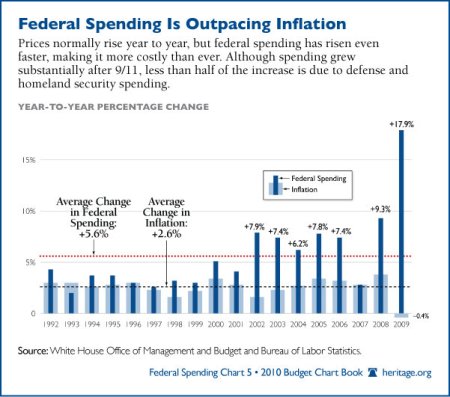
(Via Paul Ryan.)
Leave a Comment » | Political | Permalink
Posted by K. Crary
April 21, 2010
After the Democrats passed their health care nationalization bill in the face of strong public opposition, they tried to put a brave face on the public outrage, arguing that the public would like the bill once they came to understand it. Democrats, we were told, would be delighted to campaign on the issue.
That has turned out to be pure spin. The White House is now treating the issue like the millstone it is, and wants to talk about anything but:
Three months ago, at a private meeting of nervous House Democratic lawmakers, President Obama promised to put the full weight of his office behind the marketing of the health-care bill once it became law.
“We’ve spent so much time talking about the House bill versus the Senate bill that we haven’t been able to talk about how great the bill is overall. Once we have a final bill, we can really talk about how it’s going to help Americans,” Obama said at the time.
But since April 1, the subject has hardly escaped his lips publicly, and it looks like the entire month of April might go by without a presidential event focused on health care.
The White House announced Tuesday that his next swing through Main Street America — a trip to Iowa, Missouri and Illinois next week — will focus on jobs and the economy as Obama meets with small-business owners and farmers.
There was no mention of health care in the announcement.
(Via Hot Air.)
Leave a Comment » | Political | Permalink
Posted by K. Crary
April 21, 2010
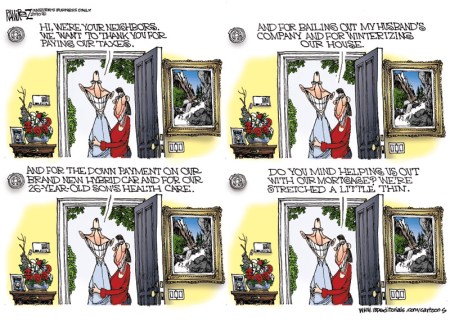
Ridiculous. Who ever heard of a parasite saying thank you?
(Via Power Line.)
Leave a Comment » | Political | Permalink
Posted by K. Crary
April 20, 2010
Bill Clinton’s op-ed last weekend did accomplish one thing. I had begun to look back wistfully at the Clinton administration as a time when a Democratic president was generally competent. His op-ed reminds me why I despised him so much at the time.
The purpose of Clinton’s piece is to try to stigmatize opposition to the government, and in so doing, marginalize the Tea Party movement in which that opposition is concentrated. In the piece, he compares the Tea Party movement to the Oklahoma City bombers. Naturally, he writes it very carefully, never actually accusing anyone in particular of violence. But the message is clear: those people are dangerous. Some of them are going to resort to violence, and then all of them are culpable for “demonizing the government.”
This sort of guilt-by-tenuous-association usually starts after the violence takes place. That was Bill Clinton’s modus operandi after the Oklahoma City bombing when he spent years exploiting it to demagogue the right. But now Clinton knows that the likelihood of actual violence is very low. (In fact, virtually all the actual violence is being directed at Tea Partiers by the left, union thugs mostly.)
So now Clinton’s indulges in some pre-emptive guilt-by-tenuous-association. There is no actual violence being perpetrated by Tea Partiers, but they’re guilty all the same:
We should remember that there is a big difference between criticizing a policy or a politician and demonizing the government that guarantees our freedoms and the public servants who enforce our laws. . .
As we exercise the right to advocate our views, and as we animate our supporters, we must all assume responsibility for our words and actions before they enter a vast echo chamber and reach those both serious and delirious, connected and unhinged.
A few years ago, the left went apoplectic about Ari Fleischer’s remark after 9-11 that Americans should “watch what they say”. (In fact, the remark was taken out of context and referred to one politician’s statement that anyone wearing “a diaper on his head” should be investigated.) Now we have Bill Clinton saying the same thing, and this time it’s fully in context.
POSTSCRIPT: Mark Tapscott adds:
Clinton’s argument that criticism of government by peaceful citizens participating in Tea Party demonstrations leads to domestic terrorism like the Oklahoma City bombing really is nothing new. Monarchs and others in government have been using that line to silence their critics for hundreds of years.
(Via Instapundit.)
Leave a Comment » | Political | Permalink
Posted by K. Crary
April 19, 2010
Initial unemployment claims fell steadily throughout most of 2009, but since November 2009 there’s been no discernible trend:
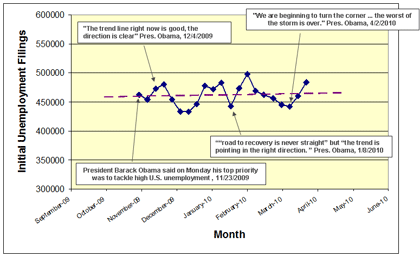
(Click on the graph if the quotes are hard to read.)
It also seems to be surprisingly hard to say what the “break-even” point is for new unemployment claims. My google search found that everyone uses a different number, but recently numbers in the vicinity of 400k-425k seem to be the most common.
(Via Hot Air.)
Leave a Comment » | Political | Permalink
Posted by K. Crary
April 16, 2010
On the verge of a bipartisan deal on financial reform, Democrats scuttled the talks, deciding they would rather have an election issue than a bipartisan deal.
Fine, I’m sure I wouldn’t have liked the bipartisan deal anyway.
Leave a Comment » | Political | Permalink
Posted by K. Crary
April 16, 2010
According to Rasmussen, 42% would vote for Barack Obama, 41% for Ron Paul. Wow.
That’s particularly striking when you consider that Paul would lose much of the right. I don’t think I could bring myself to vote for either.
(Via Power Line.)
Leave a Comment » | Political | Permalink
Posted by K. Crary
April 16, 2010
Forget about guns, Swiss Army knives are illegal in Britain:
A disabled caravanner who kept a penknife in his glove compartment to use on picnics has blasted the authorities after being dragged through court for possessing an offensive weapon. Rodney Knowles, 61, walks with the aid of a stick and had used the Swiss Army knife to cut up fruit on picnics with his wife. Knowles yesterday admitted possessing an offensive weapon at Torquay Magistrates Court. He was given a conditional discharge.
It wasn’t even on his person. Police found it in his car’s glove compartment along with other tools.
(Via the Corner.)
Leave a Comment » | Political | Permalink
Posted by K. Crary
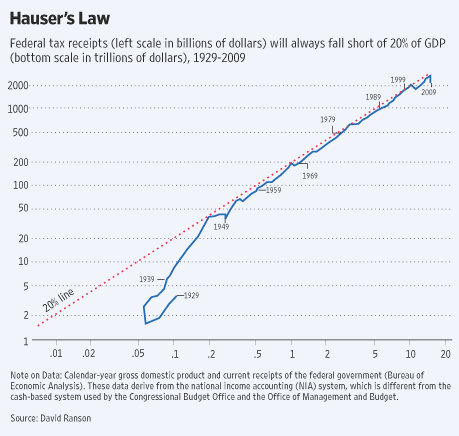
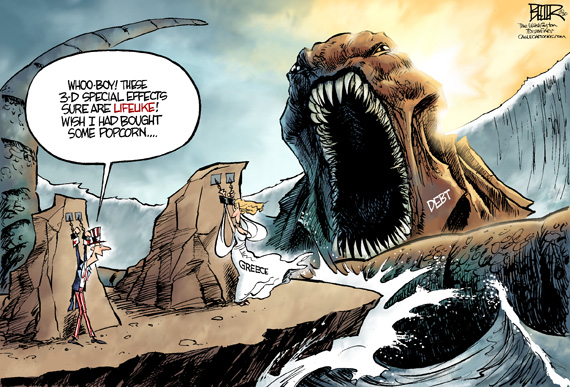
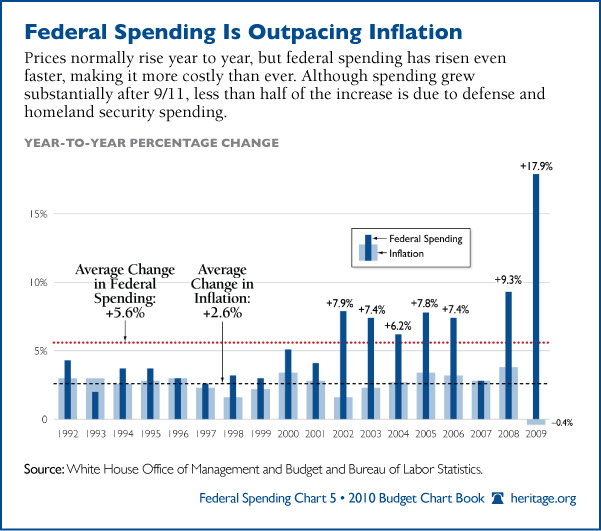
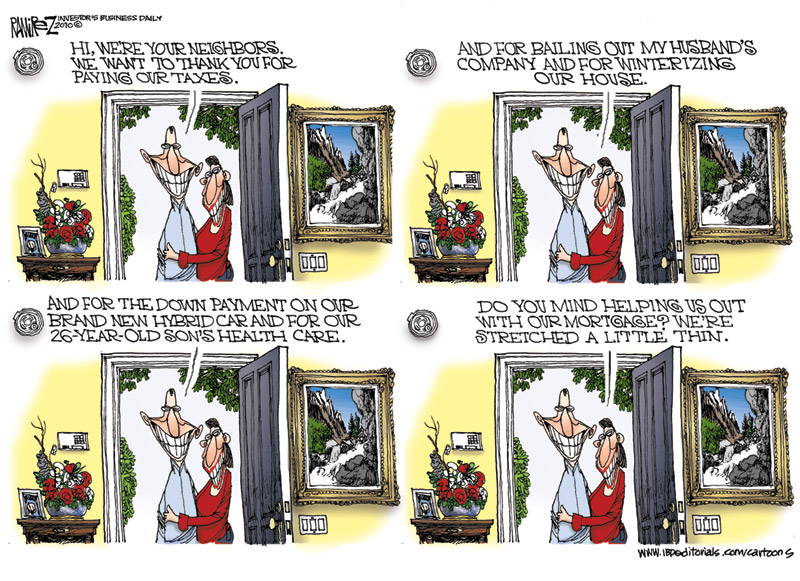
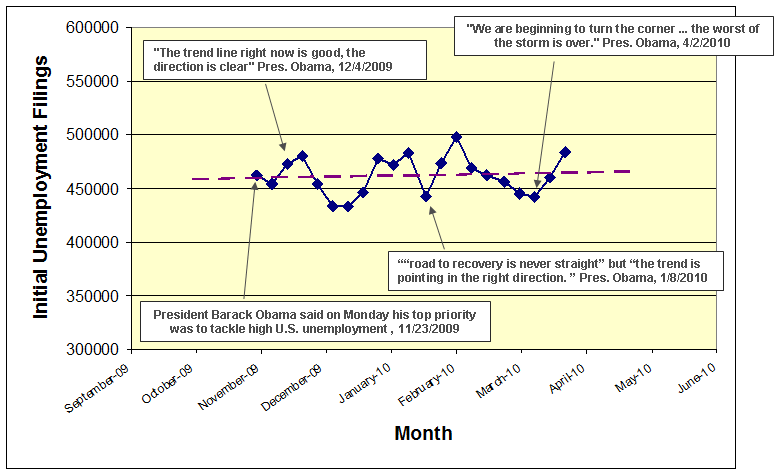
 Internet Scofflaw
You must be logged in to post a comment.