The Washington Post reports that Hamas’s resistance to Israel during Operation Cast Lead was ineffective:
Interviews with Israeli officers and soldiers who took part in the assault, along with a review of IDF information released during the war, indicate that Hamas fighters did not significantly challenge the assault and that the gunmen who did used tactics and weapons that were largely ineffective. Israeli officials had feared Hamas would deploy Iranian-supplied antitank missiles, for example, but such weapons do not appear to have been used against Israeli forces. . .
Ultimately, Hamas “was less professional than we expected it to be,” [an Israeli] commander said, and was unable to cause significant Israeli losses. . .
The IDF said Hamas did make widespread use of booby traps and roadside bombs, and described homes with petroleum-soaked walls, mannequins dressed like fighters and rigged to explode, and situations in which Hamas gunfire and movement seemed designed to draw IDF forces down streets littered with explosive traps.
The Binghamton murders last weekend illustrate the folly of relying on the government to protect you. The police arrived quickly, but took no action until well after the incident was over:
Police said they arrived within two minutes. . .
Police heard no gunfire after they arrived but waited for about an hour before entering the building to make sure it was safe for officers. They then spent two hours searching the building.
While the victims waited for rescue and medical treatment, the police waited outside until they were sure it was safe for themselves. How many people died because of the delay?
A U.S. Education Department study released yesterday found that District students who were given vouchers to attend private schools outperformed public school peers on reading tests, findings likely to reignite debate over the fate of the controversial program. . . Congress has cut off federal funding after the 2009-10 school year unless lawmakers vote to reauthorize it.
Overall, the study found that students who used the vouchers received reading scores that placed them nearly four months ahead of peers who remained in public school. However, as a group, students who had been in the lowest-performing public schools did not show those gains. There was no difference in math performance between the groups. . .
The study, conducted by the Education Department’s research arm, the Institute of Education Sciences, compared the performance and attitudes of students with scholarships with those of peers who were eligible but weren’t chosen in a lottery. Parents of students in the program were more satisfied with their children’s new schools and considered the schools safer, the report found. Students showed no difference in their level of satisfaction.
The usual counterattack by the education statists against vouchers is that private schools engage in “creaming” taking the best students and therefore producing the best results. That argument will be very hard to make now, since the DC participants were selected by lottery. I suppose the new argument will draw from the fact that the students from the very worst schools did not improve, but I’m not sure how they’ll form it.
Still, I’m not wild about vouchers, for a completely different reason. What the government funds, it always ends up trying to control. Private schools that accept vouchers are setting themselves up for government interference, which will ultimately hurt educational performance, as well as degrade some of the other attributes that make them more attractive than public schools. I’ve always felt that the best way to implement school choice is via refundable tax credits, rather than vouchers. That way there’s no money flowing directly from the government to schools.
The Geithner plan has taken on a whole new complexion with this story from the Financial Times:
US banks that have received government aid, including Citigroup, Goldman Sachs, Morgan Stanley and JPMorgan Chase, are considering buying toxic assets to be sold by rivals under the Treasury’s $1,000bn (£680bn) plan to revive the financial system.
The plans proved controversial, with critics charging that the government’s public-private partnership – which provide generous loans to investors – are intended to help banks sell, rather than acquire, troubled securities and loans.
Spencer Bachus, the top Republican on the House financial services committee, vowed after being told of the plans by the FT to introduce legislation to stop financial institutions ”gaming the system to reap taxpayer-subsidised windfalls”.
Mr Bachus added it would mark ”a new level of absurdity” if financial institutions were ”colluding to swap assets at inflated prices using taxpayers’ dollars.”
Under this scheme, banks would drive up the prices of their toxic assets by trading them with each other, obtaining a taxpayer subsidy in the process. On the face of it, this sounds like terrible use of taxpayer money. If the Geithner plan admits this abuse, then that would seem like a serious problem.
But the Wall Street Journal reports that Sheila Bair, chairwoman of the FDIC, would be okay with it:
Federal Deposit Insurance Corp. Chairman Sheila Bair said Thursday she would be open to letting banks see some of the profits if they dump problem loans that ultimately recover some value. . .
The Treasury Department’s Public-Private Investment Program involves setting up investment funds to buy loans from banks. Ms. Bair said banks might be able to take an equity stake in those funds as partial payment for their loans, which would give them a payoff if the loans ultimately rise in value and would provide bankers with more incentive to sell troubled assets.
“We’d be open to comments on that,” Ms. Bair said.
Moreover, it would be very hard to prevent this from happening, since banks could act through third-parties. They might even do it unknowingly. We might as well view it as part of the plan.
In fact, if the point is to prop up the value of the bad assets with government subsidies, how does it matter who owns the assets in the end. Come down to it, maybe this doesn’t really matter. Well, there’s moral hazard: it is offensive that the banks that created the problem should profit from its cleanup. But with all the bailouts, moral hazard is pretty much institutionalized already.
It certainly sheds a different kind of light on the risks and costs to the taxpayer the plan will involve.
POSTSCRIPT: I’ll make another prediction, viz a viz my earlier post about political risk. Recall there are two ways the Geithner plan can work out (if it’s implemented): either the private sector will make a lot of money or the government will lost a lot. Either way, someone will be accused of wrongdoing. I think we have here a glimpse of what the accusation will be.
[President Obama] also gave his most unequivocal pledge yet to proceed with a missile defense system in Europe while Iran pursues nuclear weapons, as the West alleges. That shield is to be based in the Czech Republic and Poland. Those countries are on Russia’s doorstep, and the move has contributed to a significant decline in U.S.-Russia relations.
In the interest of resetting ties with Moscow, Obama previously had appeared to soft-pedal his support for the Bush-era shield proposal. But he adopted a different tone in Prague.
“As long as the threat from Iran persists, we will go forward with a missile defense system that is cost-effective and proven,” Obama said, earning cheers from the crowd.
This was in part a message to Russia, which has balked at using its influence to press Iran to drop its nuclear pursuits.
This could merely be part of an effort to strengthen our bargaining position with Russia. But even that would be an improvement over the idea that we might give up missile defense for Europe (and possibly even North America) in exchange for nothing at all.
At the NATO meeting in Strasbourg, President Obama made a failed plea for more troops for Afghanistan. NATO leaders agreed to send a small number of temporary, non-combat troops, but little else.
ASIDE: The number even of those varied curiously, from several hundred (the London Times), to five thousand (CNN). The Washington Post called it 3,000, and the New York Times called it “up to 5,000”.
The UK was the only one to offer substantial help (at least in the London Times’s telling). Once again, the US-UK alliance seems to be the only one capable of accomplishing anything. Two thoughts occur:
First, Operation Iraqi Freedom was derided as illegitimate because it consisted largely of the US and UK (and Spain, Australia, Poland, Denmark, and the Kurds). Will President Obama’s campaign to stabilize Afghanistan be similarly seen as illegitimate? (I hope not. Consistency can be overrated.)
Second, how stupid is it to drop the special relationship with Britain, as some seem determined to do? I’m not aware that the White House has even repudiated the statement.
The argument against unions — that they unduly burden employers with unreasonable demands — is one that corporate America makes in good times and bad, so the recession by itself is not an excuse to avoid pushing the [card-check] bill next year. The real issue is whether enhanced unionizing would worsen the recession, and there is no evidence that it would.
There is a strong argument that the slack labor market of a recession actually makes unions all the more important. Without a united front, workers will have even less bargaining power in the recession than they had during the growth years of this decade, when they largely failed to get raises even as productivity and profits soared. If pay continues to lag, it will only prolong the downturn by inhibiting spending.
In a striking example of corporate hardball, the New York Times Co. has threatened to shut down one of its journalistic jewels, the Boston Globe, unless the New England paper’s unions agree to sweeping concessions.
It’s probably too much to hope that they’re not bluffing.
As part of an effort to drum up support for President Obama’s budget, the DNS rounded up 642,000 petitions in support. Or so they claimed. But canvassing is hard work; it’s easier to lie:
The DNC arrived at its 642,000 figure by making three photocopies of each petition so that every signer’s senators and representative could get one.
DNC spokesperson Natalie Wyeth responded: “This effort was designed to give our supporters the tools to influence their elected officials. Of course we delivered a pledge to each of their members of Congress — 642,000 pledges. That’s what we said we were delivering and that’s what we did.”
When asked about the impression in the DNC press release that there were 642,000 unique pledges, she offered no response.
Before the election, we were told that President Obama’s new diplomatic approach would line up our erstwhile allies to help in Afghanistan. Alas, it turns out that President Obama is good at attracting huge crowds of cheering supporters and fawning journalists, but no better than the previous administration at extracting substantive commitments from Europe:
Behind the display of revived transatlantic friendship, European leaders have proved reluctant to follow Obama in his first major foreign policy initiative, which in effect seeks to make Afghanistan NATO’s main mission of the moment. With a few exceptions, European analysts said, the leaders are ready to heed the U.S. call for more military help in Afghanistan only to the extent necessary to stay friendly with the new administration.
“The Europeans want to come back from the summit and say, ‘Look, we’re still tight with the Americans,’ ” said Daniel Korski, an Afghanistan specialist at the European Council on Foreign Relations. “The Americans want to come back from the summit and say, ‘Look, the Europeans are going to help with the new strategy in Afghanistan.’ ”
European officials said Obama is likely to come away from the summit Saturday with a broad endorsement of his idea that stabilizing Afghanistan is a strategic goal for NATO and support for his decision to devote more civilian as well as military resources to eliminating al-Qaeda havens there and in Pakistan. But they also said that summit pleasantries are unlikely to mask Europe’s refusal to commit to major new troop deployments.
European leaders basically are saying, “stabilizing Afghanistan is a great idea; someone totally ought to do that.”
This is a classic instance of the free-rider problem. Europe knows that we will do it if no one else does, so why should they put themselves out? Military action abroad is expensive, complicated, and politically costly, so why do it when you know the United States will? Whatever animus may or may not have existed with President Bush, this was the real reason why we couldn’t get substantive contributions for Afghanistan from much of Europe, and it hasn’t changed with the new administration.
ASIDE: NATO did assist with Bosnia and Kosovo, because those conflicts mattered a lot to Europe, much more than they mattered to America. Even so, we did most of the heavy lifting.
Donald Rumsfeld recognized the free-rider problem when we created the ISAF to provide security for Kabul after Operation Enduring Freedom. Douglas Feith writes in his book (p. 156):
[The ISAF] would receive help from the United States, though American troops would not become part of ISAF. This last restriction was important to Rumsfeld. He reasoned that ISAF’s contributors would have less incentive to support the effort if they believed the Americans would join the force and the United States would therefore be likely to cover any shortfalls.
and (p. 157-158):
It soon became clear, however, that our critics wanted the United States to support the [ISAF] expansion by providing U.S. forces and funds to make it possible. This reflected the very frame of mind that Rumsfeld warned against: the Yankee can-do, fill-every-vacuum hyperactivity that deprives other countries of incentives to pull their weight in multilateral projects. . . One of ISAF’s key purposes was to allow others in the world to help the new Afghanistan. Rumsfeld did not favor reflagging U.S. operations — having our soldiers perform a mission and calling it an ISAF rather than a coalition effort — simply to make ISAF look robust. He told me he wanted ISAF to be useful, look successful, and take on more responsibility if it could, but as a serious partner, not functioning on the cheap.
Unfortunately, the ISAF did not fully satisfy those aims. The free-rider problem still existed because, although the ISAF was given responsibility for Kabul, the world still recognized that America was ultimately on the hook. Although some countries did make substantial contributions, we failed to generate the robust international effort we wanted.
The ISAF was not a complete success, but at least Rumsfeld recognized the need for a strategy to overcome the free-rider problem. In contrast, President Obama is looking to overcome it by sheer force of personality. It’s not impossible for that to work, I suppose, but it certainly never seemed likely.
Venezuelan President Hugo Chávez moved to jail a prominent opposition figure for the second time in recent weeks, an apparent bid to tighten his grip on power amid a sharp downturn in economic growth.
Raúl Baduel, a former defense minister-turned-Chávez-critic, was arrested on corruption charges Thursday, according to Mr. Baduel’s lawyer, Omar Mora Tosta, and government officials. Mr. Mora Tosta says the charges are unfounded. . .
Government officials say the actions against Messrs. Baduel and Rosales are the result of legitimate investigations into their financial dealings when they held public office.
Some observers, however, say the moves illustrate how Mr. Chávez is using government institutions to punish political opponents. “All available information suggests that this is selective prosecution motivated by political reasons,” says José Miguel Vivanco, executive director of Human Rights Watch’s Americas program. Mr. Vivanco says he was expelled from Venezuela at gunpoint last year after releasing a report critical of Mr. Chávez. . .
The sudden economic slowdown has forced Mr. Chavez to curtail spending and raise taxes — two measures that will hurt the poor and could dent his popularity. Some economists say currency devaluation may be next.
Mr. Chávez appears to be striking at chief opponents before they can use the worsening economy against him, observers said.
Well, at least Chavez’s opponents aren’t turning up dead, like Putin’s.
UPDATE: It’s buggy though, to the point where it doesn’t really work. Bringing up a particular contact (just one, oddly enough, but the only one I wanted to call) consistently crashes the app. Even rebooting doesn’t help. I hope they fix it soon.
UPDATE: For what it’s worth, Skype says they’re working on it:
Thank you for contacting Skype Support.
This error is known by our development team and will be resolved in a future release of Skype.
Stay tuned for updates in the Apple App Store and get the latest version of Skype for iPhone once it is available
Tim Geithner’s plan to fix the toxic asset problem relies on the participation of the private sector. Unfortunately for the plan, the private sector has been learning over the past weeks that it is dangerous to go into business with the government. Promises that were made at the time were quickly discarded, but no one can hold the government to its promises. Even promises that were enshrined in legislation are in the process of being revoked.
In today’s political climate, you would be crazy to enter a partnership with the government if you have any other choice. Some firms may have no other choice, but Geithner’s plan relies on participation from solvent firms. Those firms can afford to decline, and some, such as the Bridgewater hedge fund, are deciding to do just that.
Bridgewater’s manager, Ray Dalio, wrote to his investors:
Then there is the issue about the political risk, which we are more concerned about because there will be such a limited number of managers being allowed to participate in this program that it raises possibilities (or at least perceived possibilities) of them colluding because they all know each other. Either these investments will make a lot of money for their investors or the government will lose a lot of money — in either case, there will be reasons for politicians to complain and to focus on the five winners to see how they “abused” the system.
Dalio nails it here. If the plan results in a profit, participants will make a lot of money. They will be vilified for it, and perhaps face a 90% tax on their profits. If the plan results in a loss, the government will lose a lot of money. The participants will be vilified even more, and perhaps be charged with some trumped-up crime. Either way, the small number of participants will set up charges of collusion, which will be key to the ensuing vilification and/or prosecution. Dalio says to hell with it, he’s not going to play.
What we have here is a consequence of the congressional/presidential tantrum over the last few weeks. There’s always political risk, but the behavior of our leadership has ratcheted it to extreme levels. Quite simply, the government has shown that it cannot be trusted to abide by any agreement it makes right now, even if it’s written into law. Geithner’s plan had a lot stacked against it already, and this could be the final blow.
UPDATE: The Economist’s story on the Geithner plan also sees political risk as a problem:
This time, too, the sweet terms have piqued the interest of big fund managers, such as BlackRock and PIMCO. The biggest obstacle to their participation is no longer financial risk but the political sort, thanks to the bonus frenzy over American International Group (AIG). The Obama administration may have toned down its Wall Street-bashing, and Congress is rethinking its plan to tax bonuses at up to 90%. But many still worry that they could become a target if they reap big windfalls.
Democratic members of the New York Board of Elections voted against taking steps to make it possible for deployed military to vote.
Despite a general consensus that military absentee ballots need to be given at least 45 days because of mail delivery delays, New York allows only 25. The Justice Department sued after New York refused to correct its procedures, but it ultimately let New York slide with a still-insufficient 30 days.
Something to keep in mind as they count absentee ballots in the NY-20 special election where the candidates are separated by just 25 votes.
You’ve heard this shocking “fact” before — on TV and radio, in newspapers, on the Internet and from the highest politicians in the land: 90 percent of the weapons used to commit crimes in Mexico come from the United States.
— Secretary of State Hillary Clinton said it to reporters on a flight to Mexico City.
— CBS newsman Bob Schieffer referred to it while interviewing President Obama.
— California Sen. Dianne Feinstein said at a Senate hearing: “It is unacceptable to have 90 percent of the guns that are picked up in Mexico and used to shoot judges, police officers and mayors … come from the United States.”
— William Hoover, assistant director for field operations at the Bureau of Alcohol, Tobacco, Firearms and Explosives, testified in the House of Representatives that “there is more than enough evidence to indicate that over 90 percent of the firearms that have either been recovered in, or interdicted in transport to Mexico, originated from various sources within the United States.”
There’s just one problem with the 90 percent “statistic” and it’s a big one:
It’s just not true.
In fact, it’s not even close. By all accounts, it’s probably around 17 percent.
What’s true, an ATF spokeswoman told FOXNews.com, in a clarification of the statistic used by her own agency’s assistant director, “is that over 90 percent of the traced firearms originate from the U.S.”
68% of the guns used in Mexican crimes are never even submitted for tracing, because they do not have traceable markings. (Such guns are almost certainly not from the U.S., which requires such markings.) Of those, 45% cannot be traced. Thus, just 17% of the guns used in Mexican crimes are successfully traced. Of those, 90% came from the United States.
So all the 90% statistic means is that guns from the U.S. are traced much more easily than most Mexican crime guns.
UPDATE (4/18): Annenberg Political Fact Check estimates the number as 36%. Either way, it’s nowhere near 90%.
Attorney General Holder refuses to release the OLC opinion that concluded the DC voting act is unconstitutional. I’m sure the Democratic leadership won’t issue a subpoena, but there are surely several Freedom of Information Act requests on their way.
Perhaps he should listen to Dawn Johnsen, the President Obama’s nominee to head the OLC, who wrote:
OLC should follow a presumption in favor of timely publication of its written legal opinions. Such disclosure helps to ensure executive branch adherence to the rule of law and guard against excessive claims of executive authority. Transparency also promotes confidence in the lawfulness of governmental action.
THE world of philanthropy faces a three-pronged attack. First, philanthropic institutions have been hit by the impact of recession on charitable giving. Next, last month, Barack Obama’s budget proposed to limit tax deductions on donations by individuals earning over $200,000. But America’s proud charitable foundations are also worried about another threat: political pressure to increase the “diversity” of their employees, with hints of racial and sexual quotas on employment and even on recipients.
In a paper released on March 12th the Philanthropy Roundtable, a group based in Washington, DC, described this diversity initiative, first instigated in 2007 by the Berkeley-based Greenlining Institute, as a shakedown for the benefit of the already privileged professional elite in the minority workforce (that is, blacks and Latinos). Heather MacDonald of the Manhattan Institute thinks this “diversity police” will discourage personal giving by diverting charities from their true objectives and will transform foundations into job-creation schemes for minorities. . .
Partisan interest could allow lawmakers to “insert themselves into foundation governance and grant-making”, worries Sue Santa of the Philanthropy Roundtable. Philanthropists fear America may go down the British route, where charities must show clear public benefit to qualify for tax deductions; and that will open the door to politics.
That’s the major problem with private charities; they’re private. What good is it to help people if you’re not answerable to the government?
An article (pdf) by Jonathan Turley in the George Washington Law Review argues convincingly that the DC voting rights bill is unconstitutional (that’s easy), and further that DC cannot constitutionally be made into a state either.
The problem can be resolved legally only by moving the residents of the District of Columbia into a state (such as by retrocession), or by a constitutional amendment. Retrocession seems preferable to me, as it would fix not only the problem of representation, but also the more general problem of which representation is an symptom: the bizarre special status of DC.
An obstacle to retrocession is the fact that years of mismanagement make Washington, D.C. an unattractive addition to any state. That obstacle could possibly be resolved through a federal pledge to cover Maryland’s DC-related costs for several years to come.
Either way, retrocession or amendment, Democrats will have to lower their sights. Retrocession would add one Democratic representative (in Maryland), but it would end the DC representation debate. It would not set a precedent that would lead ultimately to two additional Democratic senators. The same is true of any amendment that would be likely to pass. For that reason, DC representation will not happen until all the other schemes (unconstitutional but more attractive to Democrats) have been conclusively eliminated by the Supreme Court.
The largest increase in tobacco taxes took effect despite Obama’s promise not to raise taxes of any kind on families earning under $250,000 or individuals under $200,000. This is one tax that disproportionately affects the poor, who are more likely to smoke than the rich. . .
“I can make a firm pledge,” he said in Dover, N.H., on Sept. 12. “Under my plan, no family making less than $250,000 a year will see any form of tax increase. Not your income tax, not your payroll tax, not your capital gains taxes, not any of your taxes.”
He repeatedly vowed “you will not see any of your taxes increase one single dime.”
Now in office, Obama, who stopped smoking but has admitted he slips now and then, signed a law raising the tobacco tax nearly 62 cents on a pack of cigarettes, to $1.01. Other tobacco products saw similarly steep increases.
For months, this newspaper has opposed President Obama’s bold, forward-thinking agenda. What a colossal mistake.
We realize now that we were merely clinging to the discredited ideas of the past. Holding on to disposable relics like tradition, religion and the Constitution only delays the glorious new world that awaits us all. . .
President Obama has shown us all that to achieve the unrealized promise of this great nation, we must transcend outdated values such as public thrift, individual liberty and restrained government. All power must be shifted to Washington and deposited in the hands of a wise and benevolent ruler whose will is never questioned. . .
The road to prosperity, President Obama has shown, is traveled by high-speed rail and government-mandated hybrid automobiles, powered by wind, water and air, subsidized by gargantuan energy taxes and paid for by borrowing trillions that our grandchildren and great-grandchildren will never be able to repay. It is a road that can be constructed only by an energetic national government unconstrained by law, tradition or actual cash reserves.
We know that questioning change is bad; stepping back and letting it happen no matter the consequences is good. So let us all stand idly by, mouths shut in obedience to our new rulers, and watch the traditions that hold up our society, like pillars of a great temple, crumble and collapse from the force of great, howling winds that sing hauntingly of a future filled with consequences none of us understands.
No socialist revolution is complete without identifying enemies of the people, and one group always serves particularly well in that role:
The Venezuelan Jewish community traces its roots back more than 200 years and has no history of tension with the local population. Before the rise of Hugo Chavez, the Jews were a welcome part of a society known for its warm temperament and amiable disposition, free from the discrimination and anti-Semitic violence in many other countries. Over the last 10 years conditions have worsened dramatically, and although 15,000 still remain, more than half the Jewish population has already fled.
CHAVEZ’S CAMPAIGN against the Jews has three principal components. The first is the systematic stigmatizing of Israel as a “bloodthirsty,” “oppressive,” “genocidal” and “monstrous” country (quoted from Chavez and his officials) that disregards basic human decency and arrogantly defies international law. The second is the objectification of Jews as Zionists, seamlessly tying the Jews to the imagined evils and horror of the Israeli state. Statements such as “Zionism is Nazism” abound, both on the streets and in parliament.
All of this takes place in the context of anti-capitalist class warfare, in which “enemies of the people” are labeled by the government-controlled media to provide both justification and an outlet for bitter frustration and anger. This strategy was used to great effect in the national socialist movements of the 20th century, where Jews were specifically targeted as “elitist” to subject them to the anger and resentment of collectivist masses.
With crime exploding to astonishing levels, and disastrous economic policies destroying the middle class, Chavez is applying this same model. He uses his charisma and populist appeal to instill hatred of Jews and capitalists in his supporters, who are mainly from the lower class, the military and those who profit from his power. . .
There is public documentation of more than 400 anti-Semitic and anti-Israel public statements made by government officials since the expulsion [of Israeli diplomats in January], including a call to action in a state-run newspaper urging Venezuelans to “challenge Jews” where they live and work. “Denounce publicly, with names and last names, the members of the powerful Jewish groups present in Venezuela, indicating the companies they own to establish a boycott.”
Justice Department lawyers concluded in an unpublished opinion earlier this year that the historic D.C. voting rights bill pending in Congress is unconstitutional, according to sources briefed on the issue. But Attorney General Eric H. Holder Jr., who supports the measure, ordered up a second opinion from other lawyers in his department and determined that the legislation would pass muster. . .
In deciding that the measure is unconstitutional, lawyers in the department’s Office of Legal Counsel matched a conclusion reached by their Bush administration counterparts nearly two years ago, when a lawyer there testified that a similar bill would not withstand legal attack.
Holder rejected the advice and sought the opinion of the solicitor general’s office, where lawyers told him that they could defend the legislation if it were challenged after its enactment.
Democratic and Republican Justice Department veterans said it is unusual, though not unprecedented, for the solicitor general, who backs the administration’s position before the Supreme Court, to be asked to weigh in before a case makes its way into a courtroom.
I thought it was bad to politicize the Justice Department, or to override the OLC. What’s changed?
Anyway, Holder, bringing the chutzpah, actually claims this wasn’t political:
Through a spokesman, Holder portrayed the basis for his override of the OLC ruling as grounded in law, not politics.
Yeah, right. With a bill less blatantly unconstitutional, you could make this argument fly. This is not such a bill; it sets aside Article 1, Section 2 (the Constitution’s second sentence after the preamble) and creates a new House of Representatives in its place. It’s not even close. There’s no way this decision had anything to do with the law.
This is also a misuse of the solicitor general’s office. The solicitor general’s job is to argue the administration’s opinion in court, not to render judgements on the law. Rendering judgements on the law is the job of the Office of Legal Counsel, which they did, twice, in two different administrations.
UPDATE: Jonah Goldberg notes that the solicitor general’s office recently argued before the Supreme Court that book banning is constitutional, which indicates that they are a particularly bad judge of what is constitutional.
UPDATE: Jonathan Adler expands on the inappropriateness of going to the solicitor general’s office for a second opinion when you don’t like the first. Adler notes that Holder’s action violates a recent paper, Principles to Guide the Office of Legal Counsel, written by President Obama’s OLC nominee and nineteen other former OLC attorneys.
UPDATE: Andy McCarthy notes a double standard in Holder’s application of the defensibility standard:
When enforcement of a patently defensible statute would undermine the progressive agenda, the statute goes under the bus; when enforcement of a patently unconstitutional statute would further the progressive agenda, the presumption of validity lives and the statute need only pass the laugh-test (though I don’t think the D.C. voting-rights bill meets even that low bar).
But other than that, Holder would never play politics with the law, nosiree.
The U.S. Justice Department asked a federal judge on Wednesday to throw out the corruption conviction of former Alaskan Senator Ted Stevens because prosecutors withheld helpful evidence from his lawyers.
Attorney General Eric Holder said he decided to abandon the case against Stevens, a Republican who narrowly lost his bid for re-election last year amid heavy publicity over the case, after a review showed prosecutors did not turn over to the defense information that might have helped Stevens’ case.
(Stop me if you’ve heard this one before. . .) The latest Obama cabinet appointment with unpaid tax is HHS nominee Kathleen Sebelius:
Health and Human Services nominee Kathleen Sebelius recently corrected three years of tax returns and paid more than $7,000 in back taxes after finding “unintentional errors” _ the latest tax troubles for an Obama administration nominee. The Kansas governor explained the changes to senators in a letter dated Tuesday that the administration released. She said they involved charitable contributions, the sale of a home and business expenses.
Sebelius’s last trip into the national limelight was when when she politicized a tornado disaster by blaming the Iraq War for missing equipment. The charge ultimately proved to be entirely without merit, which was obvious from the outset to anyone who knew how the military was managing equipment in Iraq.
The Equal Employment Opportunity Commission, responsible for ensuring that the nation’s workers are treated fairly, has itself willfully violated the Fair Labor Standards Act on a nationwide basis with its own employees, an arbitrator has ruled.
The agency’s practice of offering compensatory time off to its employees rather than overtime pay amounted to “forced volunteering” and was a knowing violation of the law, according to the ruling.
“The case before me, in my view, demonstrates action that went beyond mere negligence,” arbitrator Steven M. Wolf wrote in a decision released last week.
I’m surprised that the Fair Labor Standards Act actually applies to government agencies. Usually the government exempts itself from the rules it imposes on the private sector.
Senate Budget Chairman Kent Conrad (D-ND) seems to think that Herbert Hoover was a laissez-faire conservative:
That’s going back to Hoover economics. The notion that the government doesn’t have much of a role, that the market will correct itself on its own. It didn’t work in the Great Depression, it wouldn’t work here, and even the previous administration recognized that.
It’s not remotely true; Hoover was a progressive interventionist. In fact, such was Hoover’s reputation among progressives that in 1920 there was talk of a Hoover-Roosevelt Democratic ticket. During the 1932 campaign, Hoover proclaimed:
Two courses were open to us. We might have done nothing. That would have been utter ruin. Instead, we met the situation with proposals to private business and to the Congress of the most gigantic program of economic defense and counterattack ever evolved in the history of the Republic. We put that program in action.
The most that can be said is that Hoover’s “gigantic program of economic counterattack” paled in comparison to his successor’s.
Perhaps Conrad is confusing Hoover with his predecessor, Calvin Coolidge. Coolidge was a laissez-faire conservative, and he was frequently at odds with Hoover (his Secretary of Commerce). Regarding Hoover, he once remarked “for six years that man has given me unsolicited advice–all of it bad.”
Coolidge’s worst mistake, in retrospect, probably was declining to run for re-election. He said, if he were elected to a second full term, that would make him president for ten years, “longer than any other man has had it–too long!” We never found out how Coolidge’s policies would have worked. Probably he would have let the banks fail, which we know now was one of the major causes of the depression. On the other hand, Smoot-Hawley, another major cause of the depression, would certainly not have become law in the Coolidge administration.
It’s not surprising that the left wants to make Hoover into a laissez-faire conservative. Hoover, after all, was a disaster. But it’s far from the truth.
From the annals of surprising research results: new research suggests that one can get an accurate sense of someone’s creditworthiness by looking at their face. That’s in the sense that physiognomy has statistically significant predictive value that is independent of other measurable factors.
When the bank bailout was carried out, Secretary Paulson strong-armed all the major banks into taking the money, including those that didn’t need it. The idea was that if only the weak banks took the money, taking TARP funds would become a stigma of instability, which could further weaken the banks they were trying to save.
Now, many of those banks are regretting going along with the scheme. The government’s (predictable) interference in their affairs is making it hard to do business. In particular, restrictions on executive pay is making it hard to them to retain good people. Consequently, many banks want to give the money back. (Via Instapundit.)
Ah, but it’s not so simple, because the government won’t let them return the money until regulators complete a “stress-test” of the banks (whatever that means), which will happen, well, some time in the future.
The long-term consequence of this is the business world has learned not to accept the government’s money unless they really, really need it. Consequently, the government will probably never be able to carry out a TARP-like bailout again. Depending on what you think of the bailout, that might be a good thing. The irony is it’s exactly the people who believe in government intervention in the economy who are doing it.
UPDATE: Dear God. Barney Frank thinks that the government should be setting salaries throughout Wall Street, not just at TARP recipients.
UPDATE: More here on how the government forced the money on banks, and now refuse to accept it back. (Via Instapundit.)
If Lynn Chu’s Wall Street Journal op-ed is accurate, the class-action lawsuit against Google for digitizing and posting copyrighted books is reaching a horrifying conclusion. Apparently, Google has reached a settlement in which Google gets to post books, and a new entity is created that decides how much the authors will be paid. (Also, the class-action lawyers make $30 million.) Shockingly, this arrangement would apply to authors who are not a party to the litigation and have not consented to the settlement.
This can’t be right, can it? The comments to Jonathan Adler’s strongly suggest it is, at least to some extent (it’s hard to know what a 385-page legal settlement actually means). Lynn Chu expands on authors’ options here.
Reporting from Washington — President Obama’s plan to save failing U.S. automakers — and make them the instruments for creating a cleaner, greener transportation system — marked a major step across the line that traditionally separates government from private industry.
His announcement Monday of a new position on bailing out Detroit went beyond a desire to be sure tax dollars were not wasted in bailing out struggling companies. It put the Obama administration squarely in the position of adopting a so-called industrial policy, in which government officials, not business executives or the free market, decided what kinds of products a company would make and how it would chart its future.
His automotive task force concluded, for example, that the Chevy Volt, the electric car being developed by General Motors Corp., would be too expensive to survive in the marketplace. It declared that GM was still relying too much on high-margin trucks and SUVs, and that Chrysler’s best hope was to merge with a foreign automaker, Fiat.
Judgments like those are usually rendered in corporate boardrooms or announced in quarterly reports. But this time they were coming directly from the White House.
President Obama says he doesn’t want to run GM, but apparently he means that only in the sense that he doesn’t want to manage its day-to-day operations. Choosing the CEO, dictating business plans, and passing judgement on products; all that he is willing to do.
Obama says he doesn’t want to waste the taxpayers’ money. That’s a load of crap. Every dollar we put into these failing companies is wasted. Soon these companies will be going into bankruptcy; everyone sees that now. We could have let them go into bankruptcy several billion dollars ago.
But apparently we now live in a country where the government runs businesses, and not merely in the old-fashioned way (“you’d better make more home loans to low-income buyers, or else”) either. We have a model of how government-run businesses work out, and it’s not pretty.
UPDATE: I guess the Democrats are serious about getting the government into the auto business. House Majority Leader Steny Hoyer wants to create a trade-in program. (Via the Corner.)
As a child, the standard cry whenever you lose something is “who stole my pencil?” (or whatever). To a child, it doesn’t occur that he simply forgot where he left it, it must be the fault of some malicious external actor.
Keith Olbermann, it seems, never grew up. Olbermann blasted Twitter as the “worst person in the world” when he learned that it had allowed someone else to open a Twitter account in his name. That someone naturally had to be Fox News. (Those guys are always stealing Olbermann’s pencils.)
As it turned out, the Twitter account was being run by Olbermann’s employer, MSNBC, which was running it to promote his program.
As Democrats prepared to take control of Congress after the 2006 elections, a top boss at the insurance giant American International Group Inc. told colleagues that Sen. Christopher J. Dodd was seeking re-election donations and he implored company executives and their spouses to give. . .
Mr. Dodd’s campaign quickly hit pay dirt, collecting more than $160,000 from employees and their spouses at the AIG Financial Products division (AIG-FP) in Wilton, Conn., in the days before he took over as the committee chairman in January 2007. Months later, the senator transferred the donations to jump-start his 2008 presidential bid, which later failed.
A lot of people these days are finding the new compact fluorescent bulbs anything but simple. Consumers who are trying them say they sometimes fail to work, or wear out early. At best, people discover that using the bulbs requires learning a long list of dos and don’ts. . .
Irritation seems to be rising as more consumers try compact fluorescent bulbs, which now occupy 11 percent of the nation’s eligible sockets, with 330 million bulbs sold every year. Consumers are posting vociferous complaints on the Internet after trying the bulbs and finding them lacking.
This key point is this one:
Some experts who study the issue blame the government for the quality problems, saying an intensive federal push to lower the price essentially backfired by encouraging manufacturers to use cheap components.
“In the pursuit of the holy grail, we stepped on the consumer,” said Michael Siminovitch, director of a lighting center at the University of California, Davis.
Israeli campaign against Palestinian terrorists last December brought, as it always did, stories of Israeli war crimes. The New York Times ran a story on Israeli “excessive force and wanton killing,” based entirely on hearsay and rumor. These sorts of stories always turn out to be false, and this one is no exception. An IDF investigation found no evidence that any of the incidents happened. (Via Power Line.)
The striking thing here is that papers like the NYT, after repeatedly being used by anti-Israeli agitators, continue credulously to report their stories, which invariably turn out to be false. One might draw the conclusion that the NYT is more interested in attacking Israel than it is in reporting the truth.
Bolivia has a new constitution. In itself, this is nothing unusual; the South American socialist states adopt them all the time. But Bolivia’s new constitution has an unusual provision, authorizing so-called “community justice.” Community justice is about giving village elders the authority to impose penalties on accused offenders without the rigmarole of trials, juries, or even laws. This supposedly takes Bolivia back to a more enlightened time, before the arrival of westerners and western ideas. What it really does is authorize and encourage mob rule.
A particularly prominent incident involves a major opponent of the new constitution:
Ahead of a referendum in January in which voters approved this document, [Victor Hugo] Cárdenas appeared in opposition television advertisements. He says that the constitution’s endorsement of “community justice” is a “mechanism of abuse”.
On March 7th a mob of indigenous people several hundred-strong attacked Mr Cárdenas’s house in a village on the shore of Lake Titicaca, violently evicting his wife, Lidia Katari, herself an indigenous-rights activist, and two of his children before setting fire to his belongings. The few police who turned up did nothing. The assailants claimed that they had staged an act of “community justice” against Mr Cárdenas. They later said that they would not allow him, the police or public prosecutors to enter the area, claiming that the new constitution gives them control over a large swathe of surrounding territory.
Mr Morales may well have had nothing to do with the attack. But his opponents have long claimed that he is opening the way to this kind of mob rule. The government information service implausibly claimed that Mr Cárdenas had staged the incident himself as a publicity ploy.
Tsk, tsk. But that’s just a Latin American banana republic that has intentionally turned its back on idea of rule of law. This has nothing to do with the west, right?
Don’t be so sure. In the UK, scapegoating of bankers is starting to result in mob violence. But that’s just the UK, right? Consider this:
Andrew M. Cuomo is starting to unearth some of the most closely guarded secrets on Wall Street: the identities of Merrill Lynch employees who collected large bonuses even as the brokerage firm lost billions.
Mr. Cuomo, the New York attorney general, won a legal battle on Wednesday to compel Bank of America, which bought Merrill in December, to provide his office with the names of the Merrill employees with the 200 largest bonuses. Mr. Cuomo said he would make the names public as early as Thursday.
He also vowed to identify publicly the employees who had received bonuses at the American International Group, whose payouts prompted an uproar, and to work with other financial companies that have received taxpayer dollars to consider disclosing more about employee compensation.
Mr. Cuomo pledged to press ahead with his effort even as Edward M. Liddy, the embattled chief executive of A.I.G., told Congress on Wednesday that some A.I.G. employees received death threats in recent days as the public furor over pay escalated.
The highest-ranking law-enforcement officer in the State of New York plans to publicize the names of AIG bonus recipients and other financial figures (with public opprobrium, to be sure), despite the fact that some of these people are already receiving death threats.
As AIG employees get disturbing threats from people ticked off about bonuses that came in the wake of the federal bailout, the state has thrown someone into the fire who did not belong there, a [Connecticut] state representative says.
Christopher Pohle, of New Canaan, was falsely identified as an AIG employee who received a retention bonus, State Representative John W. Hetherington, said in a news release Thursday. To be clear, everyone, he did not get a bonus.
Pohle is demanding that the State of Connecticut, including the Attorney General and the legislature’s Banks Committee, apologize and issue a retraction.
Of course, the United States is far from becoming Bolivia, but nevertheless we’re seeing is a breakdown in confidence in the rule of law, with public sentiment whipped up by cynical politicians.
Israel’s Defense Ministry says it has successfully tested a high-tech system designed to intercept incoming rockets.
A ministry statement says the Iron Dome system successfully dealt with incoming rockets of the types fired by Palestinian and Lebanese militants in tests this week, terming the test a “milestone.”
The statement stopped short of saying the system shot rockets down with an interceptor missile. Defense officials said Friday the system will likely be ready by the 2010 target date for deployment.
Hey, I’ve got an idea — why don’t we organize society so that it rewards hard work! We could even see that people who work harder and do better make more money! And then their efforts would pay off in more general societal prosperity, making life better for everyone! And we could . . . Naaaah.
The President is committed to responsibly winding the war down. I don’t do foreign policy, but I can tell you this: ending wars saves money – and so the Administration’s budget includes savings from ramping down overseas military operations over time.
Orszag cites cost-savings in defense starting in 1991, but those cost-savings reflected not just the end of Operation Desert Storm, but a general drawdown in military spending at the end of the Cold War (the “peace dividend”).
In fact, it turns out that pulling out of Iraq will not save any money at all in the short run. The GAO says that the process of withdrawing from Iraq will cost a “significant” amount for several years:
The removal of about 140,000 U.S. troops from Iraq by the end of 2011 will be a “massive and expensive effort” that is likely to increase rather than lower Iraq-related expenditures during the withdrawal and for several years after its completion, government investigators said in a report released yesterday.
“Although reducing troops would appear to lower costs,” the Government Accountability Office said, withdrawals from previous conflicts have shown that costs more often rise in the near term. The price of equipment repairs and replacements, along with closing or turning over 283 U.S. military installations in Iraq, “will likely be significant,” the GAO reported.
Moreover, the GAO also says that the some of the necessary closings will take longer than estimated. For example, the closing of Balad Air Base needs to begin immediately to keep to the president’s timeline.
The Justice Department’s Office of Legal Counsel is important because it interprets the law for the executive branch before the fact. That is, the OLC’s purpose is not to litigate to defend the administration’s actions, but to ensure that it obeys the law in the first place.
The OLC has been particularly controversial in recent years because the OLC issued a number of memos that have been construed as expanding presidential power. (This may be true; I don’t have the legal background to say.) Most notorious was the so-called “torture memo” which sought to establish what constitutes torture and is therefore illegal. (Many disagreed with the memo’s conclusions, and construed it as justifying torture. The memo was later rescinded, and new legislation later clarified the law somewhat.)
Dawn Johnsen is President Obama’s nominee for the Justice Department’s Office of Legal Counsel. Johnsen was an outspoken critic of expanding presidential power during the Bush administration, but was a strong proponent of expanding presidential power during the Clinton administration, explains Andrew McCarthy:
Particularly rich is Johnsen’s diatribe against Bush’s purportedly outlandish claim of power to ignore statutes that encroach on executive authority. When Johnsen served in the Clinton administration (which invented extraordinary rendition, detained Cuban refugees without trial at Guantanamo Bay, conducted warrantless national-security searches, and attacked a foreign country without congressional authorization), OLC’s official position was that “the President has enhanced responsibility to resist unconstitutional provisions that encroach upon the constitutional powers of the Presidency.” The office opined that several statutes (including privacy provisions in the federal wiretap law) could not bind the president, and Johnsen herself authored a 1997 OLC opinion concluding that presidents were above consumer-credit-disclosure laws. In that case, she broadly asserted that “statutes that do not expressly apply to the President must be construed as not applying to him if such application would involve a possible conflict with his constitutional prerogatives.”
So, Johnsen isn’t so much an opponent of expanded presidential power, as she is an opponent of expanded Republican presidential power.
In a similar fashion, she opposes politicization of the justice department by the right, but supports it (explicitly!) by the left:
A parallel hypocrisy is illustrated by Johnsen’s rants about how the Bush administration “politicized” the Justice Department. Her solution to this problem: Politicize the Justice Department. She argues that job applicants who may have been passed over by the Bush administration for holding leftist political views should get “special consideration” in DOJ hiring but, at the same time, maintains that nominees for the federal judiciary should be rejected out of hand if they embrace constitutional originalism or are members of the judicially conservative Federalist Society
Not only is Johnsen a partisan gunslinger, but she also has a history of making outlandish legal arguments. In 1989, as part of an argument for government funding of abortion, she infamously argued that unwanted pregnancy is tantamount to slavery, and restrictions on abortion violate the 13th Amendment. This year, when questioned by the Senate Judiciary Committee about that argument, she denied that she had ever made it, until her words were quoted back to her.
Most of the OLC’s opinions are never tested in court, so it’s important that it be giving sober, non-partisan legal advice. With her record, it seems unlikely that Johnsen will give advice that is either sober or non-partisan. It’s not even clear that she wants to.
The Democratic Senatorial Campaign Committee (DSCC) has apparently decided to keep $100K in contributions from Bernie Madoff, who faces up to 150 years in prison for swindling billions from the likes of Steven Spielberg, Elie Wiesel, Kevin Bacon and Kyra Sedgwick in a massive Ponzi scheme.
In campaigns, one side often calls on the other to return money for one reason or another. Sometimes it’s valid, sometimes not. Regardless, it’s Campaign 101. But when the contributor in question is the single biggest financial criminal in history, there can be no question that those illicit funds should not remain in campaign coffers.
Sens. Charles Schumer (D-N.Y.) and Ron Wyden (D-Ore.) gave thousands in Madoff donations to charity. Reps. John Dingell (D-Mich.) and Charles Rangel (D-N.Y.) are doing the same.
Given the economic uncertainty our nation faces and that Madoff not only fleeced the rich and famous but major corporations such as HSBC — in other words, Madoff swindled all of us — the DSCC’s decision is shockingly tone-deaf.
However, what’s almost equally surprising is the virtual silence from the media. During the Enron scandal, returning campaign money was a daily drumbeat, as were the news stories discussing Enron’s purported ties to President Bush. Now, when the Democratic Senate campaign vehicle makes the conscious decision to keep $100K in Madoff money, stolen just as if it came from a bank holdup, there’s little to no outrage. Why?
Even when running a monopoly that is used by every single person in America, the government can’t stay in the black. By all means, let’s let these people run the health care and financial industries. What could go wrong?
This open letter of resignation by an AIG vice-president gives a window into the terrible state of morale at the insurance giant. (Via the Corner.) Who is going to want to work there, when one is being publicly vilified, US Senators are calling for your suicide, and Congress is trying to remove any financial incentive to stay? Without qualified personnel, AIG won’t survive for long.
The peculiar thing is that the United States just bought AIG. With an 80% government stake, it’s close to a wholly owned subsidiary. So it appears that the government’s policy towards AIG is to buy it, then destroy it. One might question the wisdom of this policy.
There’s been a lot of talk of individuals going John Galt. It seems like the government is going Francisco d’Anconia.
He trails Pat Toomey 41-27. Specter won the 2004 primary by 2 points, after receiving the endorsements of President Bush and Rick Santorum. This time there’s no one to save him.
The Obama Administration argued before the Supreme Court Tuesday that the government has the power to ban political books, signs, and YouTube videos. Alas, this is no joke:
By the end of an exceptionally lively argument at the Supreme Court on Tuesday, it seemed at least possible that five justices were prepared to overturn or significantly limit parts of the court’s 2003 decision upholding the McCain-Feingold campaign finance law, which regulates the role of money in politics.
Several of the court’s more conservative justices reacted with incredulity to a series of answers from a government lawyer about the scope of Congressional authority to limit political speech. The lawyer, Malcolm L. Stewart, said Congress has the power to ban political books, signs and Internet videos, if they are paid for by corporations and distributed not long before an election. . .
Justice Samuel A. Alito Jr. asked . . . whether a campaign biography in book form could be banned. Mr. Stewart said yes, so long as it was paid for with a corporation’s general treasury money, as opposed to its political action committee.
Chief Justice John G. Roberts Jr. asked whether it would make a difference if a 500-page book had a single sentence in it that said “vote for X.” Then he asked about “a sign held up in Lafayette Park saying vote for so and so.”
If corporate money were used to pay for the book or the sign, Mr. Stewart said, Congress would have the power to ban them before elections.
The real culprit here is McCain-Feingold, which established the principle that the government could suppress speech based on extrinsic conditions such as how it was paid for. The First Amendment says Congress will make no law “abridging the freedom of speech, or of the press.” There is no proviso in the First Amendment saying that Congress can abridge freedom of speech in a manner that is not content-based. McCain-Feingold created that proviso, and the Supreme Court accepted it in the 5-4 McConnell v. FEC decision. (Wherein, incidentally, the majority was made up of the “liberal” justices.)
Once McCain-Feingold was upheld, the government had the power to ban speech. It was only a matter of time until the next step was taken, to extend the government’s speech-suppressing power from TV to other media. The Obama Administration has now taken that step.
The good news is that it seems the administration’s new censorship regime is too much for the Supreme Court to stomach. Several justices (the conservative justices and Souter) seemed horrified by the administration’s claim to have the power to ban books. It looks as though Deputy Solicitor General Stewart’s efforts may have backfired, and may even lead to a reconsideration of McCain-Feingold.
That would be good news. Ironically, the administration’s position might inadvertently end up as a big victory for free speech.
Michael Barone makes a very interesting observation. The Geithner plan, finally unveiled on Monday, relies on unregulated firms to bail out the regulated ones. It’s hard to excerpt, but here’s the main point:
I have noticed what I think is a paradox in the Geithner plan. He is asking the most unregulated parts of the financial system—hedge funds, private equity firms—to bail out the most regulated part of the financial system—the banks. . .
Geithner, as I see it, is asking the unregulated players—the hedge funds and private equity firms—to do what Wallison recommended that the government do, buy the troubled assets “at their ‘net realizable value,’ which is based on an assessment of their current cash flows, discounted by their expected credit losses over time.” He’s trusting the unregulated players, rather than the government, to discover what that value is, by subsidizing their investments while limiting their downside risk. The government provides six-sevenths of the price, gets half the profits, but doesn’t have recourse to go back to the investors to recover losses. The unregulated players have great leverage to make profits while their losses are limited to their outlays.
This may work as intended. I certainly hope so. But it does give us some things to keep in mind as we ponder how financial markets should be regulated in the future. We don’t want to regulate every player strictly. There is a place for unregulated operators. And tight regulation will never automatically protect us against systemic risk. We need to keep our eyes open for areas where we need tighter regulation and where we don’t.
In most of the Muslim world, Israel is the all-purpose scapegoat for anything bad that happens. Whatever atrocity is committed, and no matter how clear it is who perpetrated it, it was actually an Israeli conspiracy (or perhaps an American one). For example, throughout the Muslim world, the overwhelming majority believe that Osama bin Laden was not connected to 9/11. The popular choices for the real perpetrators are Israel, the US, or some vague “non-Muslim terrorists.”
The latter theory is popular in Pakistan (and probably Bangladesh, which was not surveyed). There, in the Subcontinent, India rather than Israel takes the role of the all-purpose scapegoat. Here’s two stories from a couple of weeks ago. The first regards the terrorist attack in Pakistan on the Sri Lankan cricket team. Among the Pakistani talking heads, it was clear that the culprit was not Pakistani terrorists, but an Indian conspiracy:
FOR many foreigners, events in Lahore, the capital of Punjab province, on March 3rd confirmed their view of Pakistan as a hotbed of terrorism. A dozen masked gunmen ambushed a convoy carrying Sri Lanka’s national cricket team, killing six policemen and two others, and wounding seven cricketers and a British coach. But for many Pakistani pundits, quick to appear on television, events fitted another familiar pattern: Pakistan as victim of Indian conspiracy.
In January Punjab’s intelligence service had warned the police that India’s spies were planning to attack the Sri Lankan team. Now the pundits claimed the ambush was intended as retaliation for the attack on Mumbai in November in which more than 170 people were killed, to show that Pakistan was a security risk. As evidence, they pointed to the assailants’ escape: Pakistan’s Islamist terrorists, went the argument, make sure to kill themselves as well as their victims. To bolster their case, they cited India’s crowing over its decision not to send its own cricket team, for which Sri Lanka’s was standing in, and its leaders’ complaints, after the attack, about Pakistan’s intact terrorist “infrastructure”.
This far-fetched analysis, and the refusal to accept the reality of Pakistan’s terrorist problem, owes much to the religious-nationalist leanings of many young but influential television presenters. Their opinions were formed by the distorted education they received under General Zia ul-Haq, Pakistan’s dictator from 1977-88. So, despite many occasions when al-Qaeda has claimed attacks in Pakistan, many Pakistanis refuse to believe the group exists, let alone that it is dangerous for their country.
The terrorists’ escape, and the fact that India accurately judged Pakistan as unsafe, are both evidence that India was responsible. Awesome.
India, it seems, has a long reach. Because at the same time as it was orchestrating a terrorist attack on Sri Lankan cricketers, it is also accused of instigating a mutiny in Bangladesh:
EVEN as the corpses of 56 army officers—victims of a mutiny on February 25th and 26th by Bangladesh’s paramilitary border force—were being retrieved from a mass grave and sewers in Dhaka, the conspiracy histories were being written.
Rabid nationalists, on the fringe of the opposition Bangladesh Nationalist Party (BNP), blamed India for the uprising, which occurred at the huge headquarters of the Bangladesh Rifles (BDR) force, then flared at paramilitary camps around the country.
In Bangladesh, at least, the India theory was only one of many conspiracies used to explain the mutiny.
Plasma TVs may be the cheaper way to get a large-screen HD television, but it seems they use a little more power than LCDs, so California is going to ban them. The LCD industry approves.
One of the most important freedoms enjoyed by most Americans is afforded not by the Constitution, but by Henry Ford. Affordable access to automobiles gives us the ability to come and go wherever and whenever we please. We are not limited to the routes offered by trains, nor are we limited to their schedules. This freedom is as fundamental to our lives as many of those in the Bill of Rights.
Outside the world’s wealthy nations, most people do not enjoy that freedom because they cannot afford a car. But soon, many more people will be able to enjoy that freedom. India’s Tata motors has repeated Henry Ford’s feat and dramatically reduced the cost of an automobile. Its new car, the Nano, will cost just $2000 new. This brings the car within the grasp of the developing world’s middle class, and will bring them a freedom of mobility they have never known.
Naturally, many environmentalists are appalled. Only by living in abject poverty can people keep their carbon emissions at a satisfactory level.
How can you make the Wall Street Journal a supporter of card check? You can’t, honestly that is. But, if you’re George Miller (D-CA), the chairman of the House Labor Committee, you can make it appear as though they do by some editing. Here’s the quote, as the Wall Street Journal wrote it, and as Miller rendered it:
The bill doesn’t remove the secret-ballot option from the National Labor Relations Act but in practice makes it a dead letter.
Here’s the week’s scariest story that doesn’t mention Iran. President Obama wants the government to control executive pay, and not just at firms accepting bailout money, and not even just at financial firms:
The Obama administration will call for increased oversight of executive pay at all banks, Wall Street firms and possibly other companies as part of a sweeping plan to overhaul financial regulation, government officials said. . .
The administration has been considering increased oversight of executive pay for some time, but the issue was heightened in recent days as public fury over bonuses spilled into the regulatory effort. . .
One proposal could impose greater requirements on company boards to tie executive compensation more closely to corporate performance and to take other steps to ensure that compensation was aligned with the financial interest of the company.
The new rules will cover all financial institutions, including those not now covered by any pay rules because they are not receiving federal bailout money. Officials say the rules could also be applied more broadly to publicly traded companies.
Geithner knew about the AIG bonuses at least a week earlier than he has admitted:
The question was direct and prescient. Representative Joseph Crowley, Democrat of New York, asked the Treasury secretary in an open hearing what could be done to stop American International Group from paying $165 million in bonuses to hundreds of employees in the very unit that had nearly destroyed the company.
Timothy F. Geithner, the Treasury secretary, responded by saying that executive pay in the financial industry had gotten “out of whack” in recent years, and pledged to crack down on exorbitant pay at companies like A.I.G. that were being bailed out with billons of taxpayer dollars.
The exchange took place before the House Ways and Means Committee on March 3 — one week before Mr. Geithner claims he first learned that the failed insurance company was about to pay a round of bonuses that have since caused a political uproar.
But don’t take the New York Times’s word for it, the C-SPAN video is available on YouTube.
So there are just two possibilities: either Geithner wasn’t listening during the March 3 committee meeting, or his claims not to heard until March 10 are a fabrication. Fool or liar, take your pick.
POSTSCRIPT: The straw I think Geithner will grasp is this: Geithner says he didn’t know the “full extent” until March 10. Although Crowley told Geithner enough, Geithner will say that Crowley didn’t tell him the full extent. Geithner spoke the literal truth, he will argue. But the literal truth can still be a lie, when fashioned to deceive. Geithner’s clear and deliberate implication was that he didn’t know enough to act, which we now know is false.
It seems obvious to me that the AIG bonuses confiscation bill is unconstitutional. The Constitution says:
No bill of attainder or ex post facto Law shall be passed.
The dictionary defines bill of attainder:
a legislative act that imposes punishment without a trial
That’s exactly what the bill is, so it’s unconstitutional, right? Well, I’m relying here on the plain meaning of the Constitution. That, I suppose, is what lawyers call a “naive argument.” To find out what the Constitution really means, you can’t look at its text, you have to look at centuries of case law.
The one thing everyone (except Congress) seems to agree on is this is terrible policy. Not just because it would undercut Treasury’s ability to deal with the financial crisis, but because it’s a terrible precedent to say that the government can confiscate any income it thinks is too much.
The rush to do this, despite it obviously being a bad idea, is because the Democrats are exposed. They made this happen, and now they need cover.
President Obama has demonstrated his “smart diplomacy” yet again. This time, he snubbed French President Nicolas Sarkozy by writing to his predecessor Jacques Chirac as if he were still a head of state. Jim Lindgren has the story, and speculates:
If we could see the address on the letter to Chirac, it might be clear whether Obama or one of his staff was confused about the identity of the French President. My guess is that this was just a rookie mistake, i.e., bad diplomacy in wording a letter, not confusion about identities. . .
2d UPDATE: As noted by the Christian Science Monitor and elsewhere, the context was the one I suspected. Obama was writing to Chirac as the head of his Foundation for Sustainable Development and Cultural Dialogue.
The Economist reports that things have worked out very well for Colombia:
A YEAR ago Colombia’s neighbours condemned it for sending troops into Ecuador to bomb and overrun a camp of the Revolutionary Armed Forces of Colombia (FARC). The raid was a success: one of the FARC’s senior leaders, Raúl Reyes, was killed and Colombian forces grabbed three laptops containing vital intelligence, including evidence of the guerrillas’ contacts with the leftist governments of Ecuador and Venezuela. Since then Colombia’s American-backed drive to crush the FARC has made further progress. The guerrillas have lost other leaders and suffered desertions. A group of prominent hostages they were holding was rescued in July. On March 2nd the army said it had killed another FARC leader, José de Jesús Guzmán, alias “Gaitán”, suspected of organising bombings in the capital, Bogotá.
After last year’s raid, Ecuador and Venezuela severed diplomatic relations with Colombia and sent troops to their borders with it. Other South American countries, even moderate Brazil, condemned the incursion. Two regional clubs, the Organisation of American States (OAS) and the Rio Group, expressed disapproval. However, within weeks of the raid, Colombia’s President Álvaro Uribe was again on backslapping terms with President Hugo Chávez of Venezuela. Mr Uribe smoothed things over with Brazil on a recent visit there. Relations with Ecuador remain cut but overall, says Alfredo Rangel, a security analyst in Bogotá, Colombia has paid a “small diplomatic price”.
The diplomatic price has certainly been insignificant when weighed against the enormous intelligence benefits they gained from the raid. FARC is all but defeated now.
But, relations are still frosty between Colombia and Ecuador:
[Ecuadorean President Rafael] Correa says relations will not be restored until certain conditions are met. These include Colombia improving its border security to stop the FARC crossing into Ecuador. Mr Correa also wants the Colombians to give a full report of their raid on his country’s territory, including all the information they found on the FARC’s computers. . . Finally, Mr Correa wants Colombia to stop “defaming” his government by revealing what the computers told it about the rebels’ links to Ecuadorean officials.
Let me get this straight. FARC is a guerilla army fighting the Colombian government (on the occasions it’s not functioning as a mere criminal gang), and Ecuador gave them save haven, but it’s Colombia’s responsibility to keep them from using that safe haven? Also, Ecuador wants to know all the intelligence that Colombia gained. Surely only a cynic would wonder if it might somehow get turned over to FARC. Finally, they want Colombia to stop showing the world proof of the ties between FARC and Ecuador. If that’s the price of good relations, I’m sure Colombia will be content with bad ones.
In turbulent times, it’s good to know some things never change. After a week in which President Obama thanked himself for inviting him to the White House, compared AIG executives to suicide bombers, and did the first Presidential retard joke on national TV, I was impressed to find that Slate is bravely keeping up its Bushism Of The Day feature.
Bob Krumm makes a good point about the AIG bill of attainder:
As bad a precedent as the AIG bill is, there is one positive. Congress has established the principle that $165 million is not too inconsequential a sum as to require strict budget hawkishness. I can’t wait to apply that standard during the next earmark fight.
The problem with this point is it assumes some sort of consistency from Congress. This isn’t about fiscal policy, this is the Congressional equivalent of a mob with torches and pitchforks.
Even President Obama’s supporters are starting to lose patience with him, with a savaging on the New York Times editorial page:
The leading liberal voices of the New York Times editorial pages all criticized—and, in some cases, clobbered—President Obama on Sunday for his handling of the economy and national security.
It’s not unusual for Barack Obama to take a little friendly fire from the Times. But it’s perhaps unprecedented for him to get hit on the same day by columnists Frank Rich, Thomas Friedman and Maureen Dowd—and in the paper’s lead editorial. Their critique punctuated a weekend that started with a widely circulated blog post by Paul Krugman that said the president’s yet to be announced bank rescue plan would almost certainly fail.
The sentiment, coming just two months after the president was sworn in, reflects elite opinion in the Washington-New York corridor that Obama is increasingly overwhelmed, and not fully appreciative of the building tsunami of populist outrage.
Gov. Paterson stuck to his guns Saturday, insisting he knew nothing about a $100,000 donation from AIG to the state Democratic Party days before his office helped save the insurance giant.
State Republicans charged the Democrats with stonewalling an investigation into the Aug. 29 donation, uncovered last week by The Associated Press.
Two Democratic congressmen, Pete Stark of California and Eliot Engel of New York, illegally claim to be Maryland residents to qualify for tax breaks on their Maryland homes. (Via Instapundit.)
Huge news for real-life ray guns: Electric lasers have hit battlefield strength for the first time — paving the way for energy weapons to go to war.
In recent test-blasts, Pentagon-researchers at Northrop Grumman managed to get its 105 kilowatts of power out of their laser — past the “100kW threshold [that] has been viewed traditionally as a proof of principle for ‘weapons grade’ power levels for high-energy lasers,” Northrop’s vice president of directed energy systems, Dan Wildt, said in a statement.
When President Obama snubbed British PM Gordon Brown a couple of weeks ago by giving him a set of DVDs (whereas Brown gave Obama a collection of uniquely historical gifts), some wondered if they would even play in the UK, due to DVD region restrictions. I thought that was unnecessarily cynical; surely the White House would at least have gone to the trouble to get region 2 DVDs.
I was wrong. This White House is really starting to look uniquely incompetent.
The Obama Administration is abandoning a controversial policy to charge veterans for treatment of combat-related injuries. What they were thinking is still anyone’s guess.
Nancy Pelosi wants to avoid the outrage over the AIG bonuses, so she wants us to know that she isn’t reponsible for the provision that protects them. But Pelosi goes further, and makes the bizarre, counterfactual claim that the House never saw the provision at all:
Pelosi continuously denied that she or any other House Democrat signed off on the provision, even though the House eventually voted to agree to the conference report on the stimulus bill.
“This was never brought to conference,” she said. “This never came to the House side, and you can talk to any of our conferees. It’s a matter of fact and record.”
Obviously, the bill did come to the House side, since that’s how bills become law. Presumably Pelosi knows this; does she think we don’t? Anyway, to avoid any confusion, I’m offering this as a public service:
Has any president had an active book deal while in office before? (Via the Corner.) Apparently it’s legal (I’m sure no one ever thought to ban it), but it’s certainly unseemly.
Attorney General Eric Holder said some detainees being held at Guantanamo Bay, Cuba, may end up being released in the U.S. as the Obama administration works with foreign allies to resettle some of the prisoners.
I’m surprised the Administration would want to make itself a hostage to fortune like this. When these released detainees start committing crimes, the voters will know who to blame. The convict furloughs of yesteryear pale to this.
The U.S. Census is supposed to be free of politics, but one group with a history of voter fraud, ACORN, is participating in next year’s count, raising concerns about the politicization of the decennial survey.
The Association of Community Organizations for Reform Now signed on as a national partner with the U.S. Census Bureau in February 2009 to assist with the recruitment of the 1.4 million temporary workers needed to go door-to-door to count every person in the United States — currently believed to be more than 306 million people.
ACORN invented hundreds of thousands of people for the voting rolls, and now it’s going to be counting people for the census. Swell. But wait:
ACORN spokesman Scott Levenson told FOXNews.com that “ACORN as an organization has not been charged with any crime.” He added that fears that the organization will unfairly influence the census are unfounded.
A POSSE COMITATUS ACT ISSUE? Army Investigating How and Why Troops Were Sent Into Alabama Town After Murder Spree. “The U.S. Army has launched an inquiry into how and why active duty troops from Fort Rucker, Ala., came to be placed on the streets of Samson, Ala., during last week’s murder spree in that tiny South Alabama community. The use of the troops was a possible violation of federal law.”
Rep. John Murtha (D-PA) explains that Congress can do whatever it wants:
U.S. Rep. John Murtha, D-Johnstown, responded by waving the Constitution at the camera, saying: “What it says is the Congress of the United States appropriates the money. Got that?”
No more pestering our rulers with stories of corruption and waste, please.
It’s now called “man-caused disasters,” according to our new Secretary of Homeland Security. (Via the Corner.) Glad to see this administration is taking the problem seriously.
POSTSCRIPT: We got rid of our enemy combatants the same way. Perhaps renaming is the solution to all our problems.
The Service Employees International Union (SEIU) is union-busting the union that organizes its staff, or so the latter is complaining. The Washington Post reports:
The workers union, which goes by the somewhat postmodern name of the Union of Union Representatives, has filed charges of unfair labor practices against the SEIU with the National Labor Relations Board. The workers union’s leaders say that the SEIU is engaging in the same kind of practices that some businesses use: laying off workers without proper notice, contracting out work to temporary-staffing firms, banning union activities and reclassifying workers to reduce union numbers.
BONUS: SEIU’s layoffs are happening because they are short on money, because of all the money they spent supporting Barack Obama and card check. This gets better and better.
The THAAD system was tested successfully again yesterday. That extends missile defense’s near-perfect testing record since the system was deployed in December 2002. This seems like a good occasion to update the testing chronology:
The land- and air-based systems have a perfect record since December 2002. The four failures during that time are all of the Aegis/SM-3 system (against nine successes).
Despite President Obama’s loudly expressed outrage over the AIG bonuses, it turns out that he knew about them already, reports the Washington Post:
President Obama was informed about the $165 million in bonuses due to employees of the American Insurance Group the day before they were paid out last week, the White House disclosed late Tuesday.
Obama has expressed outrage that the company, which has received about $170 billion in government bailout money, proceeded to pay out the bonuses. He said the idea of a company rescued with taxpayer money awarding bonuses runs counter to “our values.”
The timeline released Tuesday marked the first time the White House has acknowledged when the president was told about the bonuses, which have prompted calls from Congress for the administration to recover the money. . .
The president did not publicly express anger over the bonuses until after they were disclosed Sunday in The Washington Post.
So the bonuses were no big deal, as long as no one knew about them. It wasn’t until they became public that Obama needed to get in front of the issue.
In fact, not only was Obama okay with the bonuses until Monday, it seems that he was instrumental for making them happen. The stimulus bill actually explicitly protects the bonuses:
(iii) The prohibition required under clause (i) shall not be construed to prohibit any bonus payment required to be paid pursuant to a written employment contract executed on or before February 11, 2009, as such valid employment contracts are determined by the Secretary or the designee of the Secretary.”
When asked about the bonuses, Harry Reid said “hindsight is 20/20.” But, in fact, the Senate had the foresight to prohibit them in its original bill. That provision was deleted in conference, and replaced with the provision protecting the bonuses, CNN reports:
The mystery isn’t just how what was effectively a protection for AIG was put into the stimulus bill — it’s also how a provision intended to prevent AIG from giving executive bonuses, was taken out.
The Senate passed a bipartisan amendment proposed by Sen. Olympia Snowe, R- Maine, and Sen. Ron Wyden, D-Oregon, that would have taxed bonuses on any company getting federal bailout dollars, if the company didn’t pay back the bonus money to the government.
But the idea was stripped from the stimulus bill during hurried, closed-door negotiations with the White House and House of Representatives.
So, who did it? Blame had been centering on Christopher Dodd (D-CT), the chair of the Senate banking committee, who reportedly added the provision. But Dodd says it wasn’t his fault, it was the Treasury Department. The New York Times reports:
Mr. Geithner reiterated the Treasury position that lawyers inside and out of government had agreed that “it would be legally difficult to prevent these contractually mandated payments.”
That position was being questioned at the Capitol. Congressional Republicans, eager to implicate Democrats, initially blamed Senator Christopher J. Dodd, the Connecticut Democrat who heads the banking committee, for adding to the economic recovery package an amendment that cracked down on bonuses at companies getting bailout money, but that exempted bonuses protected by contracts, like A.I.G.’s.
Mr. Dodd, in turn, responded Tuesday with a statement saying that the exemption actually had been inserted at the insistence of Treasury during Congress’s final legislative negotiations.
So if Dodd is to be believed (a big if), the Obama Administration actually insisted on the bonuses it is now condemning. If Dodd is lying, the President Obama still negotiated the bill and signed it. Either way, this is Obama’s baby.
UPDATE: Actually, Dodd originally said he wasn’t involved in the provision “in the slightest.” Now he says Treasury insisted on it. Either way, Dodd lied. So I should have said: if Dodd is to be believed now. . .
Treasury Learned of AIG Bonuses Earlier Than Claimed
Although Treasury Secretary Timothy Geithner told congressional leaders on Tuesday that he learned of AIG’s impending $160 million bonus payments to members of its troubled financial-products unit on March 10, sources tell TIME that the New York Federal Reserve informed Treasury staff that the payments were imminent on Feb. 28. That is 10 days before Treasury staffers say they first learned “full details” of the bonus plan, and three days before the Administration launched a new $30 billion infusion of cash for AIG.
For the first time in ages, the GOP leads on the generic ballot 41-39, according to the latest Rasmussen poll. (Via Hot Air.) The Democrats lead by seven points on Inauguration Day, but have steadily faded since then.
It’s not just Rasmussen; the latest NPR poll has the parties tied 42-42 on the generic ballot. (Via Power Line.) NPR reports the poll here, but don’t expect to find any mention of the generic ballot; the NPR story cherrypicks the results that are positive for Democrats. You can find the full results (including the generic ballot on page 3) here (pdf).


 Posted by K. Crary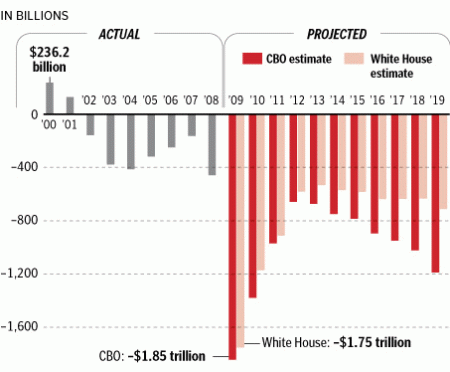

 Internet Scofflaw
You must be logged in to post a comment.