Marion Barry is the latest. Since Barry is an actual criminal, this isn’t all that surprising.
(Via Instapundit.)
Marion Barry is the latest. Since Barry is an actual criminal, this isn’t all that surprising.
(Via Instapundit.)
 Leave a Comment » |
  Political |
  Permalink
 Posted by K. Crary
More than three decades of research shows that a focus on effort—not on intelligence or ability—is key to success in school and in life.
Glenn Reynolds adds:
Hey, I’ve got an idea — why don’t we organize society so that it rewards hard work! We could even see that people who work harder and do better make more money! And then their efforts would pay off in more general societal prosperity, making life better for everyone! And we could . . . Naaaah.
Get serious, Glenn.
Related item here.
Leave a Comment » | Political, Scientific | Permalink
Posted by K. Crary
The Economist makes a strong case for decriminalizing drugs.
Leave a Comment » | Political | Permalink
Posted by K. Crary
The Obama budget relies on cost savings from pulling out of Iraq. The OMB director, Peter Orszag, says:
“The president is committed to getting — to winding down the war. That’s going to save money. It’s pretty clear,” Orszag said.
and:
The President is committed to responsibly winding the war down. I don’t do foreign policy, but I can tell you this: ending wars saves money – and so the Administration’s budget includes savings from ramping down overseas military operations over time.
Orszag cites cost-savings in defense starting in 1991, but those cost-savings reflected not just the end of Operation Desert Storm, but a general drawdown in military spending at the end of the Cold War (the “peace dividend”).
In fact, it turns out that pulling out of Iraq will not save any money at all in the short run. The GAO says that the process of withdrawing from Iraq will cost a “significant” amount for several years:
The removal of about 140,000 U.S. troops from Iraq by the end of 2011 will be a “massive and expensive effort” that is likely to increase rather than lower Iraq-related expenditures during the withdrawal and for several years after its completion, government investigators said in a report released yesterday.
“Although reducing troops would appear to lower costs,” the Government Accountability Office said, withdrawals from previous conflicts have shown that costs more often rise in the near term. The price of equipment repairs and replacements, along with closing or turning over 283 U.S. military installations in Iraq, “will likely be significant,” the GAO reported.
(Via Hot Air.)
Moreover, the GAO also says that the some of the necessary closings will take longer than estimated. For example, the closing of Balad Air Base needs to begin immediately to keep to the president’s timeline.
Leave a Comment » | Military, Political | Permalink
Posted by K. Crary
What’s next after AIG bonus confiscation? This is funny. I think.
(Via Instapundit.)
Leave a Comment » | Political | Permalink
Posted by K. Crary
I agree with Glenn Reynolds, President Obama should take as much time off as he likes. Maybe next time he can take some of Congress with him.
Leave a Comment » | Political | Permalink
Posted by K. Crary
The Justice Department’s Office of Legal Counsel is important because it interprets the law for the executive branch before the fact. That is, the OLC’s purpose is not to litigate to defend the administration’s actions, but to ensure that it obeys the law in the first place.
The OLC has been particularly controversial in recent years because the OLC issued a number of memos that have been construed as expanding presidential power. (This may be true; I don’t have the legal background to say.) Most notorious was the so-called “torture memo” which sought to establish what constitutes torture and is therefore illegal. (Many disagreed with the memo’s conclusions, and construed it as justifying torture. The memo was later rescinded, and new legislation later clarified the law somewhat.)
Dawn Johnsen is President Obama’s nominee for the Justice Department’s Office of Legal Counsel. Johnsen was an outspoken critic of expanding presidential power during the Bush administration, but was a strong proponent of expanding presidential power during the Clinton administration, explains Andrew McCarthy:
Particularly rich is Johnsen’s diatribe against Bush’s purportedly outlandish claim of power to ignore statutes that encroach on executive authority. When Johnsen served in the Clinton administration (which invented extraordinary rendition, detained Cuban refugees without trial at Guantanamo Bay, conducted warrantless national-security searches, and attacked a foreign country without congressional authorization), OLC’s official position was that “the President has enhanced responsibility to resist unconstitutional provisions that encroach upon the constitutional powers of the Presidency.” The office opined that several statutes (including privacy provisions in the federal wiretap law) could not bind the president, and Johnsen herself authored a 1997 OLC opinion concluding that presidents were above consumer-credit-disclosure laws. In that case, she broadly asserted that “statutes that do not expressly apply to the President must be construed as not applying to him if such application would involve a possible conflict with his constitutional prerogatives.”
So, Johnsen isn’t so much an opponent of expanded presidential power, as she is an opponent of expanded Republican presidential power.
In a similar fashion, she opposes politicization of the justice department by the right, but supports it (explicitly!) by the left:
A parallel hypocrisy is illustrated by Johnsen’s rants about how the Bush administration “politicized” the Justice Department. Her solution to this problem: Politicize the Justice Department. She argues that job applicants who may have been passed over by the Bush administration for holding leftist political views should get “special consideration” in DOJ hiring but, at the same time, maintains that nominees for the federal judiciary should be rejected out of hand if they embrace constitutional originalism or are members of the judicially conservative Federalist Society
Not only is Johnsen a partisan gunslinger, but she also has a history of making outlandish legal arguments. In 1989, as part of an argument for government funding of abortion, she infamously argued that unwanted pregnancy is tantamount to slavery, and restrictions on abortion violate the 13th Amendment. This year, when questioned by the Senate Judiciary Committee about that argument, she denied that she had ever made it, until her words were quoted back to her.
Most of the OLC’s opinions are never tested in court, so it’s important that it be giving sober, non-partisan legal advice. With her record, it seems unlikely that Johnsen will give advice that is either sober or non-partisan. It’s not even clear that she wants to.
Leave a Comment » | Legal, Political | Permalink
Posted by K. Crary
The Hill reports:
The Democratic Senatorial Campaign Committee (DSCC) has apparently decided to keep $100K in contributions from Bernie Madoff, who faces up to 150 years in prison for swindling billions from the likes of Steven Spielberg, Elie Wiesel, Kevin Bacon and Kyra Sedgwick in a massive Ponzi scheme.
In campaigns, one side often calls on the other to return money for one reason or another. Sometimes it’s valid, sometimes not. Regardless, it’s Campaign 101. But when the contributor in question is the single biggest financial criminal in history, there can be no question that those illicit funds should not remain in campaign coffers.
Sens. Charles Schumer (D-N.Y.) and Ron Wyden (D-Ore.) gave thousands in Madoff donations to charity. Reps. John Dingell (D-Mich.) and Charles Rangel (D-N.Y.) are doing the same.
Given the economic uncertainty our nation faces and that Madoff not only fleeced the rich and famous but major corporations such as HSBC — in other words, Madoff swindled all of us — the DSCC’s decision is shockingly tone-deaf.
However, what’s almost equally surprising is the virtual silence from the media. During the Enron scandal, returning campaign money was a daily drumbeat, as were the news stories discussing Enron’s purported ties to President Bush. Now, when the Democratic Senate campaign vehicle makes the conscious decision to keep $100K in Madoff money, stolen just as if it came from a bank holdup, there’s little to no outrage. Why?
(Via the Corner.)
Why no media outrage? That’s what is called a “rhetorical question.”
Leave a Comment » | Political | Permalink
Posted by K. Crary
Even when running a monopoly that is used by every single person in America, the government can’t stay in the black. By all means, let’s let these people run the health care and financial industries. What could go wrong?
Leave a Comment » | Political | Permalink
Posted by K. Crary
This open letter of resignation by an AIG vice-president gives a window into the terrible state of morale at the insurance giant. (Via the Corner.) Who is going to want to work there, when one is being publicly vilified, US Senators are calling for your suicide, and Congress is trying to remove any financial incentive to stay? Without qualified personnel, AIG won’t survive for long.
The peculiar thing is that the United States just bought AIG. With an 80% government stake, it’s close to a wholly owned subsidiary. So it appears that the government’s policy towards AIG is to buy it, then destroy it. One might question the wisdom of this policy.
There’s been a lot of talk of individuals going John Galt. It seems like the government is going Francisco d’Anconia.
UPDATE: More people bail out of AIG.
Leave a Comment » | Political | Permalink
Posted by K. Crary
He trails Pat Toomey 41-27. Specter won the 2004 primary by 2 points, after receiving the endorsements of President Bush and Rick Santorum. This time there’s no one to save him.
(Via the Corner.)
Leave a Comment » | Political | Permalink
Posted by K. Crary
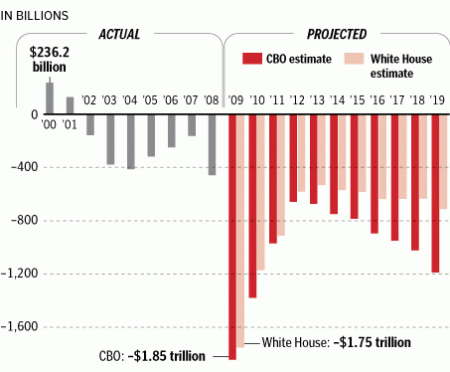
(From the Washington Post. Via the Foundry, via Instapundit.)
The Bush budget for 2009 would have been about $1 trillion in deficit, based on current economic conditions.
Leave a Comment » | Political | Permalink
Posted by K. Crary
Michael Barone makes a very interesting observation. The Geithner plan, finally unveiled on Monday, relies on unregulated firms to bail out the regulated ones. It’s hard to excerpt, but here’s the main point:
I have noticed what I think is a paradox in the Geithner plan. He is asking the most unregulated parts of the financial system—hedge funds, private equity firms—to bail out the most regulated part of the financial system—the banks. . .
Geithner, as I see it, is asking the unregulated players—the hedge funds and private equity firms—to do what Wallison recommended that the government do, buy the troubled assets “at their ‘net realizable value,’ which is based on an assessment of their current cash flows, discounted by their expected credit losses over time.” He’s trusting the unregulated players, rather than the government, to discover what that value is, by subsidizing their investments while limiting their downside risk. The government provides six-sevenths of the price, gets half the profits, but doesn’t have recourse to go back to the investors to recover losses. The unregulated players have great leverage to make profits while their losses are limited to their outlays.
This may work as intended. I certainly hope so. But it does give us some things to keep in mind as we ponder how financial markets should be regulated in the future. We don’t want to regulate every player strictly. There is a place for unregulated operators. And tight regulation will never automatically protect us against systemic risk. We need to keep our eyes open for areas where we need tighter regulation and where we don’t.
(Via Instapundit.)
Leave a Comment » | Political | Permalink
Posted by K. Crary
A government rescue for newspapers? (Via Instapundit.)
Leave a Comment » | Political | Permalink
Posted by K. Crary
Whew. Statement here.
Leave a Comment » | Political | Permalink
Posted by K. Crary
The Obama Administration wants the Treasury Department to have the power to seize any business. Swell.
Leave a Comment » | Political | Permalink
Posted by K. Crary
Plasma TVs may be the cheaper way to get a large-screen HD television, but it seems they use a little more power than LCDs, so California is going to ban them. The LCD industry approves.
Leave a Comment » | Political | Permalink
Posted by K. Crary
One of the most important freedoms enjoyed by most Americans is afforded not by the Constitution, but by Henry Ford. Affordable access to automobiles gives us the ability to come and go wherever and whenever we please. We are not limited to the routes offered by trains, nor are we limited to their schedules. This freedom is as fundamental to our lives as many of those in the Bill of Rights.
Outside the world’s wealthy nations, most people do not enjoy that freedom because they cannot afford a car. But soon, many more people will be able to enjoy that freedom. India’s Tata motors has repeated Henry Ford’s feat and dramatically reduced the cost of an automobile. Its new car, the Nano, will cost just $2000 new. This brings the car within the grasp of the developing world’s middle class, and will bring them a freedom of mobility they have never known.
Naturally, many environmentalists are appalled. Only by living in abject poverty can people keep their carbon emissions at a satisfactory level.
(Via Instapundit.)
Leave a Comment » | Political, Technological | Permalink
Posted by K. Crary
How can you make the Wall Street Journal a supporter of card check? You can’t, honestly that is. But, if you’re George Miller (D-CA), the chairman of the House Labor Committee, you can make it appear as though they do by some editing. Here’s the quote, as the Wall Street Journal wrote it, and as Miller rendered it:
The bill doesn’t remove the secret-ballot option from the National Labor Relations Act but in practice makes it a dead letter.
(Archived here.) (Via ShopFloor, via the Corner.)
Come on, that’s not even clever.
But, I guess the SEIU (the nation’s most influential union) thought it was clever, because they’re doing it too.
Leave a Comment » | Political | Permalink
Posted by K. Crary
Here’s the week’s scariest story that doesn’t mention Iran. President Obama wants the government to control executive pay, and not just at firms accepting bailout money, and not even just at financial firms:
The Obama administration will call for increased oversight of executive pay at all banks, Wall Street firms and possibly other companies as part of a sweeping plan to overhaul financial regulation, government officials said. . .
The administration has been considering increased oversight of executive pay for some time, but the issue was heightened in recent days as public fury over bonuses spilled into the regulatory effort. . .
One proposal could impose greater requirements on company boards to tie executive compensation more closely to corporate performance and to take other steps to ensure that compensation was aligned with the financial interest of the company.
The new rules will cover all financial institutions, including those not now covered by any pay rules because they are not receiving federal bailout money. Officials say the rules could also be applied more broadly to publicly traded companies.
(Via the Corner.)
Can anyone deny that President Obama is a socialist with a straight face any more?
Leave a Comment » | Political | Permalink
Posted by K. Crary
Geithner knew about the AIG bonuses at least a week earlier than he has admitted:
The question was direct and prescient. Representative Joseph Crowley, Democrat of New York, asked the Treasury secretary in an open hearing what could be done to stop American International Group from paying $165 million in bonuses to hundreds of employees in the very unit that had nearly destroyed the company.
Timothy F. Geithner, the Treasury secretary, responded by saying that executive pay in the financial industry had gotten “out of whack” in recent years, and pledged to crack down on exorbitant pay at companies like A.I.G. that were being bailed out with billons of taxpayer dollars.
The exchange took place before the House Ways and Means Committee on March 3 — one week before Mr. Geithner claims he first learned that the failed insurance company was about to pay a round of bonuses that have since caused a political uproar.
(Via the Corner.)
But don’t take the New York Times’s word for it, the C-SPAN video is available on YouTube.
So there are just two possibilities: either Geithner wasn’t listening during the March 3 committee meeting, or his claims not to heard until March 10 are a fabrication. Fool or liar, take your pick.
POSTSCRIPT: The straw I think Geithner will grasp is this: Geithner says he didn’t know the “full extent” until March 10. Although Crowley told Geithner enough, Geithner will say that Crowley didn’t tell him the full extent. Geithner spoke the literal truth, he will argue. But the literal truth can still be a lie, when fashioned to deceive. Geithner’s clear and deliberate implication was that he didn’t know enough to act, which we now know is false.
Leave a Comment » | Political | Permalink
Posted by K. Crary
It seems obvious to me that the AIG bonuses confiscation bill is unconstitutional. The Constitution says:
No bill of attainder or ex post facto Law shall be passed.
The dictionary defines bill of attainder:
a legislative act that imposes punishment without a trial
That’s exactly what the bill is, so it’s unconstitutional, right? Well, I’m relying here on the plain meaning of the Constitution. That, I suppose, is what lawyers call a “naive argument.” To find out what the Constitution really means, you can’t look at its text, you have to look at centuries of case law.
The legal scholars seem split. On the constitutional side, you have Laurence Tribe (last week) and Jack Balkin. On the unconstitutional side, you have Laurence Tribe (this week), Erik Jensen, and Jonathan Adler. (Via Instapundit, JustOneMinute, and Asymmetrical Information.)
The one thing everyone (except Congress) seems to agree on is this is terrible policy. Not just because it would undercut Treasury’s ability to deal with the financial crisis, but because it’s a terrible precedent to say that the government can confiscate any income it thinks is too much.
The rush to do this, despite it obviously being a bad idea, is because the Democrats are exposed. They made this happen, and now they need cover.
Leave a Comment » | Legal, Political | Permalink
Posted by K. Crary
President Obama has demonstrated his “smart diplomacy” yet again. This time, he snubbed French President Nicolas Sarkozy by writing to his predecessor Jacques Chirac as if he were still a head of state. Jim Lindgren has the story, and speculates:
If we could see the address on the letter to Chirac, it might be clear whether Obama or one of his staff was confused about the identity of the French President. My guess is that this was just a rookie mistake, i.e., bad diplomacy in wording a letter, not confusion about identities. . .
2d UPDATE: As noted by the Christian Science Monitor and elsewhere, the context was the one I suspected. Obama was writing to Chirac as the head of his Foundation for Sustainable Development and Cultural Dialogue.
Leave a Comment » | Geopolitical, Political | Permalink
Posted by K. Crary
The LA Times reports: Obama White House bars press from press award ceremony.
(Via Instapundit.)
Leave a Comment » | Political | Permalink
Posted by K. Crary
The inimitable Mark Steyn writes:
In turbulent times, it’s good to know some things never change. After a week in which President Obama thanked himself for inviting him to the White House, compared AIG executives to suicide bombers, and did the first Presidential retard joke on national TV, I was impressed to find that Slate is bravely keeping up its Bushism Of The Day feature.
Leave a Comment » | Political | Permalink
Posted by K. Crary
Bob Krumm makes a good point about the AIG bill of attainder:
As bad a precedent as the AIG bill is, there is one positive. Congress has established the principle that $165 million is not too inconsequential a sum as to require strict budget hawkishness. I can’t wait to apply that standard during the next earmark fight.
(Via Instapundit.)
The problem with this point is it assumes some sort of consistency from Congress. This isn’t about fiscal policy, this is the Congressional equivalent of a mob with torches and pitchforks.
Leave a Comment » | Political | Permalink
Posted by K. Crary
Even President Obama’s supporters are starting to lose patience with him, with a savaging on the New York Times editorial page:
The leading liberal voices of the New York Times editorial pages all criticized—and, in some cases, clobbered—President Obama on Sunday for his handling of the economy and national security.
It’s not unusual for Barack Obama to take a little friendly fire from the Times. But it’s perhaps unprecedented for him to get hit on the same day by columnists Frank Rich, Thomas Friedman and Maureen Dowd—and in the paper’s lead editorial. Their critique punctuated a weekend that started with a widely circulated blog post by Paul Krugman that said the president’s yet to be announced bank rescue plan would almost certainly fail.
The sentiment, coming just two months after the president was sworn in, reflects elite opinion in the Washington-New York corridor that Obama is increasingly overwhelmed, and not fully appreciative of the building tsunami of populist outrage.
(Via Instapundit.)
Leave a Comment » | Political | Permalink
Posted by K. Crary
The NY Daily News reports:
Gov. Paterson stuck to his guns Saturday, insisting he knew nothing about a $100,000 donation from AIG to the state Democratic Party days before his office helped save the insurance giant.
State Republicans charged the Democrats with stonewalling an investigation into the Aug. 29 donation, uncovered last week by The Associated Press.
(Via Instapundit.)
Leave a Comment » | Political | Permalink
Posted by K. Crary
Two Democratic congressmen, Pete Stark of California and Eliot Engel of New York, illegally claim to be Maryland residents to qualify for tax breaks on their Maryland homes. (Via Instapundit.)
Leave a Comment » | Political | Permalink
Posted by K. Crary

(Via Power Line.)
Leave a Comment » | Political | Permalink
Posted by K. Crary
When President Obama snubbed British PM Gordon Brown a couple of weeks ago by giving him a set of DVDs (whereas Brown gave Obama a collection of uniquely historical gifts), some wondered if they would even play in the UK, due to DVD region restrictions. I thought that was unnecessarily cynical; surely the White House would at least have gone to the trouble to get region 2 DVDs.
I was wrong. This White House is really starting to look uniquely incompetent.
(Via Hot Air.) (Previous post.)
UPDATE: Mark Steyn comments.
Leave a Comment » | Political | Permalink
Posted by K. Crary
The Obama Administration is abandoning a controversial policy to charge veterans for treatment of combat-related injuries. What they were thinking is still anyone’s guess.
Leave a Comment » | Political | Permalink
Posted by K. Crary
Nancy Pelosi wants to avoid the outrage over the AIG bonuses, so she wants us to know that she isn’t reponsible for the provision that protects them. But Pelosi goes further, and makes the bizarre, counterfactual claim that the House never saw the provision at all:
Pelosi continuously denied that she or any other House Democrat signed off on the provision, even though the House eventually voted to agree to the conference report on the stimulus bill.
“This was never brought to conference,” she said. “This never came to the House side, and you can talk to any of our conferees. It’s a matter of fact and record.”
(Via the Corner.)
Obviously, the bill did come to the House side, since that’s how bills become law. Presumably Pelosi knows this; does she think we don’t? Anyway, to avoid any confusion, I’m offering this as a public service:
Leave a Comment » | Political | Permalink
Posted by K. Crary
Has any president had an active book deal while in office before? (Via the Corner.) Apparently it’s legal (I’m sure no one ever thought to ban it), but it’s certainly unseemly.
Leave a Comment » | Political | Permalink
Posted by K. Crary
The fecklessness continues:
Attorney General Eric Holder said some detainees being held at Guantanamo Bay, Cuba, may end up being released in the U.S. as the Obama administration works with foreign allies to resettle some of the prisoners.
(Via the Corner.)
I’m surprised the Administration would want to make itself a hostage to fortune like this. When these released detainees start committing crimes, the voters will know who to blame. The convict furloughs of yesteryear pale to this.
Leave a Comment » | Military, Political | Permalink
Posted by K. Crary
Fox News reports:
The U.S. Census is supposed to be free of politics, but one group with a history of voter fraud, ACORN, is participating in next year’s count, raising concerns about the politicization of the decennial survey.
The Association of Community Organizations for Reform Now signed on as a national partner with the U.S. Census Bureau in February 2009 to assist with the recruitment of the 1.4 million temporary workers needed to go door-to-door to count every person in the United States — currently believed to be more than 306 million people.
ACORN invented hundreds of thousands of people for the voting rolls, and now it’s going to be counting people for the census. Swell. But wait:
ACORN spokesman Scott Levenson told FOXNews.com that “ACORN as an organization has not been charged with any crime.” He added that fears that the organization will unfairly influence the census are unfounded.
Whew, that’s a relief.
Leave a Comment » | Political | Permalink
Posted by K. Crary
Instapundit notes:
A POSSE COMITATUS ACT ISSUE? Army Investigating How and Why Troops Were Sent Into Alabama Town After Murder Spree. “The U.S. Army has launched an inquiry into how and why active duty troops from Fort Rucker, Ala., came to be placed on the streets of Samson, Ala., during last week’s murder spree in that tiny South Alabama community. The use of the troops was a possible violation of federal law.”
What I believe he meant to say was:
They told me that if I voted for McCain, there would be martial law on our nation’s streets. And they were right!
Leave a Comment » | Political | Permalink
Posted by K. Crary
Rep. John Murtha (D-PA) explains that Congress can do whatever it wants:
U.S. Rep. John Murtha, D-Johnstown, responded by waving the Constitution at the camera, saying: “What it says is the Congress of the United States appropriates the money. Got that?”
No more pestering our rulers with stories of corruption and waste, please.
(Via Instapundit.)
Leave a Comment » | Political | Permalink
Posted by K. Crary
It’s now called “man-caused disasters,” according to our new Secretary of Homeland Security. (Via the Corner.) Glad to see this administration is taking the problem seriously.
POSTSCRIPT: We got rid of our enemy combatants the same way. Perhaps renaming is the solution to all our problems.
Leave a Comment » | Political | Permalink
Posted by K. Crary
The Service Employees International Union (SEIU) is union-busting the union that organizes its staff, or so the latter is complaining. The Washington Post reports:
The workers union, which goes by the somewhat postmodern name of the Union of Union Representatives, has filed charges of unfair labor practices against the SEIU with the National Labor Relations Board. The workers union’s leaders say that the SEIU is engaging in the same kind of practices that some businesses use: laying off workers without proper notice, contracting out work to temporary-staffing firms, banning union activities and reclassifying workers to reduce union numbers.
(Via the Corner.)
Delicious. This should be fun to watch.
BONUS: SEIU’s layoffs are happening because they are short on money, because of all the money they spent supporting Barack Obama and card check. This gets better and better.
Leave a Comment » | Political | Permalink
Posted by K. Crary
Despite President Obama’s loudly expressed outrage over the AIG bonuses, it turns out that he knew about them already, reports the Washington Post:
President Obama was informed about the $165 million in bonuses due to employees of the American Insurance Group the day before they were paid out last week, the White House disclosed late Tuesday.
Obama has expressed outrage that the company, which has received about $170 billion in government bailout money, proceeded to pay out the bonuses. He said the idea of a company rescued with taxpayer money awarding bonuses runs counter to “our values.”
The timeline released Tuesday marked the first time the White House has acknowledged when the president was told about the bonuses, which have prompted calls from Congress for the administration to recover the money. . .
The president did not publicly express anger over the bonuses until after they were disclosed Sunday in The Washington Post.
(Emphasis mine.) (Via Hot Air.)
So the bonuses were no big deal, as long as no one knew about them. It wasn’t until they became public that Obama needed to get in front of the issue.
In fact, not only was Obama okay with the bonuses until Monday, it seems that he was instrumental for making them happen. The stimulus bill actually explicitly protects the bonuses:
(iii) The prohibition required under clause (i) shall not be construed to prohibit any bonus payment required to be paid pursuant to a written employment contract executed on or before February 11, 2009, as such valid employment contracts are determined by the Secretary or the designee of the Secretary.”
When asked about the bonuses, Harry Reid said “hindsight is 20/20.” But, in fact, the Senate had the foresight to prohibit them in its original bill. That provision was deleted in conference, and replaced with the provision protecting the bonuses, CNN reports:
The mystery isn’t just how what was effectively a protection for AIG was put into the stimulus bill — it’s also how a provision intended to prevent AIG from giving executive bonuses, was taken out.
The Senate passed a bipartisan amendment proposed by Sen. Olympia Snowe, R- Maine, and Sen. Ron Wyden, D-Oregon, that would have taxed bonuses on any company getting federal bailout dollars, if the company didn’t pay back the bonus money to the government.
But the idea was stripped from the stimulus bill during hurried, closed-door negotiations with the White House and House of Representatives.
(Via ButAsForMe.)
So, who did it? Blame had been centering on Christopher Dodd (D-CT), the chair of the Senate banking committee, who reportedly added the provision. But Dodd says it wasn’t his fault, it was the Treasury Department. The New York Times reports:
Mr. Geithner reiterated the Treasury position that lawyers inside and out of government had agreed that “it would be legally difficult to prevent these contractually mandated payments.”
That position was being questioned at the Capitol. Congressional Republicans, eager to implicate Democrats, initially blamed Senator Christopher J. Dodd, the Connecticut Democrat who heads the banking committee, for adding to the economic recovery package an amendment that cracked down on bonuses at companies getting bailout money, but that exempted bonuses protected by contracts, like A.I.G.’s.
Mr. Dodd, in turn, responded Tuesday with a statement saying that the exemption actually had been inserted at the insistence of Treasury during Congress’s final legislative negotiations.
(Emphasis mine.) (Via the Corner.)
So if Dodd is to be believed (a big if), the Obama Administration actually insisted on the bonuses it is now condemning. If Dodd is lying, the President Obama still negotiated the bill and signed it. Either way, this is Obama’s baby.
UPDATE: Actually, Dodd originally said he wasn’t involved in the provision “in the slightest.” Now he says Treasury insisted on it. Either way, Dodd lied. So I should have said: if Dodd is to be believed now. . .
UPDATE: Time reports:
Treasury Learned of AIG Bonuses Earlier Than Claimed
Although Treasury Secretary Timothy Geithner told congressional leaders on Tuesday that he learned of AIG’s impending $160 million bonus payments to members of its troubled financial-products unit on March 10, sources tell TIME that the New York Federal Reserve informed Treasury staff that the payments were imminent on Feb. 28. That is 10 days before Treasury staffers say they first learned “full details” of the bonus plan, and three days before the Administration launched a new $30 billion infusion of cash for AIG.
(Via the Corner.)
Phony outrage indeed.
Leave a Comment » | Political | Permalink
Posted by K. Crary
For the first time in ages, the GOP leads on the generic ballot 41-39, according to the latest Rasmussen poll. (Via Hot Air.) The Democrats lead by seven points on Inauguration Day, but have steadily faded since then.
It’s not just Rasmussen; the latest NPR poll has the parties tied 42-42 on the generic ballot. (Via Power Line.) NPR reports the poll here, but don’t expect to find any mention of the generic ballot; the NPR story cherrypicks the results that are positive for Democrats. You can find the full results (including the generic ballot on page 3) here (pdf).
Leave a Comment » | Political | Permalink
Posted by K. Crary
The latest world leader to be snubbed by the White House is the President of Brazil:
When Brazilian President Luiz Inacio Lula da Silva becomes the first Latin American leader to sit down with President Barack Obama this weekend, he brings undisputed clout. . .
Still, the White House made several moves interpreted as snubs by the Brazilian media.
Silva aides said the trip was pushed forward from Tuesday because of the St. Patrick’s Day holiday — making Latin America once again look like an afterthought. Then, the White House announcement misspelled his name as “Luis Ignacio” and put “Lula” — a nickname that decades ago became a legal part of the Brazilian leader’s name — in quotes.
(Via Power Line.)
Maybe this is actually really clever. In order to patch things up with the UK, the White House is snubbing everyone, in order that that its treatment of the British PM will be nothing out of the ordinary. But if that’s the plan, they dropped the ball with Ireland; the teleprompter breakdown with the Irish PM was more of a screw-up than a real snub.
Leave a Comment » | Geopolitical, Political | Permalink
Posted by K. Crary
It’s not just tax cheats that get jobs in the Obama Administration, but thieves as well:
Troubles for the man in charge of federal spending and policy on information technology continue to be revealed.
According to Maryland state records, Vivek Kundra, the White House chief information officer who took leave last Thursday — one week after being named to the position, pleaded guilty to a petty theft charge 12 years ago.
Kundra, who was formerly the D.C. technology officer, received supervised probation before judgment in 1997 for pleading guilty to a theft of less than $300. He was also fined $500, which was lowered to $100 after the rest was suspended.
ASIDE: This is separate from the recent FBI raid on Kundra’s office, in an investigation of which we are assured Kundra is not a target. We’ll see.
One’s first inclination is to blame incompetent vetting, but that might not be right. We just learned yesterday that the Obama Administration was aware of the tax problems with many of its nominees, but decided to go forward with them anyway. So it seems possible, even likely, that the vetters were aware that Kundra is a convicted thief, but the White House hired him anyway.
Leave a Comment » | Political | Permalink
Posted by K. Crary
When Australia introduced Internet censorship to stop child pornography, I was not alone in predicting that it wouldn’t be used only against child pornography for long. Still, I didn’t think that Australia would be blocking political content quite so soon.
It’s happening now. The Australian Communications and Media Authority (ACMA) has blacklisted an anti-abortion web site that shows gruesome pictures of aborted babies. That’s not even the end of the story. Whirlpool, a web site of discussion forums on the Internet and broadband, was given a takedown notice for linking to the site, according to the Australian. Had they refused, they would have faced fines of $11,000 (Australian) per day. (The placeholder for one deleted post can be seen here.)
The anti-abortion activists are not alone. ACMA has also blacklisted Wikileaks, for including a copy of Denmark’s blacklist.
The current state of affairs of Australian censorship allows the ACMA to censor domestic content, using takedown notices and threats of huge fines. However, the ACMA has no power (obviously) to take down foreign content. To correct that “problem”, the Australian government is looking to institute nationwide net filtering.
The Australian Minister for Broadband, Communications, and the Digital Economy, Stephen Conroy, assures Australians that:
The Government does not view this debate as an argument about freedom of speech. Freedom of speech is fundamentally important in a democratic society and there has never been any suggestion that the Australian Government would seek to block political content.
But, as we have just seen, it already has.
Conroy also asks Australians to have faith in them, adding:
“The Government of Australia is elected,” he said. “If the parliament wants to take this path, the last time I checked, that’s ok.”
Have faith in the censors? Heh. Good one. Anyway, Conroy clearly has forgotten the principles of limited government, if he ever knew them. An elected government can do anything it wants? What has become of you, Australia?
(Via Volokh.)
Leave a Comment » | Political | Permalink
Posted by K. Crary
A new White House position. (Via the Corner.) Apparently President Obama is serious about making us into Europe.
Leave a Comment » | Political | Permalink
Posted by K. Crary
Obama’s $80 billion exaggeration:
Last week, President Barack Obama convened a health-care summit in Washington to identify programs that would improve quality and restrain burgeoning costs. He stated that all his policies would be based on rigorous scientific evidence of benefit. The flagship proposal presented by the president at this gathering was the national adoption of electronic medical records — a computer-based system that would contain every patient’s clinical history, laboratory results, and treatments. This, he said, would save some $80 billion a year, safeguard against medical errors, reduce malpractice lawsuits, and greatly facilitate both preventive care and ongoing therapy of the chronically ill.
Following his announcement, we spoke with fellow physicians at the Harvard teaching hospitals, where electronic medical records have been in use for years. All of us were dumbfounded, wondering how such dramatic claims of cost-saving and quality improvement could be true.
The basis for the president’s proposal is a theoretical study published in 2005 by the RAND Corporation, funded by companies including Hewlett-Packard and Xerox that stand to financially benefit from such an electronic system. And, as the RAND policy analysts readily admit in their report, there was no compelling evidence at the time to support their theoretical claims. Moreover, in the four years since the report, considerable data have been obtained that undermine their claims. The RAND study and the Obama proposal it spawned appear to be an elegant exercise in wishful thinking.
Leave a Comment » | Political | Permalink
Posted by K. Crary
An object lesson in South America:
As a small, open economy dependent on banking, beach tourism and beef exports, Uruguay ought to be more exposed to the world recession than Argentina, with its large domestic market. Both economies have slowed sharply after years of rapid growth. But Uruguay looks set to fare much less badly than Argentina. . .
That is because the growth in Argentina owed much to expansionary fiscal and monetary polices which caused the economy to overheat. Over the past year prices for its farm exports have fallen, bringing down tax revenues. To keep public spending going, President Cristina Fernández de Kirchner nationalised the private pension system in October, destroying what little confidence investors had in her government. Argentines, long inured to such behaviour, responded as they always do, by taking their money out. Capital outflows reached 7% of GDP in 2008.
Much of that money went across the river. Deposits in Uruguay’s banks by non-residents rose by 41% in the 12 months to December. These pesos follow others: during the presidency of Néstor Kirchner, Ms Fernández’s husband and predecessor, some Argentine beef farmers sold their herds rather than submit to export bans and price controls, and ploughed the money into Uruguayan ranches. . .
Uruguay is better placed to mitigate recession than its neighbour. Argentina may struggle to roll over the $23 billion in debt maturing this year and next because of investors’ distrust: its bonds yield 15 percentage points more than American Treasury bonds. Uruguay is charged a premium of only five percentage points, and can thus more easily afford a fiscal stimulus.
Leave a Comment » | Political | Permalink
Posted by K. Crary
A very insightful column by Shelby Steele.
Leave a Comment » | Political | Permalink
Posted by K. Crary
The geniuses who run the Democratic party have determined that this is the perfect time for a trade war:
A long-simmering trade dispute boiled over into sanctions on Monday after Mexico said it would raise tariffs on $2.4bn of US exports in retaliation for ending a pilot programme to allow Mexican trucks on American roads.
The announcement marks one of the first big tests for trade policy under President Barack Obama, who has sought to tread a fine line between assuaging his domestic constituencies and upholding the US’s international obligations.
Mexico said it would increase tariffs on 90 industrial and agricultural goods, likely to include politically sensitive farm products, after Congress last week killed a pilot programme allowing a limited number of Mexican trucks on American highways. Mexico obtained a judicial ruling in 2001 under the North American Free Trade Agreement (Nafta) allowing it to impose such sanctions, but has held off since the US introduced the pilot scheme.
The sanctions, which Mexican officials say are set to be imposed later this week, will be one of the largest acts of retaliation against US exports. US goods exports to Mexico totalled $151.5bn last year. On Monday, Gerardo Ruíz Mateos, Mexico’s economy minister, said: “We believe that the action taken by the US is wrong, protectionist and in clear violation of Nafta.”
The White House said on Monday it would seek to create a new programme that would address what it called the “legitimate concerns of Congress” while meeting the US’s Nafta commitments. But Mexican officials said they would not be bought off with promises.
(Via Instapundit.)
You cannot simultaneously support free trade and placate the unions. You have to decide.
Leave a Comment » | Political | Permalink
Posted by K. Crary
The Seattle Post-Intelligencer, which has been in financial trouble since I was a child, has finally folded.
The failure of the PI can be seen as an application of Hotelling’s Law. Two newspapers can survive with one slightly left of center and the other slightly right of center. Then each gets half the market share. With one far left paper (the Seattle Times) and one even further left paper (the PI), the one at the extreme will not survive.
Leave a Comment » | Political | Permalink
Posted by K. Crary
What is the deal with the outbreak in blatantly unconstitutional legislative proposals? In just the last few days:
Wasn’t there a time when our leaders felt a responsibility to obey the Constitution, or am I looking back to a halcyon age that never really existed? If it ever existed, that time is surely gone now. Today, many of our leaders (“rulers” might be more apt) have clearly decided that the thankless task of applying the Constitution is the sole provenance of the courts. Their job, as they see it, is to get away with as much as they can.
Leave a Comment » | Political | Permalink
Posted by K. Crary
The reason so many Obama nominees have had tax problems is the Administration thought it was no big deal, reports the DC Examiner:
It’s been a recurring question about the young Obama administration: Why have so many of its nominees come down with tax problems?
Timothy Geithner, Tom Daschle, Ron Kirk, Nancy Killefer, and a number of others who didn’t make it to the nomination stage — all have been felled, or tainted, by unpaid tax bills ranging from a few hundred dollars to more than $140,000. After the first few cases, Republican Rep. Eric Cantor quipped that “it’s easy for [Democrats] to sit here and advocate higher taxes because — you know what? — they don’t pay them.”
For their part, some Democrats have suggested that the Senate Finance Committee, which investigates nominees before confirmation, has gotten so nit-picky in examining tax returns that good candidates have gone down in flames. “The Finance Committee has gone a bit overboard, and I find it a little striking that a Democratic committee is doing this to a Democratic administration,” one anonymous insider told the Politico recently. . .
Now, we find out that neither Cantor nor the unnamed Democrat was correct. The problem is not with Democrats in general, nor with the Finance Committee in particular. The problem is the Obama White House, which, fully aware of its nominees’ tax issues, decided that those problems were trivial, or that the public wouldn’t care about them, and pushed forward with nominations that in the past would have been quietly shelved.
In little-noticed remarks last week, Sen. Charles Grassley of Iowa, the ranking Republican on the Senate Finance Committee, gave us a look inside the confirmation process. Irritated by news reports suggesting the committee had been too hard on Obama’s nominees, Grassley pointed the finger back at the White House.
“I want to stress that the Finance Committee is not doing anything different now from what it has always done under the leadership of either Senator Baucus or me,” Grassley said, referring to Democratic chairman Max Baucus of Montana. “We are vetting nominees for the current administration the same way we vetted nominees for the previous administration.”
“The tax issues of the nominees considered by the committee this year came to be public only because the nominees chose to proceed.”
(Via Instapundit.)
Wow.
Leave a Comment » | Political | Permalink
Posted by K. Crary
The New York Times must be finding it harder to find material for negative Iraq stories. The latest crisis they’ve uncovered (I am not making this up) is stray dogs. (Via the Corner.)
Leave a Comment » | Political | Permalink
Posted by K. Crary
It might be simplest if the White House announced that all of its campaign rhetoric is “no longer operative.” To wit: taxing health benefits, formerly the worst idea ever, is now under consideration. James Capretta explains:
Remember this devastating political ad from last year?
Many Americans probably do, as it represented a real turning point in the presidential campaign.
Aired in October, the ad picked up on an exchange from the vice-presidential debate between then-Senator Joe Biden and Alaska Gov. Sarah Palin. Palin had just explained that the McCain health-care plan would provide refundable tax credits of $5,000 per household to help families buy portable insurance. Biden, who had clearly been waiting for the issue to come up, responded with a scripted attack. What the McCain-Palin folks don’t tell you, Biden warned, is that they would — “for the first time in history” — tax your employer-provided health benefits.
The public, most of whom get their insurance from their workplaces, was taken aback and confused. Why would Republicans want to tax employer-sponsored health-care benefits? Aren’t Republicans for cutting taxes? Aren’t they for private, as opposed to public, health insurance? And how could a tax increase make anyone better off?
It was a devastating blow. The McCain campaign never adequately explained their plan or offered an effective counter-argument — and the Obama-Biden campaign never looked back. They rode the issue for weeks, airing millions of dollars in attack ads. Indeed, the effectiveness of the coordinated attack on the McCain health plan is surely one of the main reasons for Obama’s victory in November.
Well, guess what? Not five months later, having secured the presidency, President Obama has changed his tune. Taxing health-care benefits is not such a bad idea after all, he and his team now say.
If done properly, this could be a good idea. The preferential tax treatment of benefits (principally health care) has distorted employee compensation, favoring benefits over wages. In regards to health care, this has an important undesirable second-order effect. When a large part of employee compensation can be spent only on health care, employees are encouraged thereby to spend more on health care. Supply and demand then tell us that, consequently, the price of health care and the quantity consumed will increase.
Of course, the new tax on benefits ought to be matched with a tax cut, in order to leave taxes unchanged overall. This was John McCain’s plan. Once people adjust to the new incentives, the end result is simply more money in your pocket to spend on whatever you want, rather than only on health care. Unfortunately, President Obama almost certainly will not do it that way, because (unlike McCain) he sees it as a source of revenue, rather than a way to remove a distortion in the marketplace.
And so Obama’s true hypocrisy is revealed. McCain never planned a tax increase levied on health-care benefits (attack ads notwithstanding). Obama is considering exactly that. Thus, the policy that Senator Obama attacked so effectively never was McCain’s policy, but it has now become Obama’s.
Leave a Comment » | Political | Permalink
Posted by K. Crary
The Wall Street Journal makes a provocative observation:
We’re constantly told that taxes don’t matter to business and investors, but listen to that noted supply-side economist, Alec Baldwin. The actor recently rebuked New York Governor David Paterson for threatening to try to help close the state’s $7 billion budget deficit by canceling a 35% tax credit for films shot in the Big Apple.
“I’m telling you right now,” Mr. Baldwin declared, “if these tax breaks are not reinstated into the budget, film production in this town is going to collapse, and television is going to collapse and it’s all going to go to California.” Well, well. Apparently taxes do matter, at least when it comes to filming “30 Rock” in Manhattan.
(Via Dr. Helen, via Instapundit.)
Heh. Seriously, though, I doubt anyone needs to strike Mr. Baldwin from their dinner party invitation list. I’m sure that Baldwin is just looking for preferential treatment for his own industry, not to stimulate the economy in general.
Leave a Comment » | Political | Permalink
Posted by K. Crary
Ronald Rotunda (writing for the Chicago Tribune) notices an unconstitutional provision in the stimulus act. It seems that if a state governor has the temerity to refuse the stimulus funding, the act gives the state legislature the power to override him. The federal government most certainly does not have the power to override state constitutions like that.
Alas, the provision will surely be found to be severable, so we can’t realistically hope that this will bring down the entire mess.
(Via Instapundit.)
Leave a Comment » | Political | Permalink
Posted by K. Crary
On January 1, 1995, after two years of Republican filibusters, the New York Times wrote it was time to abolish the filibuster:
The U.S. Senate likes to call itself the world’s greatest deliberative body. The greatest obstructive body is more like it. In the last session of Congress, the Republican minority invoked an endless string of filibusters to frustrate the will of the majority. This relentless abuse of a time-honored Senate tradition so disgusted Senator Tom Harkin, a Democrat from Iowa, that he is now willing to forgo easy retribution and drastically limit the filibuster. Hooray for him. . . Now is the perfect moment . . . to get rid of an archaic rule that frustrates democracy and serves no useful purpose.
But, by March 2005, when Democrats were the ones employing the filibuster, the New York Times was able to see a useful purpose after all:
In the past we’ve been frustrated when legislators tried to stop important bills from passing by resorting to the same tactic. The filibuster, which allows 41 senators to delay action indefinitely, is a rough instrument that should be used with caution. But its existence goes to the center of the peculiar but effective form of government America cherishes. . .
While the filibuster has not traditionally been used to stop judicial confirmations, it seems to us this is a matter in which it’s most important that a large minority of senators has a limited right of veto. . .
A decade ago, this page expressed support for tactics that would have gone even further than the “nuclear option” in eliminating the power of the filibuster. At the time, we had vivid memories of the difficulty that Senate Republicans had given much of Bill Clinton’s early agenda. But we were still wrong. To see the filibuster fully, it’s obviously a good idea to have to live on both sides of it. We hope acknowledging our own error may remind some wavering Republican senators that someday they, too, will be on the other side and in need of all the protections the Senate rules can provide.
As one of the nation’s least consistent, most partisan papers, it seemed likely that the NYT’s opportunistic rediscovery of the filibuster’s value would disappear once the Republicans began using it again. With Democrats in ascendance, it seemed inevitable that the NYT would rediscover the evil of the filibuster. It’s only been a matter of time.
Nevertheless, I am a little bit surprised. I thought that they would wait until the Republicans had actually filibustered something. Nope. Two weeks ago, the NYT ran two op-ed pieces vilifying the filibuster, and this week the NYT’s editorial page launched its pre-emptive strike on the filibuster. Moreover, it took a strikingly shrill tone:
When President George W. Bush was stocking the federal courts with conservative ideologues, Senate Republicans threatened to change the august body’s rules if any Democrat dared to try to block his choices, even the least-competent, most-radical ones. Filibustering the president’s nominees, they said, would be an outrageous abuse of senatorial privilege. . .
Now that President Obama is preparing to fill vacancies on federal benches, Republican senators have fired off an intemperate letter threatening — you got it — filibusters if Mr. Obama’s nominees are not to their liking. . .
It is particularly strange to see Senate Republicans raising the specter of filibustering nominees. When Mr. Bush was doing the nominating, Senator Orrin Hatch, Republican of Utah and a former Judiciary Committee chairman, warned Democrats that filibusters “mired the judicial-confirmation process in a political and constitutional crisis that undermines democracy, the judiciary, the Senate, and the Constitution.”
A filibuster can be an appropriate response when it is clear that a particular nominee would be a dangerous addition to the bench. The Republicans’ rush to threaten filibusters in the absence of actual nominees is not only at odds with their previous views on the subject, but shows a lack of respect for the confirmation process.
The NYT is clearly conscious of the danger of making itself a laughingstock if it reverses itself a second time, so it tries to find some nuance. Filibustering an actual nominee, that’s okay (when he or she would be a “dangerous addition” to the bench), but writing a letter saying that you might filibuster a nominee, that is beyond the pale!
Come again? If filibustering is okay, how can not-yet-filibustering be wrong?
There is a matter of substance to address here, though. To try to hide its own hypocrisy, the NYT employs a bit of rhetorical jujitsu. The Republicans are being hypocritical, they argue, because they used to argue that filibusters were bad, and now they plan to use them. Michael Barone’s first rule (all process arguments are insincere) certainly comes to mind, but I think the GOP can actually offer a good defense.
They key point is that the Democrats prevailed on the filibuster. Republicans argued that what the Democrats were doing was wrong, and tried to put a stop to it, but they failed. If the GOP had exercised the “nuclear option,” abolishing filibusters of judicial nominees, and then demanded them back, they would be hypocrites of the first order.
But they did not. Filibusters of judicial appointments were not abolished, and were used extensively. Republicans need to use them now. If they do not, they accede to an arrangement in which Democrats block nominees and Republicans do not. That kind of unilateral disarmament would be fatal to all we hold dear, and it is preposterous for the NYT to suggest that the GOP submit to it.
ASIDE: Something very much like this happened in the debate over term limits. The term-limits caucus failed to enact them for everyone, but far too many of them decided to impose them on themselves. As a result, the term-limits caucus is largely gone. All that are left are the “hypocrites” who decided not to impose term limits unilaterally on themselves.
POSTSCRIPT: Beyond its flagrant hypocrisy, Jonathan Adler points out that the NYT editorial also includes a number of factual distortions. There’s also the topic of blue slips, which I’ll leave for another post.
Leave a Comment » | Political | Permalink
Posted by K. Crary
According to Tapped (a lefty blog), negotiators on the foreclosure bill have agreed that the cramdown provision will apply only to mortgages that exist when the bill is passed, not new mortgages going forward. If true, this has to be taken as tacit acknowledgement that mortgage cramdowns are generally bad policy, that would cause mortgage rates to rise on good credit risks in order to subsidize bad ones.
By limiting cramdowns to existing mortgages, the bill would avoid the effect on interest rates going forward. Except, that is, to the extent that lenders are not fools. Lenders will learn not to trust the government; what it does now, it will do again. Any loan they make will ultimately be subject to cramdown the next time there’s a foreclosure bill.
But the primary effect of the bill is still on existing mortgages, and that’s still where it is truly dangerous. The banking system is still reeling from the impact of a drop in the value of its loans. Cramdown would be yet another blow to those assets and to the banking system. To do it right now is the apotheosis of stupidity.
Leave a Comment » | Political | Permalink
Posted by K. Crary
President Obama has determined that the United States will no longer hold enemy combatants, er, in the sense that we will no longer use the word “enemy combatant.” In substance, the policy remains essentially unchanged. In the new policy, disclosed Friday, President Obama claims an ever so slightly broader authority to hold Al Qaeda and Taliban fighters, and an ever so slightly narrower authority to hold others. Scotusblog has the rundown. (Via Instapundit.)
I think Ed Whelan has the right idea. Next we can resolve the Guantanamo problem in a similar manner, by renaming Guantanamo.
Leave a Comment » | Legal, Military, Political | Permalink
Posted by K. Crary
Douglas Shoen (a pollster for Bill Clinton) and Scott Rasmussen write that President Obama is not polling well:
It is simply wrong for commentators to continue to focus on President Barack Obama’s high levels of popularity, and to conclude that these are indicative of high levels of public confidence in the work of his administration. Indeed, a detailed look at recent survey data shows that the opposite is most likely true. The American people are coming to express increasingly significant doubts about his initiatives, and most likely support a different agenda and different policies from those that the Obama administration has advanced.
Polling data show that Mr. Obama’s approval rating is dropping and is below where George W. Bush was in an analogous period in 2001. . . Overall, Rasmussen Reports shows a 56%-43% approval, with a third strongly disapproving of the president’s performance. This is a substantial degree of polarization so early in the administration. Mr. Obama has lost virtually all of his Republican support and a good part of his Independent support, and the trend is decidedly negative.
A detailed examination of presidential popularity after 50 days on the job similarly demonstrates a substantial drop in presidential approval relative to other elected presidents in the 20th and 21st centuries. The reason for this decline most likely has to do with doubts about the administration’s policies and their impact on peoples’ lives.
(Via Instapundit.)
They go on to show that he polls even worse on the issues. No wonder they’re attacking commentators like Limbaugh, Santinelli, and Cramer; they want people’s attention anywhere else.
Leave a Comment » | Political | Permalink
Posted by K. Crary
Megan McArdle is dismayed to learn that she is one of the rubes:
Our sister publication asks analysts whether the administration’s economic forecasts are too optimistic. They would have gotten a more interesting discussion if their query had been “Is the Pope Catholic?” Of course they’re too optimistic. In fact, the word optimistic is too optimistic. A better choice might have been “insane”. Like Greg Mankiw, I would love to find a sucker investor who is willing to take the other end of a bet that both growth and revenue will fall short of the administration’s predictions.
Having defended Obama’s candidacy largely on his economic team, I’m having serious buyer’s remorse. Geithner, who is rapidly starting to look like the weakest link, is rattling around by himself in Treasury. Meanwhile, the administration is clearly prioritized a stimulus package that will not work without fixing the banks over, um, fixing the banking system. . .
The budget numbers are just one more blow to the credibility he worked hard to establish during the election. Back then, people like me handed him kudoes for using numbers that were really much less mendacious than the general run of candidate program promises. Now, he’s building a budget on the promise that this recession will be milder than average, with growth merely dipping to 1.2% this year and returning to trend in 2010. . . He has now raced passed Bush in the Delusional Budget Math olympics.
(Via Instapundit.)
Leave a Comment » | Political | Permalink
Posted by K. Crary
The White House is refusing Freedom of Information Act requests for documents regarding the Anti-Counterfeiting Trade Agreement, on national-security grounds:
“Please be advised the documents you seek are being withheld in full,” wrote Carmen Suro-Bredie, chief FOIA officer in the White House’s Office of the U.S. Trade Representative.
The national security claim is stunning, given that the treaty negotiations have included the 27 member states of the European Union, Japan, South Korea, Canada, Mexico, Australia, Switzerland and New Zealand, all of whom presumably have access to the “classified” information.
(Via BoingBoing, via Instapundit.)
How can international treaty negotiations be classified? I’d really like to hear this one justified.
Anyway, so much for President Obama’s ballyhooed commitment to the Freedom of Information Act.
Leave a Comment » | Political | Permalink
Posted by K. Crary
Another municipality busted. (Via Instapundit.)
Leave a Comment » | Political | Permalink
Posted by K. Crary
John Hinderaker has some useful perspective on the recession. What it has most in common with the Great Depression is the effort to exploit it.
Leave a Comment » | Political | Permalink
Posted by K. Crary
CNN reports:
Veterans Affairs Secretary Eric Shinseki confirmed Tuesday that the Obama administration is considering a controversial plan to make veterans pay for treatment of service-related injuries with private insurance. . .
No official proposal to create such a program has been announced publicly, but veterans groups wrote a pre-emptive letter last week to President Obama voicing their opposition to the idea after hearing the plan was under consideration.
The groups also cited an increase in “third-party collections” estimated in the 2010 budget proposal — something they said could be achieved only if the Veterans Administration started billing for service-related injuries.
Asked about the proposal, Shinseki said it was under “consideration.”
“A final decision hasn’t been made yet,” he said.
Currently, veterans’ private insurance is charged only when they receive health care from the VA for medical issues that are not related to service injuries, like getting the flu.
Charging for service-related injuries would violate “a sacred trust,” Veterans of Foreign Wars spokesman Joe Davis said. Davis said the move would risk private health care for veterans and their families by potentially maxing out benefits paying for costly war injury treatments.
(Via LGF.)
I’m honestly shocked by this. Set aside the obvious (or so I would have thought) immorality of charging veterans for treatment of injuries incurred while serving their country. Also set aside the bizarre spectacle of arguing for universal health care while cutting back health care for veterans. And set aside the strange decision to demand sacrifices of veterans while the government goes on a deficit-financed spending spree.
All that aside, it strikes me as terrible politics. Why slap veterans in the face with a plan that will never be enacted? I don’t get it.
Leave a Comment » | Military, Political | Permalink
Posted by K. Crary
The increasing use of presidential signing statements began in the Reagan Administration and continued into the administrations that followed. The primary historical use of signing statements was to point out constitutional problems and direct the executive branch in how to deal with them. So has there been a great increase in unconstitutional legislation? Quite possibly, but there is another reason why the use of signing statements has grown.
When interpreting the law, courts frequently go back to its legislative history to get a sense of its authors’ intent. This leads to an imbalance between the branches of government, because the legislative and judicial branches both get their say regarding the meaning of the law, but not the executive branch. To address that imbalance, Samuel Alito (then Deputy Assistant Attorney General) proposed in a 1986 memo (pdf) to expand the use of signing statements:
Our primary objective is to ensure that Presidential signing statements assume their rightful place in the interpretation of legislation. In the past, Presidents have issued signing statements when presented with bills raising constitutional problems. [Office of Legal Counsel] has played a role in this process, and the present proposal would not substantively alter that process.
The novelty of the proposal previously discussed by this Group is the suggestion that Presidential signing statements be used to address questions of interpretation. Under the Constitution, a bill becomes law only when passed by both houses of Congress and signed by the President (or enacted over his veto). Since the President’s approval is just as important as that of the House or Senate, it seems to follow that the President’s understanding of the bill should be just as important as that of Congress. Yet in interpreting statutes, both courts and litigants (including lawyers in the Executive branch) invariably speak of “legislative” or “congressional” intent. Rarely if ever do courts or litigants inquire into the President’s intent. Why is this so?
Part of the reason undoubtedly is that Presidents, unlike Congress, do not customarily comment on their understanding of bills. Congress churns out great masses of legislative history bearing on its intent–committee reports, floor debates, hearings. Presidents have traditionally created nothing comparable. Presidents have seldom explained in any depth or detail how they interpreted the bills they have signed. Presidential approval is usually accompanied by a statement that is often little more than a press release. From the perspective of the Executive Branch, the issuance of interpretive signing statements would have two chief advantages. First, it would increase the power of the Executive to shape the law. Second, by forcing some rethinking by courts, scholars, and litigants, it may help to curb some of the prevalent abuses of legislative history.
Alito accurately predicted that Congress would not take kindly to the proposal:
It seems likely that our new type of signing statement will not be warmly welcomed by Congress. The novelty of the procedure and the potential increase of presidential power are two factors that may account for this anticipated reaction. In addition, and perhaps most important, Congress is likely to resent the fact that the President will get in the last word on questions of interpretation.
I’m not aware of an occasion in which an expanded signing statement has been tested in court, so it’s too soon to say whether Alito’s experiment has succeeded.
Leave a Comment » | Legal, Political | Permalink
Posted by K. Crary
Three days ago, President Obama took a stand against signing statements:
President Obama tried to overturn his predecessor again on Monday, saying he will not use bill signing statements to tell his aides to ignore provisions of laws passed by Congress that he doesn’t like. . . Obama sent a two-page memo to department heads saying he would only raise constitutional issues in his signing statements and do so in “limited circumstances.” These statements “should not be used to suggest that the president will disregard statutory requirements on the basis of policy disagreements,” the memo said.
Bush’s tactics were not cited specifically. Obama also instructed agencies to consult Attorney General Eric Holder before relying on any previous signing statement as a basis for “disregarding, or otherwise refusing to comply with any provision of a statute.” . . .
In his memo, Obama asked aides to work out constitutional problems before Congress acts.
Michelle Boardman, a deputy assistant attorney general in the Bush administration, said the Bush White House tried to do just that. She said it is the executive branch’s responsibility to point out conflicts between newly passed laws and the Constitution.
Obama “will discover for himself just how infrequently Congress shows any interest in removing unconstitutional provisions,” she said.
Boardman’s remark was prophetic, because President Obama issued his first signing statement just two days later:
President Barack Obama, sounding weary of criticism over federal earmarks, defended Congress’ pet projects Wednesday as he signed an “imperfect” $410 billion measure with thousands of examples. . . On another potentially controversial matter, the president also issued a “signing statement” with the bill, saying several of its provisions raised constitutional concerns and would be taken merely as suggestions. He has criticized President George W. Bush for often using such statements to claim the right to ignore portions of new laws, and on Monday he said his administration wouldn’t follow those issued by Bush unless authorized by the new attorney general.
(Via Instapundit.)
So the Obama Administration’s position on substantive signing statements is identical to that of the Bush Administration (and others as far back as the Monroe Administration), to use them to identify constitutional problems in legislation and to direct the executive branch how to deal with them. The only difference is a new president bringing new ideology.
This is expected. Regardless of what they say on the campaign trail, presidents invariably are fans of presidential power. Senator Obama may have chafed at presidential signing statements, but President Obama is going to use them all he likes. The only surprising thing is that anyone would be surprised.
There is something new here, though. Before issuing his first signing statement, President Obama did issue a memo overturning all previous signing statements. As far as I know, that hadn’t been done before. It makes sense, though, from Obama’s point of view. He need not support his predecessors’ executive power in order to exercise his own. Posturing aside, all his memo Monday did was order the executive branch to follow his signing statements, but not to follow anyone else’s without checking first.
In this, Obama has surely set a new precedent. The next Republican president no doubt will issue a similar memo overturning all previous signing statements. On that day, there will be much hue and cry from Democrats, and the signing statement will become bad again. Until the next Democrat.
POSTSCRIPT: More in the next post.
Leave a Comment » | Legal, Political | Permalink
Posted by K. Crary
The Census Bureau will report to the Secretary of Commerce, as always. Were they stung by public criticism, or did they notice that the plan was illegal?
Leave a Comment » | Political | Permalink
Posted by K. Crary
Connecticut Democrats are now trying to absolve themselves of responsibility for the bill.
Leave a Comment » | Political | Permalink
Posted by K. Crary
Eric Cantor nails it:
Just three weeks after President Obama signed his ‘stimulus’ bill into law, Congressional Democrats are already conceding that it will fail to achieve its objective. As the Speaker knows, the only reason to craft a second stimulus bill would be if the first one failed. Every Republican in the House voted against the first stimulus bill because we believed that Congress could do better, and we had a plan to achieve that goal. America does not need another massive spending bill, what we need is to create jobs.
(Via the Corner.)
Leave a Comment » | Political | Permalink
Posted by K. Crary
Nancy Pelosi, it seems, needs to travel in style. Not only won’t she demean herself by flying commercial, she won’t even demean herself by flying in just any military aircraft, she insists on the Gulfstream G5. Also, she’s made efforts to keep one on-call for herself every weekend, just in case, at considerable taxpayer expense. This is according to emails obtained by Judicial Watch under a Freedom of Information Act request:
- In response to a series of requests for military aircraft, one Defense Department official wrote, “Any chance of politely querying [Pelosi’s team] if they really intend to do all of these or are they just picking every weekend?…[T]here’s no need to block every weekend ‘just in case’…” The email also notes that Pelosi’s office had, “a history of canceling many of their past requests.”
- One DOD official complained about the “hidden costs” associated with the speaker’s last minute changes and cancellations. “We have…folks prepping the jets and crews driving in (not a short drive for some), cooking meals and preflighting the jets etc.”
- The documents also detail correspondence from intermediaries for Speaker Pelosi issuing demands for certain aircraft and expressing outrage when requested military planes were not available. “It is my understanding there are no G5s available for the House during the Memorial Day recess. This is totally unacceptable…The speaker will want to know where the planes are…” wrote Kay King, Director of the House Office of Interparliamentary Affairs.
- In a separate email, when told a certain type of aircraft would not be available, King writes, “This is not good news, and we will have some very disappointed folks, as well as a very upset [s]peaker.”
The NY Post reports the story here.
(Via Hot Air and Instapundit.)
I expect there will be a gold toilet in the Speaker’s office before long.
Leave a Comment » | Political | Permalink
Posted by K. Crary
Ron Kirk, tax cheat and US Trade Representative nominee, looks likely to be confirmed. (Via Instapundit.)
Leave a Comment » | Political | Permalink
Posted by K. Crary
ABC reports:
The White House Tuesday evening disclosed that almost three weeks ago the Obama administration granted ethics wavers for two additional officials who had previously worked as lobbyists. On February 20 the administration signed waivers for Jocelyn Frye, former general counsel at the National Partnership for Women & Families, and Cecilia Muñoz, the former senior vice president for the National Council of La Raza, allowing them to work on issues for which they lobbied.
These two are in addition to deputy Defense Secretary Bill Lynn, a former Raytheon lobbyist whose waiver was granted two days after President Obama announced on January 21 what he heralded as the most sweeping ethics rules in American history — ones that would “close the revolving door that lets lobbyists come into government freely.”
Leave a Comment » | Political | Permalink
Posted by K. Crary
More smart diplomacy:
Officials in Jerusalem are quietly scratching their heads in wonderment as to why the White House did not release an official statement condemning yesterday’s tractor terrorist rampage here, the third attack of its kind in recent months.
Two police officers were lightly wounded in Jerusalem when an Arab tractor driver overturned their police car and drove it into a bus before being shot by police and an armed taxi driver. The terrorist later died of his wounds in an Israeli hospital. . .
Usually, following any terrorist attack in Israel, the White House like clockwork immediately releases an official statement condemning the attack. But this time, no statement was forthcoming from either the White House or Clinton’s State Department.
Speaking to WND, a White House spokesman would only confirm he was not aware of any statement regarding the attack, but he would not speculate as to why the terrorism wasn’t condemned.
(Via Mere Rhetoric, via LGF.)
Maybe they were too tired.
Leave a Comment » | Geopolitical, Political | Permalink
Posted by K. Crary
The UAW has announced that it has agreed to concessions with Ford; GM and Chrysler are still negotiating. This stuff matters, to be sure, but I think it’s really all a side show. The deciding factor in whether these companies survive is whether they are able to manufacture good cars. You don’t have to be a car guy (I’m not) to know that Ford is the only major American car company that’s not building crap.
The latest Consumer Reports has graph of car reliability by make. Starting from the worst, the bottom dozen are:
It’s not hard to see that the automotive crapulence industry is dominated by Chrysler and GM. After that there are several foreign companies (Audi, Suzuki, BMW, and Porsche) and then Buick, which is by far the most reliable GM brand, being almost average. On the other hand, all four Ford brands (Lincoln, Mercury, Volvo, and Ford) are above average. Ford and Volvo are only barely so, but Lincoln actually beats a few Japanese companies. Ford did own Land Rover for several years, but unloaded it last year.
POSTSCRIPT: Although Mercedes-Benz, Volkswagen, BMW, and Porsche score poorly in reliability, they do score well in initial quality (especially Porsche). The same cannot be said of the other makes in the bottom dozen, all but one of which are GM or Chrysler. On the other end, the most reliable makes are Scion (Toyota), Acura, Honda, and Toyota.
Leave a Comment » | Political | Permalink
Posted by K. Crary
The latest is with the “urban czar”:
President Obama’s new urban czar renovated his Bronx home with help from the architect on a major development that needed his approval, a Daily News investigation has found.
Adolfo Carrión, who last week left his job as Bronx borough president to be director of the White House Office on Urban Policy, hired the architect to design a renovation of his Victorian two-family on City Island.
Weeks after the architect’s work on Carrión’s house was complete, Carrión approved the architect’s project.
Carrión would not say how much he paid the architect, if anything. He also refused to provide copies of checks for the work.
(Via Instapundit.)
Accepting favors in exchange for official action isn’t just a conflict of interest, it’s bribery. The Wall Street Journal said it about Christopher Dodd, but it applies here: Rare is the politician who could clear his name overnight and chooses not to.
Well, at least he pays his taxes (as far as we know).
POSTSCRIPT: Why on earth do we need an urban czar when we already have a Secretary of Housing and Urban Development? Robert Byrd was right when he complained:
“As presidential assistants and advisers, these White House staffers are not accountable for their actions to the Congress, to cabinet officials, and to virtually anyone but the president,” Byrd wrote. “They rarely testify before congressional committees, and often shield the information and decision-making process behind the assertion of executive privilege. In too many instances, White House staff have been allowed to inhibit openness and transparency, and reduce accountability.”
Had this been a cabinet appointment, Carrión would have required Senate confirmation, and would have been questioned on this.
Leave a Comment » | Political | Permalink
Posted by K. Crary
The Connecticut legislature is considering a bill that would dictate the way the Catholic Church governs itself. Wow.
UPDATE: After a firestorm of public outcry, the bill has been killed in committee. (Via the Corner.)
UPDATE: Rick Hills wonders what they were thinking:
The only interesting question suggested by Bill 1098 is why the CT legislature would propose a bill that would serve only to provide some lucky lawyer with some section 1988 “prevailing party” fees during a lean period for the bar. What, in short, is the political function served by an obviously unconstitutional bill? I see three conceivable explanations: (a) The CT Assembly’s leadership is actually innocent of any familiarity with simple constitutional doctrine — even the sort of doctrine that is so basic that it normally percolates into popular culture — and therefore thinks that this bill is a serious legislative proposal; (b) The CT Assembly’s leadership wants to placate some interest group with an empty gesture by proposing a bill that it knows will go nowhere but Injunctionville after it leaves the state house; or (c) The bill was introduced with the secret support of the Catholic hierarchy as a way of exciting sympathy for Catholics by a show of anti-Catholic demagoguery. Both (a) nor (b) tend to re-enforce Fred Schauer’s jaundiced view of legislatures’ interest in honoring constitutional norms, while (c) seems too kookily conspiratorial for a state legislature.
(Via Volokh.)
Leave a Comment » | Political | Permalink
Posted by K. Crary
As everyone piles on over President Obama’s snubs of British PM Gordon Brown, and the State Department’s statement that no special relationship exists between the US and UK, I thought it would be good to recall this statement by then-Senator Obama last year, saying that the special relationship needs to be adjusted to be fairer to the UK:
Barack Obama has called for the “special relationship” between the US and Britain to be “recalibrated” to make it a fairer, more equal partnership, the Guardian has learned.
Senator Obama, who leads the race to be the Democratic candidate for the US presidency, made the remarks in a telephone address to a fundraising event attended by American expatriates in London.
He has long been seen by British officials as the most anglophile of the three remaining presidential candidates, but these latest comments are his first public suggestion that the relationship is unequal and ripe for change.
“We have a chance to recalibrate the relationship and for the United Kingdom to work with America as a full partner,” Obama told more than 200 American expatriates gathered at the Notting Hill home of Elisabeth Murdoch, the head of Shine television production company and daughter of the media tycoon Rupert Murdoch.
Oops. As Glenn Reynolds puts it, “As always with Obama, it’s a question of who the rubes really are.” I guess that makes the entire UK the latest rubes. Don’t feel bad, John Bull; you’re in good company.
Leave a Comment » | Political | Permalink
Posted by K. Crary
Greyhawk takes a look at some peculiar troop deployments that seem calculated to create the impression of a drawdown in Iraq that is not actually happening. (Via Instapundit.)
It certainly seems stupid to divert a unit to Afghanistan that’s trained for Iraq, when you’re just going to have to pluck another unit to replace it in the rotation. It’s hard to see why you wouldn’t just send the first unit where it trained for, and then send the second unit to Afghanistan. But there’s no way to know if it’s really intended as a deception, or if it’s simple incompetence, or if there’s some hidden reason that it’s actually reasonable. That’s the sort of question you might expect a responsible press to ask.
Leave a Comment » | Political | Permalink
Posted by K. Crary
Does this official speak for the Obama Administration?
The real views of many in Obama administration were laid bare by a State Department official involved in planning the Brown visit, who reacted with fury when questioned by The Sunday Telegraph about why the event was so low-key.
The official dismissed any notion of the special relationship, saying: “There’s nothing special about Britain. You’re just the same as the other 190 countries in the world. You shouldn’t expect special treatment.”
Not just a denial of the special relationship, but “fury” at the very idea. Is this the “smart diplomacy” we were told so much about? Is this how President Obama is going to mend fences with our allies?
UPDATE (3/24): Niles Gardiner says the White House should apologize. Maybe, but at the very least, they should repudiate the statement. So far, they haven’t. If the administration won’t do so on its own, the press should ask about it. I can’t imagine why they haven’t, unless it’s out of a desire to protect the administration from embarrassment.
Leave a Comment » | Geopolitical, Political | Permalink
Posted by K. Crary
President Obama’s job approval rating continues to track those of President Bush (before 9/11). The latest Rasmussen poll puts Obama’s job approval at 56% positive versus 43% negative. On March 9-11, 2001, Bush’s job approval was at 58% positive versus 29% negative.
As John Hinderaker points out, Democrats may be overestimating their ability to exploit President Obama’s popularity to push through unpopular policies.
Leave a Comment » | Political | Permalink
Posted by K. Crary
The American press largely ignored President Obama’s snub(s) of the British Prime Minister, but the British press certainly has not. In the latest development, the White House now says that the President was “too tired”:
Sources close to the White House say Mr Obama and his staff have been “overwhelmed” by the economic meltdown and have voiced concerns that the new president is not getting enough rest.
British officials, meanwhile, admit that the White House and US State Department staff were utterly bemused by complaints that the Prime Minister should have been granted full-blown press conference and a formal dinner, as has been customary. They concede that Obama aides seemed unfamiliar with the expectations that surround a major visit by a British prime minister.
But Washington figures with access to Mr Obama’s inner circle explained the slight by saying that those high up in the administration have had little time to deal with international matters, let alone the diplomatic niceties of the special relationship.
Allies of Mr Obama say his weary appearance in the Oval Office with Mr Brown illustrates the strain he is now under, and the president’s surprise at the sheer volume of business that crosses his desk.
A well-connected Washington figure, who is close to members of Mr Obama’s inner circle, expressed concern that Mr Obama had failed so far to “even fake an interest in foreign policy”.
A British official conceded that the furore surrounding the apparent snub to Mr Brown had come as a shock to the White House. “I think it’s right to say that their focus is elsewhere, on domestic affairs. A number of our US interlocutors said they couldn’t quite understand the British concerns and didn’t get what that was all about.”
The American source said: “Obama is overwhelmed. There is a zero sum tension between his ability to attend to the economic issues and his ability to be a proactive sculptor of the national security agenda.
(Via LGF.)
Does the “too tired” excuse make even a bit of sense? Doesn’t the President of the United States have a staff to organize state visits by key foreign allies? A much better explanation is that Obama cannot “even fake an interest in foreign policy.” That sort of attitude does not go unnoticed by the political staff.
Also, President Obama is surprised at the sheer volume of business that crosses his desk? What job did he think he was campaigning for? Other presidents have managed the workload without insulting our most important ally; why can’t Obama?
Leave a Comment » | Geopolitical, Political | Permalink
Posted by K. Crary
According to the New York Times, President Obama misunderstands the legal status of detainees:
The president went on to say that “we don’t torture” and that “we ultimately provide anybody that we’re detaining an opportunity through habeas corpus to answer to charges.”
Aides later said Mr. Obama did not mean to suggest that everybody held by American forces would be granted habeas corpus or the right to challenge their detention. In a court filing last month, the Obama administration agreed with the Bush administration position that 600 prisoners in a cavernous prison on the American air base at Bagram in Afghanistan have no right to seek their release in court.
Instead, aides said Mr. Obama’s comment referred only to a Supreme Court decision last year finding that prisoners held at Guantánamo Bay, Cuba, have the right to go to federal court to challenge their continued detention.
(Via the Corner.)
Ah, it’s good that his aides were available to explain that he didn’t mean what he very clearly said. Otherwise, you might interpret “anybody that we’re detaining” to mean anybody that we’re detaining.
I’m certain that President Obama is aware of the facts at some level, but this exchange makes clear that they haven’t fully penetrated his thinking. They don’t come to mind when he is speaking off the cuff. Now that he is president, this kind of semi-informed thinking is dangerous.
I’m glad that President Obama has continued most elements of the Global War on Terror, but this makes you wonder if that’s just because he has not been paying much attention.
UPDATE: More evidence that President Obama has simply not been paying attention.
Leave a Comment » | Political | Permalink
Posted by K. Crary
Todd Zywicki has been warning that the mortgage cramdown provision is extremely dangerous because of the effect it could have on the credit market:
Mortgage modifications during bankruptcy will almost certainly increase the losses of mortgage lenders — and this may further freeze credit markets. The reason is that when mortgage-backed securities were created, they provided no allocation of how losses were to be assessed in the event that Congress would do something inconceivable, such as permitting modification of home mortgages in bankruptcy. According to a Standard & Poor’s study, most mortgage-backed securities provide that bankruptcy losses (at least above a certain initial carve-out) should be assessed pro rata across all tranches of securities holders. Given the likelihood of an explosion of bankruptcy filings and mortgage losses through bankruptcy, these pro rata sharing provisions likely will be triggered. Thus, the holders of the most senior, lowest-risk trances would be assessed losses on the same basis as the most junior, riskiest tranches.
The implications of this are obvious and potentially severe: The uncertainty will exacerbate the already existing uncertainty in the financial system, further freezing credit markets.
But have no fear, Congress is on the case. If mortgage cramdown would trigger the pro rata sharing provisions in existing securities, simply erase those provisions by legislative fiat! Never mind that those provisions were an integral part of a privately negotiated contract, they’re now gone “as such provision shall be contrary to public policy.” It’s hard to predict what the next domino will be, but whatever it is, surely the government can simply prohibit it from falling as well.
The end result of this will be a lessening of trust in the economy. When people can’t trust contracts to stay the way they were written, commerce becomes riskier. Interest rates (the premium for risk) go up, suppressing the economy, and some enterprises that would have been narrowly profitable simply won’t happen at all.
The good news, for Democrats, is the negative consequences of their folly will take place over the long-term, continuing long after they are out of power, so they’ll be unlikely to take the blame they deserve.
Leave a Comment » | Political | Permalink
Posted by K. Crary
Yuval Levin notes a troubling, but perhaps predictable development in the politics of stem cells. For years we’ve been told that we need to support federal funding of research using stem cell lines derived from leftover embryos. Now that that’s on the verge of happening, it’s suddenly not enough. Now we’re told we need to fund the destruction of embryos that were specifically created for the purpose.
Leave a Comment » | Political | Permalink
Posted by K. Crary
I’m so glad the grown-ups are back in charge, in Congress:
After an angry, swearing late night meeting among top Democrats, Congress voted Friday to give itself another five days to try to complete a long-overdue omnibus spending bill that had become a growing embarrassment for party leaders and President Barack Obama. . .
The heated, sometimes profane, exchanges were described as “ugly” by Democrats on both sides of the Capitol. Staff, kicked out in the hall, could hear the yelling, and Pelosi herself seemed a little abashed the next day, joking that nothing her leadership could say to her now would match the night before.
(Via Instapundit.)
and at the White House:
President Obama gave British Prime Minister Gordon Brown a set of 25 classic American films to mark his historic visit to the White House, British media reported on Friday.
Brown, the first European leader to visit Obama since his Jan. 20 inauguration, was presented with a “special collector’s box” of DVDs during his two-day visit to Washington.
Downing Street, which reportedly tried to keep the present a secret, declined to say what movies were included in the set.
“One reason for the secrecy might be that the gift seems markedly less generous and thoughtful than the presents taken to Washington by the Prime Minister,” London’s Evening Standard newspaper reported. . .
Brown, who is not known to be a movie buff, gave the president and his children several uniquely historical gifts.
and at the State Department:
Hillary Clinton raised eyebrows on her first visit to Europe as secretary of state when she mispronounced her EU counterparts’ names and claimed U.S. democracy was older than Europe’s. . .
A veteran politician, Clinton compared the complex European political environment to that of the two-party U.S. system, before adding:
“I have never understood multiparty democracy.
“It is hard enough with two parties to come to any resolution, and I say this very respectfully, because I feel the same way about our own democracy, which has been around a lot longer than European democracy.”
The remark provoked much headshaking in the parliament of a bloc that likes to trace back its democratic tradition thousands of years to the days of classical Greece.
One working lunch later with EU leaders, Clinton raised more eyebrows when she referred to EU foreign policy chief Javier Solana, who stood beside her, as “High Representative Solano.”
She also dubbed European Commission External Relations Commissioner Benita Ferrero-Waldner as “Benito.”
and a bit more at the State Department:
After promising to “push the reset button” on relations with Moscow, Secretary of State Hillary Clinton planned to present Russian Foreign Minister Sergei Lavrov with a light-hearted gift at their talks here Friday night to symbolize the Obama administration’s desire for a new beginning in the relationship. . .
She handed him a palm-sized box wrapped with a bow. Lavrov opened it and pulled out the gift—a red plastic button on a black base with a Russian word “peregruzka” printed on top.
“We worked hard to get the right Russian word. Do you think we got it?” Clinton said as reporters, allowed in to observe the first few minutes of the meeting, watched.
“You got it wrong,” Lavrov said, to Clinton’s clear surprise. Instead of “reset,” he said the word on the box meant “overcharge.”
(Via Instapundit.)
Yep, it’s high time we got those cowboys out of office. Those guys were embarrassing. . .
UPDATE: London is in an uproar over President Obama’s gifts.
Leave a Comment » | Geopolitical, Political | Permalink
Posted by K. Crary
The Democratic House once again displays its high ethical standards:
The House on Thursday night turned back another call to investigate the PMA Group, a once-powerful lobbying firm whose offices were recently raided by the FBI and which has close ties to Pennsylvania Rep. John P. Murtha (D).
Twenty-one Democrats, including nine freshmen, voted to proceed with debate on the measure offered by Arizona Rep. Jeff Flake (R) calling for an investigation of the lobbying firm. Most of the Democrats represent fiscally conservative districts.
(Via Instapundit.)
Tim Murphy, incidentally, voted with the Democrats.
Leave a Comment » | Political | Permalink
Posted by K. Crary
The 2009 International Property Rights Index has been released (large pdf). Once again, Finland stands at the top (tax rates do not figure in). The substantial correlation between property rights and per capita income continues, and once again, the bottom of the list is made up of notorious economic basket cases including Chad, Angola, Burundi, Zimbabwe and Bangladesh. Venezuela appears third from the bottom, but manages to be poor rather than destitute (for now) because of its oil wealth. The study made no effort to score every nation; many of the poorest nations don’t appear (e.g., North Korea, Malawi).
Embarrassingly, the United States ranks only 15th in property rights, tied with the UK and one rank below Canada. The United States does well for intellectual property, and decently for physical property rights, but poorly (among the top tier) for legal and political environment. Legal and political environment is defined as judicial independence, rule of law, political stability and absence of violence, and control of corruption.
Leave a Comment » | Geopolitical, Political | Permalink
Posted by K. Crary
Joe “the plumber” Wurzelbacher is suing three Ohio officials for illegally searching his records after he rose to prominence for asking Barack Obama an inconvenient question during the presidential campaign. One might think that he has a slum-dunk case, since the Ohio Inspector-General already determined that the search was illegitimate, but under the doctrine of official immunity it’s not so clear. They might be held to be immune from lawsuits for any misconduct perpetrated in an official capacity.
I’m also surprised that the suit targets specifically those who searched Wurzelbacher’s records at the Department of Job and Family Services. Five other Ohio departments investigated him, including the Ohio Attorney General’s office. Why aren’t they also being sued?
Leave a Comment » | Legal, Political | Permalink
Posted by K. Crary
Scrappleface reports:
Obama to Drop Shield if Russia Helps with Limbaugh
(2009-03-05) — President Barack Obama has reportedly written another private note to his Russian counterpart offering to halt deployment of a defensive nuclear missile shield in Europe, this time in exchange for Russia’s help in dealing with U.S. talk-radio host Rush Limbaugh.
The White House immediately denied the existence of the letter to President Dmitry Medvedev, but acknowledged “ongoing internal deliberations over a measured response using all the tools of U.S. power, including diplomacy.”
Dealing with Mr. Limbaugh has taken the Obama administration’s focus off of other global trouble spots like North Korea, Iran and Chicago.
The rift between President Obama and Mr. Limbaugh started in October when the radio kingpin said of Mr. Obama “I hope he fails.” Tension escalated when Democrat pollsters discovered that Rush Limbaugh is the only remaining divisive Republican with name recognition higher than 10 percent.
(Via Instapundit.)
Leave a Comment » | Political | Permalink
Posted by K. Crary
Understandably, President Obama wants to blame his predecessor for the horrifying state of the Federal budget. Two days ago, the President’s chief of staff claimed to have inherited a $1.7 trillion deficit:
“First, this is a $1.7 trillion deficit he inherited. Let’s be clear about that. We inherited this deficit and we inherited $4 trillion of new debt,” Emanuel said. “That is the facts.”
Emanuel is claiming that President Obama’s entire proposed 2009 deficit was inherited from President Bush. “That is the facts.” The actual numbers tell a somewhat different story.
Washington operates on a bizarre system in which budgets are projected using a moving baseline. Budget increases are assumed to take place automatically. (Any budget freeze is therefore a cut.) The Congressional Budget Office’s official projection (pdf) of the 2009 baseline indicates a $1.19 trillion deficit, up from $455 billion in 2008 (actual). That was in January. A week ago, numerous news articles were referring to a $1.3 trillion deficit. I’m not sure what that’s based on (I’m unable to find any CBO estimates more recent than January 2009), but it’s plausible that the budget picture has worsened $100 billion in the last two months.
The White House, through the Office of Management and Budget, does its own calculations. The OMB’s own calculation (pdf, page 5) puts the baseline 2009 deficit at $1.51 trillion. So where is Emanuel getting his 1.7 figure? That’s the deficit in President Obama’s proposed 2009 budget (pdf, page 2) , or $1.752 trillion to be precise. Blaming President Bush for automatic spending increases might be fair (that’s how Washington operates), but trying to blame him for President Obama’s budget choices is a bit much.
In fact, for 2009 we have a rare opportunity to compare two budgets. President Bush, after all, submitted a 2009 budget to Congress last year. The Democratic Congress dropped it on the floor, hoping that a Democrat would win the election and propose a new budget more to their liking. So how do the two budgets compare?
The 2009 Bush budget proposed a $400 billion deficit, but that was based on revenue estimates calculated before the financial crisis. The situation now is much worse, but we can do a back-of-the-envelope calculation to see where the Bush budget would be today, had it been enacted.
Bush’s budget — which the Washington Post called “austere” — proposed $3.1 trillion in spending. That figure didn’t include full funding for the War on Terror, so we need to adjust it. Let’s assume that the war in 2009 costs what it did in 2008 (with the Surge over, that’s probably high), so that’s $200 billion where the budget only provides $70 billion. An extra $130 billion bumps the Bush budget up to about $3.2 trillion.
On the revenue side, we’ll throw out the Bush numbers and start from the latest CBO estimate (pdf) of $2.36 trillion. The Bush budget included a $146 billion stimulus plan (remember when that seemed big?), and if we assume that it was mostly tax rebates, that cuts revenue to $2.21 trillion. Subtract revenue from spending, and we get a $1 trillion deficit. That’s a bit more than half of the $1.75 trillion deficit in the Obama budget.
There’s one more interesting calculation we can perform, which I think best expresses the reckless spending we are rushing into. That’s the deficit as a percentage of revenue.
The Bush budget proposed spending 15% more than revenue, but our calculation shows that it would have come in closer to 46%. No one can survive for long, spending half-again their income, and severe adjustments would have been required.
The Obama budget proposes $3.9 trillion in spending against $2.2 trillion in revenue. That’s a staggering overspending ratio of 80%, without even the justification of a world war.
Supply-side economics works in the other direction too. (Via the Corner.)
UPDATE: More here.
Leave a Comment » | Political | Permalink
Posted by K. Crary
Now that Kathleen Sebelius has been nominated for HHS Secretary, it seems worthwhile to remember her last appearance in the national limelight, falsely blaming the Iraq War for a shortage of heavy equipment needed for tornado recovery.
Leave a Comment » | Political | Permalink
Posted by K. Crary
Joe Biden, our stimulus czar, has no idea what the Louisiana employment figures say — even whether they are increasing or decreasing — but that won’t stop him from making something up:
Wednesday morning on the CBS Early Show, Vice President Joe Biden asked, “But what I don’t understand from Governor Jindal is what would he do? In Louisiana, there’s 400 people a day losing their jobs. What’s he doing?”
But that claim is wrong if you look at the numbers from the Louisiana Workforce Commission.
“In December, Louisiana was the only state in the nation besides the District of Columbia, according to the national press release, that added employment over the month,” said Patty Granier with the Louisiana Workforce Commission.
“The state gained 3,700 jobs for the seasonally adjusted employment,” Granier said of the most recent figures.
Those numbers are available on Louisiana’s employment website, laworks.net.
Also available on the site are the state’s latest unemployment statistics, statistics that appear to directly contradict what the vice president said Wednesday morning.
(Via Instapundit.)
Leave a Comment » | Political | Permalink
Posted by K. Crary
This is starting to remind me of how my pre-schooler tells jokes. She’ll tell any joke that ever drew a laugh over and over again. Did you hear the one about the Obama nominee that didn’t pay his/her taxes?
The latest tax evader cum public servant is Ron Kirk, President Obama’s nominee for US Trade Representative:
Former Dallas mayor Ron Kirk, who is President Obama’s nominee to be the U.S. Trade Representative, failed to pay almost $10,000 in taxes during the past three years because of a series of mistakes, the Senate Finance Committee announced today.
Kirk’s errors involved honoraria from speeches, on which he should have paid taxes; the cost of sports games, for which he deducted too much; and improper treatment of accounting fees on his income taxes. Kirk has agreed to file amended returns.
(Via Instapundit.)
Here’s the updated scorecard:
UPDATE: Solis has already been confirmed. I’ve corrected the scorecard.
2 Comments | Political | Permalink
Posted by K. Crary
I trust no one is surprised by this:
The White House on Sunday downplayed massive deficit spending and President Barack Obama’s pledge not to sign legislation laden with billions in earmarks amid Republican criticism that he was recanting on a key campaign promise.
The administration’s top budget official, Peter Orszag, said Obama would sign the $140 billion spending bill despite a campaign pledge that he would reject tailored budget requests that let lawmakers send money to their home states. Orszag said Obama would move ahead and overlook the time-tested tradition that lets officials divert millions at a time to pet projects. . .
Taxpayers for Common Sense, a watchdog group, identified almost 8,600 earmarks totaling $7.7 billion; Democrats say the number is $3.8 billion.
The promise was broken already by the “stimulus” bill, so this is actually the second.
Leave a Comment » | Political | Permalink
Posted by K. Crary
A new Susquehanna poll shows that 66% of Pennsylvania Republicans want a new senator, against just 26% that support Specter. Specter’s best chance might be to switch parties; Pennsylvania Democrats narrowly support him, by a 49-42 margin. (Via the Corner.)
Leave a Comment » | Political | Permalink
Posted by K. Crary
The “card check” bill being championed by Democrats in Washington doesn’t just abolish the secret ballot for unionization votes, it also gives government bureaucrats the power to set wages in the absence of a contract.
(Via Kausfiles, via Instapundit.)
Leave a Comment » | Political | Permalink
Posted by K. Crary
Joe Biden is not the one who invented the Internet:
During an interview on CBS’ “Early Show” on Wednesday, Biden told viewers to check out a government-run Web site tracking stimulus spending, but admitted he was embarrassed because he couldn’t remember the site’s “number.”
“You know, I’m embarrassed. Do you know the Web site number?” he asked an aide standing out of view. “I should have it in front of me and I don’t. I’m actually embarrassed.”
Biden, who seemed to indicate that he thought the Internet worked like a giant telephone, sounded an unusually Luddite note inside an administration often heralded for its mastery of the Web.
No doubt someone will try to explain that he was referring to the IP address. . .
Leave a Comment » | Political | Permalink
Posted by K. Crary
 Internet Scofflaw
You must be logged in to post a comment.