The National Court of Spain has issued an arrest warrant for three American soldiers in relation to a seven-year-old incident in Iraq. The US Army concluded years ago that the soldiers had acted properly. Moreover, the incident has nothing whatsoever to do with Spain. Nevertheless, Spain has given itself the authority to prosecute any supposed crime anywhere in the world, under their doctrine of universal jurisdiction.
Naturally, the United States (even under this administration) is not likely to extradite the soldiers. Still, this means that the three can never travel to Spain, or anywhere else in the world that might be less reticent to extradite them.
Americans ought to withhold their business from Spain as long as Spain persists in persecuting American soldiers. But Michelle Obama clearly doesn’t see it that way.
WHEN Jorge Urosa, the archbishop of Caracas, said recently that Hugo Chávez was installing a “Marxist-communist” regime in Venezuela, the country’s leftist president called him a “troglodyte” and accused him of “instilling fear in the people.” Yet Mr Chávez, an avowed socialist, is openly seeking to introduce what looks like a novel form of communism. After taking over the courts and provoking an opposition boycott of legislative elections, he is now targeting state and municipal governments, currently the last bulwark against his rule among elected officials. By forcing them to compete for resources with pliable “communes”, he may starve them to death.
I’m not sure what is so novel about Chavez’s communism. It sounds as though the communes will control all aspects of their members’ lives, and membership is not voluntary:
Each commune will “regulate social and community life [and] guarantee public order, social harmony and the primacy of collective over individual interests.” Their courts will have jurisdiction over all residents, even though the communes are exclusively intended for socialists.
The Economist notes that the project is unpopular and unconstitutional, but it seems unlikely that either matters any more.
If you have an online subscription to the Economist, their piece on the politics of the Saudi royal family is quite interesting. I’m afraid there’s no good way to excerpt it, though.
I’ve been hearing rumors about this for a while, but now it’s been reported in the London Times. Their article is behind a paywall, so here’s The Australian’s story:
Correspondence obtained by The Sunday Times reveals the Obama administration considered compassionate release more palatable than locking up Abdel Baset al-Megrahi in a Libyan prison.
The intervention, which has angered US relatives of those who died in the attack, was made by Richard LeBaron, deputy head of the US embassy in London, a week before Megrahi was freed in August last year on grounds that he had terminal cancer.
The document, acquired by a well-placed US source, threatens to undermine US President Barack Obama’s claim last week that all Americans were “surprised, disappointed and angry” to learn of Megrahi’s release.
Scottish ministers viewed the level of US resistance to compassionate release as “half-hearted” and a sign it would be accepted.
The US has tried to keep the letter secret, refusing to give permission to the Scottish authorities to publish it on the grounds it would prevent future “frank and open communications” with other governments.
If this is true (and it sounds like it is, since a major newspaper claims to have the correspondence), this is absolutely sickening. It’s one thing to have backed the release. But it’s quite another, having backed the release, then to pretend to be shocked and dismayed.
UPDATE: Originally I mistakenly said it was the Australian that had the correspondence, rather than the London Times. I’ve corrected the error.
UPDATE: The State Department has now released the letter. John Hinderaker reads it and thinks that it exonerates the administration:
Unless some contrary information comes to light, I consider this a non-controversy in which the State Department and the Obama administration acted honorably and appropriately.
I disagree. One can argue that the administration’s position, preferring compassionate release to prisoner transfer, is justified. However, the letter clearly failed to convey our opposition to Megrahi being released from Scottish custody at all. “The United States is not prepared to support” hardly sounds like full-throated opposition. I admit, I don’t speak Diplomat, but for a translation you can look to the Scottish reaction that found our opposition to Megrahi’s release to be “half-hearted”. So while the administration’s position may have been justifiable, it’s execution was certainly incompetent.
But all this is beside the point! It’s one thing for the administration to have reluctantly accepted the release. It’s quite another, once it happened, to pretend to be shocked and dismayed by it. That was neither honorable nor appropriate. It damaged our relations with the UK (again) for no reason other than to offer the Obama administration a little temporary cover.
Despite the desperate privations caused by Israel’s blockade, Gaza somehow managed to open a brand new shopping mall yesterday. Judging by the photos, the only dire shortage is of good taste.
SOMETHING is rotten in the state of Venezuela: over 2,300 container-loads (and counting) of decomposing food, imported by the government last year and never distributed. The scandal is particularly embarrassing for President Hugo Chávez, since it comes amid growing shortages of basic foodstuffs in state-run grocery chains. But rather than rethink his statist food and agriculture policy, the president has declared “economic war” on the private sector. . .
Since 2003, the government has imposed price controls on many foodstuffs. In that year the government defeated a business-led strike which came close to paralysing the economy. The private sector has since faced mounting harassment.
The results have been persistent shortages and soaring inflation: the price of food and drink rose by 21% in the first five months of 2010, according to the Central Bank. Elías Jaua, the vice-president, this week blamed inflation on “speculators [linked to] political interests seeking destabilisation as part of a campaign strategy”, before a legislative election in September.
Basic goods are scarcer in Mercal and PDVAL shops than in private supermarkets, according to a survey by Datanálisis, a polling company. But the government is stepping up expropriations of farms, food manufacturers and distributors, in a bid to achieve what it calls state “hegemony” over the food supply. On June 7th it announced the takeover of 18 more food companies accused of violating regulations.
All eyes are now on Empresas Polar, a family-owned giant that is Venezuela’s biggest private food-and-drink company. . . Mr Chávez has often threatened Lorenzo Mendoza, Polar’s billionaire chairman, with expropriation. But as the rotting food shows, his government is better at destroying the existing order than at creating a viable alternative. Some 70% of Venezuela’s food is now imported, which generates ample opportunities for graft. Most of the farms and food companies the president has expropriated suffer from inflated payrolls, declining productivity and rampant inefficiency. His threats against Polar are rejected by a well-paid and loyal workforce. The company is one of the biggest remaining obstacles to the installation of Cuban-style communism in Venezuela. But to seize it now might well lose Mr Chávez the legislative election. As Venezuelans say “love, with hunger, doesn’t last.”
After Turkey’s smashing propaganda success against Israel, Iran was going to follow up by sending “aid ships” of their own to Gaza, but they backed down when Israel announced it would take such a provocation as a declaration of war:
Iran has cancelled sending an aid ship to the Gaza Strip which had been scheduled to set sail for the Palestinian territory on Sunday, state news agency IRNA reported.
“The trip is not going to happen,” Hossein Sheikholeslam, secretary general of the International Conference for the Support of the “Palestinian” Intifada, an Iranian body set up by parliament, told reporters on Thursday, IRNA said. . .
He said the voyage was cancelled as Israel “had sent a letter to the United Nations saying that the presence of Iranian and Lebanese ships in the Gaza area will be considered a declaration of war on that regime and it will confront it,” IRNA quoted him as saying.
Iran blusters a lot. A lot. But they backed down at the threat of war from Israel. Imagine what would happen if the United States started standing firm for a change.
The Economist reports that some in Gaza are rethinking whether pushing Israel to lift its blockade was a good idea:
AFTER three years of campaigning for Israel to lift the siege of Gaza, some of the Islamists ruling the territory are having second thoughts. . . Some Gazans fear that Israeli merchants will sell cheap produce in Gaza, as they used to before the siege.
That’s just standard protectionism, but here’s the fascinating part: Some Gazans, wishing to keep out Israeli goods, took matters into their own hands:
Since Mr Netanyahu’s promise to ease the blockade, an eerie silence has fallen over Gaza’s border with Egypt, which hitherto echoed to the whirl of a thousand winches hauling goods to the surface. Now shopkeepers fear being lumbered with shelves of unwanted tunnel-tattered products, as Israel’s neater goods pour in. In the past, underground traffickers would have organised one of Gaza’s fighting groups to attack an Israeli position in order to provoke a closure and keep trade from Egypt flowing. But as part of its informal non-aggression deal with Israel, Hamas is policing the border and pounces on anyone operating without its consent.
(Emphasis mine.)
It would be very interesting to know how much Palestinian terrorism was perpetrated solely to pad the pockets of smugglers.
A new study in Lancet (the British medical journal that specializes in anti-Western propaganda) says that Gazans suffered from stress and insecurity after the Israeli assault. Despite it being Lancet, let’s take this at face value.
I can believe that Gaza suffered a lot of stress. Losing a war tends to do that to you. To avoid stress and insecurity, they might want to consider not instigating any more wars against superior adversaries. Moreover, I think that Israelis suffered a bit of stress of their own from all the rockets that Gazan terrorists were firing at them.
Okay, he didn’t say it in so many words, but that’s the gist:
During the interview Wednesday, when confronted with the anxiety that some Israelis feel toward him, Obama said that “some of it may just be the fact that my middle name is Hussein, and that creates suspicion.”
Oh geez, like there’s no rational reason for Israelis to be suspicious of President Obama. In one month last year, Israeli opinion of whether Obama was friendly to Israel dropped from 31% to 6%. Did he change his name that month?
Moreover, Obama seems to have forgotten that Israel signed a peace treaty with a certain King Hussein of Jordan. It’s not the name; it’s the policies.
An ESPN soccer announcer says he’s told that North Korea’s fans at the World Cup aren’t North Korean soccer fans at all; they are handpicked Chinese actors.
The Mavi Marmara, on which Israeli soldiers were ambushed by “humanitarian activists”, contained no humanitarian supplies whatsoever. It’s sole purpose was to provoke an incident with Israel.
In fact, three of the flotilla’s seven ships were passenger vessels containing no humanitarian supplies. Also, the supplies on the other four were mostly worthless:
The humanitarian aid on the four cargo ships was scattered in the ships’ holds and thrown onto piles and not packed properly for transport. The equipment was not packaged and not properly placed on wooden bases. Because of the improper packing, some of the equipment was crushed by the weight in transit.
The medicines and sensitive equipment (operating theater equipment, new clothing, etc.) are being kept in cool storage at the Defense Ministry base. Some of the medicines had already expired, and some will expire soon. The operating theater equipment, which should be kept sterile, was carelessly wrapped. A large part of the equipment, particularly shoes and clothing, was used and worn.
Unfortunately, without restricting gasoline imports, the new sanctions are unlikely to accomplish anything. But, on the (perversely) positive side, Turkey’s vote against sanctions should finally make it clear to everyone which side they are on.
An Israeli investigation has found that the “humanitarians” that ambushed Israeli troops aboard the Mavi Marmara had ties to the Turkish prime minister:
An investigation by a private body of Israel’s intelligence officials has found that the Gaza flotilla activists aboard the “Mavi Marmara” who clashed with Israel Navy forces last week were part of an organized group that was prepared for a violent conflict.
The report, which was published by the Intelligence and Terrorism Information Center (Malam), also found that the group was supported by the Turkish government and that Turkey’s Prime Minister Recep Tayyip Erdogan was aware of the plans for violence.
Malam is a private organization that serves as an unofficial branch of Israel’s intelligence community and in the past has been a medium through which Israel’s intelligence findings were made known to the public.
The probe found that the IHH fighters were allowed to bypass the security check that the other passengers were subjected to. It also found that the non-IHH passengers’ testimony that they witnessed no violence is true: they were forced below decks and had no opportunity to witness the fight. Most troublingly:
Files found on laptops owned by the IHH members pointed at strong ties between the movement and Turkey’s prime minister. Some of the activists even said that Erdogan was personally involved in the flotilla’s preparations.
Activists on a Gaza-bound Turkish ship seized four Israeli marines before other commandos stormed aboard using live ammunition, a Lebanese cameraman said in an account on Thursday that echoed elements of Israeli testimony. . .
The account from Andre Abu Khalil, a cameraman for Al Jazeera TV, echoed other testimony, from both sides, that after an initial landing by a small group of commandos armed with anti-riot weapons was overpowered by activists wielding sticks, a second wave of marines stormed in, killing those in their way. . .
Abu Khalil told Reuters by telephone from the southern Lebanese village of Marjayoun: “There were four Israeli soldiers brought to the lowest deck. They had fracture wounds.”
UPDATE: Actually, it occurs to me that it’s a good thing the “humanitarian” thugs took those soldiers hostage. That’s probably the only reason they survived.
Israel has used videos from the Mavi Marmara incident to prove that the supposed humanitarians were seeking to instigate a violent confrontation. Bizarrely, this isn’t sitting well with the Foreign Press Association (an organization I haven’t heard above before), who claim that the some of the videos may have been shot by journalists, and that this is a problem for some reason:
The Foreign Press Association, which represents hundreds of journalists in Israel and the Palestinian territories, demanded Thursday that the military stop using the captured material without permission and identify the source of the video already released.
“The Foreign Press Association strongly condemns the use of photos and video material shot by foreign journalists, now being put out by the (military) spokesman’s office as ‘captured material’,” the FPA said in a statement. It said the military was selectively using footage to back its claims that commandos opened fire only after being attacked.
Israel denies that any of the videos are captured, but that’s really beside the point. Israel is justly concerned that anyone who chose to be on that boat would be likely to suppress any material that would support the Israeli side. (Indeed, those concerns have been pretty well borne out by now.) And Israel feels that defending itself is much more important than protecting intellectual property, particularly the intellectual property of its enemies.
POSTSCRIPT: This is via Power Line, who also have two more videos showing that the “humanitarians” were violent thugs.
Victor Davis Hanson wonders why Israel is considered differently from every other nation:
What explains this preexisting hatred, which ensures denunciation of Israel in the most rabid – or, to use the politically correct parlance, “disproportionate,” terms? It is not about “occupied land,” given the millions of square miles worldwide that are presently occupied, from Georgia to Cyprus to Tibet. It is not a divided capital — Nicosia is walled off. It is not an overreaction in the use of force per se — the Russians flattened Grozny and killed tens of thousands while the world snoozed. And it cannot be the scale of violence, given what we see hourly in Pakistan, Darfur, and the Congo. And, given the Armenian, Greek, and Kurdish histories (and reactions to them), the currently outraged Turkish government is surely not a credible referent on the topic of disproportionate violence.
Perhaps the outrage reflects simple realpolitik — 350 million Arab Muslims versus 7 million Israelis. Perhaps it is oil: half the world’s reserves versus Israel’s nada. Perhaps it is the fear of terror: draw a cartoon or write a novel offending Islam, and you must go into hiding; defame Jews and earn accolades. Perhaps it is anti-Semitism, which is as fashionable on the academic Left as it used to be among the neanderthal Right.
It’s good to consider alternative possibilities, but they don’t really wash. Realpolitik doesn’t make sense: the Arab Muslims may be more numerous, but the Israelis are more powerful. If it were oil, you would expect that countries with net oil exports would be more favorable toward Israel, since they have no need to curry favor with oil-rich nations. You see no such thing. Terror doesn’t wash either. Fear of the head-hackers is largely a recent thing, much more recent than hatred of Israel. Also, you don’t need to condemn Israel to stay safe from the head-hackers; silence will do fine.
That leaves just the one thing that truly sets Israel apart from every other nation.
Juan Miguel Santos looks like a lock to win the Colombian election. Santos is Alvaro Uribe’s former defense minister and promises to continue Uribe’s policies. (Actually, all the major candidates promised to continue Uribe’s security policies, but that promise is most plausible from Santos.)
The “humanitarians” attempting to run the naval blockade into Gaza got what they wanted: a violent confrontation, dead activists, and a propaganda victory. It remains only to refute the lies.
The Israelis say that their soldiers were attacked; the “humanitarians” say they never attacked anyone. This is a binary proposition; one of them is lying. We cannot fall back on the comfortable but false notion that the truth is somewhere in between.
The New York Times paints it as a he-said-she-said, who-can-say? situation:
The Israeli Defense Forces said more than 10 people were killed when naval personnel boarding the six ships in the aid convoy met with “live fire and light weaponry including knives and clubs.” The naval forces then “employed riot dispersal means, including live fire,” the military said in a statement.
Greta Berlin, a leader of the pro-Palestinian Free Gaza Movement, speaking by telephone from Cyprus, rejected the military’s version.
“That is a lie,” she said, adding that it was inconceivable that the civilian passengers on board would have been “waiting up to fire on the Israeli military, with all its might.”
“We never thought there would be any violence,” she said.
But the NYT is ignoring the key piece of evidence, a video released by the IDF that proves they were attacked. As these things always are, it’s grainy and it’s somewhat hard to tell what’s going on, but you can clearly see the “humanitarians” swarming the soldiers, attacking them with clubs, and throwing things that explode:
Another IDF video shows the Israeli Navy offering to dock the ship at Ashdod and transport the supplies into Gaza under their observation. The “humanitarians” refused, because this mission wasn’t actually about getting supplies into Gaza.
At this hour the NYT is still running the same story, which does not mention the IDF video. One cannot adopt a position of “balance” between the truth and a lie (at least, not without lying oneself).
It does strike me that the Israelis committed a major tactical error in the way they boarded the ship. By rappelling onto the ship a few at a time, they created a situation in which their first soldiers were outnumbered and vulnerable to attack. That created a melee that led ultimately to deadly force.
I’m no expert, but it strikes me that they would have been better off approaching by boat, so they could board many soldiers at once with water cannons at the ready. I’m not sure why they didn’t. Perhaps they didn’t believe the “humanitarians” would attack them. If so, they won’t make that mistake again. (More here.)
UPDATE: More details on what went wrong here. (Via the Corner.)
UPDATE: IHH, the Turkish group that organized the “humanitarian” flotilla, is a branch of I’tilaf Al-Khayr (“Union of Good”), a group created by Hamas and designated by the US Treasury as a terrorist organization. More background on IHH here.
UPDATE: Changed the link for the Israeli account to a better story. The original link was to this story.
It’s easy to get your side of the story out first if (1) you already know you’re going to start a fight and (2) you are willing to lie about what happened. As ever, the Palestinian side met both of these criteria last night. The Israelis, by contrast, did not know in advance that they would be assaulted, though they probably should have placed a higher probability on this outcome than they did.
More importantly, the Israelis did not want to present an account of the battle until they could verify all of the details. This is understandable — the government stands to be crucified by the MSM and the international community if it gets any detail wrong. Hamas, the PA, and their supporters face no such risk.
UPDATE: This video shows that the Israelis did try to board by sea first, and were repelled. It still strikes me as odd that fast-roping from a helicopter would be easier, but I’ll admit that I know little about it.
The Economist has an interesting article on China’s oppressive Hukou system, which dictates where people are officially supposed to live. Half the people who live in China’s cities are officially rural residents. They live as second-class citizens, unable to obtain education, health care, housing, or good employment.
The United States and China reported no major breakthroughs Friday after only their second round of talks about human rights since 2002. . .
[Assistant Secretary of State Michael] Posner said in addition to talks on freedom of religion and expression, labor rights and rule of law, officials also discussed Chinese complaints about problems with U.S. human rights, which have included crime, poverty, homelessness and racial discrimination.
He said U.S. officials did not whitewash the American record and in fact raised on its own a new immigration law in Arizona that requires police to ask about a person’s immigration status if there is suspicion the person is in the country illegally.
This is appallingly stupid in at least three different ways:
If they want to cite some fashion in which the United States violates its people’s rights, they have plenty of opportunities. Instead of any of those, they reached for the Arizona law, which merely requires that authorities check suspects’ immigration status when they have a reasonable suspicion they might be illegal aliens and it is practical to do so. (And checking immigration status is accomplished simply by asking for a driver’s license, which authorities do all the time already.)
Even the ways in which the United States does violate its people’s rights bear no comparison to what China does.
Suppose we pretend that the Arizona law actually is a human rights violation, and suppose further that we pretend it is a violation on a par with harvesting organs from political prisoners or various other atrocities regularly perpetrated by the Chinese government. How on earth does it benefit us to raise the issue?
I think there must be something in the water at Foggy Bottom that causes brain damage.
So claims a new article sanctioned by China’s communist party. According to the article, the USSR notified the United States of its planned attack against China and asked the US to remain neutral. Nixon responded that any Soviet attack on China would be deemed as the beginning of a general attack, and the US would respond.
I have no idea if it’s true or not, but it’s very interesting.
I agree with Weasel Zippers that the best explanation for this story is President Obama is losing ground with American Jews:
The Obama administration has “screwed up the messaging” about its support for Israel over the past 14 months, and it will take “more than one month to make up for 14 months,” White House chief of staff Rahm Emanuel said on Thursday to a group of rabbis called together for a meeting in the White House.
The administration is obviously not concerned with Israeli opinion. Israeli opinion on Obama fell to within the margin-of-error of zero nearly nine months ago, but that brought about no effort to improve the “messaging”. In fact, Obama delivered his most overt slight yet to Israel just two months ago.
I’m glad to see that President Obama cited the special relationship with the UK in his remarks on David Cameron’s election as Prime Minister:
As I told the Prime Minister, the United States has no closer friend and ally than the United Kingdom, and I reiterated my deep and personal commitment to the special relationship between our two countries – a bond that has endured for generations and across party lines, and that is essential to the security and prosperity of our two countries, and the world.
Obama’s damage to US-UK relations was very nearly disastrous. If Brown had succeeded in clinging to power in a Lib-Lab coalition (which he nearly did), it would have given Nick Clegg a lot of influence over foreign policy. Clegg is openly skeptical of the special relationship, citing Obama’s disdain as justification.
As a minimum, Obama needed to deliver some remarks as he did today. We’ll see where Obama and Cameron go from here.
Iraqi president Jalal Talabani has called Iran “Iraq’s Real Friend.”
Whenever any Iraqi politician — Chalabi, Talabani, Maliki, Barzani, Muqtada al-Sadr or anyone else — hugs Iran, there’s a tendency in Washington to say “Aha! They were pro-Iranian all along.” This is dead wrong. They’re all politicians and can waffle with the best of them.
The real issue is that these politicians are barometers of power. Iraqi politicians are survivors, and they will align themselves with and accommodate power while fleeing weakness. No one will sacrifice himself to be pro-American if America is weak.
Some day historians will look back and wonder whatever possessed us to work so hard to minimize our influence in Iraq, and the Middle East in general.
A couple of months ago, I heard an interview with Israeli ambassador Michael Oren in which he suggested that, in the aftermath of Iran’s fraudulent election, the Iranian people would blame their leaders and not the west for any hardships they faced from sanctions in response to Iran’s nuclear program. This Telegraph story seems to confirm that theory.
Of course, this doesn’t help us unless we can get sanctions in place. Alas, there doesn’t seem to be any prospect of Russian cooperation on sanctions, what with President Obama giving them everything they want without it.
President Obama’s repeated disdain for America’s special relationship with Britain may soon be bearing consequences. Britain’s far-left third party has soared in the polls, and is using Obama’s ambivalence toward the special relationship as justification for ending it. The Washington Post explains:
Mr. Clegg’s stance on those issues could make some in Washington nervous. In a speech this week he called for a shakeup in relations between the United States and the United Kingdom and described as “embarrassing the way Conservative and Labor politicians talk in this kind of slavish way about the special relationship.” He added that there were “profound differences” between the two countries and argued that the Obama administration had already written off the idea that Britain was a special ally. “If they are moving on, why on earth don’t we?” he said.
Intentionally or not, Mr. Obama has offered support for Mr. Clegg’s argument: His relatively chilly relationship with Mr. Brown, including several perceived snubs, has been a persistent theme of British news coverage. Yet the United States can hardly afford a weaker or less friendly Britain at a time when it is still fighting two wars and when diplomacy with states such as Iran, North Korea and Syria is failing.
(Emphasis mine.)
Would it have been so hard to treat the Prime Minister and the Queen with respect, to repudiate State Department statements that the special relationship was over, and to express support for British oil claims off the Falklands coast? No, it wouldn’t have, but he didn’t.
During the Bush administration, there was a lot of idle talk about how President Bush was damaging relations with our allies. Obama has actually done it.
“With sufficient foreign assistance, Iran could probably develop and test an intercontinental ballistic missile (ICBM) capable of reaching the United States by 2015,” says a new 12 page unclassified report prepared by the Department of Defense on the Iran Military Threat.
Meanwhile, we have no strategy for dealing with Iran.
According to a memo by Defense Secretary Gates, the U.S. has no strategy for dealing with Iran:
Defense Secretary Robert M. Gates has warned in a secret three-page memorandum to top White House officials that the United States does not have an effective long-range policy for dealing with Iran’s steady progress toward nuclear capability, according to government officials familiar with the document.
Several officials said the highly classified analysis, written in January to President Obama’s national security adviser, Gen. James L. Jones, came in the midst of an intensifying effort inside the Pentagon, the White House and the intelligence agencies to develop new options for Mr. Obama. They include a set of military alternatives, still under development, to be considered should diplomacy and sanctions fail to force Iran to change course. . .
Mr. Gates’s memo appears to reflect concerns in the Pentagon and the military that the White House did not have a well prepared series of alternatives in place in case all the diplomatic steps finally failed.
I guess we should be glad that President Obama has realized, however belatedly, that we cannot afford to bet everything on his quixotic effort to change Iran’s course using overtures of friendship.
You can add the EU to the list of allies President Obama has screwed:
When the United States and European Union first signed their Open Skies aviation agreement in 2007, the U.S. airlines got the better of the deal, winning immediate access to European markets in return for promises for concessions in the future. European airlines, such as British Airways, warned that this made them hostages to fortune. As it turns out, they were right. The U.S. once again is giving in to protectionist tempation. President Obama should quickly change course and move toward truly free skies.
President Obama has struck a nuclear deal with Russia. That deal sets a warhead limit that is smaller than the number we have but greater than the number Russia has. It obtains no commitment from Russia to back sanctions against Iran, and it puts missile defense on the table.
Is there anything about this deal that’s good for us? Honestly, I’m wondering. Obama can’t be this stupid, can he?
President Obama’s approach to foreign policy is now clear. The open hand of friendship is just for our enemies; friends get screwed. The list of countries we’ve screwed was already pretty long (Brazil, Canada, China, Colombia, the Czech Republic, Honduras, Israel, Mexico, Norway, Poland, and the UK), and now we can add Georgia:
Forty-seven world leaders are Barack Obama’s guests in Washington Tuesday at the nuclear security summit. Obama is holding bilateral meetings with just 12 of them. . . One of those left out was Mikheil Saakashvili, president of Georgia, who got a phone call from Obama last week instead of a meeting in Washington. His exclusion must have prompted broad smiles in Moscow, where Saakashvili is considered public enemy no. 1 — a leader whom Russia tried to topple by force in the summer of 2008. . .
Saakashvili’s exclusion from the bilateral schedule is striking considering his strong support for U.S. interests, such as the wars in Iraq and Afghanistan. Georgia sent as many as 2,000 troops from its tiny army to Iraq. It will soon have nearly 1,000 in Afghanistan; 750 are being sent to fight under U.S. command. U.S. envoy Richard Holbrooke noted last month that Georgia’s per capita troop contribution would be the highest of any country in the world.
Obama thanked Saakashvili for that help in their phone call last week. But according to a Georgian account of the call, Obama didn’t say anything about Georgia’s aspiration to join NATO, or about Georgia’s interest in buying defensive weapons from the United States.
President Obama’s new nuclear doctrine is insane. Since the United States abandoned chemical and biological weapons, our policy has been that weapons of mass destruction form their own category. Any nation using WMDs against America could expect to face nuclear retaliation, that being the only form of WMDs we now have. This served as a good deterrent.
Obama apparently thinks that we are somehow safer if we reassure the world that they can use WMDs against us without facing retaliation in kind. That is simply insane.
It’s not clear who is going to prevail, but one thing is clear: The administration has no idea what it’s doing. (Via Hot Air.) Meanwhile, a bipartisan majority in the House of Representatives calls on President Obama to reverse course.
Given the people Obama has chosen to run his administration, an insane hostility to Israel is no more than you would expect.
There will be no claims that President Obama was “too tired” to treat Netanyahu properly. This snub was quite deliberate:
Benjamin Netanyahu was left to stew in a White House meeting room for over an hour after President Barack Obama abruptly walked out of tense talks to have supper with his family, it emerged on Thursday.
The snub marked a fresh low in US-Israeli relations and appeared designed to show Mr Netanyahu how low his stock had fallen in Washington after he refused to back down in a row over Jewish construction in east Jerusalem.
The Israeli prime minister arrived at the White House on Tuesday evening brimming with confidence that the worst of the crisis in his country’s relationship with the United States was over. . .
But Mr Obama was less inclined to be so conciliatory. He immediately presented Mr Netanyahu with a list of 13 demands designed both to the end the feud with his administration and to build Palestinian confidence ahead of the resumption of peace talks. Key among those demands was a previously-made call to halt all new settlement construction in east Jerusalem.
When the Israeli prime minister stalled, Mr Obama rose from his seat declaring: “I’m going to the residential wing to have dinner with Michelle and the girls.”
As he left, Mr Netanyahu was told to consider the error of his ways. “I’m still around,” Mr Obama is quoted by Israel’s Yediot Ahronot newspaper as having said. “Let me know if there is anything new.”
Iran and Venezuela get the open hand, but not Israel. That’s Obama foreign policy.
Venezuelan President Hugo Chavez denied that the government plans to impose controls on the Internet, saying Sunday that his administration aims to increase Web access rather than limit it.
Earlier this month, Chavez sparked concerns of a possible crackdown on Web sites critical of his government when he called for regulation of the Internet and urged prosecutors to act against Noticiero Digital, a site popular among his opponents.
Chavez has become increasingly critical of social networking sites such as Twitter and Facebook and says adversaries use them to deceive the public.
In addition to being obviously full of it, Chavez had some trouble staying on message:
Chavez also told his audience that government critics often use the Web “to generate panic,” and said such actions “cannot be permitted.”
The United States has diverted a shipment of bunker-busters designated for Israel.
Officials said the U.S. military was ordered to divert a shipment of smart bunker-buster bombs from Israel to a military base in Diego Garcia. They said the shipment of 387 smart munitions had been slated to join pre-positioned U.S. military equipment in Israel Air Force bases.
“This was a political decision,” an official said. . .
Since taking office, Obama has refused to approve any major Israeli requests for U.S. weapons platforms or advanced systems. Officials said this included proposed Israeli procurement of AH-64D Apache attack helicopters, refueling systems, advanced munitions and data on a stealth variant of the F-15E.
“All signs indicate that this will continue in 2010,” a congressional source familiar with the Israeli military requests said. “This is really an embargo, but nobody talks about it publicly.”
I’ve not heard of World Tribune, the site that ran this story, so take it with a grain of salt. But if it’s true, it seems to answer definitively whether Obama is friendly to Israel.
The many nations helping Haiti recover from the devastating earthquake that struck there have set up their own military compounds and fly their flags at the entrances.
France’s tricolor, Britain’s Union Jack and even Croatia’s coat of arms flap in the breeze.
But the country whose contributions dwarf the rest of the world’s — the United States — has no flag at its main installation near the Port-au-Prince airport.
The lack of the Stars and Stripes does not sit well with some veterans and servicemembers who say the U.S. government should be proud to fly the flag in Haiti, given the amount of money and manpower the U.S. is donating to help the country recover from the Jan. 12 quake.
The Obama administration says flying the flag could give Haiti the wrong idea.
The decision was made by US Ambassador Kenneth Merten, at the prodding of the Haitian prime minister.
Israelis are used to this pattern: give a big concession and a few months later that step is forgotten as Israel is portrayed as intransigent and more concessions are demanded with nothing in return. Here is a short history of this round:
October 31, 2009: U.S. Secretary of State Hillary Clinton lavishly praises Israel as making “unprecedented” concessions in stopping construction on West Bank settlements while it is still going to build in east Jerusalem.
November 1, 2009: The U.S. State Department cheers Israel’s announcement that it will stop construction on West Bank settlements but not in east Jerusalem: “Today’s announcement by the Government of Israel helps move forward toward resolving the Israeli-Palestinian conflict.”
March 12, 2010: Secretary of State Hilary Clinton says that Israel building in east Jerusalem is an “insult” to the United States, jeopardizes the bilateral relationship, and damages the cause of resolving the Israeli-Palestinian conflict.
This is stupid on the surface, of course. But it’s also stupid on a deeper level. The lesson Israel is learning from this is it gains no benefit from making concessions, at least during a Democratic administration. This sort of behavior seems almost calculated to limit our influence with Israel.
At the same time, there was not a peep over the Palestinian Authority naming a square after the woman who led the worst terrorist attack in Israeli history. No wonder just 4% of Israelis see President Obama as a friend to Israel.
Dozens of Palestinian students from the youth division of Fatah, the mainstream party led by President Mahmoud Abbas, gathered here on Thursday to dedicate a public square to the memory of a woman who in 1978 helped carry out the deadliest terrorist attack in Israel’s history. . .
The woman being honored, Dalal Mughrabi, was the 19-year-old leader of a Palestinian squad that sailed from Lebanon and landed on a beach between Haifa and Tel Aviv. They killed an American photojournalist, hijacked a bus and commandeered another, embarking on a bloody rampage that left 38 Israeli civilians dead, 13 of them children, according to official Israeli figures. Ms. Mughrabi and several other attackers were killed. . .
“We are all Dalal Mughrabi,” declared Tawfiq Tirawi, a member of the Fatah Central Committee, the party’s main decision-making body, who came to join the students. “For us she is not a terrorist,” he said, but rather “a fighter who fought for the liberation of her own land.” . . .
The square, planted with greenery and flowers, is outside the Palestinian Authority’s National Political Guidance headquarters, a body responsible for morale in the Palestinian security forces, according to the political guidance chief, Gen. Adnan Damiri. . .
Palestinian Media Watch, an Israeli monitoring group that highlights examples of anti-Israel incitement by Palestinians, has been tracking the plans to name the square for months. The group says that the Palestinians also named two girls high schools, a computer center, a soccer championship and two summer camps for Ms. Mughrabi in the last two years.
(Emphasis mine.)
The Obama administration has said nothing about the dedication, but at the same it has criticized Israel for building new apartments in a part of Jerusalem that is not being sought by Palestinians.
The Economist has an eye-popping article about the mismanagement of Argentina under the Kirchners: Hundreds of millions of dollars of missing money. Rigged economic statistics. Harassment of some business interests while friends of the Kirchners enjoy laissez-faire. The closing of critical media. In all that, this stands out the most:
The Central Bank, which in theory is independent, has also been brought within the president’s direct control. In December the government floated the idea of creating a “Bicentennial Fund” with the aim of using the bank’s hard-currency reserves to pay off a group of foreign bondholders who rejected a debt restructuring in 2005, thereby restoring the government’s access to international financial markets. Martín Redrado, the bank’s governor, demurred, arguing that in an economy like Argentina’s, where many people think in dollars because of past hyperinflation, the reserves were an important cushion against swings in foreign-exchange markets. He was also advised that the transfer might make funds held by the Central Bank abroad vulnerable to claims by creditors.
Thwarted by Mr Redrado, Ms Fernández decided to sack him. Mr Redrado dug his heels in, insisting that only Congress could remove him. A judge who ruled in Mr Redrado’s favour in the dispute, María José Sarmiento, found the police on her doorstep on January 9th. If that was too subtle, the president’s chief of staff, Aníbal Fernández (who is not related to the president), told reporters that the judge’s every movement was being watched. Eventually the president got her way and Mr Redrado was replaced with a more pliant figure.
Michael Yon has a troubling report from a Spanish base in Afghanistan. It seems that the Spanish are treating our Marines very badly, not just in terms of bad living conditions, but refusing to allow security improvements. One hopes that this just poor leadership at one base, but given how Spain has behaved since Zapatero came into office, one can’t help wondering if it’s policy.
Hugo Chavez is drawing his nation into a close union with Cuba, one of the very few nations in the western hemisphere run more badly than his own. Fidel Castro calls it “Venecuba”. (Personally, I think “Cubazuela” would have a better ring.) Chavez’s decision to outsource security to Cuba is the most troubling, of course, but some other areas seem even more striking:
In some ministries, such as health and agriculture, Cuban advisers appear to wield more power than Venezuelan officials. The health ministry is often unable to provide statistics—on primary health-care or epidemiology for instance—because the information is sent back to Havana instead. Mr Chávez seemed to acknowledge this last year when, by his own account, he learned that thousands of primary health-care posts had been shut down only when Mr Castro told him so.
It’s been months since the last time we screwed the British, so I guess we were due. The London Times reports:
Washington refused to endorse British claims to sovereignty over the Falkland Islands yesterday as the diplomatic row over oil drilling in the South Atlantic intensified in London, Buenos Aires and at the UN. . .
Senior US officials insisted that Washington’s position on the Falklands was one of longstanding neutrality. This is in stark contrast to the public backing and vital intelligence offered by President Reagan to Margaret Thatcher once she had made the decision to recover the islands by force in 1982.
UPDATE: A reader (yes, apparently I have some) writes to say that the US was officially neutral in the Falklands War. That was only true at first. On April 29, 1982, Argentina rejected the US peace proposal. On April 30, President Reagan declared American support for Britain and announced economic sanctions on Argentina. British landings in the Falklands began the following day.
How lost is the Obama administration when it comes to Iran’s nuclear program? Here’s a hint:
The United Nations’ nuclear watchdog also confirmed that Iran had indeed enriched uranium to nearly 20 percent, a claim made by President Mahmoud Ahmadinejad during revolutionary anniversary festivities last week but rebuffed by the White House.
“We do not believe they have the capability to enrich to the degree they say they are enriching,” White House Press Secretary Robert Gibbs said at last Thursday’s daily briefing.
But the IAEA report said that Iran had hit 19.8 percent enrichment on two days last week.
The news from Iran is bad enough, but the news from the White House is possibly worse. Are they really so clueless that they don’t even know as much as the freakin’ IAEA?
I’m worried that the White House is closing its eyes to the mounting evidence that the Iranian threat is serious and time-critical, because admitting that would mean admitting that President Obama’s strategy (which is predicated on the assumption that there’s always more time for talk) is wrong.
Iran’s parliament speaker announced that his country will “speed up” its nuclear work if the Obama administration continues to target the Gulf country with sanctions, Iran’s state-run PressTV reported.
“Even if U.S. President Barack Obama dares to repeat threats of tougher sanction against us as much as ten times, we will still be determined to pursue our enrichment program, but with a much faster pace,” said Parliament Speaker Ali Larijani, reported by PressTV.
You mean that nuclear program that is intended only for peaceful energy generation? That program? You’re threatening to start generating electricity sooner?
This threat only makes sense if Iran is developing nuclear weapons. Which of course it is. And which everyone knows, even if they pretend they don’t. But in light of this threat, it looks more foolish than ever to pretend we don’t all know what Iran is doing.
After weeks of trying, Argentine president Kirchner succeeded in sacking the president of the Argentine central bank. The head banker balked at Kirchner’s plan to seize $6.6 billion of the central bank’s foreign currency reserves to pay the government’s debt. With a more obedient central banker in place, the plan will now presumably go forward.
Argentina’s government is running out of money to confiscate. It already defaulted on most of its debt in 2001. In 2008 it confiscated the nation’s private retirement savings, to the tune of $30 billion. The latest money grab amounts to 17% of the central bank’s $48 billion in foreign currency reserves. The remainder will probably go quickly, and it’s hard to see where the government will find more money to steal. Then it will be time to run the presses.
The head of Iran’s atomic agency said the Islamic Republic would not enrich uranium to a higher level if the West provides the fuel it needs for the Tehran research reactor.
Iran is set to start enriching its stockpile of uranium to 20 percent on Tuesday, in a move sure to antagonize Western nations who fear that the process of enrichment could eventually yield material for a nuclear weapon.
France and the U.S. said Monday the latest Iranian move left no choice but to push harder for a fourth set of U.N. Security Council sanctions to punish Iran’s nuclear defiance.
Ali Akbar Salehi, a vice president as well as the head of the country’s nuclear program, said the further enrichment would be unnecessary if the West found a way to provide Iran with the needed fuel.
You have to give Salehi credit for chutzpah. The West did find a way to provide Iran with the needed fuel, but Iran reneged on the deal. They were supposed to send their enriched uranium to France, who would fashion it into fuel rods and send it back. That would have made Iran’s stockpile of enriched uranium unusable for nuclear weapons, which of course is why Iran reneged.
The ayatollahs think they can play us for fools again. Are they wrong?
The Economist reports that Hugo Chavez is done pretending:
Hugo Chávez worries ever less about maintaining a semblance of democracy
OPPONENTS of Hugo Chávez have often bewailed his knack of cloaking authoritarianism in outwardly democratic forms. So perhaps they should be grateful that the Venezuelan president is increasingly abandoning the pretence. On January 23rd—a date on which the country commemorates the 1958 uprising that ousted its last military dictator—cable-television operators were told to stop carrying RCTV, a pro-opposition channel. It was the latest in a series of recent moves that have placed Mr Chávez’s elected regime within a hair’s breadth of dictatorship.
Three years ago RCTV’s broadcasting licence was not renewed, confining it to cable. Now the government has ruled that, despite being a cable channel, it (and many other channels) must obey a broadcasting law that requires it, among other things, to transmit the president’s lengthy speeches live, whenever he feels like it. The urge came over him almost immediately, at a political rally. When RCTV declined to oblige him, its fate was sealed. . .
If the September elections were run according to the constitution, which mandates proportional representation, Mr Chávez would surely lose his strong parliamentary majority. But a new electoral law allows the largest single group to sweep the board. The government-dominated electoral authority redrew constituency boundaries this month, with the effect of minimising potential opposition gains. The closure of RCTV, one of the main outlets for anti-Chávez voices, seems to follow the same logic.
In his annual address to Parliament, earlier this month, the president announced (to no one’s surprise) that he was now a Marxist. He no longer pays lip-service to the separation of powers, which in practice disappeared some time ago. The head of the Supreme Court, Luisa Estella Morales, said last month that such niceties merely “weaken the state”. A leading member of the ruling United Socialist Party, Aristóbulo Istúriz, called for the dismantling of local government, which Mr Chávez wants to replace with communes.
The 1999 constitution guarantees property rights and the existence of private enterprise. But the president now says that private profit is the root of all evil. Callers to the government’s consumer-protection body, Indepabis, find its hold-music is a jingle about evil capitalists. Insisting that his recent currency devaluation was no excuse for price rises, Mr Chávez had Indepabis close down hundreds of stores for “speculation”. He told Parliament to change the law on expropriations and seized a French-controlled supermarket chain to add to the government’s new retail conglomerate, Comerso.
I thought that Chavez was doing a perfectly lousy job pretending already, but I’m glad (in a way) that it’s beyond dispute now.
If North Korea is telling the truth (which obviously is hardly a sure thing), this is quite possibly the stupidest man on earth:
An American man detained by North Korea after allegedly entering the communist country illegally has sought asylum and wants to join its military, a news report said Saturday.
South Korea’s Dong-a Ilbo newspaper said the man crossed into North Korea from China on Monday.
It said an unidentified source in North Korea told the newspaper the 28-year-old man said he came to the country because he did not “want to become a cannon fodder in the capitalist military,” and “wants to serve in the North Korean military” instead.
Twenty-six patients at Cuba’s largest hospital for the mentally ill died this week during a cold snap, the government said Friday.
Human rights leaders cited negligence and a lack of resources as factors in the deaths, and the Health Ministry launched an investigation that it said could lead to criminal proceedings.
A Health Ministry communique read on state television blamed “prolonged low temperatures that fell to 38 degrees Fahrenheit (4 Celsius) in Boyeros,” the neighborhood where Havana’s Psychiatric Hospital is located. . .
The statement came in response to reports from the independent Cuban Commission on Human Rights that at least 24 mental patients died of hypothermia this week, and that the hospital did not do enough to protect them from the cold because of problems such as faulty windows. . .
Communist Cuba provides free health care to all its citizens but, though the quality of its medical system is celebrated in leftist circles around Latin America, it is also plagued by shortages. Patients are expected to bring their own sheets and towels and sometimes their own food during hospital stays.
Chavez to nationalize electricity and telecommunications
Venezuela President Hugo Chavez yesterday announced plans to nationalize Venezuela’s electrical and telecommunications companies, pledging to create a socialist state in a bold move with echoes of Fidel Castro’s revolution in Cuba.
Behind the drama unfolding in the streets of Iran, the regime is quietly clamping down on some of the nation’s best students by derailing their academic and professional careers.
On Wednesday, progovernment militia attacked and beat students at a school in northeastern Iran. Since last Sunday’s massive protests nationwide, dozens of university students have been arrested as part of an aggressive policy against what are known as Iran’s “star students.”
In most places, being a star means ranking top of the class, but in Iran it means your name appears on a list of students considered a threat by the intelligence ministry. It also means a partial or complete ban from education.
The term comes from the fact that some students have learned of their status by seeing stars printed next to their names on test results.
Mehrnoush Karimi, a 24-year-old law-school hopeful, found out in August that she was starred. She ranked 55 on this year’s national entrance exam for law schools, out of more than 70,000 test-takers. That score should have guaranteed her a seat at the school of her choice. Instead, the government told her she wouldn’t be attending law school due to her “star” status. . .
More than 1,000 graduate students have been blocked from higher education since the practice began in 2006, according to statements by Mostafa Moin, a former education minister, in official media in September. . .
The regime identifies star students by tapping the same network of security forces and informants it uses to keep society generally in check. The intelligence ministry routinely monitors email and phone conversations of people it considers dissidents and activists.
Britain told American intelligence agents more than a year ago that the Detroit bomber had links to extremists, according to Downing Street.
The prime minister’s spokesman indicated that Umar Farouk Abdulmutallab was named in a file of people based in Britain who had made contact with radical Muslim preachers. The file was said to have been sent to the US authorities in 2008.
White House sources disputed the Downing Street account, stating that no such intelligence information was passed by Britain before the attempted Christmas Day attacks. The White House declined to respond officially.
Now everyone is backpedaling, with the US admitting that it did get information and the UK denying that any of it was actionable:
Barack Obama is under pressure to disclose what information MI5 passed to the American authorities about the Detroit bomber after Downing Street disclosed that a file had been “shared” with the CIA in 2008.
After initially denying that they had received British intelligence, senior American sources confirmed last night that they were “reviewing” what British information had been received on Umar Farouk Abdulmutallab. . .
A US counter-terrorism official did not deny that information on Abdulmutallab had been received from Britain but told The Daily Telegraph: “It’s wrong to think that there was, from any source, information that identified Abdulmutallab as a terrorist, let alone a terrorist who was planning to carry out an attack in the United States.”
Yesterday morning, the Prime Minister’s spokesman issued a revised statement that said: “There is no suggestion that the UK passed on information to the US that they did not act on.”
As far as the intelligence goes, I think the only way to read this is that the UK gave the US some intelligence that included Abdulmutallab. Like most intelligence, it was probably of dubious quality and was dismissed by US intelligence. But given how we disregarded other warnings about the guy, including one from his own father, it seems reasonable to wonder if we should have put things together.
More interesting, however, is what the kerfuffle tells us about relations between the White House and Downing Street. The president snubs of the prime minister and the State Department’s loose talk about ending the “special relationship” with Britain have clearly taken their toll. Don’t forget, this is called “smart diplomacy”.
Am I the only one that finds this defense of Singapore’s speech regulation unconvincing?
SIR – Philip Bowring’s account of the Far Eastern Economic Review’s encounter with the Singapore government is inaccurate (Letters, October 17th). In 1987 the government restricted the circulation of the Review after it had engaged in Singapore’s domestic politics. But an advertisement-free version was distributed widely at bookshops and supermarkets, and sold more than 1,000 copies. In March 1988 the Review applied to produce a similar version. The government agreed, subject to a ceiling of 2,000 copies, but the Review refused its offer. Would this have happened in Maoist China and North Korea?
Michael Eng Cheng Teo
High commissioner for Singapore
London
Singapore: better than Maoist China or North Korea!
Hannah Rosenthal is the president’s latest czar; her job is to monitor and report on anti-Semitism. (The position dates to the last administration.) She decided to use her first official remarks to attack the Israeli ambassador.
UK diplomatic sources confirmed there had been a major setback after China took huge offence at remarks by President Obama over the need to independently monitor every country carbon emissions.
In his speech President Obama said: “Without any accountability, any agreement would be empty words on a page” – remarks the Chinese interpreted as an attempt to humiliate them, prompting Prime Minister Wen Jiabao to return to his hotel.
President Obama will now hold a second round of talks with Mr Wen in an attempt to patch up the disagreement.
Robert Mugabe lectures the Copenhagen delegates on carbon emissions. I think that makes sense. What Mugabe has done in Zimbabwe is probably the only workable scheme for getting carbon levels down where the greens want them.
Towering eight stories over wheat fields, the Golden Lamp Church was built to serve nearly 50,000 worshippers in the gritty heart of China’s coal country.
But that was before hundreds of police and hired thugs descended on the mega-church, smashing doors and windows, seizing Bibles and sending dozens of worshippers to hospitals with serious injuries, members and activists say
Today, the church’s co-pastors are in jail. The gates to the church complex in the northern province of Shanxi are locked and a police armored personnel vehicle sits outside.
The closure of what may be China’s first mega-church is the most visible sign that the communist government is determined to rein in the rapid spread of Christianity, with a crackdown in recent months that church leaders call the harshest in years.
ASIDE: This next part was weird; I couldn’t tell whether the irony was intentional or not:
While the Chinese constitution guarantees freedom of religion, Christians are required to worship in churches run by state-controlled organizations.
Right. In China you have freedom of religion, as long as the government runs your religion.
A day before President Obama receives his Nobel Peace Prize in Oslo, the president’s treatment of his Norwegian hosts has become hot news across Scandinavia.
News outlets across the region are calling Obama arrogant for slashing some of the prize winners’ traditional duties from his schedule. . . “It’s very sad,” said Nobel Peace Center Director Bente Erichsen of the news that Obama would skip the peace center exhibit. Prize winners traditionally open the exhibitions about their work that accompany the Nobel festivities. . .
Meanwhile, the Swedish daily Svenska Dagbladet is reporting that the president has declined an invitation to lunch with King Harald V, an event every prize winner from the Dalai Lama to Al Gore has attended. (The newspaper’s headline: “Obama disses lunch with King Harald.”)
Also among the dissed, according to news reports: a concert in Oslo on Friday that was arranged in his honor, and a group of Norwegian children who had planned to meet Obama in front of City Hall.
The State Department is indicating that it will accept the Honduran congress’s refusal to restore Manuel Zelaya to office, judging by this article at the State Department’s web site:
The Honduran Congress voted 111–14 December 2 not to permit Zelaya to be reinstated to serve the final two months of his presidency.
“We’re disappointed by this decision since the United States had hoped the Congress would have approved his return,” Assistant Secretary of State Arturo Valenzuela said in a December 3 conference call. “However, the decision taken by Congress, which it carried out in an open and transparent manner, was in accordance with its mandate” in an accord designed to restore democratic order to the Latin American nation, he added. . .
Secretary of State Hillary Rodham Clinton dispatched several senior U.S. diplomats to Tegucigalpa October 28 to help the two sides overcome the remaining obstacles to a political solution. Zelaya and Micheletti agreed on October 30 to allow the Honduran Congress, with authorization from the country’s Supreme Court, to decide whether Zelaya should be allowed to return to power and whether to allow him to serve until his term ends on January 27, 2010. It also calls for a commission to investigate the events that led to the coup.
A doctor who witnessed the torture of opposition detainees in Iran died after eating a drug-laced salad, Tehran’s public prosecutor said yesterday.
The announcement raises the number of official explanations of Ramin Pourandarjani’s death to at least four.
Opposition activists have only one: that he was killed because he knew too much.
Dr Pourandarjani, 26, was doing his national service at the Kahrizak detention centre near Tehran, where hundreds of opposition demonstrators were locked up and beaten after the disputed election in June. . .
After Dr Pourandarjani’s death on November 10, officials claimed that he had been in a car accident, died of a heart attack and committed suicide.
His first impulse was to dismiss the ominous email as a prank, says a young Iranian-American named Koosha. It warned the 29-year-old engineering student that his relatives in Tehran would be harmed if he didn’t stop criticizing Iran on Facebook.
Two days later, his mom called. Security agents had arrested his father in his home in Tehran and threatened him by saying his son could no longer safely return to Iran.
“When they arrested my father, I realized the email was no joke,” said Koosha, who asked that his full name not be used.
Tehran’s leadership faces its biggest crisis since it first came to power in 1979, as Iranians at home and abroad attack its legitimacy in the wake of June’s allegedly rigged presidential vote. An opposition effort, the “Green Movement,” is gaining a global following of regular Iranians who say they never previously considered themselves activists.
The regime has been cracking down hard at home. And now, a Wall Street Journal investigation shows, it is extending that crackdown to Iranians abroad as well.
In recent months, Iran has been conducting a campaign of harassing and intimidating members of its diaspora world-wide — not just prominent dissidents — who criticize the regime, according to former Iranian lawmakers and former members of Iran’s elite security force, the Revolutionary Guard, with knowledge of the program.
Part of the effort involves tracking the Facebook, Twitter and YouTube activity of Iranians around the world, and identifying them at opposition protests abroad, these people say.
Interviews with roughly 90 ordinary Iranians abroad — college students, housewives, doctors, lawyers, businesspeople — in New York, London, Dubai, Sweden, Los Angeles and other places indicate that people who criticize Iran’s regime online or in public demonstrations are facing threats intended to silence them.
Honduras’ Congress ended hopes of reversing a coup that has isolated one of the poorest countries in the Americas, voting against reinstating ousted President Manuel Zelaya despite intense international pressure to do so.
The vote Wednesday was part of a U.S.-brokered deal to end Honduras’ crisis that left it up to Congress to decide if Zelaya should be restored to office for the final two months of his term — and lawmakers voted against the idea by a resounding 111-14 margin.
Zelaya, who listened to the proceedings from his refuge in the Brazilian Embassy, said even before the vote that he wouldn’t return for a token two months if asked. He said he should have been reinstated before Sunday’s presidential election and urged governments not to restore ties with the incoming administration of Porfirio Lobo.
Conservative rancher Porfirio Lobo won Honduras’ presidential elections Sunday in voting that many Hondurans hope will end a crippling crisis and others fear will whitewash the overthrow of a leftist leader in a June coup.
Preliminary official results showed the opposition National Party candidate with 56 percent support with more than 60 percent of the vote tally sheets counted. His main rival, Elvin Santos of the ruling Liberal Party, conceded defeat, saying it is time for “unity, the only path to confront the future and ensure the victory of all Hondurans.”
Perhaps more importantly, election officials said more than 60 percent of registered voters cast ballots — a victory for interim leaders who hoped a large turnout would bolster the vote’s legitimacy in the eyes of the world.
Good for them. The United States has promised to recognize the results. We’ll see if President Obama keeps that promise.
UPDATE: More on the election here. And this part is interesting:
Mr. Zelaya had already showed his hand when he organized a mob to try to carry out a June 28 popular referendum so that he could cancel the elections and remain in office. That was unlawful, and he was arrested by order of the Supreme Court and later removed from power by Congress for violating the constitution.
It is less well-known that as president, according to an electoral-council official I interviewed in Tegucigalpa two weeks ago, Mr. Zelaya had refused to transfer the budgeted funds—as required by law—to the council for its preparatory work. In other words, he didn’t want a free election.
Mr. Chávez didn’t want one either. During the Zelaya government the country had become a member of Mr. Chávez’s Bolivarian Alternative for the Americas (ALBA), which includes Cuba, Bolivia, Ecuador and Nicaragua. If power changed hands, Honduran membership would be at risk.
Last week a government official told me that Honduran intelligence has learned that Mr. Zelaya had made preparations to welcome all the ALBA presidents to the country the night of his planned June referendum. Food for a 10,000-strong blowout celebration, the official added, was on order.
President Obama is leaving China without any definable concessions on things such as support for tougher sanctions on Iran or currency exchange rates.
Reporting from Beijing – When it came to China, President Obama’s famous powers of persuasion failed to persuade.
He came bearing a long shopping list, including Chinese support for tougher sanctions on Iran and more flexibility by Beijing on currency exchange rates, but Obama was met with polite, yet stony, silences. . .
Not only is the U.S. president coming away without any definable concessions, but the Chinese appeared to be digging in their heels.
At what point do we admit that the Obama administration’s new approach to diplomacy simply isn’t working?
An old friend — an academic with expertise about the Japanese Empire, and in general a supporter of President Obama — sends me the following note, relating to photographs of President Obama bowing to Emperor Akihito of Japan. . .
“Obama’s handshake/forward lurch was so jarring and inappropriate it recalls Bush’s back-rub of Merkel.
“Kyodo News is running his appropriate and reciprocated nod and shake with the Empress, certainly to show the president as dignified, and not in the form of a first year English teacher trying to impress with Karate Kid-level knowledge of Japanese customs.
“The bow as he performed did not just display weakness in Red State terms, but evoked weakness in Japanese terms….The last thing the Japanese want or need is a weak looking American president and, again, in all ways, he unintentionally played that part.
It’s hard to know whether the U.S. State Department is going to keep its end of the bargain it made with Honduras, since there have been some indications it might renege. The latest hint comes from Manuel Zelaya. Zelaya is blasting the U.S. for “weakening and changing course”, which has to be a good sign. The Associated Press adds that “hopes of reinstating the deposed leader before Nov. 29 presidential elections appeared to be dimming”.
The Obama administration, attempting to salvage a faltering nuclear deal with Iran, has told Iran’s leaders in back-channel messages that it is willing to allow the country to send its stockpile of enriched uranium to any of several nations, including Turkey, for temporary safekeeping, according to administration officials and diplomats involved in the exchanges.
But the overtures, made through the International Atomic Energy Agency over the past two weeks, have all been ignored, the officials said. Instead, they said, the Iranians have revived an old counterproposal: that international arms inspectors take custody of much of Iran’s fuel, but keep it on Kish, a Persian Gulf resort island that is part of Iran.
A senior Obama administration official said that proposal had been rejected because leaving the nuclear material on Iranian territory would allow for the possibility that the Iranians could evict the international inspectors at any moment. That happened in North Korea in 2003, and within months the country had converted its fuel into the material for several nuclear weapons. . .
Members of the Obama administration, in interviews over the weekend, said that they had now all but lost hope that Iran would follow through with an agreement reached in Geneva on Oct. 1 to send its fuel out of the country temporarily — buying some time for negotiations over its nuclear program.
The naivete of our administration is positively painful. Iran never had the slightest intention of following through on the deal. The whole point, from Iran’s perspective, is to keep us talking and not acting while they run their centrifuges. And it’s working.
This should be fun to watch; Latin American socialists are planning a common currency:
The leftist Latin American ALBA trade bloc is scheduled Friday to approve measures that would replace US dollars with a new virtual currency for regional commerce, an official said here. . .
The new monetary system was adopted in principle at an ALBA summit in April by organization members, which include Venezuela, Bolivia, Cuba, Ecuador, Nicaragua, Honduras, Dominica, Saint Vincent, Antigua and Barbuda.
Initially the sucre system — the acronym comes from the Spanish name Sistema Unificado de Compensacion de Pagos Reciprocos — will be a virtual currency used in commercial exchanges between ALBA countries.
A common currency between a bunch of Latin American socialists and communists. Unlikely as this is to become reality, I nevertheless hope it does. It would be endlessly entertaining.
POSTSCRIPT: St. Vincent, Dominica, and Antigua and Barbuda have already said they won’t be joining the Sucre, and I’d be very surprised to see Honduras adopt it either (unless Zelaya somehow prevails and makes himself dictator). That leaves the effort with only the hardcore socialists.
Thirty years ago, in November 1979, Jeane Kirkpatrick wrote her famous essay Dictatorships & Double Standards, in which she wrote about how President Carter’s policy of undermining friendly dictators while appeasing hostile ones was catastrophic to US interests throughout the world.
Stephen Hayes sees the echoes of Carter’s folly in the Obama administration today:
At least four foreign journalists were detained during the [November 4 Iranian] protests, and members of government-backed militias appeared in riot gear beating protesters with heavy clubs and arresting others.
Back at the State Department, spokesman Ian Kelly prepared to open his daily briefing with an unusually harsh condemnation. The United States “deplores” the “unprecedented” actions of an unelected leadership that “have undermined any opportunity for progress toward reengagement and constructive dialogue.”
These would have been the strongest words issued by the Obama administration about the Iranian protests if they had been about the Iranian regime. But they were actually about Fiji. Kelly said absolutely nothing about Iran.
Beyond Fiji, Hayes could have cited Afghanistan, Pakistan, Israel, or Honduras as friendly governments denounced by the State Department. We are branching out, though, because those aren’t even dictatorships.
There’s been a lot confusion (at least on my part) about what the Honduras deal actually means, but the latest news makes it clear that the deal is a complete win for Honduras.
Honduras agrees to vote on whether to reinstate Zelaya, and the US State Department agrees to recognize Honduras’s upcoming elections regardless of the outcome of the reinstatement vote. In fact, Honduran congressional leaders are hinting that they may not even have the vote on reinstatement until after the elections.
Bottom line:
“We’ve made our position on President Zelaya and his restitution clear. We believe he should be restored to power,” [State Department spokesman Ian] Kelly said. “Our focus now is on implementing this process and creating an environment wherein Hondurans themselves can address the issue of restitution and resolve for themselves this Honduran problem.”
The deal left reinstatement in the hands of Congress, but hours after shaking hands, Zelaya and others indicated a behind-the-scenes arrangement had been made with Congress to reinstate him. . . His comments, and U.S. approval of the deal, left many believing Congress was ready to put him back in office. . .
Juan Carlos Hidalgo, project coordinator for Latin America at Washington-based Cato Institute, said he doesn’t expect Hondurans to be swayed by U.S. pressure.
“If Congress doesn’t reinstate Zelaya, it certainly will be a diplomatic embarrassment for the United States since they pressured so much for his reinstatement and even threatened to not recognize the election results,” said Hidalgo. “But not recognizing a popular vote was a dead-end road for the U.S. and they knew it.
The bottom line: the Obama team picked the wrong horse, found itself in a diplomatic dead end, found a mechanism to abandon its failed gambit, and now supports elections — the very position that the Honduran interim government and the administration’s critics have been urging from the beginning.
Remember that Lockerbie bomber who was released on “compassionate” grounds because he was about to die?
The health of the Lockerbie bomber has “not deteriorated” since his release from prison three months ago – despite doctors’ assessments that he would have died by now, a senior source has told The Sunday Telegraph. . .
Megrahi, who is suffering terminal prostate cancer, was sent home to Libya to die after medical experts concluded in a report on July 30 he had just three months left to live. The time span was crucial because only prisoners with three months or less to survive are eligible for release on compassionate grounds.
Within three weeks of the medical examination by Professor Karol Sikora, one of Britain’s leading cancer specialists, Megrahi was put on a plane and sent home to Tripoli to die.
But three months on from Prof Sikora’s diagnosis, Megrahi is well enough to “walk and talk” and shows no sign of deterioration, according to a senior source involved in his release.
Perhaps tapping a complete novice for Secretary of State based on her political connections wasn’t such a great idea after all:
It was supposed to be a charm offensive, but as the day wore on she put away her charm and went on the offensive. Secretary of State Hillary Clinton’s public dressing down of Pakistan during a three-day visit there, including virtually accusing the country of complicity with al-Qaida, has shaken Washington as much as it stunned her hosts.
“Her inner voice became her outer voice,” Martha Raddatz, a veteran NBC correspondent said on the network, explaining that while many in the administration believed what she said to be true (that Pakistan is coddling terrorists), it was rare for America’s top diplomat to say it publicly. Officials in Washington were trying to keep a straight face, but there were a few gasps, she added.
I haven’t formed an opinion on the Honduras deal, because I don’t understand it yet. Honduras agrees that its congress will vote on whether to reinstate Zelaya. The question is: is the lifting of sanctions dependent on the congress voting yes? If the lifting of sanctions is part of the deal regardless of what the congress does, as the Wall Street Journal seems to think, this is very good for Honduras. If not, as most in the press seem to be assuming, it’s a bad deal.
UPDATE: Otto Reich understands it the same way as the Journal. Good news.
A report from the non-partisan Law Library of Congress found that the Honduran government acted according to its constitution when it ousted Manuel Zelaya. Now, the Democratic chairmen of the foreign relations committees are demanding that the Library of Congress retract its analysis:
The chairmen of the House and Senate foreign relations committees are asking the Law Library of Congress to retract a report on the military-backed coup in Honduras that they charge is flawed and “has contributed to the political crisis that still wracks” the country.
The request, by Sen. John Kerry, D-Mass. and Rep. Howard Berman, D-Calif., has sparked cries of censorship from Republicans who say the Democrats don’t like what the August report said: that the government of Honduras had the authority to remove President Manuel Zelaya from office.
Last week, President Ortega inadvertently provided the best defense yet of the Honduran decision this summer to remove Manuel Zelaya from the presidency. Nicaragua has a one-term limit for presidents, and Mr. Ortega’s term expires in 2011. However, the Nicaraguan doesn’t want to leave, and so he asked the Sandinista-controlled Supreme Court to overturn the constitutional ban on his re-election.
Last week the court’s constitutional panel obliged him. The Nicaraguan press reported that the vote was held before three opposition judges could reach the chamber in time for the session. Three alternative judges, all Sandinistas, took their place and the court gave Mr. Ortega the green light. Mr. Ortega has decreed that the ruling cannot be appealed.
This is classic strong-man stuff on Hugo Chávez’s Venezuela model. Mr. Ortega’s approval rating is in the low-30% range and he’d have a hard time winning a fair election against a united opposition. But he controls the nation’s electoral council, and in the 2008 municipal races—the most important elected checks on the president—the council refused to provide a transparent accounting of the vote tally. It also blocked international and local observers, and the vote was marred by claims of widespread fraud.
Venezuelan President Hugo Chavez told citizens Wednesday to limit their showers to three minutes because the country is having problems supplying water and electricity.
“If you are going to lie back, in the bath, with the soap and you turn on the what’s it called, the Jacuzzi … imagine that, what kind of communism is that? We’re not in times of Jacuzzi,” Chavez said.
It’s revealing of the depth of economic mismanagement in Venezuela that the country with the greatest natural wealth in South America could be unable to supply such basic necessities as food, water, and electricity.
The Obama administration reached a new agreement Wednesday with top Polish government officials to place a new generation of missile interceptors on Polish soil, a surprising turnabout from just a few weeks earlier when it appeared the United States was ready to abandon its missile defense program in Eastern Europe.
Vice President Joseph R. Biden Jr. and Polish Prime Minister Donald Tusk emerged from a lengthy private discussion to announce that Poland’s participation in the missile defense system was, essentially, back on — though in a new format that involves delivering a smaller number of defensive weapons in 2018. . .
The hastily arranged vice presidential trip, which also will include stops in Romania and the Czech Republic this week, was intended to soothe relations and reassure the fledgling NATO members that the missile program was not being scrapped, and that the evolving policy should not be viewed as a snub or a weakening of U.S. security commitments to states in the region.
Obviously I’m glad if this actually happens, but what the heck are these jokers doing?
I can think of two explanations: (1) cancelling missile defense was part of a quid pro quo that Russia has now reneged on, or (2) these guys haven’t the foggiest idea what they’re doing. Theory 1 doesn’t make me happy (one should know better than to make quid pro quos with the Russians), but it’s still better than theory 2, which I fear is much more likely.
John Hinderaker notes a dismaying but unsurprising development in our dealings with Iran:
Iran has refined at least 1.4 tons of enriched uranium, enough — if further enriched to weapons grade — to build a nuclear bomb. Of course, Iran claims that the uranium is for peaceful energy purposes, so the US suggested an arrangement whereby Iran would ship their enriched uranium to France. France would then process the uranium into fuel rods for a nuclear reactor and ship them back. The fuel rods would be useless for weapons purposes, neatly dealing with the Iranian nuclear problem for a while.
It seems like a very good plan, if we make one important assumption. It only works if Iran is actually sincere about using its uranium for peaceful energy purposes. If Iran was not sincere, the scheme was destined to get derailed at some point before Iran actually hands over its uranium.
Iran’s negotiators have toughened their stance on the nuclear programme, signalling that Tehran will refuse to go ahead with an agreement to hand over 75 per cent of its enriched uranium. . .
Iran has amassed at least 1.4 tons of low-enriched uranium inside its underground plant in Natanz. If this was further enriched to weapons-grade level – a lengthy process – it would be enough for one nuclear weapon.
But Iran agreed to export 75 per cent of this stockpile to Russia and then France, where it would have been converted into fuel rods for use in a civilian research reactor in Tehran. This would have been a significant step towards containing Iran’s nuclear ambitions.
Before talks, however, Iranian officials signalled they would renege. “Iran wants to directly buy highly-enriched uranium without sending its own low-level uranium out of the country,” reported a state television channel.
Obviously, allowing Iran to buy fuel rods but keep its own stockpile achieves nothing at all. In fact, we’re worse off than before, because Iran is now using the previous arrangement to say that the US has accepted Iran’s uranium enrichment plan. Iran’s official news agency says:
Informed sources close to the talks in Vienna said that the US has in a series of secret meetings informed its European partners of Washington’s decision on acceptance of uranium enrichment in Iran.
I hope this teaches the administration the folly of pursuing a line of diplomacy that depends on the good intentions of our adversary.
Hugo Chavez’s totalitarian revolution marches on. His latest is education reform, which places the entire education system under his control. In addition to ensuring that all education is rooted in “Bolivarian doctrine”, it also helps Chavez stamp out the embers of Venezuela’s free press:
The new education law also lets the government suspend media outlets that affect the public’s “mental health” or cause “terror” among children.
The Obama administration’s effort to “reset” relations with Russia and its decision to renege on missile defense in Europe are finally starting to pay dividends, with Russia beginning to cooperate with the west on the Iran problem.
Just kidding!
Secretary of State Clinton visited Moscow, but Putin wouldn’t see her. (He was coincidentally out of town.) But he did warn against western powers trying to “frighten the Iranians” and said that talk of sanctions are premature.
The Library of Congress has concluded that Honduras’s removal of Manuel Zelaya was constitutional, not a coup. To justify its continued efforts to punish Honduras, the State Department cites a legal memo from Harold Koh, its top lawyer. But the thing is, Koh’s memo is secret. Even members of Congress can’t see it.
The desire to move beyond the Zelaya era was almost universal in our meetings. Almost.
In a day packed with meetings, we met only one person in Honduras who opposed Mr. Zelaya’s ouster, who wishes his return, and who mystifyingly rejects the legitimacy of the November elections: U.S. Ambassador Hugo Llorens.


 Posted by K. Crary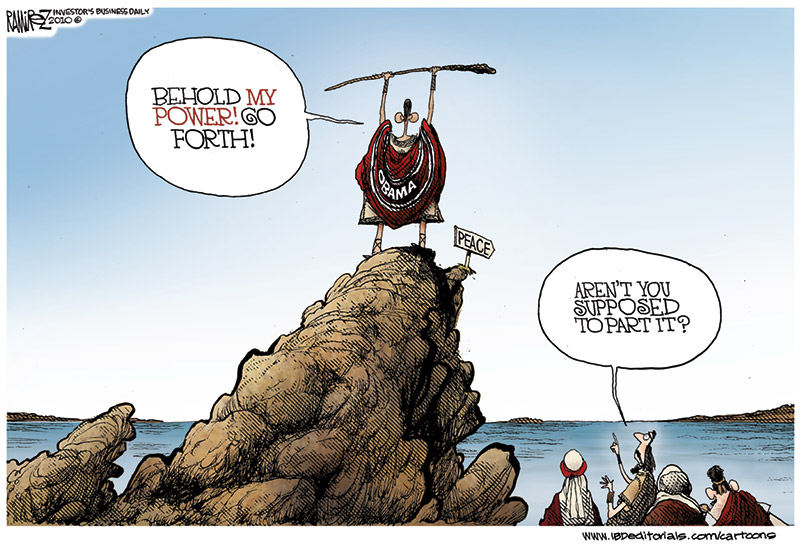


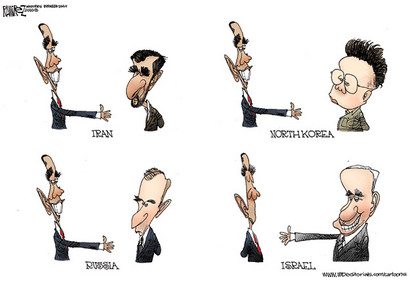
 Internet Scofflaw
You must be logged in to post a comment.