Policies aside, this story reminds us that the Bush family is a class act:
Unlike Bill and Hillary Clinton, George and Laura Bush will take few treasured mementos with them from their years at the White House.
When the Clintons left the White House in January 2001, the former first couple took with them more than 50 gifts — including a chandelier, flatware, and paintings — valued at nearly $200,000.
The Bushes, however, borrowed from furnishings that already existed within the White House collection, said Sally McDonough, press secretary to Laura Bush.
“Mrs. Bush — having the experience of being at the White House when her father-in-law was president — knew how many beautiful things she had to choose from to furnish the residence. And she will go back to Texas with only those items that belong to her,” McDonough told FOXNews.com.
ASIDE: This story is also notable for being the first Bush puff piece I’ve seen in years. (Perhaps ever; it’s hard to remember for sure.) This kind of story is usually the exclusive province of Barack Obama.
In addition to the stimulus package’s $825 billion price tag, a CBO analysis says the stimulus plan will result in more than $347 billion in additional interest costs. That makes the total cost over $1.172 trillion, nearly a third of which is interest. (Via the Corner.)
The infamous election fraud organization gets its first payoff in the stimulus package, with a share of $4.19 billion for “neighborhood stabilization activities.”
UPDATE: If at first you don’t succeed, try, try again.
The Democrats were nonplussed when a CBO analysis showed that only 7% of the infrastructure spending in the “stimulus” package would be spent this year, and only 38% by 2010. They suppressed the report, and waited in hopes that the analysis of the full package (which also includes tax cuts and transfer payments) would look better.
That analysis is now out, and it shows that 64% of the “stimulus” package would be spent by fiscal 2010. (Via Hot Air.) (The Washington Post story rounds it favorably to 65%.) After reading several stories on the report, I couldn’t find any that gave a figure for this fiscal year, so I went to the report itself (pdf, page 24) and found that the figure is 21%, a bit better than the 7% for infrastructure spending alone. Those revised figures are still terrible, and don’t even satisfy President Obama’s stated goal of 75% by fiscal 2010.
ASIDE: The U.S. fiscal year begins October 1, so fiscal 2009 refers roughly to the next eight months. Since most economists project a recovery late this (calendar) year, that represents the period of greatest need.
It’s not surprising that the tax cuts and transfer payments are much quicker than the infrastructure spending. Tax cuts go into effect instantaneously (they “spend” 36% this year and 98% by 2010, according to the CBO figures) and the government can cut transfer payment checks pretty quickly. Given that even believers in fiscal stimulus concede that it must be timely to be effective, why not scrap the boondoggle infrastructure spending and go with only the tax cuts and transfer payments?
Two reasons. First, tax cuts and transfer payments don’t really fit the mold of a Keynesian stimulus. (Tax cuts, if structured properly, can deliver supply-side stimulus, but transfer payments aren’t likely to do either.) Secondly, and much more importantly, infrastructure spending is where most of the potential for pork lies, which makes it the priority for Congress.
POSTSCRIPT: The report seems to confirm that “shovel-ready” infrastructure projects don’t exist for the most part. It does not separate the spending side into infrastructure and transfer payments, but the spending side spends 15% of its total this year and 53% by 2010, which is entirely consistent with the 7% and 38% reported for infratructure alone. This undercuts the idea, promoted by some on the left during the last week (for example), that the preliminary CBO report was bogus. It may not have been an official publication, but the numbers appear to be accurate.
UPDATE: This CBO document (an official one, I might add) does break the spending into infrastructure (“appropriations”) and transfer payments (“direct spending”). (Via Greg Mankiw, via Instapundit.) The document agrees with the preliminary report to within a few billion, but does change the percentages a little. Rather than 7% this year and 38% by 2010, the new infrastructure numbers are 12% and 41%. I’ve recalculated the next paragraph accordingly.
POST-POSTSCRIPT: We can compute the timeliness of the transfer payment component as 26% this year, and 70% by 2010. From this we can see that tax cuts are more timely (98% by 2010) than transfer payments (70%), which in turn are dramatically more timely than infrastructure spending (41%).
Iowahawk has some advice for Hollywood environmentalists. Many are good only for wealthy, preachy celebrities, but a few, like this one, are for everyone:
Crush a Third World Economic Development Movement. One of the most pressing threats facing our environment is rising income in Africa, Asia, and Latin America. A generation ago these proud little dark people were happily frolicking in the rain forest, foraging for organic foods amid the wonders of nature. Today, corrupted by wealth, they are demanding environmentally hazardous consumer goods like cars and air conditioning and malaria medicine. You can do your part to stop this dangerous consumerism trend by supporting environmentally progressive leaders like Hugo Chavez and Robert Mugabe, and their programs for sustainable low-impact ecolabor camps.
A disappointing move from the latest administration to promise to be the most transparent ever:
Barack Obama’s administration may be promising the “greatest ethical standard ever administered to an executive branch,” and increased transparency over his predecessor, but it seems to be forgoing at least one transparency practice that was routine in the Bush White House— transcripts of the daily press briefing.
It’s been four days since Press Secretary Robert Gibbs’ first (and widely panned) appearance before the White House press corps, but no transcript, summary, or video of the event has shown up on WhiteHouse.gov. The delay could be forgiven in a less tech-savvy bunch, but given the Obama team’s considerable online skill, the omission of the the transcript is clearly intentional.
In contrast, the Bush White House provided a transcript of every daily briefing, searchable and accessible in its own section on their web site. The archive, available via the Wayback Machine but not on the new WhiteHouse.gov, started Jan. 24, 2001. The Clinton White House also provided transcripts of the briefing, according to archives, at least as early as 1999.
The decision to withhold transcripts is not a departure from the Obama Team’s online posture during the campaign, and signals that’s exactly the posture they intend to take for the next four years. Team Obama got a lot of credit for being an active online presence, which indeed it was, but that presence was built for message control, not openness.
I’m sure that our nation’s free press will take up the slack and start issuing the transcripts themselves.
Ha ha! Just kidding. Glenn Reynolds’s explanation for the change is pretty much inarguable:
Bush wanted transcripts online because he expected the press to filter what he said. Obama doesn’t want transcripts online . . . because he expects the press to filter what he says.
The new Web site for Obama’s White House is already drawing attention from privacy activists and tech bloggers. While the initial focus has been on the site’s policies relating to search engine robots, a far more interesting tidbit has so far escaped the public eye: the White House has quietly exempted YouTube from strict rules relating to the use of cookies on federal agency Web sites.
The new White House Web site privacy policy promises that the site will not use long-term tracking cookies, complying with a decade-old rule prohibiting such user tracking by federal agencies. However, the privacy policy then reveals that Obama’s legal team has exempted YouTube from this rule (YouTube videos are embedded at various places around the White House Web site).
While the White House might not be tracking visitors, the Google-owned video sharing site is free to use persistent cookies to track the browsing behavior of millions of visitors to Obama’s home in cyberspace.
No other company has been singled out and rewarded with such a waiver.
Within 12 hours of the story going live, Obama’s Web team rolled out a technical fix that severely limits YouTube’s ability to track most visitors to the White House Web site.
By late Thursday evening, each embedded YouTube video had been replaced with an image of a video player, which a user must click on before the real YouTube player will be loaded. The result of this change is that YouTube is now only able to use cookies to track users who click on the “play” button on an embedded YouTube video–the majority of people who scroll through a page without clicking play will not be tracked.
That’s a step in the right direction, but the original policy was better. If persistent cookies are bad (generally they are), then why should Google get a special dispensation?
The stimulus bill currently steaming through Congress looks like a legislative freight train, but given last week’s analysis by the Congressional Budget Office, it is more accurate to think of it as a time machine. That may be the only way to explain how spending on public works in 2011 and beyond will help the economy today.
According to Congressional Budget Office estimates, a mere $26 billion of the House stimulus bill’s $355 billion in new spending would actually be spent in the current fiscal year, and just $110 billion would be spent by the end of 2010. This is highly embarrassing given that Congress’s justification for passing this bill so urgently is to help the economy right now, if not sooner.
And the red Congressional faces must be very red indeed, because CBO’s analysis has since vanished into thin air after having been posted early last week on the Appropriations Committee Web site. Officially, the committee says this is because the estimates have been superseded as the legislation has moved through committee. No doubt.
In addition to suppressing the CBO analysis, Democrats have derided it. Appropriations Chairman David Obey (D., Wis.) called it “off the wall,” never mind that CBO is now run by Democrats.
Bruce Bartlett has an interesting column on the macroeconomic debate over the past eighty years. I don’t agree with all of it, but it’s interesting and generally fair. (Via the Corner.)
The Republican National Committee criticized the Obama administration for violating [its new ethics rules] in some of its appointments. Mr. Obama’s nominee for deputy secretary of defense, William Lynn, has been a lobbyist for the defense contractor Raytheon, and his nominee for deputy secretary of health and human services, William V. Corr, lobbied for stricter tobacco regulations as an official with the Campaign for Tobacco-Free Kids.
A senior White House official, speaking on the condition of anonymity, conceded the two nominees did not adhere to the new rules. But he said that Mr. Lynn had the support of Republicans and Democrats, and would receive a waiver under the policy, and that Mr. Corr did not need a waiver because he had agreed to recuse himself from tobacco issues.
“When you set very tough rules, you need to have a mechanism for the occasional exception,” this official said, adding, “We wanted to be really tough, but at the same time we didn’t want to hamstring the new administration or turn the town upside down.”
In other words, they want to posture on ethics without the reality. Even some on the left see it. (Via Instapundit.)
This was the subject of President Obama’s run-in with the White House press corps last Thursday. He doesn’t like getting called on hypocrisy.
Joe Biden ended his own presidential bid after coming in fifth in the Iowa caucuses more than a year ago. But his presidential campaign lived on — and continued receiving taxpayer money — well after he was elected vice president.
The vice president is not gearing up to challenge President Barack Obama in the 2012 Democratic primaries, though. Rather, he’s keeping his committee, Biden for President Inc., open to tidy up loose ends in preparation for a mandatory federal audit, which could become expensive to defend.
So, Biden continued requesting federal funds for his campaign — through the so-called primary matching funds program — for months after he was tapped to be Obama’s running mate. . . [Biden] requested more than $37,000 in matching funds after he joined the Democratic ticket, including a final payment of $2,275 which came just last week.
The Federal Reserve of St. Louis has a horrifying graph of the monetary base. After growing at a fairly steady pace since 1918, it spiked catastrophically in 2008, roughly doubling in less than a year.
Nothing remotely like this has ever happened before. (In America, that is.) We have some serious inflation in our future.
A few short days ago, warrantless eavesdropping had us on the slippery slope to fascism. Today:
The Obama administration fell in line with the Bush administration Thursday when it urged a federal judge to set aside a ruling in a closely watched spy case weighing whether a U.S. president may bypass Congress and establish a program of eavesdropping on Americans without warrants. . .
Thursday’s filing by the Obama administration marked the first time it officially lodged a court document in the lawsuit asking the courts to rule on the constitutionality of the Bush administration’s warrantless-eavesdropping program. The former president approved the wiretaps in the aftermath of the Sept. 11, 2001, terror attacks.
“The Government’s position remains that this case should be stayed,” the Obama administration wrote in a filing that for the first time made clear the new president was on board with the Bush administration’s reasoning in this case.
The good news is that President Obama is showing himself to be at least somewhat responsible. The bad news is some of his supporters may be bitterly disappointed. Wait, that’s good news too.
Did you hear the one about how after Barack Obama became president this week he found out the economy was worse than he thought—so he had to lay off 17 journalists.
President Obama made a surprise visit to the White House press corps Thursday night, but got agitated when he was faced with a substantive question.
Asked how he could reconcile a strict ban on lobbyists in his administration with a Deputy Defense Secretary nominee who lobbied for Raytheon, Obama interrupted with a knowing smile on his face.
“Ahh, see,” he said, “I came down here to visit. See this is what happens. I can’t end up visiting with you guys and shaking hands if I’m going to get grilled every time I come down here.”
Pressed further by the Politico reporter about his Pentagon nominee, William J. Lynn III, Obama turned more serious, putting his hand on the reporter’s shoulder and staring him in the eye.
“Alright, come on” he said, with obvious irritation in his voice. “We will be having a press conference at which time you can feel free to [ask] questions. Right now, I just wanted to say hello and introduce myself to you guys – that’s all I was trying to do.”
(Via Instapundit, who adds: you can see why a substantive question would catch him by surprise.)
The legendary economist Robert Barro explains in the Wall Street Journal why the stimulus package will not work. (Via the Corner.)
One interesting bit that I did not know is Barro’s estimates of the Keynes multiplier. For a peacetime stimulus, the multiplier is “insignificantly different from zero.” That means that the “stimulus” does not stimulate the economy, and serves only to shift production away from consumption and investment. Even during World War 2, when it supposedly worked, the “multiplier” was just 0.8, meaning that the economy grew less than the amount of stimulus. The Obama Administration is reportedly assuming a multiplier of 1.5.
John Hinderaker says President Obama’s order to close Gitmo doesn’t mean much:
Today Barack Obama issued an entirely symbolic executive order, directing that the terrorist detainee facility at Guantanamo Bay be closed within one year. Gitmo, of course, was created in answer to the question, What are we going to do with captured terrorists? Now, with that facility slated for closure, the question arises once more.
It arose, in fact, in Press Secretary Robert Gibbs’ first press conference today. I found this exchange somewhat amusing:
[Robert Gibbs haplessly attempts to deflect Gitmo questions.]
So, in other words, Obama’s order accomplishes nothing other than to kick the can down the road. The question of what to do with the terrorists will be “studied”–and, by the way, it’s now a “very complex, very detailed question.”
Only two things seem certain. One, a year from now, the Gitmo detainees are going to be somewhere else. (Western Pennsylvania, if John Murtha has his way.) Two, White House Press Secretary is among the world’s worst jobs.
The Allegheny County Port Authority is looking for $117 million from the Federal government to finish a light rail project to the North Shore. After spending $320 million to bore two tunnels under the Allegheny River, the Port Authority has run out of money to lay the actual track.
The tunnels aren’t going anywhere. Some might say we should wait for better financial times to finish the project; but why do that when Washington is giving away free money?
On this day, we come to proclaim an end to the petty grievances and false promises, the recriminations and worn out dogmas, that for far too long have strangled our politics.
Sounds great, but does he mean it? Today, the White House web site’s Katrina agenda refers to President Bush’s “broken promises” and “unconscionable ineptitude.” Sounds a little like recrimination and worn-out dogma to me.
One premise of the GM bailout, were told, is that if GM doesn’t come up with a workable plan for profitability, we would call the loan and get the money back. This always seemed like a stupid idea, if for no other reason than most of the money will already be spent by the time GM has to present the plan.
Sure enough, it’s been about a month since GM got its first $4 billion, and GM says the money is gone:
The target date for General Motors Corp. to get its second installment of government loans passed last week, but a top company executive says he expects the money to arrive in the next several days.
Fritz Henderson, GM’s president and chief operating officer, said without the second installment of $5.4 billion, the company would run out of cash long before March 31. . .
GM received $4 billion late last year and was to get $5.4 billion Jan. 16 and another $4 billion on Feb. 17, the day it is to submit its plan to show the government how it will become viable.
Henderson told the Automotive News World Congress in Detroit that the money is critically needed to pay its bills.
By March 31, GM will already have blown $9.4 billion, and the most we can do is deny them an additional $4 billion. (And let’s not kid ourselves that we’ll do even that.) Plus, there’s Chrysler on top of that.
The story also has an interesting tidbit on GM’s reorganization:
[Henderson] told the group that GM will have four core brands in the future: Cadillac, Chevrolet, Buick and GMC.
GM is reviewing the Saturn brand with its dealers, is studying Saab and Hummer for sale and will shrink Pontiac to a performance niche brand.
I’m not a car guy, so I had to look up the list of GM brands. If we can assume that brands not listed are going to be terminated (which is not entirely clear from the wording), GM will be ending the brands Daewoo, Holden, Opel, and Vauxhall, not one of which I’ve even heard of. (GM already got rid of Geo in 1997 and Oldsmobile in 2004.) It’s good that they’re getting rid of invisible brands, I suppose, but it’s hardly a major reform.
Conservatives I’ve met in D.C. so far have been near-ebullient, not downcast or bitter. Why? a) They know how unhappy they’d be now if McCain had won; b) Obama has not fulfilled their worst fears, or even second-to-worst fears; c) now they can be an honest, straight-up opposition.
I can relate to all three of those feelings. Still, “near-ebullient” would be an exaggeration. (I suppose that could be because I’m not really a conservative.)
We didn’t get what we expected with President Bush. He campaigned on a platform of “compassionate conservatism” and less engagement in foreign crises. Taking office, his administration began in much the fashion we expected. He quickly passed the centerpieces of his domestic agenda, his education package and tax cuts. He also competently handled his first international crisis, when a US spy plane made an emergency landing in China and its crew was held by the Chinese government.
As we moved into the fall, Democrats had taken control of the Senate by a one vote plurality and a major budget battle was looming. I thought that President Bush had a strong hand in the battle and would probably prevail, but of course we never found out. The morning of September 11, Al Qaeda terrorists attacked our country. Shortly thereafter the anthrax attacks began.
Within days of 9/11, President Bush announced that fighting terrorism was the priority of his administration. His steady hand in the days after 9/11 settled our country and his approval rating soared over 90%.
In the evening of 9/11, Bush formulated the Bush Doctrine (one version of it anyway), declaring that “we will make no distinction between the terrorists who committed these acts and those who harbor them.” In his address to Congress he added that “From this day forward, any nation that continues to harbor or support terrorism will be regarded by the United States as a hostile regime.” Later that fall, the Bush Doctrine was put into action when we overthrew the Taliban in a short, brilliant campaign of air power, special forces, and local rebels.
Alas, the Bush Doctrine was set aside early in 2002, when the Administration stated that the Bush Doctrine did not apply to Yasser Arafat. In fact, the Bush Doctrine was never clearly invoked again. When President Bush began to gather support for a campaign to overthrow Saddam Hussein, he failed to make a clear case of the broad strategic importance of removing Saddam. Instead he focused on only one element, the threat posed by weapons of mass destruction.
This was one of three major mistakes of the Bush Administration. As we know, no WMD stockpiles were found in Iraq. The failure to make a broad case for the invasion ultimately undermined support for the campaign. (In contrast, the public support of the Afghanistan campaign has never wavered.)
The second major mistake of the Bush Administration was its inadequate preparation for the aftermath of the war, and, more importantly, its slowness in adapting to deteriorating conditions in Iraq. As the war dragged on, its motivation already undermined, public support for the war faltered, and so did public support for the Administration.
To his credit, Bush did eventually adapt, not in time to save his reputation, but in time to win the war. He changed tactics, increased troop levels, and placed General Petraeus in charge. Today the campaign in Iraq is concluding as a victory for the United States, its allies, and a free Iraqi people.
Still, our mistakes in Iraq have been damaging. With so much force tied up in Iraq and faltering support for the war on terror, it has been impossible to continue the global war on sponsors of terrorism. In particular, it has been impossible to do anything about the serious threat posed by Iran.
On the other hand, President Bush has achieved something that seemed unthinkable the morning of September 12. For the past seven years, there has not been a single terrorist attack on American soil. For that, President Bush deserves our gratitude.
On the domestic side, “compassionate conservatism” has been revealed to have very little in common with conservatism. President Bush’s third major mistake was to allow government spending to balloon out of control. To be sure, Congressional Republicans share the blame, but Bush was the leader of his party and, if all else failed, he could have exercised his veto.
In retrospect, Bush should have reformed the Federal housing policies that pushed banks to make more subprime loans and to securitize those loans. But, virtually no one recognized the danger of those policies at the time. (On the left, virtually no one does even now.) Bush also failed to reform social security, but at least he tried.
Bush did hit a home run with his two Supreme Court appointments, and he made a number of solid appointments to lower courts. Almost certainly, they will be President Bush’s most lasting domestic achievement.
Fox News just reported (no link yet) that a new report from the (non-partisan) Congressional Budget Office determines that the stimulus package being proposed by Democrats actually spends most of the money years from now. Only 7% of the “stimulus” spending would be in the next year. In other words, it’s just a boondoggle, not a stimulus package, even if you buy the idea that we can stimulate the economy with deficit spending.
On the Oprah Winfrey show yesterday, Joe Biden’s wife revealed that he had his choice of Vice-President or Secretary of State. It’s very interesting that he chose Vice-President. Secretary of State is an important position, in the domain to which Biden has dedicated most of his life, but instead he chose a position with nearly no responsibility. (Lucky for us!)
ASIDE: On the show, Biden reluctantly confirmed the revelation. Later, his spokeswoman ostensibly denied it, but did so in a carefully phrased way that doesn’t contradict its essence.
Why choose VP over State? Jill Biden actually cited (indirectly) the lack of duties of the job:
Mrs. Biden said she told him vice president would be better for the family. “If you’re secretary of state, you’ll be away, we’ll never see you, you know,” she said. “I’ll see you at a state dinner once in a while.”
But it’s hard to credit that explanation, since earlier the same year Biden had been running for President, which would have kept him much busier than either job.
The best explanation seems to be ambition. The Vice-Presidency has been regarded as a stepping stone to the Presidency (although it actually has rarely been successfully exploited as such except via death or resignation). Biden still imagines he can be President, and he’d rather do nothing for eight years and then be front-runner for the Democratic nomination, than manage US foreign policy for four to eight years.
The only other workable explanation I can see is that Obama promised Biden an important policy position in his administration, like Dick Cheney. If so, Biden is a fool. Sure, during a campaign there’s always talk of how the VP will help the President lead, but the VP nearly always vanishes afterward, and we’ve already seen Biden’s lack of influence during the transition period.
A rose by any other name … except when it comes to being a part of the Steelers Nation and having the word “raven” in your moniker. Pittsburgh Mayor Luke Ravenstahl has gone to great lengths to show his Steelers pride and his dislike for their rivals and upcoming playoff opponents, the Baltimore Ravens.
This morning, the Mayor changed his name from Ravenstahl to Steelerstahl, at least until after the AFC Championship match-up. . .
The Mayor changed the name on his office door, signed the official papers and has finished the name change proclamation at the City-County Building. He will keep his new name through Sunday.
Financial markets remain frozen partly because a “large quantity of troubled, hard-to-value assets” is still on institutions’ balance sheets, Bernanke said.
There are several ways to solve this problem, he said, all involving public funds.
The government could simply buy the troubled assets, or it could give asset guarantees and agree to absorb part of the prospective losses, he said.
“Yet another approach would be to set up and capitalize so-called ‘bad banks,’ which would purchase assets from financial institutions in exchange for cash and equity in the bad bank,” Bernanke said.
Treasury Secretary Henry Paulson initially requested the $700 billion contained in the government’s Troubled Asset Relief Program to purchase toxic assets, but he changed course after he sensed that banks were in dire need of capital. Setting up the cumbersome plan to reverse-auction assets would take too long, he said.
You know, September is not so long ago that we can’t remember the last time you sold us this story. Congress dutifully passed a $700 billion bailout (plus earmarks) and the money was spent buying stock in banks and making bad loans to automakers. Now we’re supposed to buy the same story again?
When you call out Obama during a rope line, the Media jumps into your history, and finds a tax lien you didn’t know you had.
If you are nominated for Treasury Secretary, and have four years of taxes you knew you owed, but didn’t pay, the Media yawns.
They also yawn when you’re the chairman of the Ways and Means committee, or when you run for Senate as a blowhard ex-comedian. If you squint right, you can almost see a pattern forming.
This is how we lose a word. The word “emergency” became meaningless today:
President Bush on Tuesday declared the District a federal emergency area, clearing the way for the city to receive federal money to help cover the overwhelming cost of providing security for official inauguration events.
Officials said it was the first time the designation had ever been used for anything other than a national disaster, such as a hurricane or widespread flooding. . .
White House spokesman Scott Stanzel said Tuesday night that D.C. Mayor Adrian M. Fenty had requested the declaration of the city as an emergency zone last week.
Preliminary planning for the inauguration had not taken into account the likelihood of unprecedented crowds, now expected to run as high as 1.5 million to 2 million people, Mr. Stanzel said.
POSTSCRIPT: They had not taken into account the likelihood of unprecedented crowds? Either that’s an outright lie, or they’re completely incompetent, since people have been predicting huge crowds for months. Last November, the predictions were as high as 5 million, more than twice what they’re now talking about.
“I don’t know if anybody’s ever done that,” said Dana Perino, the White House press secretary.
Indeed. One reason why nobody’s ever done that before is because a presidential inauguration is not (to be boringly technical about it) an “emergency.” It’s penciled in well in advance – in this case, so well in advance that for years Democrats have been driving around with “1-20-09” bumper stickers on the back of their Priuses. Emergency-wise, that’s the equivalent of Hurricane Dan Rather wrapped around a lamppost in his sou’wester, hanging there in eager anticipation every night for half a decade. . .
The proposition that a new federal administration is itself a federal emergency is almost too perfect an emblem of American government in the 21st century. FEMA was created in the 1970s initially to coordinate the emergency response to catastrophic events such as a nuclear attack. But there weren’t a lot of those even in the Carter years, so, as is the way with bureaucracies, FEMA just growed like Topsy. In his first year in office, Bill Clinton declared a then-record-setting 58 federal emergencies. By the end of the Nineties, Mother Nature was finding it hard to come up with a meteorological phenomenon that didn’t qualify as a federal emergency: Heavy rain in the Midwest? Call FEMA! Light snow in Vermont? FEMA! Fifty-seven under cloudy skies in California? Let those FEMA trailers roll!
A U.S. civil liberties group sued the federal government Monday, charging it violated the Constitution by contracting a Roman Catholic entity to help victims of human trafficking.
The American Civil Liberties Union said the U.S. Conference of Catholic Bishops was imposing its beliefs on victims of human trafficking by not allowing federal grant money to be used for contraception or abortion.
When the bishops applied for the contracts, they said they would not work with subcontractors who provided abortion services or contraceptives, such as condoms, which conflict with Catholic teachings, according to the ACLU. . .
The suit asks the court to stop the department from allowing its grants being spent in a way that is restricted by religious beliefs.
I see two ways to read the ACLU’s position: The first is that not only is abortion constitutionally protected, but it is actually unconstitutional for an organization to withhold funding for abortions. That would be amazingly radical, but the other is even more so. The second reading is that it might be okay to withhold funding for abortion, provided you can provide a secular basis for doing so, but you cannot do so for religious reasons. In essence, if you do business with the government, you cannot permit your religion to affect ethical decisions. Alas, the most natural reading of the suit is the second.
Were the ACLU to prevail, it would create a bizarre situation wherein Catholics would be prohibited from doing the exact same thing as non-Catholics, simply because they are Catholic. How a supposed civil rights organization could support such a clear violation of freedom of religion is beyond me.
Oh, it also gives a window into the ACLU’s priorities. Stopping human trafficking is less important than keeping Catholics out of the public square.
UPDATE: Changed the post title, which may have been unduly harsh.
A national safety group is advocating a total ban on cell phone use while driving, saying the practice is clearly dangerous and leads to fatalities.
States should ban drivers from using hand-held and hands-free cell phones, and businesses should prohibit employees from using cell phones while driving on the job, the congressionally chartered National Safety Council says, taking those positions for the first time.
The group’s president and chief executive, Janet Froetscher, likened talking on cell phones to drunken driving, saying cell phone use increases the risk of a crash fourfold.
“When our friends have been drinking, we take the car keys away. It’s time to take the cell phone away,” Froetscher said in interview.
I want to hear these people explain why cell phone conversations are more dangerous than other conversations in the car. (Or children; you don’t know distraction until you’ve driven children.) Until then, I can’t take them seriously. It’s particularly hard to take them seriously when they compare talking with drunk driving. For years we’ve been told that drunk drivers are basically the moral equivalent of axe murderers, and now they say that drunk driving is really no different than carrying on a conversation?
Remember how the second half of the $700 billion bailout required Congressional approval to release? It turns out, that was a total lie:
Senior Bush administration officials, consulting with the Obama transition team, have prepared a plan to ask lawmakers for the second half of the $700 billion financial rescue package despite intense opposition in Congress, sources familiar with the discussions said.
The initiative could create an unusual political scenario straddling the Bush and Obama administrations. If Congress were to vote down the measure, either President Bush or Obama would have to exercise a veto to get the money.
Obama officials would prefer that Bush exercise any veto rather than leave the new president with the unsavory task of rebuffing his fellow Democrats in Congress to advance a widely unpopular program, sources said. The White House has declined to say publicly whether Bush would be willing to issue the veto.
Two questions: Are Congress idiots, or did they draft the bill that way on purpose? And, why on earth would President Bush want to take the heat for Obama?
MORE PROBLEMS for Eric Holder? Just remember, conservatives — Zoe Baird and Kimba Wood got knocked off during the appointment process, only to be replaced by . . . Janet Reno.
The same has occurred to me. But unlike Baird and Wood, the problems with Holder are looking serious.
Last August, I noted Megan McArdle’s battle with the Pennsylvania bureaucracy (they wanted to suspend her driver’s license for underage drinking, despite the fact that she is 35 years old and lives in D.C.). Sadly, her battle with the bureaucracy was only beginning. (Via Instapundit.) By all means, let’s put these clowns in charge of health care and the Internet. . .
Ages ago, I read a very positive review by John Podhoretz of the German film The Lives of Others, and added it to my Netflix queue. This week I finally watched it, and I thought it was outstanding.
The Lives of Others is set in East Germany in 1984. Its theme is the evil of communism, but unlike some other films, it is not about the large-scale atrocities of communism such as the purges of Stalin, Mao, or Pol Pot. Rather, it is about the everyday oppression that characterized life under the party’s boot.
The film tells the story of two men, Georg Dreyman, a successful playwright, and Hauptmann Wiesler, a Stasi agent. Wiesler, an instructor at the Stasi school for interrogation, is assigned to monitor Dreyman. Wiesler’s team installs bugs in Dreyman’s home and monitors them night-and-day. Wiesler, however, becomes disillusioned when he learns that the reason he is monitoring Dreyman is not to protect the socialist state, but because the minister of culture is infatuated with Dreyman’s girlfriend and wishes to remove him as a rival. Wiesler decides to try to help Dreyman by filing false surveillance reports and by interfering in his life in subtle ways (such as making him aware of the minister’s designs on his girlfriend). Unfortunately, the minister does not give up easily.
The Lives of Others is not my usual sort of fare (it has no action whatsoever), but I highly recommend it.
There’s been a steady drip of revelations about Attorney-General Nominee Eric Holder. We already know of his central involvement in the Rich pardon (and more here), his involvement in the paramilitary capture of Elian Gonzalez without a court order, and his advocation of Internet censorship. In recent days we’ve had three more revelations:
The LA Times reports that Holder overruled his Justice Department subordinates to support a pardon for Puerto Rican terrorists, and that he muzzled the Pardon Attorney when he tried to protest:
Attorney general nominee Eric H. Holder Jr. repeatedly pushed some of his subordinates at the Clinton Justice Department to drop their opposition to a controversial 1999 grant of clemency to 16 members of two violent Puerto Rican nationalist organizations, according to interviews and documents.
Details of the role played by Holder, who was deputy attorney general at the time, had not been publicly known until now. The new details are of particular interest because Republican senators have vowed to revisit Holder’s role during his confirmation hearings next week. . .
President Clinton’s decision to commute prison terms caused an uproar at the time. Holder was called before Congress to explain his role but declined to answer numerous questions from angry lawmakers demanding to know why the Justice Department had not sided with the FBI, federal prosecutors and other law enforcement officials, who were vehemently opposed to the grants. . .
Holder instructed his staff at Justice’s Office of the Pardon Attorney to effectively replace the department’s original report recommending against any commutations, which had been sent to the White House in 1996, with one that favored clemency for at least half the prisoners . . . And after Pardon Attorney Roger Adams resisted, Holder’s chief of staff instructed him to draft a neutral “options memo” instead, Adams said.
The options memo allowed Clinton to grant the commutations without appearing to go against the Justice Department’s wishes, Adams and his predecessor, Margaret Colgate Love, said in their first public comments on the case.
Second, as Deputy Attorney General, Holder issued a memorandum designed to limit legal counsel for employees of corporations under investigation. (Via Instapundit.)
And third, how could the story be complete without a connection to the Blagojevich scandal? The Chicago Sun-Times reports:
Before Eric Holder was President-elect Barack Obama’s choice to be attorney general, he was Gov. Blagojevich’s pick to sort out a mess involving Illinois’ long-dormant casino license.
Blagojevich and Holder appeared together at a March 24, 2004, news conference to announce Holder’s role as “special investigator to the Illinois Gaming Board” — a post that was to pay Holder and his Washington, D.C. law firm up to $300,000.
Holder, however, omitted that event from his 47-page response to a Senate Judiciary Committee questionnaire made public this week — an oversight he plans to correct after a Chicago Sun-Times inquiry, Obama’s transition team indicated late Tuesday. . . Holder signed the questionnaire on Sunday — five days after Blagojevich’s arrest for allegedly putting Obama’s U.S. Senate seat up for sale.
The March 2004 Chicago news conference where Holder and Blagojevich spoke was widely covered because of a controversial 4-1 Gaming Board vote earlier that month to allow a casino to be built in Rosemont. That vote defied the recommendation of the board’s staff, which had raised concerns about alleged organized-crime links to the Rosemont casino’s developer.
Holder was given a lucrative appointment, by Blagojevich, as the “special investigator to the Illinois Gaming Board” to investigate a controversial decision raising concerns about links to organized crime. Now, he says he forgot the whole thing, despite the fact that Blagojevich’s scandal had been the top story for nearly a week when he completed the Senate questionnaire. Worse, he never remembered the matter until the Sun-Times uncovered it.
The Holder nomination is tainted from nearly every direction now: political pardons, corruption, infringement of civil liberties. It will be very interesting to see what Senate Democrats do with it, or if it even makes it to the Senate.
Some people seem puzzled about how to respond to this story:
A teacher asked three eight-year-old girls to shave his beard off in the classroom but made them pledge not to tell their parents.
Michael McLane, a third-grade teacher, then asked them to write a story about the random incident but said the essays wouldn’t be marked and he would keep them in his drawer.
If the girls told they would be banned from the class Christmas party, he said.
Confused school administrators have allowed him to remain in the school while parents are similarly perplexed as to how to react.
It’s hard to imagine what was going through the teacher’s head, but we don’t need to. There’s never any justification for hiding classroom conduct from parents. Beard or no beard, that alone should be a firing offense.
Burris has run into some trouble at his testimony to a Chicago House panel investigating Blagojevich. Burris, it seems, contacted Blagojevich (though an intermediary) about the Senate seat much earlier that he has previously admitted. This raises the possibility that he was involved in Blagojevich’s effort to strike a corrupt bargain for the seat, and the fact that he lied about it lends some additional weight to the possibility.
If the Senate wants to reverse its capitulation to Burris, this would give them justification to do so.
President-elect Barack Obama, facing a more than $1 trillion budget deficit, made his strongest pitch yet Thursday for Congress to pass a nearly $800 billion spending plan, promising that it will create new jobs, offer more tax cuts, and improve infrastructure and alternative energy development. . .
Obama delivered his speech a day after budget forecasters said the federal budget deficit would reach a record $1.2 trillion in fiscal 2009. That estimate does not factor in the stimulus package Obama and Democrats are promoting on Capitol Hill. But Obama says deficit spending is needed to jolt the economy out of recession.
(Emphasis mine.)
But not to worry:
He tried to assuage skeptics who say such a massive stimulus is irresponsible, particularly on the heels of the auto industry and Wall Street rescue packages.
“I know the scale of this plan is unprecedented, but so is the severity of our situation,” Obama said. He pledged not to “throw money” at the country’s problems or send it to wasteful pet projects and earmarks.
We’re not going to throw money at our problems? Thanks for clarifying that.
A Rasmussen poll conducted in the last week of 2008 found that while 62 percent of Republicans backed Israel’s action in Gaza, only 31 percent of Democrats did. Almost three-quarters of Republicans blamed Hamas for starting this war; only a minority of Democrats agreed. Republicans are 20 points more friendly toward Israel than Democrats. And while extreme hostility to Israel does not exist among Republicans, almost one in 10 Democrats describes Israel as an “enemy of the United States.” . . .
Democratic revulsion at Israel’s Gaza operation has multiple roots.
First, Democrats are just generally less likely to support military actions by any nation, including the United States. A 2005 MIT poll found that only 57 percent of Democrats would support the use of American troops even to destroy a terrorist training camp. (Compared to 95 percent of Republicans.)
Second, Democrats hold an inexhaustible faith in the value of negotiation. Untroubled by Hamas’ character as a terrorist movement pledged to the total destruction of Israel and the murder of its population, 55 percent of Democrats believe that Israel should have tried to find a diplomatic solution to the Hamas rocket barrage.
Third, the more closely Americans follow the news, the more likely they are to support Israel. Yet more low-information voters are Democrats than Republicans.
Fourth, Democratic attitudes are poisoned by the influence of an anti-Zionist hard left, a vociferous faction whose ideology can bleed into outright anti-Semitism. . .
Obama comes to office with the most opaque record on Israel of any new president since Gerald Ford. Certainly Israelis themselves feel intense doubts about the incoming president: a pre-election opinion poll by the Rabin Center showed that Israelis preferred John McCain by a 12-point margin.
We should all hope that President Obama can overcome the institutional flaws in his party—and the gaps in his own record—in order to sustain the U.S.-Israel friendship through the very great dangers ahead.
Even by the standards of battered automakers, Chrysler is in dire shape. Its sales in December were down a stunning 53 percent, far worse than Ford or General Motors, and analysts say it probably won’t survive the year as an independent company — despite $4 billion in government loans and the possibility of more.
Things were so bad last year that a single Toyota model, the Camry/Solara midsize car, outsold the entire fleet of Chrysler LLC’s passenger cars.
NPR’s All Things Considered had a piece this afternoon about the Bush legacy. You could tell the tone they were going to take (if you couldn’t guess already) with the opening:
Once in office, he proceeded as though he had won a mandate. With narrow Republican majorities in Congress, he immediately won approval for education reforms known as No Child Left Behind and for a series of huge tax cuts.
When the press approves of a politician, this is called “fulfilling campaign promises.”
Much of the piece, naturally, was devoted to the war in Iraq and Bush’s missteps therein. But curiously, Iraq vanished from the piece after April 2006. One might think that an important part of President Bush’s legacy was his decision in 2007 to change strategy and increase troop levels, and our subsequent victory over the insurgency. But in NPR’s view, the only significant event in Iraq in the last two years was when some guy threw his shoes at the President.
NPR concludes by pondering the question of whether history will be kinder to President Bush than his contemporary critics. I think history will be unkind to Bush. Big-government conservatism has been a disaster, the evisceration of the Bush Doctrine (the early version that equated terrorists with the regimes that harbor them) was an epic mistake, and his missteps in Iraq have been serious. But, history will not ignore the year in which we reversed course and defeated the enemy. In that, history can hardly help but be kinder than his contemporary critics, or at least the ones at NPR.
I’m reading this a month late, but it still bears notice:
A St. Louis city leader frustrated with the police response to rising crime called Tuesday on residents to arm themselves to protect their lives and property.
Alderman Charles Quincy Troupe said police are ineffective, outnumbered or don’t care about the increase in crime in his north St. Louis ward. St. Louis has had 157 homicides in 2008, 33 more than last year at this time. . .
Troupe said that when he and residents approached a district police commander last year, they were told “there was nothing he could do to protect us and the community … that he didn’t have the manpower.”
Police did not immediately return requests for comment. Chief Dan Isom told the St. Louis Post-Dispatch he understands Troupe’s frustration but doesn’t support citizens arming themselves.
Carrying guns, he said, is not a “recipe for a less violent community.”
Senate Democrats are realizing that they have no choice but to seat Roland Burris, despite his tainted appointment. (Via Instapundit.) Experts have been saying so for some time.
Illinois Democrats could have resolved the problem by providing for a special election, but scuttled the idea at the urging of Democratic Leader Harry Reid and others. The integrity of the system must be put in its proper place, you see. Integrity is important, but not so important as to risk losing a Democratic seat.
Obama said Tuesday the deficit appears on track to hit $1 trillion soon. Speaking to reporters after meeting with top economic aides, Obama said: “Potentially we’ve got trillion-dollar deficits for years to come, even with the economic recovery that we are working on.”
He wants Congress to approve a stimulus plan of about $775 billion.
The federal deficit was about $455 billion when the last fiscal year ended on Sept. 30, 2008.
So Obama plans to double the deficit his first year in office, and leave it there for years to come. We’ve tried all four combinations in recent years, and it seems the only way to get fiscal sanity is with a Democratic President and a Republican Congress. Well, let’s get right on that.
POSTSCRIPT: I may not have actually written it here, so let me write it now. The stimulus plan will not work. Why? Because Keynesianism is just plain wrong today. Keynesianism applies in the extremely rare circumstance that there should be deflation, but wages fail to fall. Arguably, this applied during the Great Depression, which is what Keynes was trying to explain. It does not apply today, nor will it ever apply with a remotely competent central bank. Obama’s stimulus package will not stimulate anything; it’s just a trillion-dollar boondoggle. But, the economy will probably recover anyway, and the stimulus will probably be given the credit.
UPDATE: The trillion dollar deficit only lasted two days. Now it’s $2 trillion.
Jay Nordlinger has a long piece up on the increasing intrusion of political commentary into what ought to be pleasant, apolitical social or cultural occasions. (Via Instapundit.) It resonates a lot with my own personal experience, but I think he misses one point. Nordlinger suggests that the ranters are assuming that everyone in the group is a leftist like them, or are at worst indifferent to the feelings of any non-leftists. In my experience it’s worse than that; the ranters do so with the deliberate intent to make those who disagree uncomfortable.
Does this happen from the right as well? I can’t say, as I’ve never flown in circles where conservatives and libertarians are a sufficient majority for it to happen.
A few weeks ago, the Economist had a story on universities that tried to employ the “Yale model” for investing their endowments without actually knowing what they were doing:
The model may also have been adopted by endowments that were too small for it. “You need to be very big and very diversified, and to be sophisticated enough to understand the risk management of complex investments,” says Anthony Knerr, who advises universities on funding strategies. Some of the hardest hit may be smaller endowments that adopted a “Yale-lite” strategy that they did not really understand. They may also have been unable to invest in the best hedge funds and private-equity firms, which have (until now) been able to pick and choose between investors.
But this is 2009; no one should have to suffer the consequences of one’s own bad judgement any more. So the latest institution to look for a Federal bailout is the University of Virginia.
Once the shenanigans begin, you know you’ve seen this movie before. Somehow, some way, the Minnesota Democrats are going to end up with the seat. The similarity to Washington 2004 is striking. “Found” ballots, improperly handled absentee ballots, and — of course — lots of Democratic precincts with more ballots than voters. Plus, Minnesota has invented a new trick, “missing” ballots that no one can produce at all, and are nevertheless counted. The Wall Street Journal goes though the latest embarrassment to our democratic system.
In Washington State, the state Supreme Court ruled, essentially, that it is impossible to overturn a corrupt election. Specifically, it ruled that it could not overturn the results of an election unless the plaintiff could produce specific individuals who had voted illegally. The mere fact that the election was clearly fraudulent (since many Democratic precincts had more ballots than voters) was not enough.
Plus, it’s worth remembering that Minnesota makes no effort to prevent illegal voting. ACORN submitted countless fraudulent voter registrations, and we are to believe that none of those, not even a few hundred, turned into fraudulent votes?
UPDATE: Power Line says the comparison to Washington 2004 is unfair.
Certainly the media has been trumpeting doom and gloom for ages; well before it had any justification for doing so. The more interesting question is when they’ll stop. The economy can’t get good until President Obama’s policies have been in effect long enough to be given credit, so probably late-2010. They don’t want to wait too long after that, unless they want to try for an FDR 1936 scenario (“re-elect me, because the economy is still terrible”), which is probably too risky.
It looks like the probe into New Mexico Gov. Bill Richardson’s business dealings must be going somewhere after all:
New Mexico Gov. Bill Richardson has withdrawn his name from consideration as commerce secretary for President-elect Barack Obama, citing an ongoing investigation about business dealings in his state. . .
The decision is the first serious political hit for one of Obama’s Cabinet nominees and comes just as confirmation hearings begin next week.
Richardson said he would remain governor of New Mexico “for now.”
During the Democratic primary last year, I thought it was very strange that Richardson didn’t do better, since he was manifestly more qualified than everyone else who sought the nomination (and particularly the three the race settled down to). I figured there must have been a problem with Richardson that wasn’t known to the public. It looks like there was.
It hasn’t been much noticed, but the political ground is already shifting under Big Labor’s card-check initiative. The unions poured unprecedented money and manpower into getting Democrats elected; their payoff was supposed to be a bill that would allow them to intimidate more workers into joining unions. The conventional wisdom was that Barack Obama and an unfettered Democratic majority would write that check, lickety-split.
Instead, union leaders now say they are being told card check won’t happen soon. It seems the Obama team plans to devote its opening months to important issues, like the economy, and has no intention of jumping straight into the mother of all labor brawls. It also seems Majority Leader Harry Reid, even with his new numbers, might not have what it takes to overcome a filibuster. It’s a case study in how quickly a political landscape can change, and how frequently the conventional wisdom is wrong.
Paradoxically, it’s Mr. Reid’s bigger majority that is now hurting him. In 2007, he got every Democrat (save South Dakota’s Tim Johnson, who was out sick) to vote for cloture. But it was an easy vote. Democrats like Mr. Pryor knew the GOP held the filibuster, and that Mr. Bush stood ready with a veto. Now that Mr. Reid has 58 seats, red-state Democrats in particular are worried they might actually have to pass this turkey, infuriating voters and businesses back home.
Another reason to oppose the Burris Senate appointment (other than the whole Blagojevich corruption mess); ProPublica reports that he sought the death penalty for a man known to be innocent:
Public fury over the governor’s alleged misconduct has masked the once lively debate over Burris’ decision to continue to prosecute – despite the objections of one of his top prosecutors – the wrong man for a high-profile murder case.
While state attorney general in 1992, Burris aggressively sought the death penalty for Rolando Cruz, who twice was convicted of raping and murdering a 10-year-old girl in the Chicago suburb of Naperville. The crime took place in 1983.
But by 1992, another man had confessed to the crime, and Burris’ own deputy attorney general was pleading with Burris to drop the case, then on appeal before the Illinois Supreme Court.
Burris refused. He was running for governor. . .
Once Burris assigned [Deputy Attorney General Mary Brigid] Kenney to the case in 1991, she became convinced that Cruz was innocent, a victim of what she believed wasprosecutorial misconduct. She sent Burris a memo reporting that the jury convicted Cruz without knowing that Brian Dugan, a repeat sex offender and murderer, had confessed to the crime. Burris never met with Kenney to discuss a new trial for Cruz, Kenney told ProPublica.
This sounds pretty bad, if true. In the end, the Illinois Supreme Court gave Cruz a new trial, at which he was acquitted.
Not only has the Treasury Department decided it can spend TARP money on whatever it wants, it has apparently also decided it can spend as much as it wants:
The Treasury Department has committed nearly $10 billion more than the $350 billion Congress has authorized to date for the financial-sector rescue package, which could constrain how the incoming Obama administration deploys the rest of the fund.
Treasury’s announcement Monday that it is directing $6 billion to auto-finance company GMAC LLC brought to $358.4 billion the total funds from the Troubled Asset Relief Program that have been pledged to a variety of programs and guarantees. That suggests Treasury is tapping into the second half of the $700 billion set aside in October before it has been released by Congress.
Why let a little thing like legal authorization stand in the way of a good bailout?
A new paper shows that gun ownership correlates with various measures of freedom and prosperity. It strikes me as not too surprising that gun rights would correlate with other freedoms.
Ilya Somin comments on an egregious use of eminent domain for private purposes:
If the Chronicle’s description is accurate, this is a typical case of the use of eminent domain for the benefit of private interest groups under a thin veneer of advancing the public interest. . . Texas law allows the condemnation of almost any property for nearly any plausible-seeming reason presented by government officials.
You may wonder how this could be. After all, Texas is one of 43 states that adopted a new eminent domain reform law in the wake of the massive public backlash after the Supreme Court’s hugely unpopular decision in Kelo v. City of New London. The answer is that Texas’ 2005 law is one of many that purports to constrain eminent domain without actually doing so. Although the new statute forbids takings that transfer property to private parties for “economic development,” it allows essentially identical condemnations that promote “community development.”
In a bizarre twist, corrupt Illinois Gov. Blagojevich has decided to appoint a Senator after all, and in an even more bizarre twist, his appointee actually wants it:
Gov. Rod Blagojevich is expected today to name former Illinois Atty. Gen. Roland Burris to replace President-elect Barack Obama in the U.S. Senate.
The action comes despite warnings by Democratic Senate leaders that they would not seat anyone appointed by the disgraced governor who faces criminal charges of trying to sell the post, sources familiar with the decision said.
Shortly after Obama’s Nov. 4 victory, Burris made known his interest in an appointment to the Senate but was never seriously considered, according to Blagojevich insiders. But in the days following Blagojevich’s arrest, and despite questions over the taint of a Senate appointment, Burris stepped up his efforts to win the governor’s support. . .
Blagojevich’s criminal defense attorney Ed Genson had said Blagojevich would not name a Senate successor to Obama.
In an interview with The Daily Telegraph, Andy Burnham says he believes that new standards of decency need to be applied to the web. He is planning to negotiate with Barack Obama’s incoming American administration to draw up new international rules for English language websites.
The Cabinet minister describes the internet as “quite a dangerous place” and says he wants internet-service providers (ISPs) to offer parents “child-safe” web services.
If he stopped there, it might be no big deal (although, to be clear, web filtering doesn’t work). Alas:
His plans to rein in the internet, and censor some websites, are likely to trigger a major row with online advocates who ferociously guard the freedom of the world wide web.
However, Mr Burnham said: “If you look back at the people who created the internet they talked very deliberately about creating a space that Governments couldn’t reach. I think we are having to revisit that stuff seriously now. It’s true across the board in terms of content, harmful content, and copyright. Libel is [also] an emerging issue.
“There is content that should just not be available to be viewed. That is my view. Absolutely categorical. This is not a campaign against free speech, far from it; it is simply there is a wider public interest at stake when it involves harm to other people. We have got to get better at defining where the public interest lies and being clear about it.”
So we are explicitly talking about censoring content the Government doesn’t like. The talk of libel is particularly alarming, given that the UK has apallingly low standards for libel. Will they go as far as Australia and China? The plans aren’t clear.
At least it’s “not a campaign against free speech.” Good of him to tell us that; otherwise we might get confused.
There’s no indication here whether the Obama Administration is interested in participating. I doubt it. Obama is smart enough to pick his battles, and censoring talk radio appears to be a higher priority for him.
The United Auto Workers may be out of the hole now that President Bush has approved a $17 billion bailout of the U.S. auto industry, but the union isn’t out of the bunker just yet.
Even as the industry struggles with massive losses, the UAW brass continue to own and operate a $33 million lakeside retreat in Michigan, complete with a $6.4 million designer golf course. And it’s costing them millions each year. . .
Managing the course may become a burden for the union. The UAW covers costs for the Reuther Center from the interest it earns on its strike fund, according to tax documents, but massive losses in the past five years have forced the union to make heavy loans to keep the center afloat. Critics call it a poor investment for a group with over $1.25 billion in assets.
The Chicago Sun-Times has a very strange story about discussions between Rahm Emanuel (Obama’s designate for Chief of Staff) and Illinois Gov. Blagojevich. Apparently, Emanuel did not only discuss a replacement for Obama in the Senate, but also one for Emanuel in the house. Emanuel was looking for someone to keep his seat “warm” for a few years until he returned.
This is strange for at least three reasons: (1) It’s not a reasonable request to make, (2) it shows a lack of commitment to the incoming administration, but most importantly (3) the governor has no power to appoint members to the House, so it’s unclear what Blagojevich could have done for Emanuel anyway. (Is there any state where the governor can appoint House members?)
To hear the city’s spin, Seattle’s road crews are making “great progress” in clearing the ice-caked streets.
But it turns out “plowed streets” in Seattle actually means “snow-packed,” as in there’s snow and ice left on major arterials by design.
“We’re trying to create a hard-packed surface,” said Alex Wiggins, chief of staff for the Seattle Department of Transportation. “It doesn’t look like anything you’d find in Chicago or New York.” . . .
The icy streets are the result of Seattle’s refusal to use salt, an effective ice-buster used by the state Department of Transportation and cities accustomed to dealing with heavy winter snows.
“If we were using salt, you’d see patches of bare road because salt is very effective,” Wiggins said. “We decided not to utilize salt because it’s not a healthy addition to Puget Sound.”
By ruling out salt and some of the chemicals routinely used by snowbound cities, Seattle has embraced a less-effective strategy for clearing roads, namely sand sprinkled on top of snowpack along major arterials, and a chemical de-icer that is effective when temperatures are below 32 degrees.
Seattle also equips its plows with rubber-edged blades. That minimizes the damage to roads and manhole covers, but it doesn’t scrape off the ice, Wiggins said. . .
Between Thursday and Monday, the city spread about 6,000 tons of sand on 1,531 miles of streets it considers major arterials.
The tonnage, sprinkled atop the packed snow, amounts to 1.4 pounds of sand per linear foot of roadway, an amount one expert said might be too little to provide effective traction.
“Hmmm. Six thousand tons of sand for that length of road doesn’t seem like it’s enough,” said Diane Spector, a water-resources planner for Wenck Associates, which evaluated snow and ice clearance for nine cities in the Midwest.
Spector and snow-control experts in four cities said sand is typically mixed with salt and used for trouble spots.
“The occasional application of salt is probably not going to have a lasting effect” on the environment, Spector said. But she cautioned it’s highly dependent on where it’s used, how often and how much is applied.
Seattle’s stand against using salt is not shared by the state Department of Transportation, which has battled the latest storms in Western Washington with de-icer, 5,800 tons of salt and 11,500 cubic yards of salt and sand mix, said spokesman Travis Phelps.
Many cities are moving away from sand because it clogs the sewers, runs into waterways, creates air pollution and costs more to clean up.
Its main attraction is that it typically costs less than one-fifth the price of salt, according to Spector.
Fake environmentalism, which lowers quality of life while not actually helping the environment, is par for the course in Seattle today.
The New York Times is planning to launch a new “Instant Op-Ed” next month that will allow the paper’s Web site to post immediate expert viewpoints on breaking news, according to Editorial Page Editor Andrew Rosenthal.
“Our Op-Ed now is very rapid response, but it is at the most the next day,” said Rosenthal. “We are looking at a way to take advantage of the expandability of the Internet, the back and forth of it and the instantaneous nature of the Internet. Taking ideas that have existed in Op-Ed form and giving them a robust position online.”
Rosenthal said three editors, among them former editorial writers, are teaming up with a Web producer to oversee the initiative. He said the team is gathering a list of numerous experts on a variety of issues to be ready to provide quick comments, essays and columns on issues or stories that come up in the news. He said the idea is to have a group that provides opinions soon after news occurs, with a solid Web space dedicated to them.
Yet another review of the origins of the financial crisis. (Via Instapundit.) Nothing especially new here, but a very succinct account, plus a panning of a terrible NYT article that discusses the origins of the financial crisis without even mentioning the Community Reinvestment Act.
The “broken windows” theory suggests that leaving petty crimes unaddressed leads to a sense that law and order have broken down, which in turns leads to more serious crime as well. According to the theory, fighting petty crimes such as vandalism, littering, and panhandling helps to improve public safety. The broken windows theory has been applied with apparently spectacular results in places like New York City, but some still question its effectiveness, suggesting that other factors were responsible for those drops in crime.
Of course, very few social phenomena have only one cause, but new research supports the hypothesis that “broken windows” policing may have contributed significantly:
A PLACE that is covered in graffiti and festooned with rubbish makes people feel uneasy. And with good reason, according to a group of researchers in the Netherlands. Kees Keizer and his colleagues at the University of Groningen deliberately created such settings as a part of a series of experiments designed to discover if signs of vandalism, litter and low-level lawbreaking could change the way people behave. They found that they could, by a lot: doubling the number who are prepared to litter and steal.
The idea that observing disorder can have a psychological effect on people has been around for a while. In the late 1980s George Kelling, a former probation officer who now works at Rutgers University, initiated what became a vigorous campaign to remove graffiti from New York City’s subway system, which was followed by a reduction in petty crime. This idea also underpinned the “zero tolerance” which Rudy Giuliani subsequently brought to the city’s streets when he became mayor.
Many cities and communities around the world now try to get on top of anti-social behaviour as a way of deterring crime. But the idea remains a controversial one, not least because it is often difficult to account for other factors that could influence crime reduction, such as changes in poverty levels, housing conditions and sentencing policy—even, some people have argued, the removal of lead from petrol. An experimental test of the “broken windows theory”, as Dr Kelling and his colleague James Wilson later called the idea, is therefore long overdue. And that is what Dr Keizer and his colleagues have provided.
Last month, President-Elect Obama proposed to create or save 2.5 million jobs. Although the press dutifully reported it as though it were a meaningful target, the “or save” phrase makes it impossible to measure whether he has succeeded. Whatever happens, so long as total employment doesn’t drop below 2.5 million, Obama can argue that we would have been 2.5 million worse off without his policies. Currently, 145 million people are employed, so the essence of his “ambitious” benchmark is for employment to drop by less than 98.3%.
Ah, but that was then. Now, Obama has increased his meaningless figure to 3 million jobs created or saved. With the new “more ambitious” goal, he’s only covered if employment drops by less than 97.9%.
Anticipating a significant worsening of the business climate and tax rates in America, oil drilling and related companies are relocating elsewhere. (Via Instapundit.)
The mere anticipation of future tax hikes and regulation is cutting tax revenues right now.
The events of the last few days in Minnesota have been alarming, to be sure, but Kathryn Jean Lopez reports that matters may not be as grim as they appear.
Well, now we know what an “orderly bankruptcy” means. It means a bailout. GM and Chrysler get $17 billion, with essentially no strings attached. Officially, the loan will be called back if they don’t make reforms, but those reforms are not binding. Does anyone think President Obama will call the loan because the UAW doesn’t make concessions? Besides, even if he were to call the loan, the money will be gone.
Also, the first half of the $700 billion Troubled Asset Relief Program is now spent, without spending a single penny on troubled assets.
One final thought, if the TARP gives the President the power to give billions of dollars to whomever the hell he feels like, mightn’t that be an unconstitutional delegation of legislative power? Or is it just a terribly written bill?
UPDATE: Jim Manzi says we were still right to support the bailout. He says the equity injection was necessary and effective. (The TED spread does seem to bear out the latter.) He has no love for the auto bailout, though, and says Congress should be very reluctant to release the second half of the $700 billion.
President-elect Barack Obama’s incoming chief of staff Rahm Emanuel had a deeper involvement in pressing for a U.S. Senate seat appointment than previously reported, the Sun-Times has learned. Emanuel had direct discussions about the seat with Gov. Blagojevich, who is is accused of trying to auction it to the highest bidder.
Emanuel talked with the governor in the days following the Nov. 4 election and pressed early on for the appointment of Valerie Jarrett to the post, sources with knowledge of the conversations told the Sun-Times. There was no indication from sources that Emanuel brokered a deal, however.
A source with the Obama camp strongly denied Emanuel spoke with the governor directly about the seat, saying Emanuel only spoke with Blagojevich once recently to say he was taking the chief of staff post.
But sources with knowledge of the investigation said Blagojevich told his aides about the calls with Emanuel and sometimes gave them directions afterward. Sources said that early on, Emanuel pushed for the appointment of Jarrett to the governor and his staff and asked that it be done by a certain date.
At least some of the conversations between Emanuel and Blagojevich were likely caught on tape, sources said.
The Bush administration is seriously considering “orderly” bankruptcy as a way of dealing with the desperately ailing U.S. auto industry.
“The president is not going to allow a disorderly collapse of the companies,” White House press secretary Dana Perino said Thursday. “A disorderly collapse would be something very chaotic that is a shock to the system.”
But, she added, “There’s an orderly way to do bankruptcies that provides for more of a soft landing. I think that’s what we would be talking about.”
It may not be clear what an “orderly bankruptcy” is, but it is already clear it won’t work:
She said one of the factors delaying an announcement on an auto rescue plan is the continuing discussion between the administration and the various stakeholders who would have to sign on to a managed bankruptcy — entities such as labor unions and equity holders in addition to the companies themselves.
The automakers can’t be saved without major union concessions, and the unions have already made it clear they won’t make them. If the unions have to sign on, this plan is dead even before arrival.
California’s Democratic leaders were planning a vote today on a brazen proposal to raise gas, sales and income taxes through a series of legal maneuvers that would bypass the Legislature’s minority Republicans.
The Democratic gambit, announced Wednesday, would raise $9.3 billion to ease the state’s fiscal crisis by increasing sales taxes by three-fourths of a cent and gas taxes by 13 cents a gallon, starting in February. The plan would add a surcharge of 2.5% to everyone’s 2009 state income tax bill. . .
Inside the Capitol, the strategy is considered revolutionary, because it would sideline the GOP. Though Republicans are a minority in both houses of the Legislature, they have repeatedly blocked tax increases and thwarted budgets they did not like, because California is one of only three states mandating a two-thirds vote for both budgets and tax increases. Achieving that threshold requires some Republican votes. . .
The plan hinges on a legal distinction made by judges that a tax is imposed broadly and used for general government purposes, while a fee is charged to users of a specific benefit provided by government, such as a road.
The proposal would employ an arcane loophole in state law that lets legislators pass a tax bill with a simple majority vote — if the bill does not raise more revenue.
The Democrats intend to do two things: eliminate some existing fees, including those on gasoline, and substitute tax increases that would include a 9.9% levy on oil extraction and the income tax surcharge.
Under the proposal, the Democrats would then reimpose the gas fees at higher levels; fees can be raised with simple majority votes. . .
Similar proposals have been considered in past budget crises but never acted on out of concern that they would unravel in court.
Helen Jones-Kelley, who illegally used a state database to spy on “Joe the Plumber” is resigning:
An Ohio agency director resigned Wednesday in the wake of a finding that she improperly used state computers to access personal information on the man who became known as “Joe the Plumber” during the presidential campaign.
Two other officials who were suspended from their positions for their role in the computer search will not be returning to their jobs, an agency spokeswoman said.
But, Jones-Kelley wants us to know that she is the real victim here:
Department of Job and Family Services Director Helen Jones-Kelley said in a statement accompanying her resignation that she won’t allow her reputation to be disparaged and that she is concerned for her family’s safety.
Sheesh.
For more disparagement of Jones-Kelley’s reputation, see the Ohio Inspector General’s report.
This isn’t the end of the story. There’s also Doug Thompson, who helped orchestrate the attempted cover-up at the Department of Job and Family Services, plus five other Ohio agencies that illegally investigated Wurzelbacher. Then there’s the question of why Ohio Governor Ted Strickland decided to stand by all these criminals.
Amid all the gloomy economic news, the New York Times brings us an encouraging report on social trends:
The number of black children being raised by two parents appears to be edging higher than at any time in a generation, at nearly 40 percent, according to newly released census data. . . .
According to the bureau’s estimates, the number of black children living with two parents was 59 percent in 1970, falling to 42 percent in 1980, 38 percent in 1990 and 35 percent in 2004. In 2007, the latest year for which data is available, it was 40 percent.
What accounts for the turnaround? The Times explains:
Demographers said such a trend might be partly attributable to the growing proportion of immigrants in the nation’s black population. It may have been driven, too, by the values of an emerging black middle class, a trend that could be jeopardized by the current economic meltdown.
The Census Bureau attributed an indeterminate amount of the increase to revised definitions adopted in 2007, which identify as parents any man and woman living together, whether or not they are married or the child’s biological parents.
The problem of illegitimacy and broken families had seemed intractable for decades, but the Census Bureau has been able to make a significant dent in it, at virtually no cost to the taxpayer, merely by redefining the word parents.
This is far from unprecedented, of course, but it’s a tragedy when we maim a word for political purposes. This was one of George Orwell’s major themes in 1984. On a less highbrow (but more entertaining) note, I’m also reminded of the Babylon 5 episode Voices of Authority, in which the Ministry of Peace’s political officer admits that Earth’s government has solved all its problems by rewriting the dictionary.
During today’s press conference, President-elect [Barack] Obama brushed off a question from Chicago Tribune reporter John McCormick about the Blagojevich scandal, and what interaction any advisers had with the Illinois governor.
“I don’t want you to waste your question,” Obama said. . .
After a few attempts, the reporter finally followed up by asking who had the better jump shot: Obama or incoming education secretary Arne Duncan?
The jump shot question reads like a very clever protest, but the video cuts off before that part, so I don’t know if it was actually a protest or merely a softball. Kudos to McCormick if it was real.
Politico continues:
The interaction with McCormick stood out from previous meetings with the press. And speaking about the exchange on MSNBC shortly after, NBC Washington bureau chief Mark Whitaker said that reporters have not been aggressive enough during Obama’s post-election pressers.
Rich Lowry writes that Paulson’s conduct of the financial bailout borders on bad faith. Like Lowry, I reluctantly favored TARP at the time. Now we have egg on our faces, now that Paulson and Bush have apparently decided that their original plan is neither sufficient nor even worth doing. I definitely owe Tim Murphy an apology.
Yesterday’s Wall Street Journal story on Google’s supposed softening on network neutrality has caused a furor. Lawrence Lessig, in particular, seems to have a fair complaint, that the WSJ portrayed his consistent position as some sort of a shift. Google’s protest, on the other hand, is much less convincing. Google has been deliberately muddying the waters on this issue, and is now reaping the consequences.
I explained what network neutrality is about in this post last April. The actual technical question is, what policy should routers (particularly ISPs) use when choosing which packets to drop? An absolutely neutral policy would prevent routers from preferring more important packets, even among packets from the same stream for the same user. Just about no one who actually understands the issue thinks this would be a good thing. Given that some discrimination is desired, the question is, what grounds for discrimination should be allowed? (And let’s please limit ourselves to ones that are technically feasible.)
Instead, companies like Google have been framing the issue differently. They say that the issue is about whether ISPs can discriminate against content providers by delivering their packets slowly or not at all. I know of no case in which this has actually happened. If it did, its customers would be outraged, because they are paying for Internet service they are not getting.
ASIDE: The Comcast-BitTorrent incident is no exception. BitTorrent is not a content provider, it’s a peer-to-peer protocol, and what Comcast was doing (slowing BitTorrent traffic) was to improve its customers’ experience, not shake anyone down. As it happens, its customers still weren’t happy, and it discontinued the practice. A better idea would have been for Comcast to throttle its bandwidth hogs directly. Why they didn’t do that is anyone’s guess.
Google has invited this problem by promoting the idea that ISPs should treat every content provider identically (never mind that this isn’t what network neutrality is about), and now asking for special treatment for Google. Make no mistake, what Google wants to do now (better caching) is reasonable. But it is at odds with their rhetoric of the past. Their current protestations amount to “we never really meant it.” Its all to the good that they didn’t mean it, but they shouldn’t have said it either.
POSTSCRIPT: By the way, ISPs are private business relationships between telcos and their customers. If I and my ISP agree that it would be best to prioritize some of my packets over others, no one has any business stopping us. If my ISP starts doing so against my wishes, I can find another ISP. The only problem arises when (like Comcast with BitTorrent) they do it and don’t tell me.
Peter Kirsanow asks a question I’ve often wondered. If card check is supposedly such a good idea for gauging union sentiment (as opposed to secret ballots), why not use card check to decertify unions as well? It’s hard to see any respectable argument for one and not the other. One might almost get the idea that Democrats want pro-union agitators to have the opportunity to intimidate workers but not anti-union ones.
Rahm Emanuel, President-elect Barack Obama’s pick to be White House chief of staff, had conversations with Gov. Rod Blagojevich’s administration about who would replace Obama in the U.S. Senate, the Tribune has learned.
The revelation does not suggest Obama’s new gatekeeper was involved in any talk of dealmaking involving the seat. But it does help fill in the gaps surrounding a question that Obama was unable or unwilling to answer this week: Did anyone on his staff have contact with Blagojevich about his choice for the Senate seat? . . .
One source confirmed that communications between Emanuel and the Blagojevich administration were captured on court-approved wiretaps.
Since Emanuel’s communications with Blagojevich are on the wiretaps, we also should eventually know whether Jim Lindgren’s theory is true (that a bribe was solicited from Obama’s people). If so, I imagine we’ll soon after find out whether it was reported.
The big question in all of this remains, why hasn’t Obama just said what he knows?
Now that the auto bailout seems to have failed (I say “seems” because these bailouts are more resilient than a Hollywood horror villain), what’s next? Hopefully, bankruptcy. Chapter 11 is specifically designed for the situation that we hope this is: a workable business that buried under commitments it cannot meet. A bailout is not going to help them, because their problem is not liquidity. Their problem is that they cannot build a good car at a competitive price.
The average labor cost (wages, benefits, and taxes) at the big three automakers is over $70 an hour, and that’s before you figure in restrictive union work rules. (The UAW and its allies have run an aggressive effort to discredit this figure, saying that it figures in retirement costs for retired workers and other non-current expenses. The Heritage Foundation has an article showing that’s not the case.) With their labor costs, Detroit must either charge higher prices (which they cannot do) or trim costs in the cars themselves, resulting in a crappy product. The only way Detroit can turn itself around is to bring its exorbitant labor costs under control.
Republican lawmakers made this a requirement for their support of a bailout, but the UAW balked, thereby killing the deal. I’m a little puzzled by what the UAW is thinking. Do they think that they will do better under bankruptcy? It seems like they’re determined to go down with the ship, like the steelworkers before them.
Perhaps Detroit needs a car czar, but let him be appointed by a bankruptcy judge.
Jim Lindgren looks at the chronology of the Blagojevich scandal. He argues that it only makes sense if Obama’s team refused a bribe solicitation from Blagojevich. Coupled with Obama’s refusal to deny any contact between his staff and Blagojevich, it seems pretty clear what must have happened.
Lindgren speculates further that Obama’s people might have cooperated with the investigation. If so, that could justify his refusal to answer whether they had any contact with Blagojevich, and Obama will come out of this looking pretty good. On the other hand, it will look very bad if they failed to report it, and some more people will get tossed under the bus.
UPDATE: Lindgren’s hypothesis looks even better now, in light of Obama’s latest carefully phrased denial: “Our office had no involvement in any deal-making for my Senate seat. That I am absolutely certain of.” Note that he does not deny any contact, just deal-making.
I do wish he would come right out and say what he knows.
Majority Democrats and the Bush White House finalized a deal to spend $14 billion on emergency loans for struggling U.S. automakers, congressional officials said — despite fierce opposition from some Republicans.
On Wednesday, the White House revealed elements of the $14 billion “bridge financing,” which would give until March 31 for the Big Three automakers to have a plan to make the firms “viable” or “the government gets its money back.”
The government gets its money back? How is that going to work?! The automakers are going to spend the money! If they were going to have $14 billion lying around on March 31, they wouldn’t need a bailout.
But let’s suppose it actually were possible for them to return the money. What is the likelihood that Congress will actually make them to so? They won’t have a workable plan, that’s for certain. (They’ve failed for decades to fix their companies; they won’t do it in three months just because Congress says they really really need to.) But why should we believe that Congress will be more willing to bury them in three months than they are now?


 Posted by K. Crary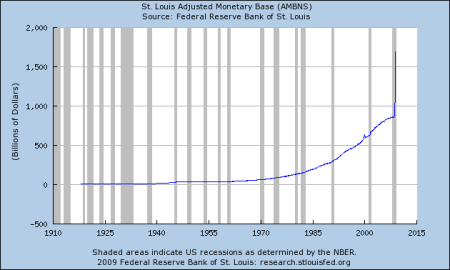
 Internet Scofflaw
You must be logged in to post a comment.