July 8, 2011
Bob Owens writes that the DOJ’s Inspector General can’t be trusted to investigate the Gunwalker scandal: Cynthia Schnedar is temporary and inexperienced (having been acting IG just since January), and her office has multiple conflicts of interest.
I would add that we learned last year that the DOJ IG isn’t even statutorily independent, much less practically independent. The former IG pointed out that, unlike most federal IGs, the DOJ IG answers to the Attorney General. He was explaining why he could not investigate the Black Panther scandal without Eric Holder’s approval.
(Previous post.)
 Leave a Comment » |
  Legal, Political |
  Permalink
 Posted by K. Crary
July 8, 2011
The Gunwalker scandal keeps getting worse:
The ABC15 Investigators have linked an additional 43 weapons recovered during a Phoenix traffic stop to the controversial Fast and Furious ATF case.
According to court paperwork, Phoenix Drug Enforcement Administration agents discovered the guns in mid-April. They pulled over a vehicle near 83rd Avenue and Interstate 10, near the Phoenix and Tolleson border.
The Washington Examiner describes the culprits as illegal immigrants, which is accurate, in that four of the five were in the United States illegally, but incidental I think. A better description would be Mexican drug traffickers.
POSTSCRIPT: Kudos to ABC’s Phoenix affiliate for doing some real journalism here. If the authorities ran down the serial numbers too, they didn’t tell anyone of the connection.
(Via Instapundit.) (Previous post.)
Leave a Comment » | Legal, Political | Permalink
Posted by K. Crary
July 6, 2011
There was a big victory for gun rights today as the Seventh Circuit Court of Appeals granted an injunction against City of Chicago’s cynical anti-gun law, adopted after McDonald, in which they require range training to own a gun but at the same time banned all public gun ranges in the city.
The decision did not throw out the law, as that was not yet at issue, but the opinion makes it virtually impossible for the law to stand. The court ruled that the First Amendment provides the right model in which to consider Second Amendment cases, and that gun laws covered by the Second Amendment should be considered with a level of scrutiny higher than intermediate scrutiny, “if not quite ‘strict scrutiny.'”
And there’s this:
This reasoning assumes that the harm to a constitutional right is measured by the extent to which it can be exercised in another jurisdiction. That’s a profoundly mistaken assumption. In the First Amendment context, the Supreme Court long ago made it clear that “ ‘one is not to have the exercise of his liberty of expression in appropriate places abridged on the plea that it may be exercised in some other place.’” . . . The same principle applies here. It’s hard to imagine anyone suggesting that Chicago may prohibit the exercise of a free‐speech or religious‐liberty right within its borders on the rationale that those rights may be freely enjoyed in the suburbs. That sort of argument should be no less unimaginable in the Second Amendment context.
UPDATE: David Kopel summarizes:
The Seventh Circuit’s decision in Ezell v. Chicago is a tremendously important case for Second Amendment doctrine. The key rules from Ezell: use originalism from both 1791 and 1868 to determine if an activity is within the scope of the Second Amendment right. If it is, apply First Amendment doctrine, and make the standard of review more stringent when the activity is closer to the core of the right, and when the government is prohibiting rather than regulating. Generally speaking, when looking for guidance, look to Eugene Volokh.
Leave a Comment » | Legal | Permalink
Posted by K. Crary
July 6, 2011
Today brought major developments to the Gunwalker scandal. Kenneth Melson, the acting director of ATF, testified before the Congressional investigation. Melson gave new details on the Department of Justice’s efforts to cover-up the scandal:
Melson provided detailed information and documents to the Office of the Deputy Attorney General at the Justice Department. But that information was not given to Congress by then-Acting Deputy Attorney General James Cole. In fact, “Melson was not allowed to communicate to Congress” and “Justice Department officials directed [ATF’s senior leadership] not to respond and took full control of replying to briefing and document requests from Congress.” According to the letter Issa and Grassley sent to Holder, it was “two days after [Melson] told [Cole] about serious issues involving lack of information sharing” that the Wall Street Journal suddenly reported that Melson was about to be ousted by the Obama administration.
Melson also directly contradicted claims made by the Justice Department:
Contrary to the Justice Department’s denials, according to Melson, ATF agents specifically witnessed transfers of weapons from straw purchasers to third parties without taking any further action.
Also, in the second major development, an email came to light showing that knowledge of the Fast and Furious operation went quite high, including Assistant Attorney General for the Criminal Division Lanny Breuer, and the heads of the FBI and DEA.
(Previous post.)
Leave a Comment » | Legal, Political | Permalink
Posted by K. Crary
July 1, 2011
The Democrats have released their minority report on the Gunwalker scandal. They say the lesson of the ATF’s insane project is that we need more gun control in the United States. If we’re going to tighten any gun control laws because of this, how about making it a crime for federal agents to traffic guns to Mexican drug cartels?! Just a thought.
The Democrats’ position that the lesson of Gunwalker is the need for more gun control (rather than, say, that the ATF shouldn’t traffic guns to Mexican drug cartels) certainly won’t do anything to quiet the suspicions of many that the real purpose of the “Fast and Furious” operation was political, to provide a pretext for more gun control.
POSTSCRIPT: They also reiterate the 90% lie (in which gun control advocates claim that 90% of Mexican crime guns come from US gun shops when the real number is less than 8%).
(Previous post.)
Leave a Comment » | Legal, Political | Permalink
Posted by K. Crary
June 30, 2011
The House Committee on Oversight and Government Reform has been holding hearings on the ATF’s horrifying Gunwalker scandal, in which the ATF trafficked guns to Mexican gun cartels. The ranking Democrat on the committee wants to change the subject, so he is summoning a bunch of gun control advocates to testify at the committee, presumably to blame gun owners for something.
Wait a second. Elijah Cummings (D-MD), a fierce gun-control advocate, wants to divert the hearing away from the ATF’s activities trafficking guns to Mexican drug cartels? It makes you wonder what gun control really means to these people.
Anyway, I see this as likely to backfire. These people will be testifying at a hearing on Gunwalker. Democrats will be happy to solicit their usual sob stories and bogus statistics, but Republicans will make them answer questions on Gunwalker, one of the worst gun-control scandals in American history. Make them explain why we should restrict the right of law-abiding Americans while the administration trafficks guns to Mexican drug cartels.
(Via Instapundit.) (Previous post.)
Leave a Comment » | Legal, Political | Permalink
Posted by K. Crary
June 29, 2011
Gunwalker guns are turning up in US neighborhoods now.
There’s also this interesting fact:
The strategy was supposed to lead ATF officials to drug cartel leaders, but agents admitted they never followed the weapons to see where they went.
I thought the whole point was supposedly to follow the guns. If they didn’t even follow the guns, it’s getting really hard to argue that the operation was carried out in good faith.
(Previous post.)
Leave a Comment » | Legal, Political | Permalink
Posted by K. Crary
June 27, 2011
Another victory for free speech today as the Supreme Court struck down Arizona’s speech-limiting “clean elections” law. I continue to be amazed that so many people equate cleanliness in elections with controls on how much people can say.
I also continue to be amazed by the Ninth Circuit, the nation’s most reversed court, which somehow managed to blow this case despite a very clear precedent in Davis v. FEC.
Leave a Comment » | Legal, Political | Permalink
Posted by K. Crary
June 27, 2011
I’m surprised at this. You would think they would wait until the scandal was off the front pages before starting to retaliate against the whistleblowers.
(Previous post.)
Leave a Comment » | Legal, Political | Permalink
Posted by K. Crary
June 25, 2011
CBS reports:
CBS News has confirmed that ATF Fast and Furious “walked” guns have been linked to the terrorist torture and murder of the brother of a Mexican state attorney general last fall.
(Via Instapundit.) (Previous post.)
Leave a Comment » | Legal, Political | Permalink
Posted by K. Crary
June 24, 2011
While the ATF was strong-arming gun stores into participating in its crazy scheme to traffic weapons to Mexican drug cartels, it was turning around and illegally leaking the names of those same gun stores to the media as prime sources of guns recovered in Mexico.
The ATF’s betrayal of the gun stores is a petty offense compared to the Gunwalker scandal as a whole, but it does make it that much harder to believe that the operation was conducted in good faith.
(Previous post.)
Leave a Comment » | Legal, Political | Permalink
Posted by K. Crary
June 24, 2011
The liberal Center for Public Integrity reports:
Fannie Mae executives bungled their stewardship of the federal government’s massive foreclosure-prevention campaign, creating a bureaucratic muddle characterized by “mismanagement and gross waste of public funds,” according to a whistleblower lawsuit by a former Fannie Mae executive and consultant.
Caroline Herron, a former Fannie vice president who returned to the mortgage giant in 2009 as a high-level consultant, claims that the homeowner-relief effort was marred by delays, missteps and executives preoccupied with their institution’s short-term financial interests.
“It appeared that Fannie Mae officers were focused on maximizing incentive payments available to Fannie Mae under various federal programs – even if this meant wasting taxpayer money and delaying the implementation of high-priority Treasury programs,” she claims in the lawsuit.
Herron alleges that Fannie Mae officials terminated her $200-an-hour consulting work in January because she raised questions about how it was administering the federal government’s push to help homeowners avoid foreclosure, known as the Home Affordable Modification Program, or HAMP.
By the way, let’s not forget that Fannie Mae got the job through a $400 billion no-bid contract.
Leave a Comment » | Legal, Political | Permalink
Posted by K. Crary
June 23, 2011
How did the Gunwalker scandal happen? Did the ATF deliberately facilitate the smuggling of weapons into Mexico in order to bolster the (false) story that weapons used in Mexican crimes mostly come from the United States, in order to advance a gun-control agenda?
We don’t know. It’s hard to believe that any administration could be so corrupt. But so far, it is the only explanation that has been offered that makes any sense. Why did the ATF traffic guns to Mexican drug cartels? It defies all reason!
The agents who are talking don’t know. They warned that the scheme would be a disaster, but their pleas were ignored.
Those who do know, on the other hand, aren’t talking. And that makes me suspect the worst. If they had a good faith reason, they should tell us. Instead, the ATF and the Justice Department have been stonewalling for months.
We don’t know when Eric Holder was briefed on the scheme. It’s hard to believe that a plan to traffic weapons into a foreign country would have been approved without going to the top. (And it hardly absolves him if he is such a careless manager as to allow crazy schemes to be put into motion without his knowledge.)
But what we do know for certain is that Eric Holder has approved the cover-up. We know that because the cover-up is ongoing and he could put a stop to it. Regardless of what he knew and when he knew it, Holder should go for that reason alone.
The latest development is someone at the DOJ is trying to fight back against Rep. Darrell Issa (R-CA). The Washington Post ran a story yesterday alleging, based on an anonymous source, that Issa was briefed on the scheme in April 2010 and raised no objections. Issa categorically denies the report, and adds that his office has been contacted by several publications to whom the story was shopped. The Post was the only publication to find it credible.
Even if the Issa story were true, it would not absolve the ATF, Eric Holder, or the Obama administration. But there’s no good reason to believe it, since there’s no good reason for the source to remain anonymous, unless he’s lying. He can’t be afraid of retaliation; one simply does not face negative consequences for running interference for your boss by attacking a Republican congressman.
If the Gunwalker scandal is as bad as it is starting to look — trafficking guns into a friendly country, for political purposes, leaving countless dead including a federal agent — it would be the worst scandal in American history. No one died in the Watergate burglary.
(Previous post.)
UPDATE: Instapundit follows the Internet Scofflaw lead.
Leave a Comment » | Legal, Media Failure, Political | Permalink
Posted by K. Crary
June 20, 2011
A big day at the Supreme Court today:
- The Court rejected a lawsuit against several power companies, saying that job of regulating carbon dioxide belongs to the EPA, not the judicial system. (However, if I am understanding properly, the court did not address the EPA’s effort to regulate carbon dioxide in a manner contrary to law.)
- The Court rejected a preposterous class action against Wal-Mart.
- The Court refused to hear ACORN’s appeal of a lower court’s ruling that upheld the defunding of ACORN.
But the decision I want to highlight most is a 8-0 decision in Bond v. United States. Anthony Kennedy’s opinion on the role of federalism in the defense of individual liberty is eloquent:
The federal system rests on what might at first seem a counterintuitive insight, that “freedom is enhanced by thecreation of two governments, not one.” . . . The Framers concluded that allocation of powers between the National Government and the States enhances freedom, first by protecting the integrity of the governments themselves, and second by protecting the people, from whom all governmental powers are derived. . .
Federalism also protects the liberty of all persons within a State by ensuring that laws enacted in excess of delegated governmental power cannot direct or control their actions. . . By denying any one government complete jurisdiction over all the concerns of public life, federalism protects the liberty of the individual from arbitrary power. When government acts in excess of its lawful powers, that liberty is at stake.
The limitations that federalism entails are not therefore a matter of rights belonging only to the States. States are not the sole intended beneficiaries of federalism. . . An individual has a direct interest in objecting to laws that upset the constitutional balancebetween the National Government and the States when the enforcement of those laws causes injury that is concrete, particular, and redressable. Fidelity to principles of federalism is not for the States alone to vindicate.
This decision was easy in a sense, in that it dealt with federalism largely in the abstract, rather than in application. Still, it’s nice to see.
(Via Bench Memos.)
UPDATE: There is an even-handed summary of the Wal-Mart decision here.
Leave a Comment » | Legal | Permalink
Posted by K. Crary
June 18, 2011
The Righthaven copyright trolls are facing ethics charges and possible disbarment.
(Via Instapundit.) (Previous post.)
Leave a Comment » | Legal | Permalink
Posted by K. Crary
June 18, 2011
GM’s $45 billion tax break violated the law, according to a new law article:
Treasury solved this problem by issuing a series of “Notices” in which it announced that the law did not apply. . . The Treasury had no legal or economic justification for these Notices, which applied to Citigroup and AIG as well as to GM. Nonetheless, the Notices largely escaped public attention, though they had the potential to transfer significant wealth to loyal supporters (the UAW). That it could do so illustrates the risk involved in this manipulation.
Leave a Comment » | Legal, Political | Permalink
Posted by K. Crary
June 18, 2011
President Obama’s absurd contention that the campaign in Libya does not constitute hostilities was adopted over the objections of the Office of Legal Counsel, and the Pentagon general counsel for good measure. This is almost never done:
Presidents have the legal authority to override the legal conclusions of the Office of Legal Counsel and to act in a manner that is contrary to its advice, but it is extraordinarily rare for that to happen. Under normal circumstances, the office’s interpretation of the law is legally binding on the executive branch.
For years we suffered through incessant prattle that President Bush had committed us to “illegal wars” in Afghanistan and Iraq, even though both campaigns were authorized by Congress. Now, under the Obama administration, we have a military action that actually does violate federal law. I won’t go so far as to call it an “illegal war”, since the War Powers Act is quite possibly unconstitutional, but for the first time a serious case could be made.
POSTSCRIPT: The administration contends that the Libyan campaign does not constitute “hostilities” because Qadaffi’s forces are unable to fire back. A similar argument would apply to nearly any American air campaign. But in 2007, Joe Biden pledged to impeach President Bush if he attacked Iran’s nuclear program without Congressional approval. I don’t think that circle can be squared.
UPDATE: How rare is “extraordinarily rare”? John Elwood can’t think of a case more recent than the Roosevelt administration, except this is the second time already during the Obama administration.
(Previous post.)
Leave a Comment » | Legal, Military | Permalink
Posted by K. Crary
June 15, 2011
Fox News reports:
A group of lawmakers filed a federal lawsuit Wednesday against the Obama administration, questioning the constitutional and legal justifications for military action in Libya. The bipartisan group is being led by Reps. Dennis Kucinich, D-Ohio, and Walter Jones, R-N.C., and includes GOP presidential candidate Rep. Ron Paul.
We used to have a very useful ambiguity as regards the status of War Powers Act. Presidents would follow its processes, while maintaining they were not required to do so. Unfortunately, President Obama damaged that ambiguity by flagrantly disregarding the Act, and now this lawsuit threatens to destroy what’s left.
ASIDE: I don’t blame those guys for filing the suit. I’m against it, but people like Kucinich and Paul are going to do what they are going to do. This was predictable given Obama’s actions.
Whatever we have after this suit won’t be as good as what we had before. Either the courts will strike down the War Powers Act (which would be bad), or they will uphold it (which would be worse), or they will find some bogus justification to avoid answering the question (the best outcome from a policy perspective, but infuriating from a jurisprudential perspective).
I think the most likely outcome is the latter — a narrow ruling that dodges the central issues, but I wouldn’t bet the farm against the courts ruling on the War Powers Act. After Boumediene, nothing seems impossible. Also, if the courts were ever going to rule on the War Powers Act, the Libya campaign is the sort of case in which they would do it: a low-profile conflict with no vital national interest at stake. (Yes, I was in favor of it, but let’s be honest.)
Meanwhile, President Obama argues that the War Powers Act doesn’t apply because we are not involved in hostilities. That sounds ridiculous on the face of it, but it strikes me as just the sort of argument that courts might be inclined to seize on if they want to avoid the central issues.
Why President Obama couldn’t have just sought Congressional approval is beyond me. It’s not like he would have lost.
UPDATE: Ilya Somin takes a look at the legalities.
Leave a Comment » | Legal, Military, Political | Permalink
Posted by K. Crary
June 15, 2011
The House has issued a blistering report on the ATF’s Gunwalker scandal. Among the findings is that the Department of Justice repeatedly lied about what had happened. I’ve glanced at the report, and that finding is really unarguable.
(Previous post.)
Leave a Comment » | Legal, Political | Permalink
Posted by K. Crary
June 15, 2011
The Righthaven copyright trolls haven’t the standing to sue:
A federal judge in Las Vegas today issued a potentially devastating ruling against copyright enforcer Righthaven LLC, finding it doesn’t have standing to sue over Las Vegas Review-Journal stories, that it has misled the court and threatening to impose sanctions against Righthaven.
This outcome seemed likely once it was revealed that Righthaven didn’t even have the rights to the stories they were suing over. Meanwhile, the judge allowed the countersuit by Righthaven’s intended victim (Democratic Underground) to go forward.
This may well (and hopefully will) be the end for Righthaven. Meanwhile, although Righthaven is losing this case on a technical point, other Righthaven suits have failed on more substantiative grounds. That will hopefully deter other trolls from trying the same thing.
(Via Instapundit.) (Previous post.)
Leave a Comment » | Legal | Permalink
Posted by K. Crary
June 14, 2011
The Wisconsin Supreme Court has thrown out the flagrantly lawless injunction against Wisconsin’s budget repair bill.
That’s the good news. Unfortunately, the rule of law only prevailed 4-3. The three justices in the minority submitted a weaselly dissenting opinion (¶130 here) in which they didn’t come out and say that the law is not a law (there being no convincing legal justification to do so), but instead made the question out to be a tough call, requiring a lengthy litigation process to settle.
In particular, they conceded a controlling decision states that “courts will not review or void an act of the legislature based on its failure to comply with its own procedural rules, unless those rules embody a constitutional requirement” but suggested that the Open Records Law might just be a constitutional requirement, somehow. Good grief.
They also did not address the injunction’s bizarre contention that the process by which the bill was passed somehow violated the Open Records Law, despite the fact that the Open Records Law explicitly states that the legislature’s rules take precedence (¶57) and the legislature’s rule explicitly permits the process that was used (¶53). I suppose dealing thorny issues like that requires a lengthy litigation process.
I was hoping for a bipartisan affirmation of the rule of law. We’ll have to settle for a narrow one.
Leave a Comment » | Legal | Permalink
Posted by K. Crary
June 9, 2011
A Gunwalker gun shoots down a Mexican government helicopter.
(Previous post.)
Leave a Comment » | Legal, Political | Permalink
Posted by K. Crary
June 7, 2011
This makes me mad:
Last November, we highlighted the story of New York City teenager Fei Lam, who had managed to sell $130,000 worth of white iPhone 4 parts in just a few months to customers eager to get their hands on a white iPhone 4 has Apple continued to delay the release of the official model. Lam claimed that he had developed a secondhand relationship with someone at Apple’s manufacturing partner Foxconn who had been supplying him with parts. At the time, the report noted that Lam had been contacted by a purported private investigator who claimed that Lam was trafficking in stolen goods, and Lam’s site disappeared soon after.
Apple yesterday finally filed a lawsuit against Lam and his parents, claiming infringement and dilution of its trademarks and engaging in deceptive practices through his conversion kit sales through his website at whiteiphone4now.com.
I should mention at the outset that it appears the suit has been settled, and we don’t know the terms of the settlement. But I don’t need to know the terms to be outraged by this. I don’t know if Apple has a case under the law — but they shouldn’t have a case.
This kid was selling aftermarket parts, that’s all. There’s nothing unusual about that. It seems to me that this is Apple using a groundless lawsuit to drive a tiny competitor out of business. And if the suit actually has a basis in law, that’s even worse.
Leave a Comment » | Legal, Technological | Permalink
Posted by K. Crary
June 3, 2011
David Berstein relates some remarks by President Obama in 2005 on the Lochner Supreme Court decision and the Lochner era in general. He then annotates them with corrections. Obama managed to make nine major errors in just five sentences.
Okay, most politicians probably don’t even know what the Lochner era was. But those people are actually ahead of Obama, insofar as they don’t believe things about Lochner that are false. But the kicker is: Barack Obama taught constitutional law!
This isn’t the first time Obama has been embarrassingly wrong about constitutional law either.
Obama certainly hasn’t been shy about bragging about his credentials as a constitutional law instructor. One wonders what he taught.
Leave a Comment » | Legal | Permalink
Posted by K. Crary
June 3, 2011
Wow:
President Obama’s solicitor general, defending the national health care law on Wednesday, told a federal appeals court that Americans who didn’t like the individual mandate could always avoid it by choosing to earn less money.
I suspect we may well see this replayed in a campaign ad.
(Via Instapundit.)
Leave a Comment » | Legal, Political | Permalink
Posted by K. Crary
May 31, 2011
In the political battle over tort reform, Democrats argue that discouraging frivolous lawsuits creates a chilling effect that also hurts those with legitimate claims. Are they in earnest? Or are they just making a convenient argument to protect the rent-seeking efforts of trial lawyers?
We get a hint at the answer by considering the terms of the auto bailouts:
Vicki Denton died several years ago after the airbag in her 1998 Dodge Caravan minivan failed to deploy during a head-on collision in the Georgia mountains. In 2009, a jury found Chrysler responsible for her death because of a manufacturing defect, awarding her surviving son and other relatives $2.2 million.
The family was near collecting those damages on the eve of Chrysler’s government-brokered bankruptcy. Now, two years removed from a $12.5 billion bailout, Chrysler Group LLC still hasn’t paid the damages, and doesn’t have to.
The reason: The company’s restructuring allowed it to wash away legal responsibility for car-accident victims who had won damages or had pending lawsuits before its bankruptcy filing. The same holds true for General Motors Co., which discarded the liabilities as part of its own $50 billion bailout and restructuring. . .
Among the creditors who suffered most, car-accident victims represent a distinct mold. Unlike banks and bondholders, this group didn’t choose to extend credit to the auto makers. As consumers, they became creditors only after suffering injuries in vehicles they purchased.
When push came to shove, Democrats protected the labor unions, not accident victims.
(Via Instapundit.)
Leave a Comment » | Legal, Political | Permalink
Posted by K. Crary
May 31, 2011
I can hardly think of any policy better suited to ending seismology research in Italy than this one:
Italian government officials have accused the country’s top seismologist of manslaughter, after failing to predict a natural disaster that struck Italy in 2009, a massive devastating earthquake that killed 308 people. A shocked spokesman for the U.S. Geological Survey (USGS) likened the accusations to a witch hunt. . .
Enzo Boschi, the president of Italy’s National Institute of Geophysics and Volcanology (INGV), will face trial along with six other scientists and technicians, after failing to predict the future and the impending disaster.
Earthquakes are, of course, nearly impossible to predict, seismologists say. In fact, according to the website for the USGS, no major quake has ever been predicted successfully.
Congratulations Italy, you have guaranteed that no one in Italy will ever predict an earthquake. And, of course, the effects won’t be limited to seismology. After this, who would work in Italy in any field that could conceivably predict a disaster?
(Via Instapundit.)
Leave a Comment » | Legal | Permalink
Posted by K. Crary
May 27, 2011
A Federal court in Virginia has ruled a law prohibiting corporations from making political contributions is unconstitutional. The ruling draws from last year’s landmark Citizens United decision.
I agree with the decision as a matter of policy. I also agree that the law is unconstitutional, reasoning from first principles. But from existing case law, I don’t think that this holds up. Citizens United found it unconstitutional to limit the speech of people in corporations, but it didn’t find campaign finance restrictions unconstitutional. Under existing case law, direct political spending is speech, but political contributions are not. Consequently, I don’t think Citizens United applies.
Leave a Comment » | Legal | Permalink
Posted by K. Crary
May 27, 2011
Maryann Sumi, the Wisconsin judge who blocked Wisconsin’s budget repair bill, has delivered her entirely unsurprising ruling throwing out the bill. The surprising thing is that she ruled so soon, thereby allowing the appellate process — which will almost certainly overrule her — to proceed.
Christian Schneider explains that Sumi, having made public pronouncements regarding the issue, was under pressure to recuse herself. By issuing her ruling, she has made the recusal matter moot.
As a tactical matter, it probably makes sense. It gets the ruling in place before anything can be done regarding her improper role in the case. But it doesn’t address the underlying ethical issue in the slightest.
Leave a Comment » | Legal | Permalink
Posted by K. Crary
May 25, 2011
Another reason not to trust the government (any government): The Economist (subscription required) reports on a new study that finds that even well-meaning justice systems can be quite arbitrary:
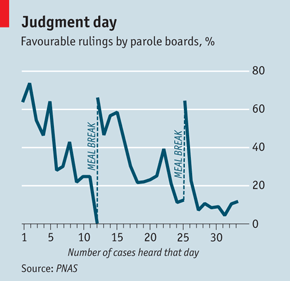
The government might deliver even-handed justice, but you certainly can’t count on it.
Leave a Comment » | Legal, Scientific | Permalink
Posted by K. Crary
May 21, 2011
The Philadelphia police have announced that they are not going to respect the law:
With a shocking altercation between Philadelphia police and a 25-year-old IT worker putting the spotlight back on open-carry gun laws, local authorities are warning gun owners that they will be “inconvenienced” if they carry unconcealed handguns in the city. Lt. Raymond Evers, a spokesman for the city police, told FoxNews.com that gun owners who open carry, which is legal in the city, may be asked to lay on the ground until officers feel safe while they check permits.
This is going to cost Philadelphia a lot of money they don’t have.
(Previous post.)
Leave a Comment » | Legal, Political | Permalink
Posted by K. Crary
May 19, 2011
In 2005 the Senate decided to keep judicial filibusters in order in “extraordinary circumstances”. Democrats, by and large, supported the filibuster, and Republicans opposed it, but a few Republicans crossed the aisle to save the maneuver.
As much as the Democrats might have hoped for it, Republicans obviously were not going to disarm unilaterally and concede the filibuster as a maneuver for Democrats only. The GOP wanted to change the rules, but the Democrats won. And if there were ever extraordinary circumstances, this was the time.
Goodwin Liu was an astonishing appointment to the US Court of Appeals:
A legal scholar who has never been a judge and has little experience practicing law, Liu occupies a place on the far left side of the legal spectrum. To take just one example, Republicans are fond of repeating Liu’s assertion that the Constitution guarantees the right to “expanded health insurance, child care, transportation subsidies, job training, and a robust earned income tax credit.”
His testimony against Samuel Alito was so intemperate — not to mention false — that even he admits it was wrong (although he never figured that out until he was facing confirmation himself). Worse, he believes that the Constitution requires liberal policies. Worse still, he is actually willing to proclaim those beliefs openly.
In short, Liu is a politician. As Lindsey Graham said, he should be running for office, not taking a seat on the bench. Now he will have the chance. I hope he loses.
Leave a Comment » | Legal, Political | Permalink
Posted by K. Crary
May 19, 2011
CBS reports:
CBS News has learned that virtually all the top ATF managers in Phoenix involved in the controversial “Fast and Furious” operation have been reassigned and replaced. The shake-up comes in the wake of the gunwalking scandal in which ATF allegedly allowed more than 2500 weapons to hit the streets or “walk.”
Good.
(Previous post.)
2 Comments | Legal, Political | Permalink
Posted by K. Crary
May 17, 2011
A truly execrable decision from the Indiana supreme court says that people may not resist the police entering their homes, even when the police entry is illegal:
Overturning a common law dating back to the English Magna Carta of 1215, the Indiana Supreme Court ruled Thursday that Hoosiers have no right to resist unlawful police entry into their homes. In a 3-2 decision, Justice Steven David writing for the court said if a police officer wants to enter a home for any reason or no reason at all, a homeowner cannot do anything to block the officer’s entry.
“We believe … a right to resist an unlawful police entry into a home is against public policy and is incompatible with modern Fourth Amendment jurisprudence,” David said.
The Magna Carta reference is no hyperbole; the opinion itself acknowledges it:
The English common-law right to resist unlawful police action existed for over three hundred years, and some scholars trace its origin to the Magna Carta in 1215.
The US Supreme Court has also upheld the right:
If the officer had no right to arrest, the other party might resist the illegal attempt to arrest him, using no more force than was absolutely necessary to repel the assault constituting the attempt to arrest.
This, by the way, is exactly what the victim here did. He didn’t shoot at the police, or anything reckless like that. He physically blocked the door, and when the police tried to force their way in, he pushed back.
(Via the Corner.)
POSTSCRIPT: The opinion pretty much admits to judicial activism:
We believe however that a right to resist an unlawful police entry into a home is against public policy and is incompatible with modern Fourth Amendment jurisprudence.
What follows is not a legal argument, but, as promised, a public policy argument. But here’s what is what is particularly troubling about when the courts change the law. We are protected from ex post facto laws passed through the political process; the legislature cannot make a law that retroactively criminalizes something that happened before the law was passed. But we have no such protection when the courts change the law. In this case, the court admits that it is changing the law, and the victim goes to jail as a result:
In sum, we hold that Indiana [sic] the right to reasonably resist an unlawful police entry into a home is no longer recognized under Indiana law. Accordingly, the trial court‘s failure to give Barnes‘s proffered jury instruction on this right was not error.
Leave a Comment » | Legal | Permalink
Posted by K. Crary
May 17, 2011
The Philadelphia police arrested a man and subject him to verbal abuse for legally carrying a firearm. They released him when they found they hadn’t a leg to stand on, but when he posted recordings of the incident they charged him with disorderly conduct:
The Police Department heard about the YouTube clips. A new investigation was launched, and last month the District Attorney’s Office decided to charge Fiorino with reckless endangerment and disorderly conduct because, a spokeswoman said, he refused to cooperate with police.
This is going to cost Philadelphia a lot of money. I hadn’t heard they had money to waste.
POSTSCRIPT: The police also says that their officers weren’t trained in the relevant gun laws. I’m not sure if it’s worse if that’s true or false.
Leave a Comment » | Legal, Political | Permalink
Posted by K. Crary
May 10, 2011
The appeal of the Virginia lawsuit against Obamacare will be heard by an all-Democratic panel, so we can expect the lower court decision will probably be overturned. The more interesting thing will be to see what reasoning they come up with.
Then it will be on to the next-level appeal. And the appeal of multi-state lawsuit heard in Florida is still pending. It’s a pity the Supreme Court declined to take the case up early.
Leave a Comment » | Legal | Permalink
Posted by K. Crary
April 24, 2011
A court in Dearborn, Michigan has forbidden Terry Jones to protest in front of mosque. When he refused to agree, he was briefly thrown in jail! (More here.) Something is seriously wrong in that town.
This is so obviously unconstitutional that it can’t possibly withstand appeal. But in the meantime Dearborn has made Jones into a free-speech martyr. We’ll never be rid of him now. Nice job, jackasses.
UPDATE: From the ACLU brief:
In Forsyth County v Nationalist Party, the Supreme Court held that “[s]peech cannot be financially burdened, any more than it can be punished or banned, simply because it might offend a hostile mob.” 505 US 123, 34-135 (1992). In Forsyth, the Court considered the constitutionality of an ordinance that allowed a local administrator to assess a fee for demonstrations or parades depending on how much the administrator estimated it would cost to maintain public order during the event.
Leave a Comment » | Legal | Permalink
Posted by K. Crary
April 21, 2011
A Pajamas Media source within DOJ says that prosecutions of domestic organizations (such as CAIR) that support terrorism have been spiked for political reasons.
(Via the Corner.)
UPDATE (4/27) : Confirmed.
Leave a Comment » | Legal, Political | Permalink
Posted by K. Crary
April 21, 2011
Rep. Darrell Issa (R-CA) has lost patience with ATF’s stonewalling over the “gunwalking” scandal. Despite subpoenas, the ATF is refusing to produce the required documents, so Issa is ready begin contempt proceedings.
(Previous post.)
Leave a Comment » | Legal, Political | Permalink
Posted by K. Crary
April 21, 2011
A judge has delivered a body blow to the Righthaven copyright trolls. Judge Roger Hunt has unsealed the contract between Righthaven and Stephens Media, which shows that Righthaven has not acquired any rights to the content in question other than the right to sue for infringement. This may scuttle the entire affair, since it doesn’t seem likely that the right to sue for infringement is transferable in isolation from other substantiative rights. Certainly it should not be.
(Via Instapundit.) (Previous post.)
Leave a Comment » | Legal | Permalink
Posted by K. Crary
April 13, 2011
Senate Democrats have blocked an effort to forbid the EPA from regulating carbon dioxide.
The battle is not over, in so far as the EPA simply does not have (subscription required), under the law, the authority to do what it is doing. The Clean Air Act is designed to deal with pollution, and sets thresholds for action that are entirely inappropriate for carbon dioxide, which is much more prevalent than pollutants in even the worst polluted air. The EPA recognizes that applying the Clean Air Act’s rules to carbon dioxide would be absurd, but rather than abandoning the effort (as it should), it simply made up its own rules. This is an unconstitutional usurpation of legislative authority.
The Supreme Court has ruled against the EPA on carbon dioxide once already, in Massachusetts v. EPA. It may well do so again. A legislative solution would have been preferable to a judicial one, but unfortunately the Democrats have prevented that. In the meantime, they own the problem.
(Via Instapundit.)
Leave a Comment » | Legal, Political | Permalink
Posted by K. Crary
April 10, 2011
The Department of Justice has completed its legal opinion justifying President Obama’s power to launch his war kinetic military action in Libya without Congressional approval. The opinion is based on two findings (page 10): First, the war serves “sufficiently important national interests” (as if that could ever be found not to be the case). Second, the war isn’t really a “war”.
No really, that’s exactly their argument:
Turning to the second element of the analysis, we do not believe that anticipated United States operations in Libya amounted to a “war” in the constitutional sense necessitating congressional approval under the Declaration of War Clause. This inquiry, as noted, is highly fact-specific and turns on no single factor. [Scofflaw: yeah, I’ll bet!] See Proposed Bosnia Deployment, 19 Op. O.L.C. at 334 (reaching conclusion based on specific “circumstances”); Haiti Deployment, 18 Op. O.L.C. at 178 (same). Here, considering all the relevant circumstances, we believe applicable historical precedents demonstrate that the limited military operations the President anticipated directing were not a “war” for constitutional purposes.
(Emphasis mine.)
You want to know why the Obama administration is refusing to call this a war? There’s your answer right there. If they called it a war, their own analysis says it would be illegal.
POSTSCRIPT: My personal opinion is that the president has plenary authority as commander-in-chief to carry out brief military actions, and he doesn’t need to make up delicate, bogus, and insulting legal tests. However, he was unwise to use that authority in a situation such as this, where the war kinetic military action is unlikely to be over within 60 days. He was particularly unwise, given his emphatic earlier statements against presidential war-making power. He should have sought Congressional approval, and he would have received it easily.
(Via Beltway Confidential.)
Leave a Comment » | Legal, Political | Permalink
Posted by K. Crary
April 8, 2011
President Obama has reversed policy from 1995, and will withhold military pay if the government shuts down:
When the government was shut down in 1995, military personnel continued to report to work and were paid, but the planning guidance sent to the services and defense agencies says a shutdown this time will be different.
“All military personnel will continue in normal duty status regardless of their affiliation with exempt or non-exempt activities,” says the draft planning guidance that was prepared for the services and defense agencies. “Military personnel will serve without pay until such time as Congress makes appropriated funds available to compensate them for this period of service.”
I’m astonished.
(Via Hot Air.) (Previous post.)
Leave a Comment » | Legal, Political | Permalink
Posted by K. Crary
April 7, 2011
I was just getting ready to write some comments on Tuesday’s supreme court election in Wisconsin, when the result was turned upside down.
I noticed Wednesday morning that Prosser (the Republican) had not picked up as many votes from Waukesha County as I expected. But my estimate was a highly unscientific, back-of-the-envelope calculation, so I didn’t think much of it. Ann Althouse noticed the same thing (and, unlike me, she actually blogged it):
Waukesha is now shown as completely in, but the numbers didn’t change, so I think something may have been misreported. I took the trouble to do a calculation and was going to predict that Prosser would net 40,000 more votes in Waukesha. What happened?
Well, it turns out that something did happen. The Waukesha County clerk failed to record the votes from one city. (She failed to save the database after importing the data.) When the error was discovered during canvassing, Prosser gained 7,582 net votes, demolishing his razor-thin 204-vote deficit.
The clerk emphasized:
This is not a case of extra votes, or extra ballots, being found. This is human error, which I apologize for. . . Which is why the state requires us to conduct a canvass.
Prosser’s new lead is outside the margin that requires an automatic recount, but I suspect we will see a recount nevertheless. I won’t go out on a limb and say that this thing is over, but I think Prosser’s campaign has to be pretty happy with their position.
Democrats and union bosses had been crowing about the Prosser’s apparent defeat as a rebuke to Scott Walker, the Republican governor, and indeed to Republicans nationwide. (This was already foolish, given the narrowness of the margin despite the huge union effort for Kloppenburg, Prosser’s opponent.) Now, well, Mary Katharine Ham puts it best:
Small, state-wide election with vital national implications soon to have no national implications whatsoever.
ASIDE: If you want more schadenfreude, watch this video in which Kloppenburg brushes off the question of whether she should be claiming victory with such a narrow margin.
Now, although the tone will be quite a bit different than it might have been, I still need to remark on why it was so important that Kloppenburg lose this race (and therefore that Prosser win). This photo, taken by Ann Althouse, tells the whole story:
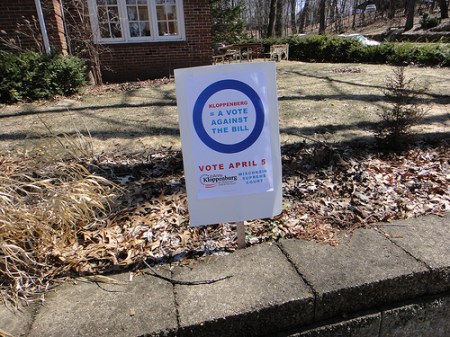
Kloppenburg was campaigning on a promise to overturn Wisconsin’s budget repair bill that was fiercely opposed by public-sector unions. This is absolutely not what a court is supposed to be doing. Under the rule of law, a court is supposed to rule on the law, not pursue a political outcome. Of course, this rule is frequently violated, especially by the left’s judicial activists, but always they at least pretend to take a proper judicial view.
That pretense is valuable. While I would prefer their counterfeit judicial temperament to be real instead, their need to pretend does limit how far they can go in carrying out their political aims. When judicial candidates can come out and promise to rule a particular way in particular controversies, the courts will have become just another political body. We don’t need a third branch of the legislature. We need the rule of law.
Mickey Kaus put it this way, when we all thought Kloppenburg had probably won:
There is also the minor issue of whether opponents of the anti-union law have a case. Or does everyone agree that doesn’t matter anymore?
Fortunately, it looks like that still does matter. For now.
(Via Althouse.)
UPDATE: The vice-chair of the Waukesha Democratic Party stands by the new totals.
UPDATE: Apparently Prosser had already taken a narrow lead in canvassing before the Waukesha correction.
Leave a Comment » | Legal, Political | Permalink
Posted by K. Crary
April 3, 2011
If you’re wondering what the “gunwalking” scandal is about, National Review has a good summary. (Briefly: the ATF facilitated illegal gun sales to Mexican gangsters, as part of a harebrained scheme to see where the guns ended up. One of the guns was used to kill a US Border Patrol agent.)
UPDATE: Clarified some of the nomenclature.
(Previous post.)
Leave a Comment » | Legal, Political | Permalink
Posted by K. Crary
March 25, 2011
The Obama administration has limited Miranda protection for terrorism suspects:
New rules allow investigators to hold domestic-terror suspects longer than others without giving them a Miranda warning, significantly expanding exceptions to the instructions that have governed the handling of criminal suspects for more than four decades. . .
The Supreme Court’s 1966 Miranda ruling obligates law-enforcement officials to advise suspects of their rights to remain silent and to have an attorney present for questioning. A 1984 decision amended that by allowing the questioning of suspects for a limited time before issuing the warning in cases where public safety was at issue.
That exception was seen as a limited device to be used only in cases of an imminent safety threat, but the new rules give interrogators more latitude and flexibility to define what counts as an appropriate circumstance to waive Miranda rights.
The new rules were issued last December, but not made public.
Yet another civil rights triumph from the administration that wants to search laptops without a warrant, sample the DNA of every suspect arrested, and track US citizens via their cell phones (without a warrant), that investigated political opponents posing no threat to public safety, and that planned to limit our rights to petition our government. (Those last two policies were reversed after they came to light.)
(Via Professor Bainbridge.)
Leave a Comment » | Legal, Political | Permalink
Posted by K. Crary
March 20, 2011
The Righthaven copyright trolls have lost another ruling. US District Judge James Mahan found that the defendant’s use of the material satisfied the conditions for fair use, but then made a much more important observation:
Mahan also found Righthaven’s use of the copyright for a lawsuit gives the copyright less protection than if the Review-Journal were using it in the normal course of delivering the news.
“Here the copyright has been removed from its original context,” Mahan said.
“Righthaven is not using the copyright the same way the R-J used it. Righthaven is using it to support a lawsuit,” Mahan said.
This type of copyright use has a chilling effect on free speech and doesn’t advance a purpose of the federal Copyright Act, which is to encourage and protect creativity, Mahan said.
(Via Instapundit.) (Previous post.)
Leave a Comment » | Legal | Permalink
Posted by K. Crary
March 12, 2011
A federal judge in Kansas has struck down a tax increase in the Shawnee Mission School District. A victory for individual rights? Not in this case.
The reason the tax hike was struck down had nothing to do with protecting the taxpayer. The tax hike was struck down because it would make that district’s schools too good:
U.S. District Judge John W. Lungstrum dismissed the case on the grounds that the cap was a crucial and integral part of the state’s complex formula for distributing education funds in a manner meant to ensure that wealthy school districts don’t pull far ahead of poorer districts.
If you want to cap public-school spending to protect the taxpayer, I could get behind that. But capping public-school spending to keep schools from becoming better than others is simply perverse.
Leave a Comment » | Legal, Political | Permalink
Posted by K. Crary
March 11, 2011
The Righthaven copyright trolls are complaining that one of their targets is running up excessive legal bills. That takes chutzpah, since unnecessary litigation is Righthaven’s entire business model.
(Via Instapundit.) (Previous post.)
Leave a Comment » | Legal | Permalink
Posted by K. Crary
March 8, 2011
The US Court of Appeals has ruled that the University of Wisconsin cannot discriminate against religious activities:
A key part of the ruling involved the university’s decision to fund broad categories of activities in the first place. The majority decision indicated that the university could have blocked student fees from going to the activities in question if it had blocked entire categories of support — no matter whether conducted by secular or religious groups. Once a university allows any category of student activity to receive support, however, the court ruled that it can’t bar support for that activity just because it may involve worship.
Sounds right.
Leave a Comment » | Legal | Permalink
Posted by K. Crary
March 6, 2011
It’s tempting to characterize the Supreme Court’s decision in Snyder v. Phelps — in which the high court upheld First Amendment protection for the Westboro jerks picketing at a US Marine’s funeral — as a straightforward free speech case in which the court declined to recognize a jackass exception to the First Amendment.
But on reading the opinion, I think that characterization is wrong. The opinion makes the decision into a much more close-run thing, hinging on whether the Westboro jerks are expressing opinions on matters of public concern or merely private concern. They find that the speech is on matters of public concern, and therefore it is protected. (Alito, to the extent to which I understand his dissenting opinion, seems to find that the speech is on matters of private concern, and so is unprotected.)
Where does this public/private concern test arise? The opinion cites Dun & Bradstreet v. Greenmoss Builders for the distinction, but Dun & Bradstreet seems to say something quite different. It says that in matters of private concern there is less protection for false statements; a plaintiff need not show “actual malice” in order to recover damages. But as referenced in Snyder, this morphs into the idea that opinion may be unprotected if it relates to matters of private concern.
I’d like to know where this doctrine was first extended to opinion. Was it just invented in Snyder v. Phelps, or was it invented in some case between Dun & Bradstreet (1985) and today?
Frankly, I find the idea very troubling. Apparently, If I go across the street and call my neighbor a jerk, that is a private concern so it is not protected by the First Amendment. There’s no law against that today (that I know of), but if the government wanted to pass such a law, this doctrine would allow it. This is not what the freedom of speech ought to mean.
POSTSCRIPT: As I said, I don’t really understand Alito’s dissenting opinion, but he seems to be working from the same distinction between public and private concerns as the majority opinion. Breyer’s concurring opinion is even more troubling: he says that the public-concern determination should not be the end of the analysis. Even speech related to public concerns could be restricted without violating the First Amendment, he says.
In this case, Breyer finds with the majority because of one of those horrible, ill-defined balancing tests he seems to like so much. Granted, there are some rare cases in which the government must restrict speech (e.g., the proverbial crowded theater) but nothing remotely like that is in play here. The fact that Breyer finds it necessary to mention the balancing test suggests that he thinks the balancing point is much closer than it should be.
UPDATE (4/29): Glenn Reynolds explained to me that a distinction in torts between public and private concern goes back to English common law. I still don’t quite understand it, but we weren’t speaking in a setting conducive to a more detailed discussion. But it definitely seems safe to say this is not a new doctrine.
Leave a Comment » | Legal | Permalink
Posted by K. Crary
March 3, 2011
Two weeks ago, the Obama administration asked Judge Vinson, the federal judge in Florida that struck down Obamacare, to order states to obey it nonetheless. I thought the administration was unlikely to prevail.
As it turns out, the administration did win, sort of, but they probably would rather they hadn’t. In a harshly worded order, Judge Vinson said he would stay his decision, but only for seven days, on the condition that the administration file an expedited appeal.
The administration, you see, has not yet gotten around to filing an appeal. In the meantime, however, they have simply proceeded as if the court had not ruled against them. When some states announced they would cease implementing the law, the administration asked the court to order them to resume, the ruling notwithstanding.
The administration presumably prefers to delay the ultimate resolution of the case by the Supreme Court for some political reason. The conditional stay forces the administration to do it now (p. 19):
As I wrote about two weeks after this litigation was filed: “the citizens of this country have an interest in having this case resolved as soon as practically possible” . . . That was nearly eleven months ago. In the time since, the battle lines have been drawn, the relevant case law marshaled, and the legal arguments refined. Almost everyone agrees that the Constitutionality of the Act is an issue that will ultimately have to be decided by the Supreme Court of the United States. It is very important to everyone in this country that this case move forward as soon as practically possible.
He had sharp words for the administration’s failure to comply with his ruling (p. 14):
So to “clarify” my order and judgment: The individual mandate was declared unconstitutional. Because that “essential” provision was unseverable from the rest of the Act, the entire legislation was void. This declaratory judgment was expected to be treated as the “practical” and “functional equivalent of an injunction” with respect to the parties to the litigation. This expectation was based on the “longstanding presumption” that the defendants themselves identified and agreed to be bound by, which provides that a declaratory judgment against federal officials is a de facto injunction. To the extent that the defendants were unable (or believed that they were unable) to comply, it was expected that they would immediately seek a stay of the ruling, and at that point in time present their arguments for why such a stay is necessary, which is the usual and standard procedure. It was not expected that they would effectively ignore the order and declaratory judgment for two and one-half weeks, continue to implement the Act, and only then file a belated motion to “clarify.”
(Emphasis mine.) Also note that this is almost word-for-word consistent with the analysis I cited here.
He had even sharper words for the administration’s actions in light of their promise (on which they reneged) to obey a declaratory order (p. 11):
The defendants have suggested, for example, that my order and judgment could not have been intended to have the full force of an injunction because, if I had so intended, I would have been “required to apply the familiar four-factor test” to determine if injunctive relief was appropriate. . .
I did not undertake this four-factor analysis for a simple reason: it was not necessary. Even though the defendants had technically disputed that the plaintiffs could satisfy those four factors, the defendants had acknowledged in their summary judgment opposition brief that, if I were to find for the plaintiffs, separate injunctive relief would be superfluous and unnecessary. The defendants expressly assured the court that, in light of the “long-standing presumption that a declaratory judgment provides adequate relief as against an executive officer, as it will not be presumed that that officer will ignore the judgment of the Court,” any declaratory judgment in the plaintiffs’ favor “would [ ] be adequate to vindicate [the plaintiffs’] claims.”
And he found the administration’s profession of confusion frankly dishonest (footnote 6):
The defendants have suggested in reply to the plaintiffs’ response that the reason for the delay was due to the fact that my order “required careful analysis,” and it was only after this “careful review” that the defendants could determine its “potential impact” with respect to implementation of the Act. . . This seems contrary to media reports that the White House declared within hours after entry of my order that “implementation will proceed apace” regardless of the ruling.
His sharpest words were in a footnote in which he dispensed with the administration’s argument that they should be permitted to continue to apply the law despite it being struck down (footnote 5):
The two cited cases are plainly inapposite for the reasons identified by the plaintiffs. . . Mendoza-Martinez, for example, applied a statute that precluded single-judge district courts from enjoining an Act of Congress; but that statute was repealed by Congress thirty-five years ago, in 1976. The defendants’ selective quoting from those cases — to suggest that the federal government may simply ignore a declaratory judgment by a district court until the appeals process has fully run its course — borders on misrepresentation.
(Emphasis mine.)
That’s going to sting.
Leave a Comment » | Legal | Permalink
Posted by K. Crary
February 27, 2011
This is wrong in so many ways:
Since 2009, Mr. Heicklen has stood [outside the federal courthouse] and at courthouse entrances elsewhere and handed out pamphlets encouraging jurors to ignore the law if they disagree with it, and to render verdicts based on conscience.
That concept, called jury nullification, is highly controversial, and courts are hostile to it. But federal prosecutors have now taken the unusual step of having Mr. Heicklen indicted on a charge that his distributing of such pamphlets at the courthouse entrance violates a law against jury tampering.
This man was arrested for handing out leaflets in a public space! His speech was constitutionally protected even if he was urging people to commit a crime. And he was not urging people to commit a crime: a whole series of decisions going back to 1794 affirm jurors’ rights to nullify.
What we have here is the latest instance of a longstanding outrage. Lawyers want to control the legal system; they don’t want anyone outside the priesthood coming in and interfering with their process. If they could, they would get rid of juries entirely. Since they can’t, they have to settle for controlling the juries, spoon-feeding juries exactly what they want juries to hear, and giving them explicit instructions for how to return a verdict. The last thing they want to see is juries consulting their own consciences and deciding to acquit. The courts have even upheld jury instructions that lie, informing jurors they may not nullify.
Here, the lawyers’ eagerness to control the legal process is leading them even to trample our right to free speech. And who is going to stop them? The judicial system is populated entirely with lawyers. Perhaps that is inevitable, but nearly all of our legislators are lawyers too. So is the president. We need to discard our entire political class and start over.
Leave a Comment » | Legal | Permalink
Posted by K. Crary
February 24, 2011
The likelihood that the Supreme Court will consider the constitutionality of health care nationalization, already quite high, has now gone to 100%. That’s because, whatever the court ultimately decides about Obamacare, the D.C. District Court’s ruling upholding the law will certainly be overturned.
For what has to be (doesn’t it?) the first time in American jurisprudence, Judge Gladys Kessler has asserted the government’s power to regulate mental activity. I am not making this up (p. 45):
As previous Commerce Clause cases have all involved physical activity, as opposed to mental activity, i.e. decision-making, there is little judicial guidance on whether the latter falls within Congress’s power. . . However, this Court finds the distinction, which Plaintiffs rely on heavily, to be of little significance. It is pure semantics to argue that an individual who makes a choice to forgo health insurance is not “acting”. . . Making a choice is an affirmative action, whether one decides to do something or not do something.
Note that “mental activity” is her own phrase, not my paraphrase. She says “mental activity” is the same as doing things. Your thoughts can now be regulated under the Federal government’s interstate commerce power. Wow.
I don’t think we’re going to see the Democrats crow about this decision very much. These lower court decisions are mostly symbolic, and regulation of thought is symbolism they can do without.
(Via Patterico.)
Leave a Comment » | Legal | Permalink
Posted by K. Crary
February 21, 2011
Sen. Charles Grassley (R-IA) is complaining that the ATF is stonewalling a Senate investigation into the ATF’s gun-running activities (yes, the ATF is engaged in gun-running), and their involvement in the murder of a Border Patrol agent. I don’t think this scandal is going away; subpoenas are presumably next.
(Via Instapundit.)
Leave a Comment » | Legal, Political | Permalink
Posted by K. Crary
February 21, 2011
Some Washington State Democrats are calling for an amendment to the US Constitution that would declare that corporations are not persons and are entitled to not of the protections of persons. They are targeting the Citizens United decision, but, as Eugene Volokh points out, they haven’t thought through the ramifications of their proposal: Media corporations would lose the right to a free press, non-profits (e.g., the ACLU) would lose their right to free speech, the government could take corporate property without compensation, the police could search the premises or wiretap the phones of any corporation without a warrant, etc.
In addition to that, these fools continue to misunderstand what the Citizens United ruling actually said. (Probably they are getting their information from the legacy media.) They decry the notion that corporations are persons, but the ruling never said that corporations are persons. On the contrary, the ruling found that corporations are made up of persons who have chosen to organize their efforts as a corporation. Restricting the speech of a corporation means restricting the speech of those persons who make up the corporation.
The average liberal would understand the danger of allowing the government to search the desks in a corporate office without a warrant, but somehow they fail to see the same danger in suppressing their speech.
Leave a Comment » | Legal, Political | Permalink
Posted by K. Crary
February 18, 2011
The White House is asking Judge Vinson, the federal judge in Florida that struck down Obamacare, to order states to obey it nonetheless. I read an analysis somewhere (can’t find it now, sorry) that suggested that Vinson’s decision contained some pretty strong hints that he would not issue such an order. But even that aside, isn’t it pretty unusual for a judge to order the winning party to do what the losing party wants?
I think we have to see this as a political decision. Rather than waiting for an appeals court to hear the case, the White House has decided it wants a confrontation with this judge, right now.
UPDATE: This isn’t the same analysis, but it mentions many of the same things.
UPDATE: Here it is:
Also, it should be noted that a few commentators have considered the failure of the anti-Obamacare forces to obtain an injunction against the act as some kind of victory. It really isn’t. Instead the court reasoned that a judgment declaring the law to be unconstitutional is sufficient relief to the plaintiffs because “there is a long-standing presumption that officials of the Executive Branch will adhere to the law as declared by the court. As a result, the declaratory judgment is the functional equivalent of an injunction.” (internal quotation marks removed.) In other words, he felt that the Federal Government would try to obey the law without the court formally ordering its obedience. But believe you me, if the Obama administration ignores this ruling, the court can and certainly will revisit the matter and issue an injunction.
Leave a Comment » | Legal, Political | Permalink
Posted by K. Crary
February 16, 2011
Last weekend, the Department of Homeland Security seized 84,000 domains, and replaced those sites with a banner asserting that they were trafficking in child pornography. All but ten of them (at most) were innocent. None of the owners had the opportunity to fight the action, nor were any of them even notified it would happen.
Homeland Security is unembarrassed.
(Via Instapundit.)
Leave a Comment » | Legal, Political | Permalink
Posted by K. Crary
February 12, 2011
The New York Times editorial page has weighed in on the constitutionality of Obamacare. It’s failure on a basic factual level isn’t a good sign for nationalization supporters. If they had a strong case, you would think that they could describe the debate accurately.
UPDATE: The Times runs Barnett’s letter. In keeping with NYT policy, the letter doesn’t say that they were wrong — a reader would have to go back and compare with the editorial to discover that.
Leave a Comment » | Legal, Media Failure | Permalink
Posted by K. Crary
February 11, 2011
The left went crazy over the Bush-era Terrorist Surveillance Program, in which we eavesdropped on foreign terrorists’ communications without a warrant. I’ll be interested to see what the left thinks of this:
The Obama administration’s Justice Department has asserted that the FBI can obtain telephone records of international calls made from the U.S. without any formal legal process or court oversight, according to a document obtained by McClatchy.
We’ll find out who really cares about this sort of thing, and who just found it a convenient club with which to attack the Bush administration.
(Via Instapundit.)
Leave a Comment » | Legal, Political | Permalink
Posted by K. Crary
February 11, 2011
Charges are being filed against the UC Irvine students who disrupted (and ultimately prevented) a speech by Israeli ambassador Michael Oren. Immediately after the incident, the students claimed implausibly that the disruptions were not organized, and emails later surfaced that proved that the disruptions were organized by the university’s Muslim Student Union.
The real problem here is the death of respect for free speech at our universities. Far too many students seem to believe that preventing someone from speaking is somehow an exercise of free speech. Orwell would be amused.
(Via Instapundit.)
Leave a Comment » | Legal | Permalink
Posted by K. Crary
February 3, 2011
A small victory for the rule of law and a small defeat for our lawless government: A federal court has sanctioned the Obama administration after it flagrantly ignored a court ruling against its drilling moratorium:
The Obama Administration acted in contempt by continuing its deepwater-drilling moratorium after the policy was struck down, a New Orleans judge ruled.
Interior Department regulators acted with “determined disregard” by lifting and reinstituting a series of policy changes that restricted offshore drilling, following the worst offshore oil spill in U.S. history, U.S. District Judge, Martin Feldman of New Orleans ruled yesterday.
“Each step the government took following the court’s imposition of a preliminary injunction showcases its defiance,” Feldman said in the ruling.
“Such dismissive conduct, viewed in tandem with the re-imposition of a second blanket and substantively identical moratorium, and in light of the national importance of this case, provide this court with clear and convincing evidence of the government’s contempt,” Feldman said.
(Via Patterico.)
Leave a Comment » | Legal, Political | Permalink
Posted by K. Crary
January 31, 2011
The federal judge in Florida hearing the 26-state lawsuit against health care nationalization has found it unconstitutional. Importantly, he found that individual mandate was not separable and threw out the entire law.
Obviously, this is just one step in a long legal battle, but it deals a body blow against the presumption that this law will survive.
UPDATE: Some analysis linked here.
Leave a Comment » | Legal, Political | Permalink
Posted by K. Crary
January 24, 2011
An appeals court has ruled that he is not a Chicago resident.
But I predict it will not matter; Rahm will be the next mayor of Chicago. This is Chicago we’re talking about. Does anyone really think that the machine will allow itself to be denied, just because of what the law says?
UPDATE: Like I said.
Leave a Comment » | Legal, Political | Permalink
Posted by K. Crary
January 23, 2011
Verizon is suing the FCC to overturn the FCC’s net neutrality decree. They have a good case.
(Previous post.)
Leave a Comment » | Legal, Technological | Permalink
Posted by K. Crary
January 23, 2011
A federal judge denies attorney fees to McDonald (of McDonald v Chicago), based on the astonishing argument that McDonald is somehow not the prevailing party.
The judge’s argument, as best I understand it, goes like this: the case wasn’t completely over when McDonald won at the Supreme Court, and the case became moot when Chicago changed the law in response to losing at the Supreme Court, so no one actually prevailed. Sheesh.
(Via Instapundit.)
Leave a Comment » | Legal | Permalink
Posted by K. Crary
January 8, 2011
Maryland’s highest court has ruled that the Second Amendment gives no right to carry weapons outside the home. I don’t see how this can stand. Heller said explicitly that the right to “bear arms” means right to carry arms on one’s person:
At the time of the founding, as now, to “bear” meant to “carry. . . When used with “arms,” however, the term has a meaning that refers to carrying for a particular purpose—confrontation. In Muscarello v. United States, 524 U. S. 125 (1998) , in the course of analyzing the meaning of “carries a firearm” in a federal criminal statute, Justice Ginsburg wrote that “[s]urely a most familiar meaning is, as the Constitution’s Second Amendment … indicate[s]: ‘wear, bear, or carry … upon the person or in the clothing or in a pocket, for the purpose … of being armed and ready for offensive or defensive action in a case of conflict with another person.’ ” . . . We think that Justice Ginsburg accurately captured the natural meaning of “bear arms.”
To suggest that that right is somehow limited to the home (where it would be no different than the right to keep arms) doesn’t seem tenable to me.
Leave a Comment » | Legal | Permalink
Posted by K. Crary
January 8, 2011
This seems right:
Magnus v. U.S., decided today by the D.C. Court of Appeals . . . concludes that a defendant who pled guilty in 1996 to violating D.C. handgun ban can now have that plea set aside given D.C. v. Heller, assuming his conduct was indeed protected by the Second Amendment . . . “A conviction for conduct that is not criminal, but is instead constitutionally protected, is the ultimate miscarriage of justice,” and a defendant can therefore ask to have it set aside (via a petition for coram nobis relief) even many years later.
Leave a Comment » | Legal | Permalink
Posted by K. Crary
December 30, 2010
Eugene Volokh takes a look at this week’s Ohio Supreme Court case striking down Cleveland’s anti-gun laws. It seems that Ohio’s appeals court was making a novel argument. The Ohio constitution provides that municipalities have the right to make their own legislation, provided it does not conflict with “general laws”, which have been interpreted to mean “part of a statewide and comprehensive legislative enactment.”
The appeals court claimed that Ohio’s law, which allows individuals to own guns, was not “comprehensive” precisely because it left a “great deal of firearm activity unregulated.” In other words, the appeals court argued that a state law was comprehensive, and therefore binding on local governments, only to the extent that it restricted individuals. Conversely, a law that protects individual liberty is not binding on local governments.
This would be a very dangerous principle, in practice and theory. The practical consequence is obvious: every person would be subject to the maximum restriction attempted by any government. But the idea behind it is perhaps even more troubling: it says no government scheme is complete unless it is telling people what they can and cannot do. This is not an American idea. I’m glad it was struck down.
Leave a Comment » | Legal | Permalink
Posted by K. Crary
December 22, 2010
The Obama administration is discovering the Unitary Executive theory:
Turning to how terror suspects are tried, Holder said he still believes the “decision as to how people get prosecuted, where they get prosecuted, is an executive branch function. Even if those suspects are being held now at Guantanamo Bay. Holder said Congress should not be interfering with that.
“It’s — from my perspective — a constitutional issue,” he said.
This was bound to happen as soon as a Democrat was in office. Not that anyone will admit changing their position; objection to the unitary executive theory was always based on misstating what it is. The actual theory, which says that the Constitution vests the executive power solely in the president, can’t really be argued, since the Constitution reads:
The executive Power shall be vested in a President of the United States of America.
Those who attacked the unitary executive theory made it out to be something it never was: the idea that the president somehow holds the legislative and judicial powers as well.
UPDATE: It’s not completely clear from the article, but it appears that Holder is alluding to Congress’s legislation barring the transfer of any prisoners from Guantanamo Bay to the United States. That’s interesting, because Holder is actually going beyond the real unitary executive theory to something close to its liberal parody: he is claiming for the executive branch powers that belong to the legislative branch.
The processes of the criminal justice system and the Uniform Code of Military Justice (which include “where” and “how” people are prosecuted) are established by law — that is, by the legislative branch. But Holder seems to be claiming the authority to establish those processes for the executive branch.
Leave a Comment » | Legal, Political | Permalink
Posted by K. Crary
December 22, 2010
The Righthaven copyright trolls are diversifying from newspaper articles to images.
(Previous post.)
Leave a Comment » | Legal | Permalink
Posted by K. Crary
December 18, 2010
The US Commission on Civil Rights’s report on the Black Panther scandal, blasting the Department of Justice, is here.
This is only the beginning. The DOJ refused to allow its employees to testify before the commission, despite subpoenas. When Republicans take over the House of Representatives in January, they will doubtless begin a Congressional investigation. The DOJ won’t ignore Congressional subpoenas as easily.
(Previous post.)
Leave a Comment » | Legal, Political | Permalink
Posted by K. Crary
December 18, 2010
This is the sort of story that you can’t read without becoming furious. A New Jersey man was sentenced to seven years in prison for nothing at all: a hyper-technical violation of New Jersey’s insane (and unconstitutional) gun laws of which he wasn’t even guilty.
Fortunately, Gov. Chris Christie is considering a pardon.
Leave a Comment » | Legal | Permalink
Posted by K. Crary
December 15, 2010
Columbia University has succeeded in stealing its neighbors’ land. Columbia employed a cynical plan in which they bought up adjacent land, allowed it to fall into disrepair, and then prevailed on the government to condemn the entire area as “blighted”. A court blocked the scheme but was overruled by the New York Supreme Court. The US Supreme Court will not review the case.
Disgusting. Absolutely disgusting.
POSTSCRIPT: Glenn Reynolds points out:
Eminent domain is often sold as “the people vs. the powerful.” But in fact it’s property rights that protect the people from the powerful.
Indeed.
UPDATE: Reynolds’s latest column is on the topic.
Leave a Comment » | Academic, Legal, Political | Permalink
Posted by K. Crary
December 13, 2010
Stephen Breyer thinks that it’s okay for some places to infringe the Bill of Rights, as long as your civil rights are respected elsewhere:
WALLACE: I understand. But [the Bill of Rights] certainly didn’t provide for a [gun] ban, at least that’s what the court’s decision was, your court’s — it didn’t provide for a ban on all handguns as they have here in Washington, D.C.
BREYER: Are you a sportsman? Do you like to shoot pistols at targets? Well, get on the subway and go to Maryland. There is no problem, I don’t think, for anyone who really wants to have…
Of course, the hallmark of the left is inconsistency, so we probably don’t have to worry about this jurisprudence being applied to the First or Fourth amendments.
Leave a Comment » | Legal | Permalink
Posted by K. Crary
December 13, 2010
Breaking news.
UPDATE: Meanwhile, public support for Obamacare hits a new low in the ABC News/Washington Post poll.
Leave a Comment » | Legal, Political | Permalink
Posted by K. Crary
December 10, 2010
In Radley Balko’s latest piece on recording the police and other government officials, I was dismayed to learn that the Fraternal Order of Police supports arresting citizens who record the police:
Jim Pasco, executive director of the national Fraternal Order of Police, says he sees no problem with arresting people who photograph or record on-duty cops. Pasco says his main concern is that activists will tamper with videos or use clips out of context to make police officers look bad. . .
Pasco, the head of the Fraternal Order of Police, says cases where video contradicts police testimony are rare. “You have 960,000 police officers in this country and millions of contacts between those officers and citizens,” he says. “I’ll bet you can’t name 10 incidents where a citizen video has shown a police officer to have lied on a police report.” . . .
“Letting people record police officers is an extreme and intrusive response to a problem that’s so rare it might as well not exist,” Pasco insists. “It would be like saying we should do away with DNA evidence because there’s a one-in-a-billion chance that it could be wrong. At some point, we have to put some faith and trust in our authority figures.”
Put some faith and trust in our authority figures? Hell no. And this sort of attitude just makes that trust even less likely.
Oh, this sort of thing makes that trust less likely still:
This is not the first time a police camera in Prince George’s County has malfunctioned at a critical time. In 2007 Andrea McCarren, an investigative reporter for the D.C. TV station WJLA, was pulled over by seven Prince George’s County police cars as she and a cameraman followed a county official in pursuit of a story about misuse of public funds. In a subsequent lawsuit, McCarren claimed police roughed her up during the stop, causing a dislocated shoulder and torn rotator cuff. McCarren won a settlement, but she was never able to obtain video of the incident. Prince George’s County officials say all seven dashboard cameras in the police cruisers coincidentally malfunctioned.
All seven dashboard cameras coincidentally malfunctioned?! That’s just insulting.
Leave a Comment » | Legal, Political | Permalink
Posted by K. Crary
December 4, 2010
Wired reports that federal agencies have been using credit card systems and other electronic systems to track the movements and activities of Americans in real-time, without obtaining warrants.
A few years ago, the press was outraged because we were eavesdropping on foreign terrorists who occasionally spoke to Americans. This is something entirely different. Here, agencies are tracking the movements of Americans on US soil. But, with a Democratic president in charge, I expect the press’s reaction to be muted, if there is any at all.
(Via Instapundit.)
Leave a Comment » | Legal, Political | Permalink
Posted by K. Crary
November 26, 2010
Z Street, a pro-Israel non-profit organization, alleges the IRS is delaying its tax-exempt status and may reject it for taking a pro-Israel position. According to the complaint:
The plaintiff in this case, Z STREET, is a nonprofit organization devoted to educating the public about the facts relating to the Middle East, and that relate to the existence of Israel as a Jewish State, and Israel’s right to refuse to negotiate with, make concessions to, or appease terrorists. The case is brought because, through its corporate counsel, Z STREET was informed explicitly by an IRS Agent on July 19, 2010, that approval of Z STREET’s application for tax-exempt status has been at least delayed, and may be denied because of a special IRS policy in place regarding organizations in any way connected with Israel, and further that the applications of many such Israel-related organizations have been assigned to “a special unit in the D.C. office to determine whether the organization’s activities contradict the Administration’s public policies.”
(Emphasis mine.)
If the allegations are true (and they are detailed and specific), this is a shocking, unconstitutional overreach, even for this administration.
(Via Pajamas Media.)
Leave a Comment » | Legal, Political | Permalink
Posted by K. Crary
November 24, 2010
An instructive story:
When I was in Iraq, we did not have a single M.P. (military police) on our base. Our work was done with cavalry scouts and armor officers, and they did a magnificent job and took great care in their work. But they’re not detectives, there were no Miranda warnings, and they cannot be held to that standard. It’s absurd. They’re war-fighters, not cops.
I vividly remember the day I learned that lesson. It was early in the deployment, and I had a lot to learn. We’d brought in a few detainees, and I was surveying the evidence packets. I approached the troop’s First Sergeant (most senior noncommissioned officer) and said, “First Sergeant, do you think we can get some more stuff on these guys? Could we go out and interview some additional witnesses? I’d like better Iraqi sworn statements.”
He gave me a look that I can best describe as respectful incredulity, and said: “Sir, we grabbed those guys after a troop-level raid in a hostile zone after riding over and through a known IED ambush. That operation took weeks to prepare, all of my guys risked their lives, and we were lucky enough to pull it off without anyone dying. You’re saying you want us to stop our other operations to plan another raid to maybe find one or two more people to give sworn testimony? People who won’t live another day in that village if they’re seen talking to us?”
I felt like an idiot for asking the question.
Leave a Comment » | Legal, Military | Permalink
Posted by K. Crary
November 22, 2010
John Yoo, in commenting on the Ghailani debacle, mentions something I had not known before:
In the middle of a hot war, though, releasing intelligence can be disastrous, because it informs the enemy of our knowledge, capabilities and intentions. That’s what happened when federal prosecutors tried the plotters of the 1993 World Trade Center bombing in civilian court. Al Qaeda learned which individuals the U.S. suspected of being in its organization, so it had an enormous intelligence advantage in planning future plots.
Leave a Comment » | Legal, National Security, Political | Permalink
Posted by K. Crary
November 21, 2010
There’s just something about the combination of insufferable smugness and being dead wrong. When Sarah Palin complained about Gawker (some kind of gossip blog, I gather) publishing excerpts from her new book without permission, Maureen O’Connor (the copyright infringer) turned the smug up to 11:
Sarah: If you’re reading this—and if you are, welcome!—you may want to take a moment to familiarize yourself with the law. Try starting here or here. Or skip the totally boring reading and call one of your lawyers. They’ll walk you through it.
The two links were to explanations of the fair use doctrine, which O’Connor evidently doesn’t understand nearly so well as she thinks.
There are four factors that a court considers when deciding fair use: the transformative nature of the use, the nature of the copyrighted work, the substantiality of the use, and the use’s economic impact. Gawker does poorly on all four (even the first factor, which is their strongest), but especially on the second. An unpublished work is a very weak case for fair use, since authors have the right to control the first public revelation of their work. (O’Connor would have known this if she actually read either of the links she smugly suggested to Palin.)
The story ends with a delightful smackdown for the smugly ignorant O’Connor: a restraining order from a federal judge.
(Via Ruby Slippers.)
UPDATE (11/25): The judge’s opinion confirms my brief analysis; Gawker’s post did poorly even on the transformation test:
As to the first factor, defendant had not used the copyrighted material to help create something new but has merely copied the material in order to attract viewers to Gawker. See Campbell v. Acuff- Rose Music, 510 U.S. 569, 578-79 (1994). As noted above, defendant essentially engaged in no commentary or discussion.
and loses big on the nature of the copyrighted work test:
As to the second factor, the excerpts used by defendant come from an unpublished work, substantially weakening defendant’s fair use claim.
And now Gawker has given up its fair use claim and is settling the lawsuit. They’ve also updated the page to delete O’Connor’s mockery.
BONUS: Oliver Willis — who was probably right about something once but I have no idea when it might have been — mocks Palin:
sarah palin thinks leaking book excerpts is illegal. sweet jesus, she aint quick.
Uh huh.
Leave a Comment » | Legal | Permalink
Posted by K. Crary
November 18, 2010
Judicial Watch has uncovered a smoking gun that proves that Assistant Attorney General Thomas Perez was (at the very least) wrong when he testified that no political appointees were involved in the decision to dismiss the voter intimidation charges against the Black Panthers:
COMMISSIONER KIRSANOW: Was there any political leadership involved in the decision not to pursue this particular case any further than it was?
ASST. ATTY. GEN. PEREZ: No. The decisions were made by Loretta King in consultation with Steve Rosenbaum, who is the Acting Deputy Assistant Attorney General.
Using the Freedom of Information Act, Judicial Watch obtained emails showing that Thomas Perrelli (the Associate Attorney General, which is the DOJ’s 3rd-ranking official and obviously a political appointee) discussed the matter at length with Sam Hirsch (one of Perrelli’s deputies, and other political appointee).
The exchange begins:
From: Hirsch, Sam
Sent: Tuesday, April 30, 2009 9:12 PM
To: Perrelli, Thomas J.
Subject: Fw: New Black Panther Party Update
Tom,
I need to discuss this with you tomorrow morning. I’ll send you another email on this shortly.
If you want to discuss it this evening, please let me know which number to call and when.
The exchange contains two-and-a-half pages of redacted material and ends “Thanks. Sorry you had to stay so late.”
Thomas Perrelli is Thomas Perez’s immediate boss.
Perez must be called to account for his inaccurate sworn testimony, and with the new Congress, I expect he will be. If Perez wants to claim that he knew nothing of his boss’s involvement in the case, let him do so.
(Via Big Government.) (Previous post.)
Leave a Comment » | Legal, Political | Permalink
Posted by K. Crary

 Internet Scofflaw
You must be logged in to post a comment.