This is so sadly plausible, it took me a while to realize it was fiction.
News from the future
October 7, 2009
 Leave a Comment » |
  Geopolitical |
  Permalink
 Posted by K. Crary
Appeasement
October 6, 2009President Obama has cut off funding for the Iran Human Rights Documentation Center. Wow.
Leave a Comment » | Geopolitical, Political | Permalink
Posted by K. Crary
Ireland approves Lisbon treaty
October 5, 2009This time Irish voters did as they were told. Sigh. Background here.
This is utterly shameful. An entire continent has given up their sovereignty, and in only one country did the public even get a chance to vote on it. That allowed the rest of Europe to put enormous pressure on Ireland as the sole holdout, threatening them with isolation if they dared obstruct integration again. Suffering greatly from the recession, the Irish public decided they didn’t dare.
(Via the Corner.)
Leave a Comment » | Geopolitical | Permalink
Posted by K. Crary
Democrats and Honduras
October 4, 2009The Secretary of State acknowledges there was no coup in Honduras. The Law Library of Congress has published an analysis that concludes that Manuel Zelaya was ousted in a constitutional transfer of power. It was revealed over a week ago by the Miami Herald that Zelaya is not only a socialist wanna-be dictator, but a complete nutcase as well.
Nevertheless, there is no sign that the Obama administration and Congressional Democrats will step back in their support for an unconstitutional return of Zelaya to power. In the latest development, Sen. John Kerry (D-MA) has blocked a Congressional fact-finding trip to Honduras led by Sen. Jim DeMint (D-SC). (DeMint will reportedly be going anyway.)
How can we explain this bizarre behavior? The Iranian regime really is illegitimate (even according to its own rules) and additionally is a threat to us, but that regime has our full recognition. On the other hand, Honduras has unbroken constitutional government and is entirely friendly, but we are working to isolate them. We won’t even approve a fact-finding trip!
At this point, it’s getting hard to deny the simplest explanation: The Democrats want Manuel Zelaya in power, regardless of any legal niceties, and regardless of the fact that he is crazy. What could be so special about Zelaya? I’m not aware of a single thing that could matter to us other than his ideology; Zelaya is an unabashed Chavista socialist.
I hate to think that our foreign policy in Central America is being built around expanding socialist autocracy, but it’s become hard to read this any other way.
(Via the Corner.)
1 Comment | Geopolitical, Political | Permalink
Posted by K. Crary
Obama to make Olympic pitch
September 28, 2009President Obama will be travelling to Copenhagen for a day to make a pitch for the 2016 Olympic games to come to Chicago. Some people are upset about this, saying the president has important matters he should be attending to.
I disagree. The way I see it, any time he spends schmoozing the IOC is time he’s not working to nationalize our economy and alienate our allies. Sure, the president’s stature may suffer if the IOC picks someone else, but it can’t suffer more than it already has from the president’s own policies.
UPDATE: Ramesh Ponnuru thinks that Obama already knows Chicago has won, and is headed to Copenhagen so he can claim the credit.
Leave a Comment » | Geopolitical, Political | Permalink
Posted by K. Crary
Smart diplomacy
September 25, 2009The London Times reports:
Barack Obama has at last granted Gordon Brown a formal one-to-one meeting as the two men try to play down reports of a rift in their relations.
The Prime Minister will be given his meeting at 4pm today (9pm BST) following the G20 summit in Pittsburgh. . .
The two men put on a show of friendship for the cameras in New York yesterday as part of the damage limitation exercise after the White House described reports of a snub as “totally absurd”. . .
Neither side denied, however, that British officials made repeated efforts to secure a formal meeting before Mr Brown arrived in the United States this week, nor that Mr Obama and the Prime Minister had held a private conversation in a UN kitchen.
The British PM shouldn’t have to plead for a meeting with the president. Was the president “too tired” again?
POSTSCRIPT: More on the 15-minute kitchen meeting that wasn’t at all a snub here.
Leave a Comment » | Geopolitical | Permalink
Posted by K. Crary
Our foreign policy is deeply unserious
September 25, 2009Michael Ledeen comments:
Obama, Sarkozy, and Brown are shocked. Except that they aren’t. They’ve known about it for years. They only told us about it when the Iranians, having discovered that we knew what they were up to in Qom, told the IAEA. So what’s all the faux garment rending and chest pounding about?
Once the Iranians confessed, the West had a choice: Either we knew or we didn’t. If we didn’t, our intelligence agencies were even more incompetent than we thought. If we did, somebody might ask why we were pretending there was hope that the Iranian regime might eventually cooperate.
In other words, they knew things were much worse than they were saying, and in order to avoid embarrassing questions, Western leaders feigned outrage and promised — yet again — to be tough. . .
Meanwhile, the president’s diplomatic ire is not aimed at Iran, a tyrannical enemy. He’s focused on Israel and Honduras. Two democratic allies.
Leave a Comment » | Geopolitical | Permalink
Posted by K. Crary
Wanted: one tin-foil hat
September 24, 2009The Miami Herald reports:
It’s been 89 days since Manuel Zelaya was booted from power. He’s sleeping on chairs, and he claims his throat is sore from toxic gases and “Israeli mercenaries” are torturing him with high-frequency radiation.
“We are being threatened with death,” he said in an interview with The Miami Herald, adding that mercenaries were likely to storm the embassy where he has been holed up since Monday and assassinate him. . .
Zelaya was deposed at gunpoint on June 28 and slipped back into his country on Monday, just two days before he was scheduled to speak before the United Nations. He sought refuge at the Brazilian Embassy, where Zelaya said he is being subjected to toxic gases and radiation that alter his physical and mental state.
(Via Hot Air.)
This is the guy that the Obama administration thinks should be running Honduras.
Leave a Comment » | Geopolitical | Permalink
Posted by K. Crary
Library of Congress completes Honduras report
September 23, 2009A new report by the Congressional Research Service Law Library of Congress confirms that there was no coup in Honduras, just a constitutional transfer of power:
“The Supreme Court of Honduras has constitutional and statutory authority to hear cases against the President of the Republic and many other high officers of the State, to adjudicate and enforce judgments, and to request the assistance of the public forces to enforce its rulings.”
—Congressional Research Service, August 2009
Ever since Manuel Zelaya was removed from the Honduran presidency by that country’s Supreme Court and Congress on June 28 for violations of the constitution, the Obama administration has insisted, without any legal basis, that the incident amounts to a “coup d’état” and must be reversed. President Obama has dealt harshly with Honduras, and Americans have been asked to trust their president’s proclamations.
Now a report filed at the Library of Congress by the Congressional Research Service (CRS) provides what the administration has not offered, a serious legal review of the facts. “Available sources indicate that the judicial and legislative branches applied constitutional and statutory law in the case against President Zelaya in a manner that was judged by the Honduran authorities from both branches of the government to be in accordance with the Honduran legal system,” writes CRS senior foreign law specialist Norma C. Gutierrez in her report.
(Via Volokh.)
The United States, for some unfathomable reason, is trying to end the constitutional order in Honduras, not save it.
UPDATE: The report is here. It was actually done by the Law Library of Congress, not the CRS, which is a different branch of the Library of Congress. (Via Volokh.)
Leave a Comment » | Geopolitical | Permalink
Posted by K. Crary
Our foreign policy
September 23, 2009Nations whose leaders can get a US visa:
- Iran
- Libya
- Burma
- just about any other dictatorship, junta, or kleptocracy
Nations whose leaders cannot get a US visa:
- Honduras
I’m seeing a distinct lack of principle here.
(Via Hot Air.)
Leave a Comment » | Geopolitical | Permalink
Posted by K. Crary
Another Democrat for attacking Israel
September 20, 2009In a recent interview, Former National Security Advisor Zbigniew Brzezinski shows some of the wisdom that helped make the Carter administration such a smashing success. He pronounces that if Israel decides to take out Iran’s nuclear weapons program, the United States should shoot down their planes:
Q: How aggressive can Obama be in insisting to the Israelis that a military strike might be in America’s worst interest?
Brzezinski: We are not exactly impotent little babies. They have to fly over our airspace in Iraq. Are we just going to sit there and watch?
Q: What if they fly over anyway?
B: Well, we have to be serious about denying them that right. That means a denial where you aren’t just saying it. If they fly over, you go up and confront them. They have the choice of turning back or not. No one wishes for this but it could be a Liberty in reverse.
ASIDE: Brzezinski refers to the USS Liberty incident during the 1967 Six-day War in which Israeli jets attacked a US Navy ship, causing major damage and 34 deaths. The ensuing investigation found that the incident was a tragic mistake, and Israel paid millions in restitution. Nevertheless, some (apparently including Brzezinski) believe that Israel attacked the ship deliberately.
Fortunately, I can’t see the president giving such an order. Not only would such an attack be catastrophic to US-Israel relations (already severely damaged by the president), it would make President Obama a hostage to fortune. Anything that Iran would do with its nuclear weapons would be Obama’s inescapable, personal responsibility.
POSTSCRIPT: As horrifying as it may be, Brzezinski’s proposal is moderate compared to that of Obama foreign-policy adviser Samantha Power, who has called for the US to invade Israel and impose a settlement between Israel and the Palestinians.
(Via the Weekly Standard.)
Leave a Comment » | Geopolitical | Permalink
Posted by K. Crary
Iranian protesters adapt
September 19, 2009Iran has brutally suppressed anti-government rallies, but the protesters have found a way to adapt. They turn out for officially sanctioned rallies (mostly anti-Israel) and turn them into opposition rallies. (Via Hot Air.)
Leave a Comment » | Geopolitical | Permalink
Posted by K. Crary
The dividends of smart diplomacy
September 18, 2009The Polish prime minister refused the White House’s call to tell him that the US will renege on missile defense. (Via Instapundit.)
During the past administration, we were frequently told that our foreign policy was losing us friends and influence. In the end, however, there was no real evidence of that. Certainly no one stopped taking our calls!
On the geopolitical stage, nations look out for number one. If they disagree with our policy toward a third party or the environment or whatever, they might issue a communique or try to obstruct us at the UN, but that’s usually where it ends. They don’t risk their relationship with the United States over something like that.
We lose friends when we screw them directly. Sadly, after just eight months of the Obama administration, the list of nations we have screwed is already pretty long: Brazil, Canada, China, Colombia, the Czech Republic, Honduras, Israel, Mexico, Poland, and the UK.
President Obama calls this “smart diplomacy”.
Leave a Comment » | Geopolitical, Political | Permalink
Posted by K. Crary
Obama abandoning missile defense in Europe
September 17, 2009It’s now official; another enemy appeased, several more friends betrayed. The sheer folly of it infuriates me, even though it’s been obvious for some time that this was coming.
I wonder if President Obama is turning up efforts to appease Russia (so far failing dismally), or he is just acting on his own antipathy toward missile defense. Whether or not Russia was his motivation, missile defense at least could have been a major bargaining chip, but Obama is giving it up for nothing at all.
Certainly no one will be fooled by the Pentagon’s threadbare justification: that new intelligence shows that Iran is focusing on short-range weapons now, so we’re adjusting to the threat. (Intelligence on Iran has been oh so terrific, hasn’t it.) If that were the real reason, we would be arranging to set up missile defense in the Middle East.
UPDATE: The Czechs are not happy:
The former Czech prime minister, Mirek Topolanek, said: “This is not good news for the Czech state, for Czech freedom and independence. It puts us in a position wherein we are not firmly anchored in terms of partnership, security and alliance, and that’s a certain threat.”
(Via the Corner.)
Leave a Comment » | Geopolitical, Political | Permalink
Posted by K. Crary
Venezuela to develop nuclear technology
September 15, 2009Another totalitarian regime rich in gas and oil wants to develop nuclear energy for no clear reason. As with Iran, Russia is helping them.
But don’t suggest that Hugo Chavez is looking to build nuclear weapons. That would be alarmist.
(Via Power Line.)
Leave a Comment » | Geopolitical | Permalink
Posted by K. Crary
Chavez continues media crackdown
September 14, 2009I’m not sure if this constitutes news any more, but Venezuela is continuing to tighten its suppression of the media. Some lowlights:
On August 1st, 34 radio stations were taken off the air for allegedly failing to submit the proper paperwork to the broadcasting regulator. In all, more than half the country’s 656 privately owned radio stations face fines and possible closure on this ground. Their owners say they have tried for years to update their paperwork, with no response from the authorities.
and:
The attorney-general, Luisa Ortega, unveiled a draft law against “media crimes” which proposes jail terms of up to four years for vaguely worded offences such as “prejudicing state security” or the “mental health” of the public. Not just reporters and media owners, but anyone expressing himself in the media (or failing to report news the authorities consider essential) may face prosecution. The right to free speech must be “regulated”, Ms Ortega said.
Leave a Comment » | Geopolitical | Permalink
Posted by K. Crary
Obama foreign policy
September 11, 2009is pretty much a complete disaster:
Russian Foreign Minister Sergei Lavrov made it clear Thursday that Moscow wouldn’t back any new rounds of tough sanctions against Iran in the United Nations Security Council, and he dismissed a U.S. timetable for securing progress from Iran on ending its nuclear-fuel program.
Mr. Lavrov’s comments in Moscow led U.S. officials to acknowledge that new U.N. sanctions against Iran were now unlikely in the near term — endangering a major element of President Barack Obama’s high-profile strategy for diplomacy in the Middle East. “We’re pretty disappointed with the Russian position so far,” a senior U.S. official said.
The development also appeared a blow to hopes that the Obama administration’s “reset” of relations with Russia would lead to Moscow supporting a top U.S. foreign-policy priority.
(Via the Corner.)
There are real reasons why Russia is hostile to the west; it’s not just a personality conflict with President Bush that a new administration can “reset”. The sooner President Obama understands this, the sooner we’ll stop making asses of ourselves.
Leave a Comment » | Geopolitical | Permalink
Posted by K. Crary
France, Israel allege IAEA is covering for Iran
September 8, 2009The London Times reports:
France and Israel have led the charge against [IAEA head] Dr ElBaradei, saying that his latest report on Iran’s nuclear programme omitted evidence that the agency had been given about an alleged covert weaponisation plan.
The Israeli Foreign Ministry said that the report did not reflect all that the agency knew about Iran’s “efforts to continue to pursue its military programme”.
France went farther, alleging the existence of an unpublished annexe that addresses the evidence that Iran may be building an atom bomb.
Bernard Kouchner, the French Foreign Minister, said that France had attended a technical briefing that covered the material, so was surprised to find it missing from the report.
“In the annexes there are specifically elements which enable us to ask about the reality of an atomic bomb,” he said “There are issues of warheads, of transport.”
The published section of the report focused more on the positive, noting that Iran had slowed its production of enriched uranium and had agreed to closer monitoring of its plant.
(Via Hot Air.)
Leave a Comment » | Geopolitical | Permalink
Posted by K. Crary
US was informed of plan to release Lockerbie bomber
September 7, 2009Downing Street is firing back at President Obama and Secretary Clinton, calling their complaints over the Lockerbie bomber’s release “disingenuous”:
Downing Street has hit back at Barack Obama and Hillary Clinton for attacking the decision to release the Lockerbie bomber.
President Obama and the US Secretary of State fuelled a fierce American backlash against Britain, claiming Abdelbaset Al Megrahi should have been forced to serve out his jail sentence in Scotland – but a senior Whitehall aide said their reaction was ‘disingenuous’.
British officials claim Mr Obama and Mrs Clinton were kept informed at all stages of discussions concerning Megrahi’s return.
The officials say the Americans spoke out because they were taken aback by the row over Megrahi’s release, not because they did not know it was about to happen.
‘The US was kept fully in touch about everything that was going on with regard to Britain’s discussions with Libya in recent years and about Megrahi,’ said the Whitehall aide.
‘We would never do anything about Lockerbie without discussing it with the US. It is disingenuous of them to act as though Megrahi’s return was out of the blue.
(Emphasis mine.) (Via Hot Air.)
Are these jerks trying to damage relations with Britain, or are they really so amateurish?
1 Comment | Geopolitical, Political | Permalink
Posted by K. Crary
Libya paid for Lockerbie bomber’s doctors
September 6, 2009The Telegraph has a new revelation about the Lockerbie bomber’s shameful release:
Medical evidence that helped Megrahi, 57, to be released was paid for by the Libyan government, which encouraged three doctors to say he had only three months to live.
The life expectancy of Megrahi was crucial because, under Scottish rules, prisoners can be freed on compassionate grounds only if they are considered to have this amount of time, or less, to live.
Megrahi is suffering from terminal prostate cancer. Two of the three doctors commissioned by the Libyans provided the required three-month estimates, while the third also indicated that the prisoner had a short time to live. This contrasted with findings of doctors in June and July who had concluded that Megrahi had up to 10 months to live, which would have prevented his release.
Professor Karol Sikora, one of the examining doctors and the medical director of CancerPartnersUK in London, told The Sunday Telegraph: “The figure of three months was suggested as being helpful [by the Libyans]. . .
The Scottish and British governments actively assisted Megrahi and his legal team to seek a release on compassionate grounds even though the thrust of talks before July this year had been over his release as part of a Prisoner Transfer Agreement (PTA) between Britain and Libya.
Senior business sources have told The Sunday Telegraph that Britain was desperate that Megrahi should not die in jail after warnings by Libya in May that if this happened trade deals between the two countries – worth billions of pounds – would be cancelled. British businessmen were also told that plans to open a London office of the Libyan Investment Authority, a sovereign fund with $136billion (£83billion) to invest, would be jeopardised if Megrahi died in jail.
(Previous post.) (Via Power Line.)
Leave a Comment » | Geopolitical, Political | Permalink
Posted by K. Crary
Clinton acknowledges no coup in Honduras
September 6, 2009Secretary Clinton acknowledges there was no coup in Honduras, but she’s pressing ahead with sanctions anyway:
Clinton made the decision [to cut off aid] even though she did not determine that Zelaya’s ouster met the U.S. legal definition of a military coup d’etat. . . Clinton did not make that finding because Zelaya’s ouster involved “the participation of both the legislative and judicial branches of government as well as the military,” [State Department spokesman Ian] Kelly said.
(Via Power Line.)
Absolutely incredible.
Leave a Comment » | Geopolitical | Permalink
Posted by K. Crary
Everyone else eases on Honduras
September 6, 2009IBD points out that the United States is virtually alone in continuing to pressure Honduras:
[The United States] thinks it’s part of a group: “This is a regional and international effort,” a senior administration official told IBD Thursday. “We’ve talked to the Europeans . . . so if anything, we’ll be redoubling efforts moving forward on this. And no, we’re not isolated at all.”
But as Honduras remains firm, the rest of the world, sees this and has started to restore normal ties. If this continues, the U.S. will be left holding the bag as the world’s bad cop bully.
Even Venezuela’s Hugo Chavez, by whose influence Zelaya tried to make himself dictator, announced on Sept. 1 that he’d given up hope Zelaya would ever return to office. “Regardless of whether Zelaya returns or not . . . Honduras will keep up the fight,” Chavez said. The Venezuelan strongman can read the obvious: game over.
Meanwhile, the European Union announced it wouldn’t initiate trade sanctions on Honduras as it had threatened earlier. It knew the deal and knew its interests.
Thursday, the International Monetary Fund announced it would extend a $150 million loan to Honduras, a sharp shift from the lending cutoff announced by the World Bank after the June 28 ouster of Zelaya. Again, game over, back to business.
The Organization of American States, which egged on Zelaya’s illegal referendum and helped create the crisis, announced it would now focus on avoiding future “coups” — something that, if they were serious, would mean challenging dictators in democracy’s clothing, an unlikely thing. But they, too, are moving on.
(Previous post.) (Via Instapundit.)
Leave a Comment » | Geopolitical | Permalink
Posted by K. Crary
Administration drops the hammer on Honduras
September 3, 2009The Obama administration on Thursday cut all non-humanitarian aid to Honduras over the ouster of President Manuel Zelaya, making permanent a temporary suspension of U.S. aid imposed after he was deposed in June.
The State Department made the announcement as Secretary of State Hillary Rodham Clinton was meeting with Zelaya. Spokesman Ian Kelly did not say how much assistance would be cut but officials have said previously that more than $200 million is at stake. Kelly said it affected “a broad range of assistance to the government of Honduras.”
“The Secretary of State has made the decision, consistent with U.S. legislation, recognizing the need for strong measures in light of the continued resistance to the adoption of the San Jose Accord by the de facto regime and continuing failure to restore democratic, constitutional rule to Honduras,” Kelly said in a statement.
(Via the Corner.)
I’ve written enough on this in the past, so I won’t comment further on how appalling this is, except to say this: Isn’t it a bit much to call it the “San Jose Accord”? Usually an accord is an agreement between the interested parties. This is not an accord, it’s a proposal that was agreed on by one interested party and rejected by the other.
Leave a Comment » | Geopolitical | Permalink
Posted by K. Crary
Another broken promise
September 3, 2009NPR reports:
Japan’s recent elections have ushered in a period of political change, and the new government is likely to revise its relationship with the United States. The Obama administration’s new ambassador to Japan is not an expert on the region, but rather a Silicon Valley lawyer and political fundraiser.
This is just one sign of how President Obama is continuing a time-honored tradition of rewarding donors with plum assignments abroad.
When Obama came into office talking about change, he raised some expectations that he would alter the way he would choose new ambassadors.
“My general inclination is to have civil service, wherever possible, serve in these posts,” he said in January.
At the time, he told reporters that there would be some political appointees to ambassadorships, but that he wanted to reward the rank and file, too. . .
But so far, more than half of the ambassadors he has named are political appointees — including several so-called bundlers, or superfundraisers who organize and collect campaign contributions, according to Dave Levinthal of the Center for Responsive Politics.
Reform always looks better when you’re out than when you’re in.
(Via Instapundit.)
Leave a Comment » | Geopolitical, Political | Permalink
Posted by K. Crary
Cuba to get even poorer
August 30, 2009Raul Castro’s prescription for Cuba’s economic woes: more central control. Yeah, that’ll help.
Leave a Comment » | Geopolitical | Permalink
Posted by K. Crary
Venezuela still supports FARC
August 30, 2009The New York Times reports:
Despite repeated denials by President Hugo Chávez, Venezuelan officials have continued to assist commanders of Colombia’s largest rebel group, helping them arrange weapons deals in Venezuela and even obtain identity cards to move with ease on Venezuelan soil, according to computer material captured from the rebels in recent months and under review by Western intelligence agencies.
The materials point to detailed collaborations between the guerrillas and high-ranking military and intelligence officials in Mr. Chávez’s government as recently as several weeks ago, countering the president’s frequent statements that his administration does not assist the rebels. “We do not protect them,” he said in late July. . .
The newest communications, circulated among the seven members of the FARC’s secretariat, suggest that little has changed with Venezuela’s assistance since [Colombia’s raid on a FARC base in Ecuador]. The New York Times obtained a copy of the computer material from an intelligence agency that is analyzing it.
One message from Iván Márquez, a rebel commander thought to operate largely from Venezuelan territory, describes the FARC’s plan to buy surface-to-air missiles, sniper rifles and radios in Venezuela last year.
It is not clear whether the arms Mr. Márquez refers to ended up in FARC hands. But he wrote that the effort was facilitated by Gen. Henry Rangel Silva, the director of Venezuela’s police intelligence agency until his removal last month, and by Ramón Rodríguez Chacín, a former Venezuelan interior minister who served as Mr. Chávez’s official emissary to the FARC in negotiations to free hostages last year.
Leave a Comment » | Geopolitical | Permalink
Posted by K. Crary
Honduras floats a compromise
August 29, 2009The Washington Times reports:
The interim president of Honduras has offered the man he replaced after a June coup the chance to return to the country on the condition that both renounce claims to the presidency, a negotiator said Thursday.
Arturo Corrales, a member of a three-man Honduran panel seeking an end to the standoff, told The Washington Times that Roberto Micheletti was willing to make the concessions to restore peace and prosperity to Honduras following the coup against Manuel Zelaya. . .
Mr. Corrales, who was appointed by Mr. Micheletti, has shuttled between Honduras and the United States for the last few weeks. He told The Times that under the new proposal:
- Both Mr. Micheletti and Mr. Zelaya would resign.
- The next in line under the constitution would become interim president.
- New elections would be scheduled and monitored by independent foreign observers.
- Mr. Zelaya may return as a private citizen.
- Mr. Micheletti will support a decision by the Honduran congress to grant “political amnesty [not involving common crimes] to all parties relating to events of June 28.”
This deal makes sense for Honduras, since it preserves its constitution. But I assume Zelaya, Chavez, and Castro will not be interested, since there’s no way this proposal results in the establishment of a socialist dictatorship.
(Via Hot Air.)
Leave a Comment » | Geopolitical | Permalink
Posted by K. Crary
Brown government traded bomber for oil deal
August 29, 2009In the most appalling case of government perfidy in recent memory, documents show that the British government traded the Lockerbie bomber for a BP oil deal:
The British government decided it was “in the overwhelming interests of the United Kingdom” to make Abdelbaset Ali Mohmed al-Megrahi, the Lockerbie bomber, eligible for return to Libya, leaked ministerial letters reveal.
Gordon Brown’s government made the decision after discussions between Libya and BP over a multi-million-pound oil exploration deal had hit difficulties. These were resolved soon afterwards.
The letters were sent two years ago by Jack Straw, the justice secretary, to Kenny MacAskill, his counterpart in Scotland, who has been widely criticised for taking the formal decision to permit Megrahi’s release.
The correspondence makes it plain that the key decision to include Megrahi in a deal with Libya to allow prisoners to return home was, in fact, taken in London for British national interests.
The Brown government’s business secretary is a liar:
Lord Mandelson, the business secretary, said last weekend: “The idea that the British government and the Libyan government would sit down and somehow barter over the freedom or the life of this Libyan prisoner and make it form part of some business deal … it’s not only wrong, it’s completely implausible and actually quite offensive.”
Offensive? Yes. Implausible? If only.
(Via the Corner.)
POSTSCRIPT: To make it even more disgusting, the government has spent the last week insisting that Megrahi’s release was Scotland’s fault, and they had nothing to do with it.
UPDATE: If it weren’t appalling enough already, the trade broke a pledge made to America:
A former Cabinet minister and two sources close to talks over the handover of suspects in 1999 told The Times that Robin Cook, then Foreign Secretary, promised Madeleine Albright, US Secretary of State at the time, that anyone found guilty would serve their sentence in Scotland, where the airliner exploded with the loss of 270 lives.
A senior US official said: “There was a clear understanding at the time of the trial that al-Megrahi would serve his sentence in Scotland. In the 1990s the UK had the same view. It is up to them to explain what changed.”
(Via Hot Air.)
Leave a Comment » | Geopolitical, Political | Permalink
Posted by K. Crary
Israelis reach clarity
August 29, 2009On May 17, Israeli Jews predominantly saw President Obama as a friend of Israel, or at least non-hostile. 31% said Obama favored Israel, 40% said he was neutral, and only 14% said he favored the Palestinians. In just one month, he turned that around entirely. On June 19, only 6% thought Obama favored Israel, 36% said he was neutral, and 50% said he favored the Palestinians.
This stunning reversal apparently begat a damage control effort:
A much-cited Post poll published on June 19 that put the first figure at 6% had been cited by top officials in both the White House and the Prime Minister’s Office as the catalyst for recent American efforts to improve the American-Israeli relationship. But the new poll proves that those efforts have not improved Obama’s reputation among Israelis.
I’d be grateful to anyone who could point me toward those efforts, because I never heard anything. It doesn’t sound like the Israelis heard about them either, but Obama’s numbers have actually managed to slide further, depite having almost no room to slide.
Now just 4% see Obama as favoring Israel, in a poll that (as Allahpundit points out) has a margin of error of 4.5%. So Obama is now within the margin of error of zero (!), which has to be a historic achievement. Another 35% say Obama is neutral, while a majority say Obama favors the Palestinians.
Leave a Comment » | Geopolitical, Political | Permalink
Posted by K. Crary
Axis of evil
August 28, 2009AP reports:
The United Arab Emirates has seized a cargo ship bound for Iran with a cache of banned rocket-propelled grenades and other arms from North Korea, the first such seizure since sanctions against North Korea were ramped up, diplomats and officials told The Associated Press on Friday.
Leave a Comment » | Geopolitical, Military | Permalink
Posted by K. Crary
Smart diplomacy
August 28, 2009The Obama administration is snubbing the Polish remembrance of the start of World War 2. Once again, the world is seeing how we treat our closest friends.
Leave a Comment » | Geopolitical | Permalink
Posted by K. Crary
Obama reneges on European missile defense
August 28, 2009The Obama administration is scrapping plans to install missile defense in Poland and the Czech Republic:
The United States is poised to dump a critical missile-defense agreement with two of its most dependable NATO allies. The Polish daily Gazeta Wyborcza reported yesterday that the Obama administration is going to scrap the “third site” anti-missile system scheduled to be deployed in Poland and the Czech Republic. Missile interceptors in Poland and a radar station in the Czech Republic were scheduled to be deployed by 2013. Now the plan appears to have been shot down.
Don’t forget, European missile defense was not just a Bush pledge (abrogating your predecessor’s promises would be bad enough), but an Obama pledge as well. Once again, the world is learning clearly that the United States cannot be trusted, and it will treat its enemies better than its friends.
Leave a Comment » | Geopolitical, Military | Permalink
Posted by K. Crary
State Department sanctions Honduras
August 25, 2009Reports that the State Department was coming to its senses regarding Honduras were premature. Our appalling State Department is retaliating against Honduras for its refusal to set aside its constitution and re-install Manuel Zelaya as president:
The OAS Foreign Ministers mission is in Honduras seeking support for the San Jose Accord, which would restore the democratic and constitutional order and resolve the political crisis in Honduras. In support of this mission and as a consequence of the de facto regime’s reluctance to sign the San Jose Accord, the U.S. Department of State is conducting a full review of our visa policy in Honduras. As part of that review, we are suspending non-emergency, non-immigrant visa services in the consular section of our embassy in Honduras, effective August 26. We firmly believe a negotiated solution is the appropriate way forward and the San Jose Accord is the best solution.
Idiots. The only crisis in Honduras is the one we are instigating. The world is re-learning the lesson it learned so clearly during the Carter administration: America will treat its enemies better than its friends.
(Via Hot Air.)
Leave a Comment » | Geopolitical | Permalink
Posted by K. Crary
CIA morale plummets
August 25, 2009Putting a political hack in charge of the CIA, what could go wrong?
As the agency prepares for a politically-charged investigation of its interrogation practices, Mr. Panetta’s leadership is noticeably lacking. Indeed, there is growing evidence that the director’s recent actions have made a bad situation worse.
We refer to the manufactured “scandal” surrounding the agency’s plans to enlist contractors in the hunt for high-value terror targets. That proposal — which involved the controversial security firm Blackwater — was discussed on several occasions, but never reached the operational stage. Three previous CIA directors declined to brief the proposal to Congress, largely because there was nothing to it.
But that didn’t stop Mr. Panetta from rushing to Capitol Hill when he learned of the project, offering an emergency briefing to members of the House and Senate Intelligence Committees. Congressional Democrats immediately pounced on Panetta’s admission, saying it supported claims (by House Speaker Nancy Pelosi) that the spy agency had repeatedly lied to lawmakers.
Sources now suggest that Mr. Panetta regrets his actions. Columnist Joseph Finder, who writes for the Daily Beast, reported last week that the CIA director spoke with his predecessors after he reported the program’s existence to members of Congress. George Tenet, Porter Goss, and Michael Hayden were all aware of the program, but they elected not to inform Congress because it never evolved past the “PowerPoint” stage. . .
The looming special counsel inquiry [q.v.] will make a skittish organization even more risk averse. Talented personnel will continue to leave the agency, believing (correctly) that the CIA will leave them twisting in the wind when the going gets tough.
It’s a trend that is sadly familiar. Following previous scandals in the 70s and 80s, thousands of skilled analysts and operations specialists left Langley for greener pastures, leaving behind the hacks and politicians who presided over such intelligence debacles as 9-11.
(Via Instapundit.)
Leave a Comment » | Geopolitical, Political | Permalink
Posted by K. Crary
Venezuela’s continued slide
August 17, 2009Hugo Chavez’s growing police state has taken another step by passing a law that requires that all education in Venezuela be conducted in accordance with “Bolivarian” socialist doctrine. Journalists protesting the legislation were beaten by pro-government thugs. As usual:
The government condemned the violence and ordered an investigation. No arrests have been made.
(Via Power Line.)
Leave a Comment » | Geopolitical | Permalink
Posted by K. Crary
Liberty triumphant?
August 10, 2009This is welcome news, if true:
In a welcome about-face, the State Department told the Senate Foreign Relations Committee’s Richard Lugar, R-Ind., in a letter Tuesday that the U.S. would no longer threaten sanctions on Honduras for ousting its president, Mel Zelaya, last June 28.
Nor will it insist on Zelaya’s return to power. As it turns out, the U.S. Senate can’t find any legal reason why the Honduran Supreme Court’s refusal to let Zelaya stay in office beyond the time allowed by Honduran law constitutes a “military coup.”
(Via Instapundit.)
I hope it’s true. On the other hand, just today President Obama was continuing to blather about returning Zelaya to power.
Leave a Comment » | Geopolitical | Permalink
Posted by K. Crary
Chavez rattles the saber
August 10, 2009AP reports:
President Hugo Chavez told his military to be prepared for a possible confrontation with Colombia, warning that Bogota’s plans to increase the U.S. military presence at its bases poses a threat to Venezuela. . .
“The threat against us is growing,” Chavez said Sunday. “I call on the people and the armed forces, let’s go, ready for combat!”
The former paratroop commander said Colombian soldiers were recently spotted crossing the porous 1,400-mile border that separates the two countries and suggested that Colombia may have been trying to provoke Venezuela’s military.
“They crossed the Orinoco River in a boat and entered Venezuelan territory,” Chavez said. “When our troops arrived, they’d already left.”
Colombia denies the allegation. In contrast, Colombia acknowledged it openly when they raided a FARC base inside Ecuador last year.
Leave a Comment » | Geopolitical | Permalink
Posted by K. Crary
State Dept. walking back on Honduras?
August 6, 2009
Leave a Comment » | Geopolitical | Permalink
Posted by K. Crary
Disgrace
August 5, 2009The Obama administration says that Ahmadinejad is the “elected leader” of Iran.
UPDATE: A partial walkback:
White House spokesman Robert Gibbs on Wednesday said he had misspoken in calling Mahmoud Ahmadinejad Iran’s elected leader and that Washington will let the Iranian people decide whether Iran’s election was fair. . .
“He’s been inaugurated. That’s a fact. Whether any election was fair, obviously the Iranian people still have questions about that, and we’ll let them decide about that.”
(Via the Corner.)
Better, but it’s still pretty disgraceful to pretend that there’s some question about whether the vote was fair.
POSTSCRIPT: It’s a pity that the administration won’t let the Honduran people decide for themselves who their president is. But Honduras doesn’t have the privileges that come with being an enemy of America.
Leave a Comment » | Geopolitical | Permalink
Posted by K. Crary
Russian subs back along eastern seaboard
August 5, 2009How’s that effort to “reset” relations with Russia coming?
Two nuclear-powered Russian attack submarines have been patrolling in international waters off the East Coast for several days, in activity reminiscent of the Cold War, defense officials said Tuesday. . .
In a prepared statement, Northern Command spokesman Michael Kucharek acknowledged the patrols and said the U.S. has been monitoring the two submarines.
Two senior U.S. officials, however, said the submarines had been patrolling several hundred miles off the coast and so far had done nothing to provoke U.S. military concerns. . .
The latest incident, which was first reported by The New York Times, comes amid increased Russian military activity in the region, and as the administration of President Obama works to thaw tense relations with Moscow.
It’s hard to see any tangible objective that would be served by these patrols, particularly since these are attack subs, not boomers. They must be intended to send a message. Our response, no doubt, will be to try harder to placate them.
UPDATE: David Satter’s take is similar.
Leave a Comment » | Geopolitical, Military | Permalink
Posted by K. Crary
Chavistas attack Globovision
August 4, 2009Hugo Chavez is trying to distance himself from an incident in which supporters attacked the headquarters of Globovision, Venezuela’s sole remaining opposition station:
President Hugo Chavez on Tuesday condemned an attack on an opposition-aligned TV station that he has threatened with closure, announcing that one of his radical supporters was detained for allegedly taking part in the assault. . .
He said Lina Ron, leader of a far-left party that supports the government’s socialist policies, was arrested over the attack. He said Ron and those who accompanied her “must face the force of the law.”
On Monday, government supporters riding motorcycles and waving the flags of Ron’s party tossed tear gas canisters at Globovision, the country’s last over-the-air television station that is a strong critic of Chavez. Globovision broadcast video of the incident, allegedly showing Ron among the attackers.
Chavez has recognized Ron as an ally, but he has also criticized her in the past for going too far.
Words are cheap. We’ll see if Ron faces any real consequences. I’d be surprised if she even sees the inside of a courtroom.
In any case, Chavez hardly needs the help of his mob for this. He’s close to wrapping things up using official coercion:
The attack came as tensions are rising between Venezuela’s government and private media.
Globovision is facing multiple investigations that could lead to its closure. Broadcast regulators, meanwhile, announced Friday that they were shutting down at least 32 radio stations. More than 200 other stations are also under investigation.
Meanwhile, in Ecuador, president and Chavez-wannabe Rafael Correa is continuing to follow in his mentor’s footsteps:
President Rafael Correa of Ecuador, a close Chavez ally, announced Monday that “many” radio and TV frequencies in his country would revert to the state over what he called irregularities in their licenses. He gave no specifics.
Leave a Comment » | Geopolitical | Permalink
Posted by K. Crary
FARC funded Correa
August 4, 2009The Economist reports that the cooperation between FARC and Ecuador’s socialist government runs both ways:
SPEAKING earlier this month Ecuador’s foreign minister, Fander Falconí, observed that his country’s relations with Colombia had never been as bad. They just got worse: a video leaked to the Associated Press and published on July 17th showed the military commander of the FARC, Colombia’s biggest guerrilla group, saying that his organisation gave “aid in dollars” in 2006 for the election campaign of Rafael Correa, Ecuador’s president and had reached “agreements” with Ecuadorean officials.
There is no evidence that Mr Correa himself knew about any FARC donation, and he denies that any existed. Ecuador’s electoral commission approved his campaign’s accounts. Mr Correa was quick to claim the video was a “fabrication”. But that is implausible. The FARC commander, Jorge Briceño, is well-known. Colombian police found the video, which shows him reading a letter to a group of guerrillas last year, on the computer of a FARC organiser arrested in Bogotá in May. His remarks referred to the damage done by the leaking of guerrilla “secrets” contained in e-mails found on computer equipment belonging to Raúl Reyes, a senior FARC leader killed when Colombian forces bombed and raided his camp just across the border in Ecuador in March last year.
Leave a Comment » | Geopolitical | Permalink
Posted by K. Crary
Arafat always supported terror
July 31, 2009So says a chief advisor to Mahmoud Abbas:
Senior Palestinian Authority official Mohammed Dahlan told PA TV last week that deceased former leader Yasser Arafat had managed to fool the world with his public condemnations of anti-Israel terrorism.
Dahlan said the international community demanded that Arafat condemn terrorism against Israel in order to win land concessions from the Jewish state, so he did just that. But behind the scenes, Dahlan said Arafat continued backing the use of terrorist violence against Israelis, a fact that Western leaders only acknowledged toward the end of Arafat’s life.
“Arafat would condemn [terror] operations by day while at night he would do honorable things,” said Dahlan, who today serves as top advisor to Arafat’s successor, Palestinian leader Mahmoud Abbas.
(Via the Corner.)
This comes as no real surprise to anyone who paid attention to Arafat’s Arabic-language speeches, or to his actions. But it is unusual to see a top Palestinian official overtly boasting of how they pulled the wool over the world’s eyes.
Leave a Comment » | Geopolitical | Permalink
Posted by K. Crary
Venezuela considers new media law
July 31, 2009The number of Venezuelan media outlets not controlled by Hugo Chavez’s government is already dwindling, but the few that remain are still too independent. So Venezuela is considering abolishing the last vestiges of its free press:
A tough new media law, under which journalists could be imprisoned for publishing “harmful” material, has been proposed in Venezuela.
Journalists could face up to four years in prison for publishing material deemed to harm state stability.
Public prosecutor Luisa Ortega Diaz, who proposed the changes, said it was necessary to “regulate the freedom of expression” without “harming it”.
Oh, they’re not going to harm freedom of expression? That’s a relief.
(Via the Corner.) (Previous post.)
Leave a Comment » | Geopolitical | Permalink
Posted by K. Crary
Jerusalem consulate ignores Israel
July 30, 2009Power Line writes:
A friend called to my attention the home page of the U.S. Consulate in Jerusalem, which is devoid of any material pertaining to Jews or Israelis. Every item visible on the page is about Palestinians.
A fair reflection, I think, of where this administration’s sympathies lie and how it sees Jerusalem.
Surely an exaggeration, right? I had to see for myself.
No exaggeration. On the web page of the US consulate in Israel’s capital there are seventeen featured items. Of those, twelve relate to the Palestinian Authority or to Palestinians, one advertises two Fulbright fellowship programs (one for Palestinians and one for Arabs), one relates to the “peace process,” and the other three relate to the United States. Not one relates to Israel or Israelis.
UPDATE (8/6): It’s not just the web site. It seems that the Jerusalem consulate is essentially the embassy to Palestine, as a matter of official policy:
Claudia Rosett has since asked a few questions and was told by a press officer at the Consulate that it is “100 percent independent” of the embassy in Tel Aviv, reporting not to the U.S. Ambassador in Israel but directly to the Secretary of State in Washington.
We have promised for years that we would move our embassy in Israel to Jerusalem, but we have never gotten around to it, for fear of offending the Palestinians. At the same time, we’ve built an embassy to the Palestinians in that very city. Doesn’t that send a clear message?
Leave a Comment » | Geopolitical | Permalink
Posted by K. Crary
Joe Biden, idiot
July 29, 2009We’re seeing a lot of “White House defends Biden” stories, like this one:
White House Press Secretary Roberts Gibbs on Monday called Vice President Biden an “enormous asset to the administration,” insisting that the loose-lipped No. 2 is not a distraction even after the State Department had to walk back his thorny comments on Russia. . . The latest surprise came when [Biden] suggested that Russia will cooperate with the United States on a range of issues because the country is a mess.
“I think we vastly underestimate the hand that we hold,” Biden said during an interview with The Wall Street Journal at the end of his trip to Georgia and Ukraine. “Russia has to make some very difficult, calculated decisions. They have a shrinking population base, they have a withering economy, they have a banking sector and structure that is not likely to be able to withstand the next 15 years, they’re in a situation where the world is changing before them and they’re clinging to something in the past that is not sustainable.”
This drew a swift rebuke from the Kremlin, as the Obama administration has repeatedly said it wants to “reset” relations with Russia. The two countries produced a string of agreements on nuclear stockpile reduction and other matters following Obama’s recent trip to Moscow.
He’s right about Russia’s tough situation, but is it smart to be taunting them? I think the whole “reset” idea is foolishness, but if we’re going to try it, we ought to really try it.
Leave a Comment » | Geopolitical, Political | Permalink
Posted by K. Crary
Smoking gun
July 28, 2009It has been a long time since there was any real doubt that Venezuela supports FARC, the communist rebel/terrorist group in Colombia. It has been particularly clear since a Colombian raid captured a FARC computer containing files detailing Venezuela’s support. But Hugo Chavez claimed the files were a fraud, and those with reason to do so pretended to believe him.
Now Colombia has proof:
Swedish-made anti-tank rocket launchers sold to Venezuela years ago were obtained by Colombia’s main rebel group, and Sweden said Monday it was demanding an explanation.
Colombia said its military found the weapons in a captured rebel arms cache and that Sweden had recently confirmed they originally were sold to Venezuela’s military. . .
The head of the Swedish government agency that supervises weapons exports, Jan-Erik Lovgren, told Swedish Radio that the weapons were sold to Venezuela in the 1980s.
Lovgren said the incident — a clear violation of end-user licenses — could affect future decisions on whether to allow weapons sales to Venezuela.
Naturally, Venezuela is continuing to deny everything, but their denial doesn’t even make sense:
Venezuela’s justice minister, Tareck El Aissami, on Monday dismissed the report of the missiles, denying that “our government or institutions have ever collaborated with any type of criminal or terrorist organizations.”
He told state television that the case of the rocket launchers appears “a cheap film of the U.S. government.”
Venezuela needs to give up the charade. Sweden sold the weapons to Venezuela, and Colombia has them now. How did Colombia obtain them, if not the way it said?
Leave a Comment » | Geopolitical, Military | Permalink
Posted by K. Crary
Clown show
July 25, 2009Hillary Clinton apparently hasn’t learned yet that words are important on the international stage:
Secretary of State Hillary Rodham Clinton said this week a nuclear Iran could be contained by a U.S. “defense umbrella,” setting off tremors in the Middle East.
Since making the remark on a television chat show in Thailand, Clinton has backpedaled, saying she was only restating existing policy and not referring to any sort of formal guarantees of protection under an American “nuclear umbrella.”
And when Israeli officials raised alarms that she seemed to suggest the U.S. was resigned to a nuclear-armed Iran, Clinton and senior State Department officials hastily insisted such a prospect was still unacceptable and that no policy had changed.
Extending the “nuclear umbrella” is serious business, and shouldn’t be thrown around as small talk. It’s a pity the president chose his Secretary of State for political considerations, rather than foreign policy competence.
Leave a Comment » | Geopolitical | Permalink
Posted by K. Crary
Obama reverses on Jerusalem
July 21, 2009Let me be clear. Israel’s security is sacrosanct. It is non-negotiable. The Palestinians need a state that is contiguous and cohesive, and that allows them to prosper — but any agreement with the Palestinian people must preserve Israel’s identity as a Jewish state, with secure, recognized and defensible borders. Jerusalem will remain the capital of Israel, and it must remain undivided.
The Obama Administration, thirteen months later:
The United States views East Jerusalem as no different than an illegal West Bank outpost with regard to its demand for a freeze on settlement construction, American sources have informed both Israel and the Palestinian Authority.
(Via Volokh.)
Now that Barack Obama no longer needs to court Jewish voters, East Jerusalem has gone from part of the undivided capital of Israel to an illegal West Bank outpost. Another one for the “who are the rubes” file.
Leave a Comment » | Geopolitical, Political | Permalink
Posted by K. Crary
Islamism delenda est
July 20, 2009Another innovation from the Islamic Republic of Iran:
He said he had been a highly regarded member of the force, and had so “impressed my superiors” that, at 18, “I was given the ‘honor’ to temporarily marry young girls before they were sentenced to death.”
In the Islamic Republic it is illegal to execute a young woman, regardless of her crime, if she is a virgin, he explained. Therefore a “wedding” ceremony is conducted the night before the execution: The young girl is forced to have sexual intercourse with a prison guard – essentially raped by her “husband.”
“I regret that, even though the marriages were legal,” he said.
Why the regret, if the marriages were “legal?”
“Because,” he went on, “I could tell that the girls were more afraid of their ‘wedding’ night than of the execution that awaited them in the morning. And they would always fight back, so we would have to put sleeping pills in their food. By morning the girls would have an empty expression; it seemed like they were ready or wanted to die.
“I remember hearing them cry and scream after [the rape] was over,” he said. “I will never forget how this one girl clawed at her own face and neck with her finger nails afterwards. She had deep scratches all over her.”
(Via the Corner.)
Since these are the same monsters that execute rape victims for adultery, I guess we can’t be too surprised by this.
Leave a Comment » | Geopolitical | Permalink
Posted by K. Crary
Smoking gun
July 19, 2009The illegal Honduran referendum to allow presidential re-election never took place, but investigators searching the presidential palace after Manuel Zelaya’s ouster have found what would have been its official results. Unsurprisingly, the referendum passed by a wide margin, at least in the one polling place that is being reported. This is popping up in multiple press outlets now, so the story sounds legit.
One common argument among those who would like to see the would-be tyrant restored to office is that he is unpopular, so restoring him to power would be temporary and not make much difference. That argument is inoperative now; Zelaya’s preparations for election fraud make his unpopularity moot. (Setting aside the fact that Zelaya cannot constitutionally be restored to office.)
(Via Instapundit.) (Previous post.)
Leave a Comment » | Geopolitical | Permalink
Posted by K. Crary
And then there were none
July 17, 2009Hugo Chavez is working hard to shut down the last remaining opposition media:
TO CRITICS who call him an autocrat, Venezuela’s leftist president, Hugo Chávez, responds by pointing to a largely uncensored opposition media. Yet it is an argument that is wearing thin. Mr Chávez recently vowed to curb what he sees as the excesses of Globovisión, a 24-hour news channel that is his main bugbear. Closing it down may be the only way to do so.
Globovisión is the last remaining national channel that is critical of the government. It was one of four such channels that during Venezuela’s political conflict of 2002-04, to varying degrees, egged on an opposition that was determined to oust Mr Chávez. Two have since capitulated, firing controversial talk-show hosts and adjusting their news coverage. In 2007 the government’s broadcasting regulator refused to renew the licence of the fourth—Radio Caracas Televisión, which is now subscription-only. . .
The president recently ordered mayors and state governors to provide him with a “map of the media war”, showing which regional outlets are “in the hands of the oligarchy”. Last month he instructed not just his ministers but also several nominally autonomous state bodies to move against Globovisión. Within days, the channel and its main owner faced a legal assault.
Leave a Comment » | Geopolitical | Permalink
Posted by K. Crary
Nokia and Siemens assist Iranian oppression
July 15, 2009I didn’t notice this story last month:
The Iranian regime has developed, with the assistance of European telecommunications companies, one of the world’s most sophisticated mechanisms for controlling and censoring the Internet, allowing it to examine the content of individual online communications on a massive scale.
Interviews with technology experts in Iran and outside the country say Iranian efforts at monitoring Internet information go well beyond blocking access to Web sites or severing Internet connections.
Instead, in confronting the political turmoil that has consumed the country this past week, the Iranian government appears to be engaging in a practice often called deep packet inspection, which enables authorities to not only block communication but to monitor it to gather information about individuals, as well as alter it for disinformation purposes, according to these experts.
The monitoring capability was provided, at least in part, by a joint venture of Siemens AG, the German conglomerate, and Nokia Corp., the Finnish cellphone company.
The Iranian people sure did, though. Iranians have organized a boycott of Nokia, and an Iranian paper claims that Nokia’s sales have been halved as a result of the boycott.
(Via the Corner.)
Leave a Comment » | Geopolitical, Technological | Permalink
Posted by K. Crary
Chavez usurps municipal power in Caracas
July 13, 2009Once again, Hugo Chavez’s support for democracy is decidedly fair-weathered:
[Antonio Ledezma] is the opposition mayor of Venezuela’s capital, Caracas, who was elected by a landslide in November 2008. Yet after his victory, President Hugo Chávez effectively ignored the election results by creating a position of ”super-mayor” of Caracas, appointing a loyalist to the new job and stripping Ledezma of his offices and the bulk of his budget. . .
When he took office Dec. 7, Ledezma found out that most of his office’s funds had been transferred to other government agencies. Then, on Dec. 29, government-backed mobs started occupying various city offices. On Jan. 17, a pro-Chávez mob took over the Caracas City Hall, including the mayor’s offices.
Shortly thereafter, the Chávez-run Congress created the job of Caracas ”head of government,” and Chávez appointed a non-elected loyalist to the new position. . .
Strangled for cash, Ledezma soon found himself unable to pay city employees’ salaries. When his bids to recover his city budget were rejected by Chávez-controlled courts, he walked into the OAS offices in Caracas on July 3, and started a hunger strike.
Ledezma demanded among other things that OAS Secretary General José Miguel Insulza meet with a delegation of Venezuelan opposition mayors and governors. In addition to Ledezma, the opposition governors of the states of Zulia (Venezuela’s main oil center), Miranda and Tachira, among others, have been stripped of their jurisdiction over seaports, airports and highways, which are their main sources of funding.
Leave a Comment » | Geopolitical | Permalink
Posted by K. Crary
Mythology
July 13, 2009The Economist reviews a new book on the Venezuelan coup of 2002:
ON APRIL 11th 2002 nearly a million people marched on the presidential palace in Caracas, the capital of Venezuela, to demand the ousting of Hugo Chávez, the elected president whom they accused of undermining democracy and causing the creeping “Cubanisation” of the country. As they neared the palace, violence broke out. . .
As Brian Nelson, who teaches at Miami University, writes in this superbly researched account, the short-lived coup “would become one of the most important, yet most misunderstood, events in recent history.” It severely damaged the democratic credentials of the Venezuelan opposition, while Mr Chávez successfully portrayed himself as the innocent victim of an American-inspired conspiracy to overthrow violently an elected government. . .
So what really happened in April 2002? . . . Chávez’s brief ouster was “not a coup in the classic sense”, nor a premeditated conspiracy, and he exonerates the United States of direct involvement. He finds that the National Guard and chavista gunmen started the shooting, and were responsible for most of the bloodshed, though some victims may have been killed when the Caracas police, loyal to an opposition mayor, returned fire.
When Mr Chávez ordered the army to suppress the demonstration, his top generals refused. They rightly argued that the order was unconstitutional. When the television images showed the chavistas shedding blood, the president quickly found himself friendless. Though he did not sign a written resignation, he did agree to step down in return for safe passage to Cuba. But the generals failed to broker a constitutional transition. As they dithered, Mr Carmona stepped opportunistically into the power vacuum, staging “a coup within a popular uprising”. The army swiftly withdrew its support from the appalling Mr Carmona, making Mr Chávez’s return inevitable.
Within days his government began “a multi-million dollar campaign to rewrite the history of the coup”. According to Mr Nelson, it destroyed evidence of the killings, blocked all attempts at police and judicial investigation, and swiftly shut down hearings by the chavista-controlled National Assembly. It offered money and benefits to those willing to say they or their relatives had been shot by the opposition, writes Mr Nelson, and harassed those who truthfully claimed the opposite.
Leave a Comment » | Geopolitical | Permalink
Posted by K. Crary
Waking up
July 13, 2009Ed Morrissey thinks that Democrats are starting to back away from Zelaya. I hope so. Honduras could use some good news.
Morrissey thinks, and I agree, that the Obama administration just didn’t bother to gets the facts straight before it condemned the “coup”. Now, Obama being Obama, he cannot admit he was wrong.
Leave a Comment » | Geopolitical | Permalink
Posted by K. Crary
Detangling the wars
July 11, 2009The war on terror is being detangled from the war on drugs in Afghanistan:
The 4,000 U.S. Marines now pushing deep into Taliban-controlled tracts as part of an expanded war in southern Afghanistan are setting up fire bases amid some of the most productive poppy fields in the world’s opium-producing capital.
It’s not harvest time in Helmand province, the center of Afghanistan’s thriving opium poppy industry. But even if the flowers were blooming, it’s doubtful the Marines would do much about it.
Convinced that razing the cash crop grown by dirt-poor Afghan farmers is costing badly needed friends along the front lines of the fight against Taliban-led insurgents, U.S. authorities say they are all but abandoning the Bush-era policy of destroying drug crops.
This decision is long overdue. An aggressive fight against poppies might have made sense when it appeared that Afghanistan was largely pacified, but it’s been inexcusable for some time now. It’s been suggested that the alienation caused by our policy on poppies was largely responsible for the resurgence of the Taliban.
Bush administration officials cited the success of anti-drug efforts in Colombia in defense of anti-drug efforts in Afghanistan. There are two problems with that argument; Afghanistan is not Colombia, and Karzai is not Uribe. Colombia is of strategic importance largely because of the drug trade, and we have a strong, reliable ally there in President Uribe. Neither is true for Afghanistan. Out strategic interest in Afghanistan is fighting terror, not drugs, and President Karzai is neither strong nor reliable. Damaging the war on terror in service of an (unnecessary) war on drugs was sheer folly.
Leave a Comment » | Geopolitical, Military | Permalink
Posted by K. Crary
Honduras
July 10, 2009Miguel Estrada has the best summary of the Honduras situation I’ve seen yet. The only important thing he fails to note is that the Honduran constitution explicitly gives the supreme court the authority to use the army to carry out its rulings.
(Via the Corner.) (Previous post.)
Leave a Comment » | Geopolitical | Permalink
Posted by K. Crary
Dog bites man
July 10, 2009Hamas starts enforcing sharia in Gaza. Directly that is; in the past it has simply stood by while thugs did the enforcing.
Leave a Comment » | Geopolitical | Permalink
Posted by K. Crary
How was the Cold War won?
July 9, 2009Over at Power Line, Scott Johnson is giving President Obama a hard time for minimizing the importance of the United States in winning the Cold War. First, the context:
Then, within a few short years, the world as it was ceased to be. Make no mistake: this change did not come from any one nation alone. The Cold War reached a conclusion because of the actions of many nations over many years, and because the people of Russia and Eastern Europe stood up and decided that its end would be peaceful.
Then, in a later interview:
Q: In your speech this morning, you said the Cold War reached its conclusion because of the actions of many nations over many years. Mr. President, are the Russian sensitivities so fragile that you can’t say the Cold War was won? The West won it? And it was led by a combination of Democratic and Republican American presidents?
OBAMA: Well, listen, the — I think that you just cut out Lech Walesa and the Poles. You just cut out Havel and the Czechs. There were a whole bunch of people throughout Eastern Europe who showed enormous courage.
And I think that it is very important in this part of the world to acknowledge the degree to which people struggled for their own freedom. I’m very proud of the traditions of Democratic and Republican presidents to lift the Iron Curtain.
But, you know, we don’t have to diminish other people in order to recognize our role in that history.
It’s certainly true that many nations played a role in winning the Cold War, and it’s also certainly true that America, led by Ronald Reagan, played the primary role. Obama brings up Lech Walesa and Solidarity. In late 1981 and 1982, when Solidarity was being actively suppressed by the Polish and Soviet tyrants, the United States stood virtually alone in its support for Solidarity (see Reagan’s War, chapter 15), without which they would have been crushed.
It’s not uncommon for Democrats to minimize the role played by Reagan and America in winning the Cold War, and, in context, Obama might even have a point. What I find most remarkable about Obama’s remarks is that he concedes that our victory in the Cold War was not inevitable. This is a major change from the standard liberal position.
When Reagan took office, the conventional wisdom said that the Soviet Union would be around forever. We had to learn to coexist. Ronald Reagan disagreed. He said that we could defeat the Soviet Union, and he laid out a plan to do it. Reagan recognized that many of the things we were doing to coexist with the Soviet Union were actually propping them up, making it possible for their tyranny to survive.
Except for the Scoop Jackson wing of the Democratic party (which is now extinct), Liberals were appalled by Reagan’s effort. They said that the Soviet Union could not be defeated, and Reagan’s effort would just lead to nuclear war. They were wrong. The Soviet Union was defeated, the Cold War ended, and there was no nuclear war.
This put liberals into a very awkward position. They had opposed the very policies that won the Cold War. If they wanted to deny Reagan credit for the victory, they had to take a new position. They now argue that the Cold War victory (which they previously said was impossible) was actually inevitable. Reagan’s efforts were unnecessary; the Soviet Union would have fallen anyway.
Obama’s remarks take him off that message. By saying that the victory in the Cold War required the efforts of many nations, he implicitly concedes that it was not inevitable. He doesn’t say so, but if it was not inevitable, there is no way not to credit Reagan’s leadership, and no way to deny that the liberals were wrong.
Why the change? I think Obama sacrifices little by conceding the bad judgement of the liberals of the early 1980s. He is too young to be personally tainted by it, and most of them are retired anyway. Given that, why not acknowledge the obvious truth?
Leave a Comment » | Geopolitical, Political | Permalink
Posted by K. Crary
Fauxtography in Honduras
July 6, 2009Reuters runs a staged photograph of a bloody protester in Honduras. (Via Instapundit.)
Also, a new column in the Philadelphia Examiner summarizes what we now belatedly know about the Honduran constitution and why the government’s action was legal. (Via the Corner.)
Leave a Comment » | Geopolitical, Media Failure | Permalink
Posted by K. Crary
Saudis authorize Israeli action against Iran
July 5, 2009The London Times reports:
The head of Mossad, Israel’s overseas intelligence service, has assured Benjamin Netanyahu, its prime minister, that Saudi Arabia would turn a blind eye to Israeli jets flying over the kingdom during any future raid on Iran’s nuclear sites.
Earlier this year Meir Dagan, Mossad’s director since 2002, held secret talks with Saudi officials to discuss the possibility. . .
“The Saudis have tacitly agreed to the Israeli air force flying through their airspace on a mission which is supposed to be in the common interests of both Israel and Saudi Arabia,” a diplomatic source said last week.
Although the countries have no formal diplomatic relations, an Israeli defence source confirmed that Mossad maintained “working relations” with the Saudis.
(Via Instapundit.)
Leave a Comment » | Geopolitical | Permalink
Posted by K. Crary
Iranian clerics defy ayatollah
July 5, 2009A major development in Iran:
The most important group of religious leaders in Iran called the disputed presidential election and the new government illegitimate on Saturday, an act of defiance against the country’s supreme leader and the most public sign of a major split in the country’s clerical establishment.
A statement by the group, the Association of Researchers and Teachers of Qum, represents a significant, if so far symbolic, setback for the government and especially the authority of the supreme leader, Ayatollah Ali Khamenei, whose word is supposed to be final. The government has tried to paint the opposition and its top presidential candidate, Mir Hussein Moussavi, as criminals and traitors, a strategy that now becomes more difficult — if not impossible.
(Via the Corner.)
Iran has been trying to paint the opposition as part of conspiracy driven by foreigners, and even extracted some forced confessions to that effect. This will make that effort even less plausible.
Leave a Comment » | Geopolitical | Permalink
Posted by K. Crary
Iran to try British embassy staffers
July 4, 2009Iran continues to try to change the subject from its rigged election to sinister outside influence:
A senior Iranian cleric said Friday that the British Embassy employees arrested in Tehran in recent days would be put on trial on unspecified charges of acting against Iran’s national security, a move immediately denounced by members of the European Union.
Ayatollah Ahmad Jannati, head of the conservative Guardian Council, said in a Friday prayer sermon that the employees, all of them Iranian nationals, would “definitely be tried.” They are accused of taking part in or promoting weeks of unrest after the June 12 presidential election, which was marred by allegations of massive vote-rigging.
(Via LGF.)
Leave a Comment » | Geopolitical | Permalink
Posted by K. Crary
Honduran Article 239
July 3, 2009Octavio Sánchez, formerly Honduran minister of culture, explains what the Honduran constitution actually says about Zelaya:
Under our Constitution, what happened in Honduras this past Sunday? Soldiers arrested and sent out of the country a Honduran citizen who, the day before, through his own actions had stripped himself of the presidency.
These are the facts: On June 26, President Zelaya issued a decree ordering all government employees to take part in the “Public Opinion Poll to convene a National Constitutional Assembly.” In doing so, Zelaya triggered a constitutional provision that automatically removed him from office.
Constitutional assemblies are convened to write new constitutions. When Zelaya published that decree to initiate an “opinion poll” about the possibility of convening a national assembly, he contravened the unchangeable articles of the Constitution that deal with the prohibition of reelecting a president and of extending his term. His actions showed intent.
Our Constitution takes such intent seriously. According to Article 239: “No citizen who has already served as head of the Executive Branch can be President or Vice-President. Whoever violates this law or proposes its reform [emphasis added], as well as those that support such violation directly or indirectly, will immediately cease in their functions and will be unable to hold any public office for a period of 10 years.”
Notice that the article speaks about intent and that it also says “immediately” – as in “instant,” as in “no trial required,” as in “no impeachment needed.”
Continuismo – the tendency of heads of state to extend their rule indefinitely – has been the lifeblood of Latin America’s authoritarian tradition. The Constitution’s provision of instant sanction might sound draconian, but every Latin American democrat knows how much of a threat to our fragile democracies continuismo presents. In Latin America, chiefs of state have often been above the law. The instant sanction of the supreme law has successfully prevented the possibility of a new Honduran continuismo.
(Via Power Line.)
I’ve looked up article 239 on-line and this is accurate. As it is undisputed that Zelaya did indeed propose to change the law to allow himself a second term, this resolves the question conclusively.
UPDATE: In case one had any lingering questions about whether the army’s action was legal, it turns out that article 313 of the Honduran constitution empowers the supreme court to use the military to carry out its rulings. So that’s that. (Via Instapundit.)
4 Comments | Geopolitical | Permalink
Posted by K. Crary
Justice: Honduran army acted legally
July 2, 2009Rosalinda Cruz, a justice of the Honduran supreme court, says that the army acted on a legal arrest warrant:
“The only thing the armed forces did was carry out an arrest order,” Cruz, 55, said in a telephone interview from the capital, Tegucigalpa. “There’s no doubt he was preparing his own coup by conspiring to shut down the congress and courts.”
Cruz said the court issued a sealed arrest order for Zelaya on June 26, charging him with treason and abuse of power, among other offenses. . .
The arrest order she cited, approved unanimously by the court’s 15 justices, was released this afternoon along with documents pertaining to a secret investigation that went on for weeks under the high court’s supervision.
(Via Legal Insurrection, via Instapundit.)
We really shouldn’t be calling this a coup any more. Beyond the fact that Honduras doesn’t have our Posse Comitatus act, what exactly is our complaint now?
Leave a Comment » | Geopolitical | Permalink
Posted by K. Crary
Iranian state broadcast heightens vote-rigging suspicion
July 2, 2009The Daily Mail reports:
In the latest development, images have emerged of suspicious ballot papers which appear to show the re-elected president’s name written in the same handwriting on many sheets.
Some have also claimed that the papers were suspiciously crisp and unfolded.
The images were shown as part of footage of a recount, broadcast on Iranian state television to supposedly assuage concern over the results.
(Via Instapundit.)
Oops. When you’re producing a video to show fair vote-counting, you need to film while you’re counting the real ballots.
Leave a Comment » | Geopolitical | Permalink
Posted by K. Crary
Shameless
July 1, 2009Iran is now claiming that the murder of Neda Soltan was staged. No surprise, since Ahmadinejad had already announced what the outcome of the “investigation” would be, but it’s still disgusting.
Leave a Comment » | Geopolitical | Permalink
Posted by K. Crary
Honduras defiant
July 1, 2009Despite international pressure, Honduras refuses to return would-be-dictator Manuel Zelaya to power:
Honduras’ interim leader warned that the only way his predecessor will return to office is through a foreign invasion, setting up a dramatic showdown with the ousted president who is preparing to come home accompanied by world leaders.
(Via Hot Air.)
Also, there’s this additional wrinkle:
His foreign minister, Enrique Ortez, threw a wild card onto the table, telling CNN en Espanol that Zelaya had been letting drug traffickers ship U.S.-bound cocaine from Venezuela through Honduras. Ortez said the U.S. Drug Enforcement Administration was aware of Zelaya’s ties to organized crime.
DEA spokesman Rusty Payne could neither confirm nor deny a DEA investigation.
UPDATE: The Wall Street Journal reviews what Zelaya was up to. Bottom line, democratic institutions in Latin America are not so strong that they need not be defended. (Via Instapundit.)
Leave a Comment » | Geopolitical | Permalink
Posted by K. Crary
Bad to worse in Iran
July 1, 2009Iran has begun executing dissidents. Also, they’re putting female militia on the streets to help break up protests. Their job is to beat women so that male militia don’t have to do it.
(Via Hot Air.)
Leave a Comment » | Geopolitical | Permalink
Posted by K. Crary
The Honduran non-coup
June 30, 2009Manuel Zelaya, the former president of Honduras, was overwhelmingly removed from office by the Honduran Congress, in accordance with its constitution. So why is the US saying that Zelaya is still the legitimate president?
UPDATE: How often do you see National Review, Investor’s Business Daily, and The New Republic agree on something? The Washington Post is more muddled, but still recognizes the basic truth. (They say it would be best if Zelaya temporarily resumes his post, and presumably is then re-deposed.) The New York Times says nothing, which I interpret to mean they weren’t able to come up with an argument defending the president.
Leave a Comment » | Geopolitical | Permalink
Posted by K. Crary
Ahmadinejad orders “investigation”
June 29, 2009AP reports:
President Mahmoud Ahmadinejad asked Iran’s cleric-controlled judiciary on Monday to investigate the killing of Neda Agha Soltan, who became an icon of Iran’s ragtag opposition after gruesome video of her bleeding to death on a Tehran street was circulated worldwide.
Ahmadinejad’s Web site said Soltan was slain by “unknown agents and in a suspicious” way, convincing him that “enemies of the nation” were responsible.
The regime has implicated protesters and even foreign intelligence agents in Soltan’s death. But an Iranian doctor who said he tried to save her told the BBC last week she apparently was shot by a member of the volunteer Basij militia.
It was good of Ahmadinejad to say what the outcome of the investigation should be. It avoids confusion that way.
Leave a Comment » | Geopolitical | Permalink
Posted by K. Crary
The coup that wasn’t
June 29, 2009The big news of the last day is the military coup in Honduras that is now starting to look like not so much of a coup after all. It has now been confirmed that in deposing the president, the military acted under direction from the Honduran supreme court, with support from the Honduran Congress. (Via Moe Lane, via Instapundit.)
Manuel Zelaya, the deposed president, instigated the crisis by proceeding with public referendum on constitutional amendment that had been ruled illegal by the supreme court. (The Honduran constitution does not provide for amendment by public referendum.) He had also flouted several other laws in his effort to carry out the referendum. Zeyala, an ally of Hugo Chavez, was seeking to lift presidential term limits so that he could remain in office.
I have no idea whether the Honduran constitution provides for the procedure that was used to remove Zelaya. In the abstract, however, it’s surely appropriate for two of the three branches of government to act to together to depose an executive that is flouting the law. It sounds to me as though the military backed the right side. In America, if a president were impeached and refused to leave office (not a perfect parallel, I realize), the military would support the Constitution, not the president.
It’s very unfortunate that President Obama and Secretary Clinton jumped in with both feet to condemn this action. I wonder if they simply didn’t get their facts straight before proclaiming their condemnation, or whether they really think that Zelaya is in the right. The contrast with the administration’s days of silence on Iran is particularly striking. These people really have no idea what they’re doing.
UPDATE: Fixed an important typo. Oops.
UPDATE: A good summary at the Wall Street Journal.
Leave a Comment » | Geopolitical | Permalink
Posted by K. Crary
Axe murderers
June 20, 2009AP reports:
The pro-government Basij militia has held back its full fury during this week’s street demonstrations. But witnesses say the force has unleashed its violence in shadowy nighttime raids, attacking suspected opposition sympathizers with axes, daggers, sticks and other crude weapons.
At least once, the militiamen opened fire on a crowd of strone-throwing protesters. State media said seven were killed.
If supreme leader Ayatollah Ali Khamenei authorizes a crackdown on protesters calling for a new presidential election, as he warned on Friday, the Basij will almost certainly be out in force.
Leave a Comment » | Geopolitical | Permalink
Posted by K. Crary
Obama on Iran
June 16, 2009After President Obama’s bizarrely over-cautious remarks on Iran’s stolen election, one thing is now clear. Not only is force off-the-table for dealing with Iran, strong words are also off-the-table. So what’s left?
Joe Biden was right about one thing; Barack Obama is being tested, and it’s not apparent he’s handling it right.
Leave a Comment » | Geopolitical | Permalink
Posted by K. Crary
Iran’s fake election
June 16, 2009The latest evidence that Iran’s election was fake, if we needed any more (Sullivan’s graph being pretty conclusive):
Speed of Iran vote count called suspicious
CAIRO (AP) — How do you count almost 40 million handwritten paper ballots in a matter of hours and declare a winner? That’s a key question in Iran’s disputed presidential election. International polling experts and Iran analysts said the speed of the vote count, coupled with a lack of detailed election data normally released by officials, was fueling suspicion around President Mahmoud Ahmadinejad’s landslide victory.
(Via Instapundit.) (Previous post.)
Leave a Comment » | Geopolitical | Permalink
Posted by K. Crary
Iran’s fake election
June 15, 2009This chart, due to Andrew Sullivan, makes it clear that the election results are a fiction. This kind of uniformity could never happen in reality.
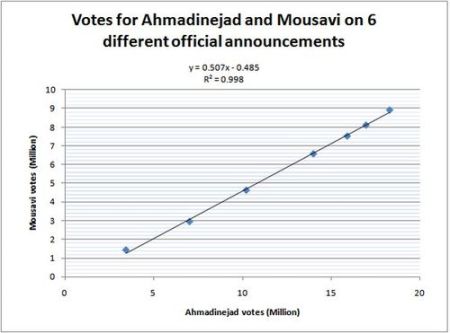
(Via Gary’s Choices, via the Corner.) (Previous post.)
UPDATE: Leaked election results, if accurate, show Ahmadinejad came in third. (Via Instapundit.)
Leave a Comment » | Geopolitical | Permalink
Posted by K. Crary
Iran’s fake election
June 15, 2009It’s chaos in Tehran. (Via the Corner.)
Michael Ledeen has often said that what Iran needs most is some western encouragement for its liberal dissidents. If there ever were a time for that, it’s now.
Leave a Comment » | Geopolitical | Permalink
Posted by K. Crary
Ex-detainees: Gitmo is better than China
June 13, 2009Fox News reports:
The four of the Chinese Muslims, or Uighurs, released to Bermuda from the Guantanamo Bay prison told FOX News that they are innocent, glad to be free and hold no grudges against the United States for their captivity. . .
The four, who range from 31 to 38 years old, also said they think life under oppressive rule in China, where they face persecution, is worse than life at Guantanamo.
Leave a Comment » | Geopolitical | Permalink
Posted by K. Crary
Iran’s fake election
June 13, 2009Opinion polls before the Iranian election gave Mir Hussein Moussavi a clear lead over incumbent president Mahmoud Ahmadinejad, putting Ahmadinejad on the defensive and fueling speculation that Moussavi might win outright in the first round. But, when they conducted the election, Ahmadinejad won in the first round, by an astounding 30 points. Moussavi even lost in his own home town.
Iranian polling is hardly reliable. If Ahmedinejad had squeeked by, no one could have said for certain that the election was a fraud. So why give him such an implausible margin of victory?
In truth, this matters only as a signal. The Iranian president has only the power that is permitted him by the mullahs and the “supreme guide.” A reformer (if indeed Moussavi is one, which is hardly clear) as president could not have undermined the mullahs’ agenda in any meaningful way. I think the mullahs are sending a signal that they like the job Ahmadinejad is doing and they don’t care what their people or the world think.
(Via Instapundit, and Instapundit.)
UPDATE: Daniel Pipes makes the case that this is actually for the best:
While my heart goes out to the many Iranians who desperately want the vile Ahmadinejad out of power, my head tells me it’s best that he remain in office. When Mohammed Khatami was president, his sweet words lulled many people into complacency, even as the nuclear weapons program developed on his watch. If the patterns remain unchanged, better to have a bellicose, apocalyptic, in-your-face Ahmadinejad who scares the world than a sweet-talking Mousavi who again lulls it to sleep, even as thousands of centrifuges whir away.
(Via the Corner.)
UPDATE: Rich Lowry coins a useful phrase to describe what we’ve seen: the mullahs over-stole the election. Sounds about right.
Also Max Boot agrees with Pipes. (Via Instapundit.)
Leave a Comment » | Geopolitical | Permalink
Posted by K. Crary
Agent provocateur
June 13, 2009The Economist reports:
THE death of Benno Ohnesorg stirred a whole movement of left-wing protest and violence. On June 2nd 1967 the newly wed student of literature joined a protest in West Berlin against the visiting shah of Iran. As he watched a commotion in the courtyard of a house into which police had chased some demonstrators, he was shot in the back of the head by a policeman, Karl-Heinz Kurras, who claimed he had been threatened by knife-wielding protesters.
This was a turning-point. In the eyes of many young Germans the state had unmasked itself as evil. Many joined what would become the 1968 student movement; some took up arms. “This fascist state wants to kill us all,” said Gudrun Ensslin, who went on to become a leader of the Red Army Faction terrorist group and died in prison in 1977.
Had she lived, she would be stunned to learn that Mr Kurras, now 81, had been a long-time agent of East Germany’s secret police, the Stasi. Historians trawling through the Stasi’s archives stumbled across 17 volumes chronicling Mr Kurras’s secret career.
I won’t shed a tear for the likes of Ensslin, who co-founded the Baader-Meinhof Gang (or Red Army Faction), Europe’s most infamous terrorist group. If one responds to the killing of an innocent by killing a lot more innocents, one had the makings of a terrorist all along. If not for this, something else would have have pushed her to become a terrorist.
But this is interesting, because this incident is a big part of the founding mythology of the Red Army Faction and other communist or anarchist groups. One, the June 2 Movement, is even named after it. This revelation puts that mythology in a substantially different light.
This concluding bit is odd, though:
The unmasking of Mr Kurras does not entitle Germans to pin the blame for Ohnesorg’s killing on East Germany. But it does remind them that the Stasi was at the heart of the regime’s nastiness.
It doesn’t? Why on earth not? It’s certainly in the nature of the Economist to try to be measured about everything, but come on. If the killing was done by a Stasi agent, it seems reasonable, even necessary, to pin it on the Stasi. If the Economist is saying that West Germany somehow facilitated the killing, they really ought to say how.
Leave a Comment » | Geopolitical | Permalink
Posted by K. Crary
Good news from Lebanon
June 7, 2009March 14 coalition wins, Hezbollah loses. (Via Instapundit.)
Leave a Comment » | Geopolitical | Permalink
Posted by K. Crary
UN performs to type
May 30, 2009The London Times reports:
An Egyptian cabinet minister who offered to burn Hebrew books last year entered the final straight as favorite for leadership of UNESCO Friday in the face of fierce opposition from Jewish groups and intellectuals in Europe.
Farouk Hosni, 71, an artist who has served as Culture Minister for 21 years, apologized this week for his book-burning call and is still deemed front-runner among seven contenders for the post of director-general of the Paris-based United Nations Educational, Scientific and Cultural Organization.
A book burner as the UN chief for education, science, and culture. That seems about right.
Leave a Comment » | Geopolitical | Permalink
Posted by K. Crary
Chavez versus labor
May 16, 2009The Economist reports:
HIS government espouses “21st-century socialism” and claims to stand for the working class. Yet Hugo Chávez, Venezuela’s president, has never been a fan of his country’s trade unions. He portrays them as corrupt vestiges of a capitalist past and of the previous political order. Ever since he was first elected, in 1998, he has sought ways to bring them to heel. Having first tried and failed to take over the main trade-union confederation, he encouraged a pro-government rival. Now he wants to bypass the unions altogether, by establishing in their place “workers’ councils” that amount to branches of the ruling Unified Socialist Party of Venezuela (PSUV).
A bill in the government-controlled National Assembly would eliminate collective bargaining and give powers in labour matters to the new councils. “The government’s policy is the total elimination of the union movement,” says Orlando Chirino, a former chavista who is one of the architects of the Labour Solidarity Movement, a new group which embraces unions from both sides of the country’s political divide and which defends union autonomy.
If this is surprising, you’re looking at Hugo Chavez the wrong way. Chavez is a totalitarian. He wants all power to rest with the government, under his control. Whatever he might feign to the people, his mission is not to serve the working class; his mission is to amass power for himself. Labor unions represent a power base distinct from his own, so he must destroy them.
Leave a Comment » | Geopolitical | Permalink
Posted by K. Crary
Venezuela seizes more oil facilities
May 8, 2009It’s a classic Venezuelan story: the state oil company stops paying oil contractors, so the oil contractors stop operating their facilities, so the government steps in to seize the contractors and their assets. It seems that the usual process for Chavez to confiscate private property was too time consuming, so he instituted a new process whereby he can confiscate property instantly.
I hope Chavez is happy with the oil facilities he has, because he’s ensuring that he’ll never have any more.
Leave a Comment » | Geopolitical | Permalink
Posted by K. Crary
Report warns of Iranian nuclear progress
May 7, 2009AP reports:
Congressional investigators say some foreign intelligence analysts believe U.S. intelligence is underestimating Iran’s progress toward designing a nuclear warhead before Tehran halted its program in 2003.
The foreign analysts believe that Iran ended its work because it had made sufficient progress, not because of international pressure, as the 2007 U.S. national intelligence assessment concluded.
The report by the Senate Foreign Relations Committee did not identify its sources, referring only to “intelligence analysts and nuclear experts working for foreign governments.” It says some research was conducted in Israel, which has been publicly critical of the 2007 U.S. assessment.
The foreign analysts believe “intelligence indicates Iran had produced a suitable design, manufactured some components and conducted enough successful explosives tests to put the project on the shelf until it manufactured the fissile material required for several weapons,” the report says.
Clearly this is just more warmongering from the neocons, like, er, John Kerry.
Leave a Comment » | Geopolitical | Permalink
Posted by K. Crary
Mini-Mao preparing for succession?
May 1, 2009Fox News reports:
North Korean dictator Kim Jong Il has begun shifting power away from the communist party apparatus and strengthened the authority of his country’s military, veteran watchers of the Stalinist regime have told FOX News.
The 67-year-old Kim, who appeared frail but engaged at a gathering of the Supreme People’s Assembly in Pyongyang on April 9, has wielded ultimate power in his country since 1994, but is now said to be making his first serious moves to establish a clear line of succession. The April gathering was his first public appearance before a large audience since the stroke he is believed to have suffered last August.
Leave a Comment » | Geopolitical | Permalink
Posted by K. Crary
Better late than never, maybe
April 27, 2009Politico reports:
Democrats in Congress are joining Republicans in calling for tough new sanctions on Iran and warning the Obama administration that its policy of engagement shouldn’t last too long before turning to harsher steps aimed at halting Tehran’s nuclear program.
This week, as many as 20 senators, including several senior Democrats in the House and Senate, are expected to join in introducing a bill that would authorize sanctions against companies involved in supplying gasoline and other refined petroleum products to Iran.
A similar bill is also in the works in the House. Last month, seven senior Democrats, including Majority Leader Steny Hoyer (D-Md.), warned President Barack Obama against “open-ended engagement with Iran.”
The administration is so far moving on a slower timetable, refusing to commit itself to new sanctions until it sees whether its diplomatic outreach to Iran produces results.
(Via Instapundit.)
I wonder what’s prompting this, new intelligence or new politics?
Leave a Comment » | Geopolitical, Political | Permalink
Posted by K. Crary
Venezuela’s economy tanks
April 24, 2009The Economist reports that Hugo Chavez is out of money for the social spending that props up his government. Viva la revolution!
Leave a Comment » | Geopolitical | Permalink
Posted by K. Crary
Empty seats at Durban 2
April 20, 2009The UN racism meeting will be boycotted (so far) by the United States, Canada, Australia, Germany, Sweden, Italy, Holland, Israel, and New Zealand. That’s more than I would have dared hope. (Mostly via LGF.)
Leave a Comment » | Geopolitical | Permalink
Posted by K. Crary
Maoists offended by comparison to Hitler
April 19, 2009AFP reports:
China’s official media and outspoken bloggers on Friday protested over a German advert promoting the use of condoms which shows revolutionary leader Mao Zedong as a sperm cell alongside Adolf Hitler and Osama bin Laden.
The Communist Party’s People’s Daily devoted a page to the storm, quoting internet commentaries which called for the makers of the advert to apologise to China.
(Via the Corner.)
Presumably, they are offended by the comparison of Mao — a truly accomplished mass murderer with 77 million murders to his name — with someone like Hitler (whose 21 million murders leave him a distant third place) or bin Laden (who hasn’t even come close to notching his first million, if not for lack of trying). I’m sure they feel that only Stalin (43 million murders) would be a worthy comparison.
POSTSCRIPT: For the record, I think the ad is in very poor taste, but certainly not because of any unfairness to history’s worst murderer.
Leave a Comment » | Geopolitical | Permalink
Posted by K. Crary
Venezuela’s endangered democracy
April 19, 2009Hugo Chavez’s political rivals continue to be arrested on trumped-up charges. The Economist reports the latest arrests under the heading “Venezuela’s endangered democracy.” Isn’t that a strange heading? Hasn’t Venezuela’s democracy been endangered since Chavez was given the power to rule by decree in 2000?
The only real limit to Chavez’s power has been the prospect that some day he might be forced from office. Now that presidential term limits has been revoked and his rivals are all being taken out of circulation, that prospect is all but gone. Democracy endangered? It’s over. It will take a revolution or a coup to oust him now.
Leave a Comment » | Geopolitical | Permalink
Posted by K. Crary
Comeuppance
April 15, 2009The Washington Post reports:
Russia may have to borrow money from international markets next year for the first time in a decade, Finance Minister Alexei Kudrin said Tuesday, as the government seeks to conserve cash amid a severe recession.
Russia last turned to foreign lenders in 2000. Since then, it had stashed windfall oil profits — helped by a surge in commodity prices — into a reserve fund and accumulated the third-largest foreign currency reserves in the world.
When oil prices were sky-high, Russia thought it could afford to invade neighboring Georgia. Now they’ve blown their wad and oil prices are back to normal, plus they’ve made themselves a pariah to foreign investors to boot. It couldn’t happen to a nicer tyrant.
Leave a Comment » | Geopolitical | Permalink
Posted by K. Crary
Go ahead, make my day
April 15, 2009The Washington Post reports:
President Evo Morales ended a five-day hunger strike after Bolivia’s congress broke a deadlock, approving a law that lets him run for reelection in December.
Sigh.
Leave a Comment » | Geopolitical | Permalink
Posted by K. Crary
Torture in Iran
April 6, 200960 Minutes’ piece on Ahmad Batebi is worth watching. Batebi is the Iranian dissident who was arrested and tortured for nine years after his picture appeared on the cover of the Economist.
Leave a Comment » | Geopolitical | Permalink
Posted by K. Crary
Iranian censorship rules leaked
April 6, 2009An Iranian news agency has leaked the censorship rules for the upcoming election. There’s a lot of them.
Leave a Comment » | Geopolitical | Permalink
Posted by K. Crary
Obama backs missile defense
April 5, 2009This is big, if he means it:
[President Obama] also gave his most unequivocal pledge yet to proceed with a missile defense system in Europe while Iran pursues nuclear weapons, as the West alleges. That shield is to be based in the Czech Republic and Poland. Those countries are on Russia’s doorstep, and the move has contributed to a significant decline in U.S.-Russia relations.
In the interest of resetting ties with Moscow, Obama previously had appeared to soft-pedal his support for the Bush-era shield proposal. But he adopted a different tone in Prague.
“As long as the threat from Iran persists, we will go forward with a missile defense system that is cost-effective and proven,” Obama said, earning cheers from the crowd.
This was in part a message to Russia, which has balked at using its influence to press Iran to drop its nuclear pursuits.
This could merely be part of an effort to strengthen our bargaining position with Russia. But even that would be an improvement over the idea that we might give up missile defense for Europe (and possibly even North America) in exchange for nothing at all.
UPDATE (9/17): He didn’t mean it.
Leave a Comment » | Geopolitical, Military | Permalink
Posted by K. Crary
Strikeout at Strasbourg
April 4, 2009At the NATO meeting in Strasbourg, President Obama made a failed plea for more troops for Afghanistan. NATO leaders agreed to send a small number of temporary, non-combat troops, but little else.
ASIDE: The number even of those varied curiously, from several hundred (the London Times), to five thousand (CNN). The Washington Post called it 3,000, and the New York Times called it “up to 5,000”.
The UK was the only one to offer substantial help (at least in the London Times’s telling). Once again, the US-UK alliance seems to be the only one capable of accomplishing anything. Two thoughts occur:
First, Operation Iraqi Freedom was derided as illegitimate because it consisted largely of the US and UK (and Spain, Australia, Poland, Denmark, and the Kurds). Will President Obama’s campaign to stabilize Afghanistan be similarly seen as illegitimate? (I hope not. Consistency can be overrated.)
Second, how stupid is it to drop the special relationship with Britain, as some seem determined to do? I’m not aware that the White House has even repudiated the statement.
Leave a Comment » | Geopolitical | Permalink
Posted by K. Crary
US signs air base deal with Uzbekistan
April 3, 2009Good news. Working with Uzbekistan will be a headache in the long run, but we need a replacement for Manas Air Base in Kyrgyzstan, at least for now.
Leave a Comment » | Geopolitical, Military | Permalink
Posted by K. Crary
 Internet Scofflaw
You must be logged in to post a comment.