Pittsburgh-Delta deal backfires

March 24, 2010

Oops:

The relatively new nonstop Delta (DAL) flight from Pittsburgh to Paris may very well be in trouble. It’s not meeting its revenue targets, and that’s going to cost the city a lot of money. Next year, Delta may simply pull out entirely. This shows that while cities may think they deserve transatlantic service, that’s not always the case.

Pittsburgh International Airport used to be a thriving US Airways hub with nonstop service to Europe. When US Airways cut things down to size in Pittsburgh, the city wanted desperately to get its European flights back. So last year, it entered into a revenue guarantee agreement with Delta Air Lines. Delta would come in and fly to Paris and the state, along with the Allegheny Conference on Community Development, would cover any losses. . .

The subsidies will last until June 2011, two years into the service. For the first year, if the flight underperformed, Delta could be reimbursed with up to $5 million. It looks like they’ll get the maximum. My guess is they’ll have more money coming in year two.


Hoyt gets one right

March 24, 2010

I criticize Clark Hoyt (the New York Times ombudsman) a lot, so it seems only fair to note when he gets one right. It doesn’t change the pattern; he’s still defending his paper, this time from the left. But at least he has the facts on his side this time.


Obama misunderstands his own bill

March 24, 2010

AP reports:

Under the new law, insurance companies still would be able to refuse new coverage to children because of a pre-existing medical problem, said Karen Lightfoot, spokeswoman for the House Energy and Commerce Committee, one of the main congressional panels that wrote the bill President Barack Obama signed into law Tuesday. However, if a child is accepted for coverage, or is already covered, the insurer cannot exclude payment for treating a particular illness, as sometimes happens now. . .

In recent speeches, Obama has given the impression that the immediate benefit for kids is much more robust.

Full protection for children would not come until 2014, said Kate Cyrul, a spokeswoman for the Senate Health, Education, Labor and Pensions Committee, another panel that authored the legislation. That’s the same year when insurance companies could no longer deny coverage to any person on account of health problems.

Obama’s public statements conveyed the impression that the new protections for kids were sweeping and straightforward. . . The president said Friday at George Mason University in Virginia. . . “Starting this year, insurance companies will be banned forever from denying coverage to children with pre-existing conditions.”

Did anyone read the bill?

(Via the Corner.)

UPDATE: More here and here. (Via Instapundit.)


Good riddance

March 24, 2010

Hannah Giles is dancing on ACORN’s grave. I think she’s earned it.

I don’t doubt that this is just a tactical retreat, and they’re planning to re-emerge under a new name, one that’s not associated with election fraud, child prostitution, and human trafficking. Still, the good guys won this round.


Seven sweetheart deals in the health care bill

March 24, 2010

Power Line has the details. It’s going to take work just to name them all.


The Scofflaw Principle

March 23, 2010

On the occasion of the second anniversary of Internet Scofflaw, it seems like a good time to explain the name of the blog. The blog is named in honor of the Scofflaw Principle.

Simply put, the Scofflaw Principle says that adult humans are free, and that no one but our creator has the rightful authority to impose rules on us without our consent. Consequently, we are under no moral obligation to obey rules to which we have not consented. The reason we do not murder, cheat, or steal is not because civil authorities have made such acts illegal, but because they violate the moral code given us by our creator.

However, while the civil authorities may have no rightful authority to burden us with rules and regulations, they do have the power to do so. Therefore, while we have no moral obligation to obey their rules, we may find it expedient to do so. Such decisions are made on the basis of our own evaluation of costs and benefits.

I always pay my taxes, even though they go well beyond what the government has any right to demand of me, because if I refuse to do so, it is likely that I will be caught and the penalty is high. On the other hand, I almost never obey Pittsburgh’s ubiquitous no-turn-on-red signs, because I am unlikely to be caught and the penalty is slight.

The Scofflaw Principle clarifies our relationship with the civil authorities. The government is no different from anyone else that seeks to control our actions through coercion. When no moral imperative is at issue, we comply or not based solely on our own assessment of the risks. Some suggest that we have a duty to disobey laws that are improperly constituted. But the Scofflaw Principle says that whether the law is “proper” is beside the point. In the absence of a moral imperative, what matters is whether the government has the power to punish us for breaking it.

There are those who claim that we are not actually required under the law to fulfill various obligations (such as paying taxes). The legal theories underlying such claims are extremely far-fetched, but that’s beside the point. Regardless of what the law “really” says, the fact remains there is no possibility of prevailing in court with such a theory. As a practical matter, the law is whatever the courts say. Expecting courts to do the “right” thing merely sets us up for disappointment.

This is not to say that the rule of law is not important. Our lives are inestimably better when the civil authorities are not capricious, and the rule of law is (or used to be) the most important factor limiting their caprice. The same goes for other principles of good government such as democracy, checks and balances, and separation of powers. None of these principles give the government the moral prerogative to command us, but they do serve to limit governmental caprice.

Finally, a caution. The Scofflaw Principle cuts both ways: the whims of the civil authorities carry no moral authority in either direction. While we need not heed their demands, neither may we accept their warrant. Just because government sanctions an action does not make it moral. We cannot rely on government to tell us what is right any more than what is wrong. We must make moral decisions for ourselves.


Happy bloggiversary

March 23, 2010

Internet Scofflaw turns two today.


Distrust and verify

March 23, 2010

The Economist reports:

Barack Obama was asked when he was in Copenhagen whether a provision by which countries could peek into each others’ assessment processes was strong enough to be sure there was no cheating. He answered reassuringly that “we can actually monitor a lot of what takes place through satellite imagery”. That statement conjured up thoughts of the sort of cold-war satellite system that America used to identify and count Russian missiles. But the president was being a bit previous; at the moment, no such system exists, because America’s Orbiting Carbon Observatory (OCO), a satellite that would have fulfilled the role, was lost on launch this time last year.

(Emphasis mine.)

It’s good to know that the president is making decisions based on the best scientific advice.


We still don’t want this bill

March 23, 2010

Rasmussen finds that 49% favor their state suing the federal government to overturn health care nationalization. Only 37% disagree.

UPDATE: A CBS poll finds that 62% want Republicans to continuing challenging the bill.


Duncan rigged school admissions for political allies

March 23, 2010

This is a huge scandal, even for Chicago. Isn’t it? Or is it okay for the politically well-connected to get special treatment?

While many Chicago parents took formal routes to land their children in the best schools, the well-connected also sought help through a shadowy appeals system created in recent years under former schools chief Arne Duncan.

Whispers have long swirled that some children get spots in the city’s premier schools based on whom their parents know. But a list maintained over several years in Duncan’s office and obtained by the Tribune lends further evidence to those charges. Duncan is now secretary of education under President Barack Obama.

The log is a compilation of politicians and influential business people who interceded on behalf of children during Duncan’s tenure. It includes 25 aldermen, Mayor Richard Daley’s office, House Speaker Michael Madigan, his daughter Illinois Attorney General Lisa Madigan, former White House social secretary Desiree Rogers and former U.S. Sen. Carol Moseley Braun.

Non-connected parents, such as those who sought spots for their special-needs child or who were new to the city, also appear on the log. But the politically connected make up about three-quarters of those making requests in the documents obtained by the Tribune. . .

The list surfaced amid a federal probe and an internal investigation into admissions practices at the city’s top high schools. Until Monday, the district had not revealed it had kept such a list. . .

Pickens [a former aide to Duncan] acknowledged the list was kept confidential. The vast majority of parents who follow the system’s school application process never knew they could appeal to Duncan’s office for special consideration.

“We didn’t want to advertise what we were doing because we didn’t want a bunch of people calling,” Pickens said.

They didn’t want a bunch of people calling. The appeals process wasn’t for them.

(Via Hot Air.)


Defending the kickback

March 22, 2010

The reconciliation bill rescinds Ben Nelson’s Cornhusker Kickback. Nelson has announced he will vote against the reconciliation bill. You do the math.

POSTSCRIPT: Yes, I do oppose the reconciliation bill. It makes a bad bill worse, and it doesn’t even rescind the kickback the right way. (Rather than removing the deal it gives it to every state.) But on this subject Nelson gets no benefit of the doubt.

(Via Instapundit.)


Lies, Damn Lies, and Paul Krugman

March 22, 2010

Paul Krugman, serial liar:

Here’s what Newt Gingrich, the Republican former speaker of the House — a man celebrated by many in his party as an intellectual leader — had to say: If Democrats pass health reform, “They will have destroyed their party much as Lyndon Johnson shattered the Democratic Party for 40 years” by passing civil rights legislation. . .

I want you to consider the contrast: on one side, the closing argument was an appeal to our better angels, urging politicians to do what is right, even if it hurts their careers; on the other side, callous cynicism. Think about what it means to condemn health reform by comparing it to the Civil Rights Act. Who in modern America would say that L.B.J. did the wrong thing by pushing for racial equality? (Actually, we know who: the people at the Tea Party protest who hurled racial epithets at Democratic members of Congress on the eve of the vote.)

So there you have it: opposing health care nationalization is racist. A little later, he actually comes out and says it: “It was racial hate-mongering.”

The attack on the tea party as racist is a standard rhetorical flourish. Some Democrats claim they heard racial epithets from the crowd. There’s no way to disprove it, and in a crowd of thousands, I wouldn’t be surprised if there were a few cranks. No one is taking that line of attack seriously, which is why Krugman only uses it as a throwaway line. The center of his attack is that Newt Gingrich is a racist, and by association, anyone else who opposes health care nationalization must be too.

But that attack is false, as the New York Times sheepishly admits:

This column quotes Newt Gingrich as saying that “Lyndon Johnson shattered the Democratic Party for 40 years” by passing civil rights legislation, a quotation that originally appeared in The Washington Post. After this column was published, The Post reported that Mr. Gingrich said his comment referred to Johnson’s Great Society policies, not to the 1964 Civil Rights Act.

What a fool. Krugman poses as the expert commentator who can tell us what is really happening and why. He frequently attributes thoughts and motives to his enemies based on nothing more than speculation. In fact, this column makes clear that Krugman hasn’t a clue what motivates his opponents. If he actually knew anything about Newt Gingrich, he would know that Gingrich would never say that. Gingrich has a substantial record — if Krugman cared to look at it — and it makes clear that Gingrich believes the Civil Rights Act was right and has been vindicated by history. LBJ is vilified for many things in Republican circles, and justly so, but the Civil Rights Act is not one of them.

But Krugman doesn’t achieve his insights into his enemies’ character through studying their writings and speeches. He gets it all from his own fevered imagination, in which all are rendered as mere parodies of themselves. Paul Krugman is nothing more than a curiously respectable Keith Olbermann.

The New York Times gets credit, I guess, for having the honesty to run the correction. Usually they don’t correct errors and lies in columns. But then they give most of that credit back for refusing to take the blame. Trying to shift blame to the Washington Post? Lame. The New York Times purports to be a major newspaper, but they can’t even bother to check an obviously bogus quote on which an entire column is erected?

But the Washington Post gets a full helping of blame of its own. First, the story was obviously wrong. (Gingrich’s record aside, here’s another hint the story was wrong: the direct quotation includes no mention of civil rights legislation.) Worse, they never affixed a correction to the article, and instead relegated to a post on the Washington Post blog.

(Via Instapundit.)


Prior restraint

March 22, 2010

The provost of the University of Ottawa has written to Ann Coulter in advance of her upcoming visit to the Ottawa Campus Conservatives, threatening her with prosecution if she says anything that violates Canadian censorship laws.

It’s disgusting enough that Canada has those laws in the first place, but it might be even worse to see the a university provost using those laws to intimidate a campus speaker.

Well, I guess as Dean Steacy (Canadian “human rights” investigator) put it, freedom of speech is an American concept, without value in Canada.

(Via Instapundit.)


Guantanamo 2

March 22, 2010

The Obama administration is considering reconstituting the Guantanamo prison at Bagram Air Force base in Afghanistan:

The White House is considering whether to detain international terrorism suspects at a U.S. military base in Afghanistan, senior U.S. officials said, an option that would lead to another prison with the same purpose as Guantanamo Bay, which it has promised to close. . .

That the option of detaining suspects captured outside Afghanistan at Bagram is being contemplated reflects a recognition by the Obama administration that it has few other places to hold and interrogate foreign prisoners without giving them access to the U.S. court system, the officials said.

The Guantanamo prison isn’t closed yet, but it has ceased taking new prisoners. This has already created a disaster of lost intelligence:

Without a location outside the United States for sending prisoners, the administration must resort to turning the suspects over to foreign governments, bringing them to the U.S. or even killing them.

In one case last year, U.S. special operations forces killed an Al Qaeda-linked suspect named Saleh Ali Saleh Nabhan in a helicopter attack in southern Somalia rather than trying to capture him, a U.S. official said. Officials had debated trying to take him alive but decided against doing so in part because of uncertainty over where to hold him, the official added.

I’m sure there was nothing we could have learned from him. . .

(Via Instapundit.)


Immediate benefits

March 22, 2010

The House Democrats have posted a list of immediate “benefits” people will see from the health care bill:

  • Prohibit pre-existing condition exclusions for children in all new plans;
  • Provide immediate access to insurance for uninsured Americans who are uninsured because of a pre-existing condition through a temporary high-risk pool;
  • Prohibit dropping people from coverage when they get sick in all individual plans;
  • Lower seniors prescription drug prices by beginning to close the donut hole;
  • Offer tax credits to small businesses to purchase coverage;
  • Eliminate lifetime limits and restrictive annual limits on benefits in all plans;
  • Require plans to cover an enrollee’s dependent children until age 26;
  • Require new plans to cover preventive services and immunizations without cost-sharing;
  • Ensure consumers have access to an effective internal and external appeals process to appeal new insurance plan decisions;
  • Require premium rebates to enrollees from insurers with high administrative expenditures and require public disclosure of the percent of premiums applied to overhead costs.

Let me paraphrase:

  • Make private coverage more expensive.
  • Offer a government subsidy.
  • Make private coverage more expensive.
  • Make Medicare more expensive.
  • Offer a government subsidy.
  • Make private coverage more expensive.
  • Make private coverage more expensive.
  • Make private coverage more expensive.
  • Nothing.
  • Make private coverage more expensive.

A couple of these (the appeals process and the high-risk pools) might be good ideas if they’re well-implemented (which I doubt), but every single one of them increases costs. I mention this because they go on to say:

By enacting these provisions right away, and others over time, we will be able to lower costs for everyone and give all Americans and small businesses more control over their health care choices.

Amazing. They list ten items that increase costs, and then somehow claim they are lowering costs for everyone.  Similarly, they say that they give Americans more control over their health care choices, but most of the items on their list foreclose choices. (You want to choose basic minimal coverage? Too bad.) In fact, all of them do, because cost is the greatest choice restrictor of all.

They really are completely out of touch with reality.

UPDATE: From what I’ve been reading (for example), the appeals process item really doesn’t do anything at all.


Ryan tells it like it is

March 22, 2010

The only silver lining I see in this disaster is the emergence of Paul Ryan. Before the health care debate began, most of us had never heard of him.


Preview of coming disaster

March 22, 2010

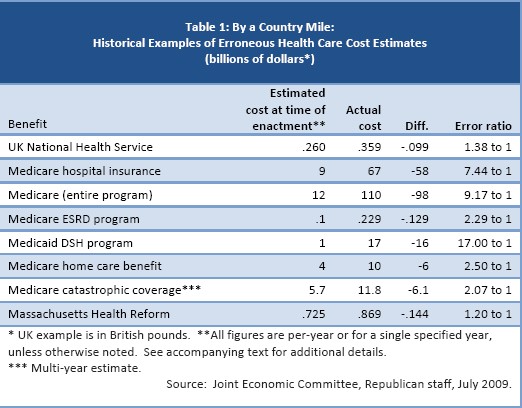
The health care bill will cost much more than projected:

Holy crap! Medicare was off by nearly an order of magnitude! Also, the taxes that purport to cover it will be unproductive.  We’re looking at utter disaster on the fiscal side of things alone.

(Via Instapundit.)


Fight

March 22, 2010

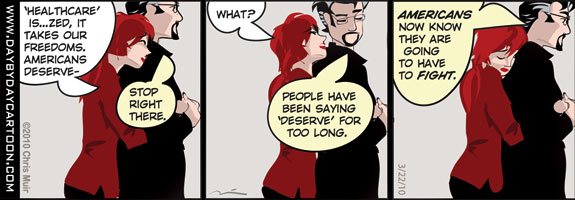
Chris Muir nails it.

We like to believe our government is basically benign. It’s not. It’s us versus them.


Make them pay

March 21, 2010

Democrats sent a clear message today: “F*** you America; we know best.” Now it’s our job to make them pay for their arrogance.


Chavez denies internet crackdown

March 21, 2010

Yeah, whatever:

Venezuelan President Hugo Chavez denied that the government plans to impose controls on the Internet, saying Sunday that his administration aims to increase Web access rather than limit it.

Earlier this month, Chavez sparked concerns of a possible crackdown on Web sites critical of his government when he called for regulation of the Internet and urged prosecutors to act against Noticiero Digital, a site popular among his opponents.

Chavez has become increasingly critical of social networking sites such as Twitter and Facebook and says adversaries use them to deceive the public.

In addition to being obviously full of it, Chavez had some trouble staying on message:

Chavez also told his audience that government critics often use the Web “to generate panic,” and said such actions “cannot be permitted.”


We don’t want this bill

March 21, 2010

A review of public opinion on the day of the vote: 54% oppose the bill. More people (45%) strongly oppose the bill than favor it (41%). 55% say that Congress should scrap the bill and start over. The numbers have scarcely budged for months.

57% say the cost of health care will go up. Hardly anyone (17%) says costs will go down. 54% say the quality of care will go down. 57% say the plan will hurt the economy. 81% say it will cost more than projected. 51% say they fear the government more than private insurers.

Just 20% believe Congress understands the bill it’s voting on. Despite all the above, people expect the bill to pass. In accordance with that expectation, just 21% say the government has the consent of the governed.

UPDATE: The CNN poll is even more lopsided but in the same ballpark: 59% oppose, 39% support. (Via Instapundit.)


Stupak folds

March 21, 2010

The word on the street is the Stupak is buying the meaningless executive order. Without the Stupak bloc, today’s vote is a forgone conclusion.

The lesson here is never to rely on a Democrat to do the right thing.

UPDATE: Stupak’s office is denying this. We’ll see.

UPDATE: There is indeed a deal. So much for the “strong” denials out of Stupak’s office.

It looks as though the pro-life Democrats have gone the way of the national-security Democrats.

UPDATE: Well put:

On Stupak, he was like watching an overmatched pitcher in a baseball game hold off a much more formidable opponent only to surrender the game-winning home run in the ninth inning. He simply ran out of gas and backbone. So very sad to see this late in the game. He obviously couldn’t stand up to the pressure. Too bad we had to watch all nine innings thinking he (and other pro-life Democrats) would pull out a victory.

Indeed. Part of what’s so maddening about this is I really came to believe that Stupak was committed to the cause. It turns out I was wrong about which cause.


Broken promises

March 20, 2010

AP reports:

It was a bold response to skyrocketing health insurance premiums. President Barack Obama would give federal authorities the power to block unreasonable rate hikes.

Yet when Democrats unveiled the final, incarnation of their health care bill this week, the proposal was nowhere to be found.

Ditto with several Republican ideas that Obama had said he wanted to include after a televised bipartisan summit last month, including a plan by Sen. Tom Coburn of Oklahoma to send investigators disguised as patients to hospitals in search of waste, fraud and abuse.

And those “special deals” that Obama railed against and said he wanted to eliminate? With the exception of two of the most notorious — extra Medicaid money for Nebraska and a carve-out for Florida seniors faced with losing certain extra Medicare benefits — they are all still there.

For the White House, these were the latest unfulfilled commitments related to Obama’s health care proposal, starting with his campaign promise to let C-SPAN cameras film negotiations over the bill.

We can be thankful that the price controls were abandoned. As for the rest, well, who really believed him anyway?

UPDATE: To be clear, although the overt price caps may be out, the bill still does bar insurers from setting actuarially fair prices. Specifically, insurers are prohibited from considering most risk factors in setting their prices. Thus, costs are pushed down for high-risk clients and pushed up for low-risk clients.


Succinctly put

March 20, 2010

Alcee Hastings (D-FL):

There ain’t no rules here, we’re trying to accomplish something. . . .All this talk about rules. . . . When the deal goes down . . . we make ’em up as we go along.

UPDATE: By the way, how crazy is it that a man who was impeached from the federal bench for corruption is now on the House rules committee?


Don’t trust the CBO score

March 20, 2010

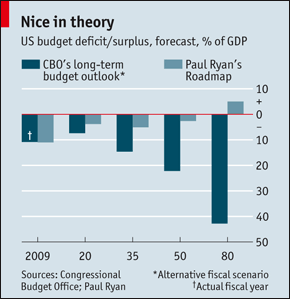
Greg Mankiw underscores something I keep saying: The Congressional Budget Office scores legislation statically, meaning that they assume the path of GDP is unchanged. But the path of GDP would not remain unchanged:

Recall that the bill raises taxes substantially. Some of these tax hikes are the explicit tax increases on capital income to pay for the insurance subsidies. Some of these tax hikes are the implicit marginal rate increases from the phase-out of the insurance subsidies as a person’s income rises. Both of these would be expected to reduce GDP growth. Indeed, to be very wonkish about it, these tax changes could have especially large GDP effects.

Also, we all know about the bogus “doc fix” problem in the CBO numbers, wherein the score assumes big future cuts in Medicare reimbursements that will never happen. Keith Hennessey points out that the reconciliation bill creates a new “doc fix” problem in Medicaid. Starting in 2015, the bill states that Medicaid reimbursements will be cut by $29 billion (over the remaining five years in the ten-year budget window). Obviously, that will never happen either.

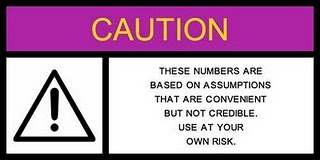
The static scoring is simply how business is done at the CBO, despite the unrealism of it, but the new funding cliff in Medicaid is simply dishonest. (And remember, the Democrats needed every penny of purported savings in order to get their bill across the line where it can be considered in the Senate under reconciliation instructions.) Now that Congress has learned to rig CBO scores by including blatant lies, I think the CBO isn’t useful any more.

(Via Instapundit.) (Graphic above due to Greg Mankiw.)


White House pressures federal workers to support health care reform

March 19, 2010

CBS reports:

The White House Office of Health Reform Director Nancy-Ann DeParle has been feverishly sending out unsolicited email messages to federal employees in an effort to build support for President Barack Obama’s health reform package over the last several weeks.

DeParle’s unsolicited emails have been regularly coming to some federal employees’ official government email inboxes for weeks without permission or request, causing some federal employees to feel threatened by the overt political language.

The Department of State employees, who receive hundreds of official government emails every day, have complained about the annoying and partisan emails but are nervous to go public for fear of retribution. The emails are addressed to the federal employees by name and use the official .gov address.

The unsolicited emails also request that the federal employees take action in order to ensure that Obama’s health reform package is passed and the federal budget isn’t at risk for bankruptcy.

Surely this must be illegal. Doesn’t the Hatch Act prohibit this?

(Via Patterico.)

UPDATE: It is indeed illegal.


The terrible, horrible, no-good very bad process

March 19, 2010

In my last post, I summarized why the bill is a travesty. It’s also worth looking at why the process that brought this bill to the brink of passage has been a travesty. So here is a non-exhaustive list of things the Democrats had to do to get here:

  • Ignore the will of the American people, of course.
  • Abandon every pretense of transparency.
  • Shamelessly game the Congressional Budget Office.
  • Buy votes with special deals for certain states (Connecticut, Florida, Louisiana, and Nebraska, among others) and for labor unions.
  • Buy the support of the American Medical Association by promising a permanent Medicare reimbursement fix, then renege.
  • Buy the support of pharmaceutical companies, then renege.
  • Attempt to buy the support of medical device companies, then punish them for refusing.
  • Adopt the Slaughter rule (although they might back off this).
  • Promise to ram a reconciliation bill through the Senate. (Whether they actually keep the promise remains to be determined.)
  • Use a manager’s amendment after previously condemning them.
  • Accept Roland Burris — a perjurer appointed by a criminal — to the Senate, rather than risk a special election.
  • Shamelessly change the law in Massachusetts to allow the governor to appoint a Senator.
  • Steal the Senate election in Minnesota.

The terrible, horrible, no-good, very bad bill

March 19, 2010

Let’s see if we can summarize briefly what’s wrong with the bill:

  • It leaves a nominally private health insurance industry in place, but the government will dictate what policies are sold, to whom, and at what price. In other words, it turns health insurance into a public utility. (UPDATE: Joe Biden says “We’re going to control the insurance companies.”)
  • It bends the cost curve upwards.
  • It costs a bazillion dollars.
  • It funds abortion.
  • It requires low-risk people to subsidize high-risk people.
  • It imposes price controls, which invariably lead to shortages. (UPDATE: I’ve read that the price controls have been abandoned. I certainly hope so.)
  • It denies individuals the right to decide for themselves whether to buy insurance.
  • It imposes new taxes on medical devices and pharmaceuticals, thereby discouraging innovation.
  • It sets the stage for health care rationing.
  • It bans some health insurance policies.
  • It imposes unjust and onerous taxes.
  • It includes payoffs for influential states and interest groups. (Yes, still.)
  • It is unconstitutional. (Interstate commerce, my foot. There isn’t any interstate commerce in health insurance.)
  • It undermines public confidence in our democracy.
  • It expands the power of the IRS.
  • It raids student loans.
  • It undermines Medicare by taking the savings from Medicare reforms and spending them elsewhere.
  • It is designed to fail, thereby justifying future government action to meddle further.
  • UPDATE: It creates a new funding cliff in Medicaid, similar to the one in Medicare.

IRS to enforce health care bill

March 19, 2010

Great idea, let’s use the second-most-reviled government agency (after the INS) to review everyone’s health care:

House Republicans said Thursday that the health care overhaul will expand IRS authority by giving agents the power to verify acceptable health care coverage and fine or confiscate the tax refunds of Americans without coverage.

The IRS will now be involved in both death and taxes.

(Via Instapundit.)


Health care adds a massive tax on investments

March 19, 2010

AP reports:

For the first time, the Medicare payroll tax would be applied to investment income, beginning in 2013. A new 3.8 percent tax would be imposed on interest, dividends, capital gains and other investment income for individuals making more than $200,000 a year and couples making more than $250,000. . .

The new tax on investment income is higher than the 2.9 percent tax proposed by President Barack Obama. House Democratic leaders increased it so they could reduce the impact of a new tax on high-cost health insurance plans strongly opposed by labor unions.

Keep in mind that taxes on dividends and capital gains are fundamentally unjust in the first place, since much of that “income” is simply inflation. It’s shameless: First the government steals your buying power by printing money. Then, if you invest wisely to compensate for inflation, they tax your resulting “gains”.

But this is worse than a mere tax hike; it also carries a severe compliance burden:

Medicare payroll taxes traditionally have been low and predictable: a 1.45 percent tax on wages, paid by both employers and workers. The money is taken out of workers’ pay before they see it. There are no forms to file, no deductions to claim.

Under the new health care bill, married couples with combined incomes approaching $250,000 would have to keep tabs on their spouses’ pay to avoid an unexpected tax bill. Those with investments would have to pay even more attention to the income they earn from interest, dividends and capital gains.

“Unless they are very conscientious folks who constantly monitor their income tax withholding, they’re going to have quite a surprise when they go to file their income taxes,” said Jeffrey L. Kummer, director of tax policy at Deloitte Tax LLP.

Finally, I suppose it’s worth pointing out that the president is once again breaking his no-tax-hikes-under-$200k pledge. Two people making $125k each would see a tax hike if they happened to be married.


Health care bill raids student loans

March 19, 2010

As I predicted, the health care bill raids students loans to help pay for health care nationalization. The student loan takeover bill would have used $61 billion in savings from taking over the student loan program to expand the Pell Grant program. However, Democratic leaders were having trouble making their health care reconciliation bill come out even (it cannot be considered under Senate rules if it expands the deficit) so they siphoned off $10 billion of that pool.

This gives an indication of where Democratic priorities are.

POSTSCRIPT: Some will try to rebut this by pointing out that the original legislation also dedicated $10 billion to deficit reduction, but that was when the takeover was expected to net $87 billion in savings, enough to pay for the Pell Grant expansion with money to spare. The CBO later reduced its savings estimate to less than the expansion would cost, necessitating a smaller expansion than originally planned. The decision to set aside $10 billion to offset health care nationalization will reduce it further.


We are all scofflaws now

March 19, 2010

The typical American driver goes 70 mph on the highway, regardless of the posted speed limit.


Obama unpopularity overtakes Bush

March 19, 2010

In the latest Rasmussen poll, President Obama’s strong-disapproval rating is at 44%. In comparison, President Bush’s strong-disapproval rating was at 43% when he left office. The vast majority (75%) say they are angry about government policies, and 45% say they are very angry.

Opinion of Congress is also terrible. The vast majority (71%) say that Congress is doing a poor job. Just 10% say it is doing well. Only 21% say the government enjoys the consent of the governed. The blame is falling on the majority party: The GOP lead on the generic ballot is at 10%, their greatest lead yet. (That’s pretty impressive, considering that people don’t even like Republicans.) Two-thirds disapprove of Nancy Pelosi, and 56% disapprove of Harry Reid. (There’s also considerable disapproval of GOP leaders, but not a majority.) Pollster Frank Luntz says the Unabomber has a higher approval rating that some members of Congress.


Obama imposes arms embargo on Israel

March 19, 2010

President Obama has reportedly cut off weapons shipments to Israel:

The United States has diverted a shipment of bunker-busters designated for Israel.

Officials said the U.S. military was ordered to divert a shipment of smart bunker-buster bombs from Israel to a military base in Diego Garcia. They said the shipment of 387 smart munitions had been slated to join pre-positioned U.S. military equipment in Israel Air Force bases.

“This was a political decision,” an official said. . .

Since taking office, Obama has refused to approve any major Israeli requests for U.S. weapons platforms or advanced systems. Officials said this included proposed Israeli procurement of AH-64D Apache attack helicopters, refueling systems, advanced munitions and data on a stealth variant of the F-15E.

“All signs indicate that this will continue in 2010,” a congressional source familiar with the Israeli military requests said. “This is really an embargo, but nobody talks about it publicly.”

I’ve not heard of World Tribune, the site that ran this story, so take it with a grain of salt. But if it’s true, it seems to answer definitively whether Obama is friendly to Israel.


Obama: do it for me

March 18, 2010

Politico reports:

President Barack Obama had exhausted most of his health care reform arguments with members of the Congressional Hispanic Caucus during a White House meeting last Thursday when he made a more personal pitch that resonated with many skeptics in the room.

One caucus member told POLITICO that Obama won him over by “essentially [saying] that the fate of his presidency” hinged on this week’s health reform vote in the House. The member, who requested anonymity, likened Obama’s remarks to an earlier meeting with progressives when the president said a victory was necessary to keep him “strong” for the next three years of his term.

(Via Instapundit.)


The CBO score

March 18, 2010

The Democratic leadership has finally released their bill, with its preliminary CBO score. The final CBO score won’t come out for a few days, possibly after the vote takes place. There’s a very good chance that the House will be voting on the bill without knowing its exact cost.

The exact cost matters, as it turns out. The reconciliation instructions require that the reconciliation bill cut the deficit by at least $1 billion; otherwise it can’t be considered. Now, $1 billion isn’t much, but with the reconciliation bill adding $170 billion to the cost, the Democratic leadership had to find at least $171 in tax hikes or savings to hit the mark.

It took them a few iterations to do so (that’s why the bill was delayed), but they eventually got to exactly $171 billion. That’s good enough for the Democrats, if that score holds up. But if the final score worsens by even $1 billion, the reconciliation bill will be dead.

Once again, the House Democrats are fools if they go for this. They are being asked to trust not only that Senate Democrats will act on the reconciliation bill unamended and Senate Republicans will fail to block it, but also that the CBO score won’t change one iota.

(Previous post.)


Still no bill

March 17, 2010

Democratic leaders still haven’t been able to produce a bill that gives them the CBO score they need. If the bill doesn’t come out in the next two hours, and sources say it won’t, they won’t be able to hold a vote on Saturday and fulfill their promise to post the bill 72 hours before the vote. (I don’t find this surprising, since I didn’t expect them to keep either promise.)

(Previous post.)


Another town bans bible studies

March 17, 2010

Gilbert, Arizona is in the process of repealing its unconstitutional ban on bible studies in the home, but a California town is standing by its ban:

For the second time in six months, the city has ordered a group of Christian worshippers who meet inside homes to get a permit or shut down.

It’s the latest incident in which religious groups in Southern California have been targeted by cities for home gatherings, though many of those groups were eventually allowed to meet without obtaining permits.

Rancho Cucamonga is trying to halt Friday night meetings at a home after receiving a complaint in February from a neighbor that 40 to 60 people were gathering weekly in the San Bernardino County location.

Officials said the homeowner needs a conditional use permit by Good Friday, April 2, to operate a church in a residential area.

Pacific Justice Institute, a nonprofit legal defense group that specializes in conservative Christian issues, said the meetings were actually a Bible study group that usually draws about 15 people.

The permit requires public hearings, traffic studies and other costly procedures. Requiring one would be “manifestly absurd and unjust,” according to a statement Tuesday from Brad Dacus, president of the Sacramento-based institute.

The city doesn’t require permits for similar-sized gatherings, “everything from birthday parties to the weekend beer bash,” added Matt McReynolds, an institute attorney.

These folks should go ahead with their meetings without a permit. There’s no way that the town’s effort to shut them down will stand up in court.

(Previous post.)


Still no bill

March 16, 2010

Democrats have still not released their latest health care bill and its CBO score, because they didn’t like the CBO score it got:

House Democratic leaders are still struggling to produce a final health care overhaul bill at an acceptable official cost estimate, but Majority Leader Steny H. Hoyer said Tuesday they continue to plan a final vote this week. House leaders were to huddle late Tuesday afternoon, following a noon session of the full Democratic Caucus. There were reports they are having trouble drafting a bill that meets their budgetary targets….

Rank-and-file Democrats did not talk about the details, but said that the CBO scores had come up short. “They were less than expected” in terms of deficit reduction, said Rep. Gene Green, D-Texas, who plans to vote for the bill.

Not only are the Democrats tossing aside their promise of transparency in the health care negotiations, they aren’t even letting us see the bills they send to the CBO.  Oh well, I suppose it’s passé to complain about the lack of transparency at this point.

The article has some more interesting details. The reconciliation instructions require that the reconciliation bill come out even in the budget (strictly speaking, it has to reduce the deficit by $1 billion, but that’s nothing these days). Their problem is that most of the changes they want to make to the Senate bill cost money, which they need to recoup somehow or they can’t use reconciliation.

Another interesting tidbit: they’ve decided to combine the health care nationalization bill with the student loan nationalization bill. That gives them another source of savings they can tap: student loans. Will Democrats decide to raid student loans (in a bill that is supposed to improve them) in order to get the number they need to overcome procedural obstacles to health care nationalization? I wouldn’t bet against it.

(Via the Corner.)


No US flag in Haiti

March 16, 2010

Army Times reports:

The many nations helping Haiti recover from the devastating earthquake that struck there have set up their own military compounds and fly their flags at the entrances.

France’s tricolor, Britain’s Union Jack and even Croatia’s coat of arms flap in the breeze.

But the country whose contributions dwarf the rest of the world’s — the United States — has no flag at its main installation near the Port-au-Prince airport.

The lack of the Stars and Stripes does not sit well with some veterans and servicemembers who say the U.S. government should be proud to fly the flag in Haiti, given the amount of money and manpower the U.S. is donating to help the country recover from the Jan. 12 quake.

The Obama administration says flying the flag could give Haiti the wrong idea.

The decision was made by US Ambassador Kenneth Merten, at the prodding of the Haitian prime minister.

(Via Hor Air.)


Democrats don’t have the votes

March 16, 2010

That’s how I read this announcement:

The House’s healthcare vote could be delayed until as late as Easter, House Majority Whip James Clyburn (D-S.C.) said Tuesday.

Clyburn, in an interview with McClatchy Newspapers, said it is possible that the House vote on healthcare reform could take place long past the vote Democratic leaders had hoped for this week.

I guess that talk about having an up-or-down vote this week regardless of the whip count was just talk.

(Via Instapundit.)


Obama administration less transparent than Bush

March 16, 2010

When President Obama came into office, he made a great show of ordering federal agencies to become more transparent. Now, over a year in, it’s clear that his order was just that: a show. In fact, the Obama administration is 50% more opaque than the Bush administration:

One day after being sworn into office, President Barack Obama instructed federal agencies to ensure government transparency by complying with the spirit of the Freedom of Information Act law.

“All agencies should adopt a presumption in favor of disclosure, in order to renew their commitment to the principles embodied in FOIA, and to usher in a new era of open Government,” Obama wrote in a memo to federal agencies Jan. 21, 2009. “The presumption of disclosure should be applied to all decisions involving FOIA.”

“The presumption of disclosure also means that agencies should take affirmative steps to make information public,” the newly-installed president continued. “They should not wait for specific requests from the public. All agencies should use modern technology to inform citizens about what is known and down by their Government. Disclosure should be timely.”

One year later, Obama’s requests for transparency have apparently gone unheeded. In fact a provision in the Freedom of Information Act law that allows the government to hide records that detail its internal decision-making has been invoked by Obama agencies more often in the past year than during the final year of President George W. Bush.

Major agencies cited that exemption to refuse records at least 70,779 times during the 2009 budget year, compared with 47,395 times during President George W. Bush’s final full budget year, according to annual FOIA reports filed by federal agencies.

An Associated Press review of Freedom of Information Act reports filed by 17 major agencies found that the use of nearly every one of the law’s nine exemptions to withhold information from the public rose in fiscal year 2009, which ended last October. . .

In all, major agencies cited that or other FOIA exemptions to refuse information at least 466,872 times in budget year 2009, compared with 312,683 times the previous year, the review found. Agencies often cite more than one exemption when withholding part or all of the material sought in an open-records request.

And this is despite receiving about the same number of FOIA requests (just 11% more):

All told, the 17 agencies reviewed by AP reported getting 444,924 FOIA requests in fiscal 2009, compared with 493,610 in fiscal 2008.”

Obama’s treatment of his promises is consistent: greater transparency (less), no signing statements (still using them), close Guantanamo (nope), cut the budget (quite the opposite), won’t raise taxes on those earning under $200k (already did, with more on the way), Jerusalem undivided (reversed), won’t take away your health insurance (just you wait).

(Via Instapundit.)


US close to losing AAA rating

March 16, 2010

Hope and change:

The U.S. and the U.K. have moved “substantially” closer to losing their AAA credit ratings as the cost of servicing their debt rose, according to Moody’s Investors Service. . .

Under the ratings company’s so-called baseline scenario, the U.S. will spend more on debt service as a percentage of revenue this year than any other top-rated country except the U.K., and will be the biggest spender from 2011 to 2013, Moody’s said today in a report.

“We expect the situation to further deteriorate in terms of the key ratings metrics before they start stabilizing,” Cailleteau said. “This story is not going to stop at the end of the year. There is inertia in the deterioration of credit metrics.”


Town bars home bible study

March 15, 2010

I’m pretty sure this won’t pass constitutional muster:

The national Alliance Defense Fund says a town code that bars religious assemblies in private homes in the Arizona community of Gilbert is unconstitutional.

The Oasis of Truth church began meeting at Pastor Joe Sutherland’s house in November and rotated homes several times a week for Bible study and fellowship.

A Gilbert code compliance officer hit the church with a violation notice after seeing a sign near a road advertising a Sunday service.

A zoning administrator told the church that Bible studies, church leadership meetings and fellowship activities are not permitted in private homes.


What makes a blockbuster

March 15, 2010

The Economist explains why blockbusters are an entirely different phenomenon from merely popular books or movies, and why blockbusters don’t have to be good:

Although you might expect people who seek out obscure products to derive more pleasure from their discoveries than those who simply trudge off to see the occasional blockbuster, the opposite is true. Tom Tan and Serguei Netessine of Wharton Business School have analysed reviews on Netflix, a popular American outfit that dispatches DVDs by post and asks subscribers to rate the films they have rented. They find that blockbusters get better ratings from the people who have watched them than more obscure ones do. Even the critically loathed “Transformers: Revenge of the Fallen” is awarded four stars out of five. Ms Elberse of Harvard Business School has found the same of ratings on Quickflix, the Australian equivalent of Netflix.

Perhaps the best explanation of why this might be so was offered in 1963. In “Formal Theories of Mass Behaviour”, William McPhee noted that a disproportionate share of the audience for a hit was made up of people who consumed few products of that type. (Many other studies have since reached the same conclusion.) A lot of the people who read a bestselling novel, for example, do not read much other fiction. By contrast, the audience for an obscure novel is largely composed of people who read a lot. That means the least popular books are judged by people who have the highest standards, while the most popular are judged by people who literally do not know any better. An American who read just one book this year was disproportionately likely to have read “The Lost Symbol”, by Dan Brown. He almost certainly liked it.

This explains why bestselling books, or blockbuster films, occasionally seem to grow not just more quickly than products which are merely very popular, but also in a wholly different way. As a media product moves from the pool of frequent consumers into the ocean of occasional consumers, the prevailing attitude to it—what Hollywood folk call word of mouth—can become less critical. The hit is carried along by a wave of ill-informed goodwill.


Slaughter rule is unconstitutional

March 15, 2010

According to Michael McConnell, a former federal judge. I think he’s right, it terms of what the Constitution says, but I’m skeptical that the Supreme Court would throw the law over this. Alas, that’s what matters.

UPDATE: This is also interesting:

Also seemingly relevant would be INS v. Chada (1983), which rejected the position that a section 7 cases present a non-justiciable political question. The practice at issue in Chada, the one-house veto, was far more established by practice and by statute than is the Slaughter Solution of “deeming” an unenacted bill to have been enacted.


A foolish inconsistency

March 15, 2010

The hobgoblin of State Department minds:

Israelis are used to this pattern: give a big concession and a few months later that step is forgotten as Israel is portrayed as intransigent and more concessions are demanded with nothing in return. Here is a short history of this round:

October 31, 2009: U.S. Secretary of State Hillary Clinton lavishly praises Israel as making “unprecedented” concessions in stopping construction on West Bank settlements while it is still going to build in east Jerusalem.

November 1, 2009: The U.S. State Department cheers Israel’s announcement that it will stop construction on West Bank settlements but not in east Jerusalem: “Today’s announcement by the Government of Israel helps move forward toward resolving the Israeli-Palestinian conflict.”

March 12, 2010: Secretary of State Hilary Clinton says that Israel building in east Jerusalem is an “insult” to the United States, jeopardizes the bilateral relationship, and damages the cause of resolving the Israeli-Palestinian conflict.

This is stupid on the surface, of course. But it’s also stupid on a deeper level. The lesson Israel is learning from this is it gains no benefit from making concessions, at least during a Democratic administration. This sort of behavior seems almost calculated to limit our influence with Israel.

At the same time, there was not a peep over the Palestinian Authority naming a square after the woman who led the worst terrorist attack in Israeli history. No wonder just 4% of Israelis see President Obama as a friend to Israel.

(Via Hot Air.)


Central planning

March 15, 2010

Good point:

I just spotted the worst U.S. Census ad yet. Several D.C. buses now sport huge ads on their sides that read (approximately — I’m doing this from memory), “If we don’t know how many people there are, we won’t know how many buses we need.” Yes, you will. A business knows about supply and demand. If operated as a business, Metro would know how many buses it needs without the census. But, increasingly, we’re an allotment society. The ad betrays the way bureaucrats, drawn to central planning (namely because they get to do the planning), think.

POSTSCRIPT: I hope that, at some point, someone does an analysis of where and how the Census spent advertising dollars. I suspect that we’ll find it spent most of its money in places that the Democrats want to be populated and less in places they don’t.


History repeats itself

March 15, 2010

The White House is looking to cut new sweetheart deals to buy the votes it needs for health care nationalization:

Clinching support for the bill might require Obama to back away from his insistence that senators purge the legislation of a number of lawmakers’ special deals.

Taking a new position, Axelrod said the White House only objects to state-specific arrangements, such as an increase in Medicaid funding for Nebraska, ridiculed as the “Cornhusker Kickback.” That’s being cut, but provisions that could affect more than one state are OK, Axelrod said.

That means deals sought by senators from Montana and Connecticut would be fine — even though Gibbs last week singled them out as items Obama wanted removed. There was resistance, however, from two committee chairman, Democratic Sens. Max Baucus of Montana and Chris Dodd of Connecticut, and the White House has apparently backed down.

Axelrod said the principles the White House wants to apply include “Are these applicable to all states? Even if they do not qualify now, would they qualify under certain sets of circumstances?”

(Via the Corner.)

So one-state deals are out (if they’re discovered and publicized), but two-state deals are in.


Heroism, Fatah style

March 14, 2010

Don’t forget, Fatah is supposedly the moderate Palestinian faction:

Dozens of Palestinian students from the youth division of Fatah, the mainstream party led by President Mahmoud Abbas, gathered here on Thursday to dedicate a public square to the memory of a woman who in 1978 helped carry out the deadliest terrorist attack in Israel’s history. . .

The woman being honored, Dalal Mughrabi, was the 19-year-old leader of a Palestinian squad that sailed from Lebanon and landed on a beach between Haifa and Tel Aviv. They killed an American photojournalist, hijacked a bus and commandeered another, embarking on a bloody rampage that left 38 Israeli civilians dead, 13 of them children, according to official Israeli figures. Ms. Mughrabi and several other attackers were killed. . .

“We are all Dalal Mughrabi,” declared Tawfiq Tirawi, a member of the Fatah Central Committee, the party’s main decision-making body, who came to join the students. “For us she is not a terrorist,” he said, but rather “a fighter who fought for the liberation of her own land.” . . .

The square, planted with greenery and flowers, is outside the Palestinian Authority’s National Political Guidance headquarters, a body responsible for morale in the Palestinian security forces, according to the political guidance chief, Gen. Adnan Damiri. . .

Palestinian Media Watch, an Israeli monitoring group that highlights examples of anti-Israel incitement by Palestinians, has been tracking the plans to name the square for months. The group says that the Palestinians also named two girls high schools, a computer center, a soccer championship and two summer camps for Ms. Mughrabi in the last two years.

(Emphasis mine.)

The Obama administration has said nothing about the dedication, but at the same it has criticized Israel for building new apartments in a part of Jerusalem that is not being sought by Palestinians.

(Via Power Line.)


IRS priorities

March 14, 2010

If you’re Timothy Geithner, or seven other Obama appointees, or countless members of Congress, paying your taxes is no big deal. However, if you are a private citizen, the IRS will send two agents for less than a nickel:

Arriving at Harv’s Metro Car Wash in midtown Wednesday afternoon were two dark-suited IRS agents demanding payment of delinquent taxes. “They were deadly serious, very aggressive, very condescending,” says Harv’s owner, Aaron Zeff.

The really odd part of this: The letter that was hand-delivered to Zeff’s on-site manager showed the amount of money owed to the feds was … 4 cents.

And then the story gets weird:

Inexplicably, penalties and taxes accruing on the debt – stemming from the 2006 tax year – were listed as $202.31, leaving Harv’s with an obligation of $202.35. . .

Now he’s trying to figure out how penalties and interest could climb so high on such a small debt. He says he’s never been told he owes any taxes or that he’s ever incurred any late-payment penalties in the four years he’s owned Harv’s.

In fact, he provided us with an Oct. 22, 2009, letter from the IRS that states Harv’s “has filed all required returns and addressed any balances due.”

One hand of the IRS tells him that he’s in the clear, while the other is accruing interest and penalties at a rate of 743% per year. I can’t imagine where the IRS gets its bad reputation.

(Via the Corner.)


Obama supports DNA sampling on arrest

March 14, 2010

Let’s not hear any more nonsense about how the Democrats are the defenders of civil liberties:

Gerstein posts a televised interview of Obama and John Walsh of America’s Most Wanted. The nation’s chief executive extols the virtues of mandatory DNA testing of Americans upon arrest, even absent charges or a conviction. Obama said, “It’s the right thing to do” to “tighten the grip around folks” who commit crime.

As the ACLU notes, a DNA sample is much more revealing than a fingerprint:

The American Civil Liberties Union claims DNA sampling is different from mandatory, upon-arrest fingerprinting that has been standard practice in the United States for decades.

A fingerprint, the group says, reveals nothing more than a person’s identity. But much can be learned from a DNA sample, which codes a person’s family ties, some health risks, and, according to some, can predict a propensity for violence.

The ACLU is suing California to block its voter-approved measure requiring saliva sampling of people picked up on felony charges. Authorities in the Golden State are allowed to conduct so-called “familial searching” — when a genetic sample does not directly match another, authorities start investigating people with closely matched DNA in hopes of finding leads to the perpetrator.

And that’s only what can be done today. Who knows what more will be possible when we’ve learned more of the genetic code?

But the more important point is that sampling on arrest means sampling from innocent people. If the president has his way, a baseless arrest will be enough to collect someone’s DNA and keep it on file forever.

(Via Instapundit.)


November Senate preview

March 14, 2010

There are sixteen Senate races this November that look to be possibly competitive.  Twelve seats are held by Democrats, four by Republicans. Sorted by the Intrade likelihood of a Republican win, they are:

  • Democratic seats: North Dakota (94%), Arkansas (85%), Indiana (79%), Delaware (75%), Colorado (72%), Nevada (71%), Pennsylvania (59%), Illinois (53%), Wisconsin (39%), California (36%), Washington (35%), New York (30%)
  • Republican seats: Kentucky (77%), New Hampshire (75%), Ohio (71%), Missouri (65%)

There’s (at least) two ways we can make a prediction from these numbers. If we assume that each seat goes with the favorite (including Illinois), the GOP picks up eight seats and loses none, leaving Democrats with a 51-49 edge. On the other hand, if we compute the expected value naively, the GOP picks up a little over six seats, leaving Democrats with a 53-47 edge. The problem with the expected value calculation is that the sixteen races aren’t actually independent variables; much of the uncertainty is in common, so we can’t compute the real expected value from these numbers. I think the best way to do it is to award each seat to the favorite, except in toss-ups like Illinois.

Additionally, I think that the Illinois and Wisconsin numbers are low. Illinois Democrats have nominated a horrible candidate. In Wisconsin, I’m assuming that Tommy Thompson will enter the race. If he does, he will be the favorite. A new poll puts Thompson over Feingold by 12. That poll may be iffy, but it’s not out of band from last month’s Rasmussen poll which gave Thompson a 5 point lead over Feingold.

Based on that, and on my belief that things are only going to get worse for the Democrats as the year wears on, I’m going to predict that the GOP picks up nine seats. That’s assuming nothing dramatic happens to change the election’s complexion. If Thompson stays out, you can subtract one GOP seat. If there’s a major international crisis or if unemployment drops dramatically, toss this prediction out entirely.

UPDATE (4/16): Thompson won’t run. That costs Republicans a seat, leaving my prediction at an eight-seat GOP pickup.


The mismanagement of Argentina

March 13, 2010

The Economist has an eye-popping article about the mismanagement of Argentina under the Kirchners: Hundreds of millions of dollars of missing money. Rigged economic statistics. Harassment of some business interests while friends of the Kirchners enjoy laissez-faire. The closing of critical media. In all that, this stands out the most:

The Central Bank, which in theory is independent, has also been brought within the president’s direct control. In December the government floated the idea of creating a “Bicentennial Fund” with the aim of using the bank’s hard-currency reserves to pay off a group of foreign bondholders who rejected a debt restructuring in 2005, thereby restoring the government’s access to international financial markets. Martín Redrado, the bank’s governor, demurred, arguing that in an economy like Argentina’s, where many people think in dollars because of past hyperinflation, the reserves were an important cushion against swings in foreign-exchange markets. He was also advised that the transfer might make funds held by the Central Bank abroad vulnerable to claims by creditors.

Thwarted by Mr Redrado, Ms Fernández decided to sack him. Mr Redrado dug his heels in, insisting that only Congress could remove him. A judge who ruled in Mr Redrado’s favour in the dispute, María José Sarmiento, found the police on her doorstep on January 9th. If that was too subtle, the president’s chief of staff, Aníbal Fernández (who is not related to the president), told reporters that the judge’s every movement was being watched. Eventually the president got her way and Mr Redrado was replaced with a more pliant figure.


Democrats renege again

March 12, 2010

Transparency pledges apply only when there’s nothing to conceal:

House Democrats appear to be softening their pledge to allow the public 72 hours to review the health care reform package online before a House vote. “We will certainly give as much notice as possible, but I’m not going to say that 72 hours is going to be the litmus test,” said Majority Leader Steny Hoyer on Friday.

(Via the Corner.)


Dem leaders want to fund abortion

March 12, 2010

Fox News reports:

The pro-life Democrat leading the charge in the House against passage of the Senate health insurance reform bill said Friday that a key committee chairman told him that Democrats want abortions to be paid by a federally-funded nationalized health insurance system. . .

In an interview . . . Stupak described what he said was a conversation with Waxman about the Senate’s version of the health care overhaul. . . “I gave him the language. He came back a little while later and said, ‘But we want to pay for abortions.’ I said, ‘Mr. Chairman, that’s — we disagree. We don’t do it now, we’re not going to start.’

“‘But we think should,'” Stupak said Waxman told him.

Despite Waxman’s admission that they are trying to change the law, other Democrats are sticking with the dishonest claim that the Hyde amendment somehow prevents federal funding for abortion:

But Rep. Anthony Weiner, D-N.Y., a liberal Democrat who says he wants federal funding for abortion, told Fox News that the Senate bill changes nothing about the “Hyde amendment,” which is decades-old law preventing taxpayer money from being used to pay for abortion except in cases of rape, incest or injury to the mother.

As has been noted many times before, this is an absolute, bald-faced lie. The Hyde amendment bars Medicaid from spending money on abortion, and it has no relevance here. In fact, the Senate voted down a Hyde-like provision in its health care bill. More here. (Via the Corner.)

UPDATE: The other argument that people make to try to claim that the bill doesn’t fund abortion is that the Senate bill contains language preventing it. That’s not as dishonest as the Hyde amendment argument (which is an outright lie), but it’s also bogus.


It’s called stealing

March 12, 2010

Is your state short on money? Here’s an idea, don’t issue tax refunds:

Residents eager to get their state tax refunds may have a long wait this year: The recession has tied up cash and caused officials in half a dozen states to consider freezing refunds, in one case for as long as five months.

States from New York to Hawaii that have been hard-hit by the economic downturn say they have either delayed refunds or are considering doing so because of budget shortfalls.

I’m sure that when taxpayers are a little short, these states will be happy to let them pay their taxes five months late. No?

All snark aside, this gimmick is pretty close to the bottom of the gimmick barrel. You can’t address real problems by pushing expenditures into the next fiscal year.

(Via Instapundit.)


Tribal politics and the suicide pact

March 12, 2010

This story underscores a basic fact about our two major parties: they don’t differ in ideology, per se. The GOP is a collection of people who share certain common ideas. There are disparate interests within the GOP, but all (or at least most) share a common desire to limit the power and reach of government. The same could be said of most minor parties, that they are based on certain common ideas. But the Democratic party is different. It doesn’t differ from other parties by having a different ideology; rather, it differs by not having an ideology.

The Democratic party is the big government party, but big government isn’t much of an ideology. While conservatives and libertarians oppose big government on principle, no one supports big government on principle. Rather, people support certain ends that might be advanced by big government. The Democratic party is a collection of tribes, cobbled together to contain enough people to contend for political power. It consists of progressives (who want to use the government to re-work society in various ways), trial lawyers (who want a heavily legislated and litigated society), various racial interests (who want to advance themselves at the expense of others), big business interests (who see the government as a tool for rent seeking), and others. Democrats share a common desire to use the reins of power to advance their interests, but do not generally agree on those interests.

They are able to work together on the scratch-my-back-and-i’ll-scratch-yours principle. One Democratic tribe will back another tribe’s goals, knowing that their own turn will come later. Occasionally the seams in the alliance will show when two tribes’ goals are in conflict, but the system generally works for them.

But today we’re looking at a case where it might not be working. The Democratic effort to pass an unpopular health care bill has become essentially a suicide pact. Democrats are looking at terrible retribution from the voters if they pass the bill, but they have decided to sacrifice everything to do it. Health care nationalization is so important, it’s worth giving up their power to accomplish it.

The problem is, that’s the progressives talking; not every tribe feels that way. Some tribes don’t care as much about health care and the suicide pact doesn’t work for them. Why should they sacrifice power to accomplish the goals of another tribe?

I think that’s what we’re seeing with the Hispanic caucus:

A group of Hispanic lawmakers on Thursday will tell President Barack Obama that they may not vote for healthcare reform unless changes are made to the bill’s immigration provisions. . .

Unlike abortion, immigration has flown beneath the radar, and almost seemed to vanish altogether as House Democrats have wrestled with how to accept a Senate healthcare bill far different from the one they passed in November. But immigration remains just as explosive an issue and carries the same potential to derail the entire healthcare endgame, a number of Democrats said. . .

The Senate language would prohibit illegal immigrants’ buying healthcare coverage from the proposed health exchanges. The House-passed bill isn’t as restrictive, but it does — like the Senate bill — bar illegal immigrants from receiving federal subsidies to buy health insurance.

Hispanic Democrats say they haven’t moved from their stance that they will not vote for a healthcare bill containing the Senate’s prohibitions.

There’s a real problem here for Democrats, because reconciliation cannot be used to change the illegal immigration language. (Unless the chair overrules the parliamentarian, but I can’t see Democrats doing something so raw for illegal immigrants.) If the Hispanic caucus is in earnest, the bill is dead.

But opponents of health care nationalization shouldn’t get excited, because the Hispanic caucus is not in earnest. They are angling here for a payoff. They are sending a message: if the Democratic leadership wants them to walk the plank with everyone else, they need something big in return. (An amnesty bill, presumably.) That’s what this story is about.

(Via Althouse, via Instapundit.)

UPDATE: Lindsey Graham (R-SC) is rarely accused of genius, but this tactic might just be genius, even if he didn’t intend it that way.

UPDATE: Luis Gutierrez (D-IL) says he is switching to no. (Via Hot Air.)


A body blow to Democratic health care plans

March 11, 2010

Roll Call reports:

The Senate Parliamentarian has ruled that President Barack Obama must sign Congress’ original health care reform bill before the Senate can act on a companion reconciliation package, senior GOP sources said Thursday.

The Senate Parliamentarian’s Office was responding to questions posed by the Republican leadership. The answers were provided verbally, sources said.

House Democratic leaders have been searching for a way to ensure that any move they make to approve the Senate-passed $871 billion health care reform bill is followed by Senate action on a reconciliation package of adjustments to the original bill. One idea is to have the House and Senate act on reconciliation prior to House action on the Senate’s original health care bill.

Information Republicans say they have received from the Senate Parliamentarian’s Office eliminates that option. House Democratic leaders last week began looking at crafting a legislative rule that would allow the House to approve the Senate health care bill, but not forward it to Obama for his signature until the Senate clears the reconciliation package.

If this is accurate (which seems likely, since Kent Conrad (D-ND) has been saying the same thing), this is a body blow for the health care bill. This means that the only way Democrats can pass this travesty is if House Democrats are willing to go out on a limb and trust the Senate. (If I’m understanding correctly, think the Slaughter rule is now moot.) Now we’ll see just how gullible House Democrats are.

(Via the Corner.)


New York nanny-staters go too far

March 11, 2010

This was only a matter of time, I suppose:

Some New York City chefs and restaurant owners are taking aim at a bill introduced in the New York Legislature that, if passed, would ban the use of salt in restaurant cooking.

“No owner or operator of a restaurant in this state shall use salt in any form in the preparation of any food for consumption by customers of such restaurant, including food prepared to be consumed on the premises of such restaurant or off of such premises,” the bill, A. 10129, states in part.

The legislation, which Assemblyman Felix Ortiz, D-Brooklyn, introduced on March 5, would fine restaurants $1,000 for each violation.


Pelosi lied about Massa

March 11, 2010

Politico reports:

An aide to House Speaker Nancy Pelosi acknowledged for the first time that her office learned of concerns about Massa far earlier than previously known. . . A Pelosi aide told POLITICO on Wednesday evening that Massa’s chief of staff, Joe Racalto, informed a member of Pelosi’s “member services” operation in October that Massa was living with several aides, had hired too many staff members and used foul language around his staff.

Racalto also raised concerns about “the way Massa ran his office” and informed Pelosi’s member-services staffer that he had asked Massa to move out of the group house on Capitol Hill, the Pelosi aide said.

Democratic insiders say Pelosi’s office took no action after Racalto expressed his concerns about his then-boss in October. . .

When news of that investigation broke last week, Pelosi told reporters that her office had previously heard a rumor about Massa, but that there had been “no formal notification” of allegations against him.

The situation is actually quite similar to the 2006 Foley situation. Just as in the Foley case, the leadership knew early of some problems with Massa but not (as far as we currently know) the worst of them, and did nothing.

POSTSCRIPT: Of course, a big difference between the two situations is that in Foley’s case, the opposition leadership (specifically Rahm Emanuel, now White House chief of staff) also knew of the problems with Foley and did nothing, preferring to wait until election season to spring the scandal. Interestingly, Emanuel also seems to have played a role in the Massa scandal, and in the Mahoney scandal in 2008. Funny how that name keeps coming up.

(Via the Corner.)


Holder withheld brief from Senate

March 11, 2010

Fox News reports:

During his confirmation more than a year ago, Attorney General Eric Holder failed to notify lawmakers he had contributed to a legal brief dealing with the use of federal courts in fighting terrorism, the Justice Department acknowledged on Wednesday.

“The brief should have been disclosed as part of the confirmation process,” Justice Department spokesman Matt Miller said in a statement. “In preparing thousands of pages for submission, it was unfortunately and inadvertently missed.”

Still, the “amicus brief,” filed with the Supreme Court in 2004, resonates years later as Holder finds himself defending the handling of some recent terrorism cases, particularly the interrogation of alleged “Christmas Day bomber” Umar F. Abdulmutallab.

The brief – filed by Holder, then a private attorney, former Attorney General Janet Reno and two other Clinton-era officials – argued that the President lacks authority to hold Jose Padilla, a U.S citizen declared an “enemy combatant,” indefinitely without charge. . .

After President Obama nominated Holder to be Attorney General, the Senate Judiciary Committee sent Holder a 47-page questionnaire, including a request for any briefs he had filed with the Supreme Court “in connection with your practice.”

In response, Holder said he participated in a total of five such briefs, none of which dealt with terrorism-related issues. He did not include the Padilla brief, and he signed a statement saying the information he provided was accurate and complete “to the best of my knowledge.”

(Via the Corner.)

UPDATE: Andy McCarthy doesn’t mince words.

UPDATE: Actually, Holder withheld seven briefs. Out of ten.

Attorney General Eric Holder didn’t tell the Senate Judiciary Committee about seven Supreme Court amicus briefs he prepared or supported, his office acknowledged in a letter Friday, including two urging the court to reject the Bush administration’s attempt to try Jose Padilla as an enemy combatant.

[Assistant AG] Weich supplied a list of seven briefs that White House lawyers missed when they prepared Holder’s confirmation questionnaire, in the cases Padilla v. Hanft, Johnson v. Bush, Miller-El v. Dretke, Rumsfeld v. Padilla, Dretke v. Haley, Missouri v. Seibert and McDonald v. United States. Holder was party to the amicus brief in all of the cases except McDonald v. United States, in which he was the lawyer who prepared the brief.

Holder’s questionnaire listed three: D.C. v. Heller, Miller-El v. Cockrell and a different brief in Johnson v. Bush.

Holder disclosed fewer than one-third of his Supreme Court briefs. I don’t see how such omission can be considered anything other than flagrant.

(Via Hot Air.)


Shameless

March 10, 2010

Taking parliamentary chicanery to a whole new level, House Democrats are working on a scheme to approve the Senate health care bill without ever actually voting on it:

House Rules Chairwoman Louise Slaughter is prepping to help usher the healthcare overhaul through the House and potentially avoid a direct vote on the Senate overhaul bill, the chairwoman said Tuesday.

Slaughter is weighing preparing a rule that would consider the Senate bill passed once the House approves a corrections bill that would make changes to the Senate version.

UPDATE: Daniel Foster explains how this would work.


Durbin: Obama is not telling the truth

March 10, 2010

Sen. Dick Durbin (D-IL) today:

Anyone who would stand before you and say ‘well, if you pass health care reform next year’s health care premiums are going down,’ I don’t think is telling the truth. I think it is likely they would go up.

President Obama, two days ago:

Our cost-cutting measures mirror most of the proposals in the current Senate bill, which reduces most people’s premiums.

I’m sure Durbin would have said something different if he had realized that Obama was out there telling this particular lie. You can’t blame Durbin, though; it’s hard to keep track of all the president’s lies. Still, I doubt that will save him from a trip to the woodshed.

(Via Hot Air.)


Printing organs

March 10, 2010

This is right out of science fiction. Enjoy your medical innovation while it’s still happening.


Government-run health care

March 10, 2010

Another horror story, this time from Canada. Government-run health care provides universal coverage, not universal access.


Democrats to require health care for part-time labor?

March 10, 2010

If I’m reading this right, and I hope I’m not, one of the House Democrats’ demanded “fixes” to the Senate bill would require businesses to provide health care for part-time workers. If that were to become law, it would pretty much put an end to part-time labor.

(Via Hot Air.)


Another wrinkle in reconciliation

March 10, 2010

It seems that the idea of using reconciliation to fix the Senate health care bill is even more far-fetched than I thought:

Senator Kent Conrad, Democrat of North Dakota and chairman of the Budget Committee, said the reconciliation instructions in last year’s budget resolution seemed to require that Mr. Obama sign the Senate bill into law before it could be changed.

“It’s very hard to see how you draft, and hard to see how you score, a reconciliation bill to another bill that has not yet been passed and become law,” Mr. Conrad said. “I just advise you go read the reconciliation instructions and see if you think it has been met if it doesn’t become law.”

So the idea that the president would sign the bill and its “fix” at the same time isn’t just far-fetched, it’s probably impossible. The Senate can’t even take up the fix until the Senate bill has been signed into law. At that point, the Senate will likely find that it has other things to do.

The House Democrats are complete fools if they go for this scam. (Which is not to say they won’t.)

(Previous post.) (Via Hot Air.)


Hayek on Obama’s apology tour

March 10, 2010

Friedrich Hayek (in The Road to Serfdom) explains why President Obama’s world apology tour has been such a failure. The players have changed, but this analysis seems just as apt today as it was in 1944.

The main cause of the ineffectiveness of British propaganda is that those directing it seem to have lost their own belief in the peculiar values of English civilization or to be completely ignorant of the main points on which it differs from that of other people. The Left intelligentsia, indeed, have so long worshiped foreign gods that they seem to have become almost incapable of seeing any good in the characteristic English institutions and traditions. . .

To believe, however, that the kind of propaganda produced by this attitude can have the desired effect on our enemies and particularly on the Germans, is a fatal blunder. The Germans know England and America, not well, perhaps, yet sufficiently to know what are the characteristic traditional values of democratic life, and what for the last two or three generations has increasingly separated the minds of the countries. If we wish to convince them, not only of our sincerity, but also that we have to offer a real alternative to the way they have gone, it will not be by concessions to their system of thought. We shall not delude them with a stale reproduction of the ideas of their fathers which we have borrowed from them — be in state socialism, Realpolitik, “scientific” planning, or corporativism. We shall not persuade them by following them half the way which leads to totalitarianism.

If the democracies themselves abandon the supreme ideal of the freedom and happiness of the individual, if they implicitly admit that their civilization is not worth preserving, and that they know nothing better than to follow the path along with the Germans have led, they have indeed nothing to offer. To the Germans all these are merely belated admissions that the [classical] liberals have been wrong all the way through and that they themselves are leading the way to a new and better world, however appalling the period of transition may be. The Germans know that what they still regard as the British and American traditions and their own new ideals are fundamentally opposed and irreconcilable views of life. They might be convinced that they way they have chosen was wrong — but nothing will ever convince them that the British or Americans will be better guides on the German path.


Wielding the rubber stamp is such a bother

March 10, 2010

Wow:

Los Angeles City Council members have figured out how to be in two places at once.

Consider the council’s meeting on Nov. 25: On that day, Councilman Tony Cardenas voted to install a new executive at the Community Redevelopment Agency. He agreed to cut the budget by slashing overtime pay. He even voted to install a bronze bust of former Councilman Nate Holden at a municipal performing arts center.

Yet Cardenas was not in his chair for any of those votes. Instead, the San Fernando Valley councilman was behind closed doors in a nearby private room for an hour and 50 minutes. As he conferred with an aide to Mayor Antonio Villaraigosa, a computer at his desk in the council chamber automatically voted “yes” on those issues — and eight others. . .

A spotty voting record can easily become a political liability. So instead of being recorded as absent, the council members have a technological fix: The chamber’s voting software is set to automatically register each of the 15 lawmakers as a “yes” unless members deliberately press a button to vote “no.”

(Via the Corner.)


Public hates health care reform

March 9, 2010

There’s no improvement in public opinion for health care reform:

The latest Rasmussen Reports national telephone survey finds that 42% favor the plan while 53% are opposed. These figures include just 20% who Strongly Favor the plan and 41% who are Strongly Opposed.

Last week, support for the health care plan inched up to 44% following the president’s televised health care summit. However, that mild bounce has faded, and support is back to where it was for months. With the exception of last week’s results, overall support for the president’s health care plan has stayed in a very narrow range from 38% to 42% since Thanksgiving.

As has been the case for months, Democrats overwhelmingly favor the plan, and Republicans are overwhelmingly opposed. As for those not affiliated with either major party, 32% favor the plan, and 64% are opposed.

Hardly anyone believes that the plan will achieve its goals:

Fifty-four percent (54%) of voters believe passage of the proposed health care legislation will lead to higher health care costs. Just 17% believe it will achieve the stated goal of reducing the cost of care.

Forty-nine percent (49%) also think passage of the plan will reduce the quality of care, while only 23% believe it will improve the quality of care. . .

When it comes to health care decisions, 51% fear the federal government more than they fear private insurance companies.

Given those numbers, it’s hard to understand why even 42% favor the plan. I think this explains it though:

One reason for the huge partisan gap is that a solid plurality of Democrats believe it would be a good for workers if they were forced off a private insurance plan and on to a government program. Republicans and unaffiliated voters strongly disagree.

The Democrats have tried to persuade the public that no one would lose their current health care under their plan. Not only is that false, it seems as though even Democrats see through it. Democrats actually seem to support the plan because they don’t believe it. The way these numbers make sense is if many Democrats are willing to accept more-expensive, lower-quality health care in exchange for forcing the public into government-run health care.

The plan has a good chance of passing despite public opposition. This is doing real damage to public confidence in our political system:

The disconnect between sustained public opposition to the plan and the belief it may pass may be one reason that just 21% of voters believe the federal government has the consent of the governed.

That one figure puts the entire debate in a nutshell. Democrats don’t care what the public wants. The public unwisely gave them the power to do whatever they want, and the public can’t take that power away until November. Democrats are going to do what they’ve always wanted, while they still can, and damn the consequences.

(Via Instapundit.)

UPDATE: A new AP poll finds over two-thirds opposition to Democrats going it alone:

More than four in five Americans say it’s important that any health care plan have support from both parties. And 68 percent say the president and congressional Democrats should keep trying to cut a deal with Republicans rather than pass a bill with no GOP support.

(Via the Corner.)


Bad ally

March 8, 2010

Michael Yon has a troubling report from a Spanish base in Afghanistan. It seems that the Spanish are treating our Marines very badly, not just in terms of bad living conditions, but refusing to allow security improvements. One hopes that this just poor leadership at one base, but given how Spain has behaved since Zapatero came into office, one can’t help wondering if it’s policy.

(Via the Corner.)


Obama’s asinine bank tax

March 8, 2010

The president wants a bank tax:

President Barack Obama said the levy he wants to impose on as many as 50 large financial firms is aimed at getting back “every single dime” that taxpayers put in to bailing out those companies. . . “We want our money back, and we’re going to get it.”

How asinine is that? Here’s a hint:

Most of the banks have already repaid the bailout with interest. And, of the companies that have not, most are not subject to the tax.

(Via Michelle Malkin.)


What’s $868 billion between friends?

March 8, 2010

Fox News reports:

Obama boasted Monday that Democrats’ health care proposals would cut deficits by $1 trillion “over the next decade,” a flub that inflated the actual estimate by $868 billion. . .

“Our cost-cutting measures mirror most of the proposals in the current Senate bill, which reduces most people’s premiums and brings down our deficit by up to $1 trillion dollars over the next decade because we’re spending our health care dollars more wisely,” Obama told an audience at Arcadia University in Glenside, Pa., a suburb north of Philadelphia. . .

“Those aren’t my numbers . . . they are the savings determined by the Congressional Budget Office, which is the nonpartisan, independent referee of Congress for what things cost.”

But the budget office did not say the Senate health care bill would save $1 trillion over the next decade — or even close to that figure.

It estimated the bill would save $132 billion from 2010 to 2019, leaving Obama’s “next decade” estimate $868 billion short.

When contacted about this disparity, a White House official said Obama meant to say the Senate bill would save $1 trillion in its second decade — a projection that would more closely match congressional analysts’ estimates.

Keep in mind that the CBO’s savings estimates are nonsense too, since they depend on counterfactuals like a reduction in Medicare reimbursements and rely on static models of economic behavior.


Massa says he was railroaded over health care

March 8, 2010

I wondered about this:

Rep. Eric Massa, D-N.Y., under investigation for alleged sexual harassment of a male staffer, accused House Democratic leaders of lying about the charges against him and using them to run him out of Congress because he voted against health care reform when it last came before the House.

Roll Call reports this morning that on the local radio show he hosts in his district, Massa said he had not been informed of the sexual harassment allegations before they became public. He claimed that Majority Leader Steny Hoyer, D-Md., spoke falsely when he said he had brought the matter to him previously, Massa said. “Steny Hoyer has never said a single word to me, at all, ever, not once,” Massa said. “Not a word. This is a lie. It’s a blatant, false statement.” . . .

Massa, who voted against health care reform in November, accused Democratic leaders of driving him out of office in the cause of passing health care reform. “With the departure of Congressman Neil Abercrombie (D), who is running for the governorship of Hawaii, and with the tragic and very sad passing of my personal friend Jack Murtha (D-Pa.), mine is now the deciding vote on the health care bill and this administration and this House leadership have said, quote-unquote, they will stop at nothing to pass this health care bill. And now they’ve gotten rid of me and it will pass. You connect the dots.”

I can totally see the Democratic leadership doing this. They’re betting everything on passing this crap; they’re not going to hold back any tactic that might gain them a vote. On the other hand, if Massa feels this way, why did he step down?

(Via Instapundit.)


Government-run health care

March 8, 2010

The Daily Mail reports:

A man of 22 died in agony of dehydration after three days in a leading teaching hospital.

Kane Gorny was so desperate for a drink that he rang police to beg for their help. They arrived on the ward only to be told by doctors that everything was under control. The next day his mother Rita Cronin found him delirious and he died within hours. . .

His 50-year-old mother says that he needed to take drugs three times a day to regulate his hormones. Doctors had told him that without the drugs he would die. Although he had stressed to staff how important his medication was, she said, no one gave him the drugs.

She said that two days after his hip operation, while Miss Cronin was at work, he became severely dehydrated but his requests for water were refused. He became aggressive and nurses called in security guards to restrain him. . .

The tragedy emerged a week after a report into hundreds of deaths at Stafford Hospital revealed the appalling quality of care given by many of the nurses.

It’s a horrifying story, but what’s more horrifying is how often we hear such stories out of the UK.

(Via Instapundit.)

UPDATE: In fact, here’s another:

Ministers dismissed a warning in 2003 by the UK’s most senior heart surgeon that half of Britain’s units should be closed. As President of the Society for Cardiothoracic Surgeons (SCTS) of Great Britain and Ireland, Prof James Monro was commissioned by ministers to propose changes following the Bristol inquiry, yet “the Government did absolutely nothing” about his key demand, he told The Sunday Telegraph.

Sir Bruce Keogh, medical director of the health service, told NHS bosses two years ago that he feared “another Bristol” tragedy because specialists were so thinly spread. . .

Britain’s leading children’s heart charity says Labour ministers “ran scared” from introducing an overhaul of the specialist system which could have saved lives, and prevented major disabilities.

(Via Power Line.)


Are House Democrats stupid?

March 7, 2010

I’m simply bewildered by President Obama’s strategy for passing health care reform. The House Democrats don’t like the Senate bill, so the White House is promising that the Senate will fix it by passing a second bill using reconciliation.

If the world made sense, the Senate would do the fix first, and then the House would vote on both bills at once. But that’s not what Obama is asking. No, he is asking that the House pass the Senate bill on spec, and trust that the Senate will make the fixes they want afterwards.

This is insane on so many levels:

  1. Once the House loses all its leverage once it passes the Senate bill. The Senate can simply move on to other things. Is Obama going to veto the bill? Not likely.
  2. Even if the Senate takes up a fix, will the Senate really fix every problem the House had with the bill? More likely, they would fix some issues and not others.
  3. Even if the Senate actually tries to fix every single issue raised by the House, who’s to say that it will do so satisfactorily? Legislation is a tricky thing. That’s why you vote on actual language, not vague promises.
  4. Even if the Senate takes up a fix that addresses every issue to the satisfaction of the House, the Senate Democrats do not necessarily have the power to pass it. The parliamentarian and the Republicans can and will interfere. At the end of the process, the bill will not be the same.

In short, the president is making a promise that is not in his power to keep. It’s not in the Senate Democrats’ power to keep either, even if they earnestly try, which seems unlikely. Why is anyone taking this scheme seriously? Are the House Democrats really this stupid? I guess we’ll see.

But it’s worse than that. It’s obvious that the sensible thing is for the Senate to act first. If they’re not doing it that way, there must be a reason. The most obvious reason would be that they know perfectly well that the Senate can’t do it. If the Senate goes first, its failure sinks the entire endeavor. But, if the House goes first, trusting the Senate to hold up its end, here’s what will happen: The Senate will make a show of trying to pass the fix, but will ultimately fail because of those awful interfering Republicans. Then Obama will sign the Senate bill without the fix.

UPDATE: The Wall Street Journal is thinking along similar lines.

UPDATE: It seems there is another reason for the House to go first that’s not at all obvious. Under the Senate’s reconciliation rules, it cannot consider a fix until the president signs the original bill. So it’s not only bad faith that has the president pushing the House to go first. Of course, this doesn’t at all change the fact that the House would be stupid to go along with it.


Taxpayers are chumps

March 7, 2010

Roll Call reports:

Newly anointed House Ways and Means Chairman Sander Levin (D-Mich.) repaid a Maryland property-tax credit Friday that he should not have received, his office confirmed.

Levin, who owns a home in Chevy Chase, Md., received a $690 credit on his most recent property tax bill, the result of Montgomery County program that provided one-time credits to residential property owners in the 2009-10 tax year.

Levin . . . received the tax credit although it was intended for only “owner-occupied” properties, and he does not live in the home. The credit reduced his tax bill to just under $9,500. . .

Levin repaid the credit Friday, [Levin’s chief of staff] said, after being contacted by Roll Call.

(Emphasis mine.)

The House’s chief tax-writer

UPDATE (6/22/2011): Evidently a draft somehow got published in place of the full post. Unfortunately, I no longer remember where I was going with this, so I’ll leave it as is.


Barro on the stimulus

March 5, 2010

Harvard economist Robert Barro has a piece in the Wall Street Journal estimating the results of the 2009 stimulus bill. He estimates the multiplier (that’s the amount by which the economy grows for a given amount of fiscal stimulus) at 0.4 for the first year and 0.6 for the second. Let’s call it 0.5 overall.

That means that $300 billion in government spending comes at the cost of $150 billion in reduced private-sector activity. So, if at least half the stimulus spending is worthwhile, society as a whole is better off, having obtained more than it gave up. On the other hand, if at least half of the stimulus is wasted, then society is worse off. You can judge for yourself which is more likely.

But that’s just one side of the ledger. Increased government spending comes at the price of higher taxes, either now or at some future date. Barro estimates the tax multiplier at -1.1. (He notes Christina Romer, the president’s chief economic advisor, has found the tax multiplier to be even worse.) That means that the taxes to pay for $300 billion in spending result in $330 billion in reduced economic activity.

Put these together and you get a combined multiplier of -0.6. That means that every $300 billion in fiscal stimulus makes society worse off by $180 billion. And that’s assuming that not one cent of the stimulus is wasted. If half of the stimulus is wasted (which strikes me as a bare minimum), we’re $330 billion worse off.

In short, the 2009 stimulus bill was a complete disaster. And we just passed another one.

POSTSCRIPT: Interestingly, the Obama administration assumed a spending stimulus of about 1.5. It’s completely unsupported (they basically concede this). but it’s an interesting number. It means that after the -1.1 tax multiplier, we would still be 0.4 ahead, so the stimulus would better society if at least 60% of its spending were worthwhile. It strikes me that 40% is just about the lowest number that could possibly be argued for stimulus waste, so it seems as though the administration’s multiplier guess is the lowest number that could justify its plan. In other words, it seems that the Obama administration determined the number by working backwards from the plan’s desired outcome.


Climate scientists to fight back

March 5, 2010

Apparently, “top climate researchers” think that climate science is insufficiently political:

Undaunted by a rash of scandals over the science underpinning climate change, top climate researchers are plotting to respond with what one scientist involved said needs to be “an outlandishly aggressively partisan approach” to gut the credibility of skeptics.

In private e-mails obtained by The Washington Times, climate scientists at the National Academy of Sciences say they are tired of “being treated like political pawns” and need to fight back in kind. Their strategy includes forming a nonprofit group to organize researchers and use their donations to challenge critics by running a back-page ad in the New York Times.

Climate science’s problems are self-inflicted, the result of extensive academic misconduct. Somehow, I don’t think “an outlandishly aggressively partisan approach” is what the doctor ordered to restore confidence in the field.

But, maybe we should take this with a grain of salt. The only scientist cited by name as supporting this approach is renowned nutcase Paul Erlich (famous for advocating forced abortions, universal sterilization, and a “Planetary Regime” the world’s resources, as well as impressively inaccurate predictions of global famine), so this might not actually be a serious endeavor. I hope not: I’d like to see climate science get its act together, not worsen its problems.


Illinois Democrats sure can pick ’em

March 4, 2010

After Rod Blagojevich failed to sell Barack Obama’s Senate seat to the highest bidder, and after Senate Democrats scuttled an effort to fill the seat with a special election (a Republican might have won), Blagojevich appointed Democratic perjurer Roland Burris to the seat.

The long-delayed special election will finally be held this November, two years after Obama was elected president. Democrats nominated this guy:

Democratic U.S. Senate candidate Alexi Giannoulias sought to blunt a potentially damaging political issue today about questions regarding his involvement in his family’s struggling bank, which he said he expects will likely fail in the coming months.

But questions were still left unanswered following a more than 70-minute meeting with the Chicago Tribune’s editorial board. Among them were exactly what Giannoulias knew about convicted bookmaker Michael Giorango’s criminal past when he received loans from Broadway Bank, and how many of the bank’s troubled loans were made while Giannoulias was working there.

Giannoulias also sought to explain nearly $70 million the bank paid out in dividends to him and his family in recent years, saying $29 million of that was taken out of the bank to diversify the family’s investments.

Awesome! In this political climate, Democrats nominate a man tied to a failing family bank. The family made loans to criminals and took $70 million out of the bank after it started to fail.

Kirk and national Republicans have questioned why Giannoulias and his family accepted the nearly $70 million in dividend payouts in 2007 and 2008 – at the same time the economy was beginning to struggle. Giannoulias in November had said the payout was the result of helping settle his father’s estate. His father, Alexis Giannoulias, died in June 2006.

In his appearance today, Giannoulias added new details, saying that $40 million went to pay off income taxes for bank shareholders – which include him and his family members – and that $29 million was paid out so he and his family could better diversify their economic portfolios.

That’s no explanation at all. The income taxes needed to be paid one way or the other (or perhaps not), so $40 million might just as well have been spent on whatever corrupt Chicago Democrats ordinarily spend their money on. But the $29 million is even better. Of course they wanted to diversify their portfolios; their bank was failing!

Giannoulias says the questions about his failing family bank are unfair:

In light of the false, reckless attacks from Republicans and Mark Kirk against Alexi Giannoulias and his role at Broadway Bank, the Alexi for Illinois campaign announced that Alexi will be answering every question posed to him by the Chicago Sun-Times and Chicago Tribune editorial boards today.

But he didn’t answer every question. Going back to the top:

But questions were still left unanswered following a more than 70-minute meeting with the Chicago Tribune’s editorial board. Among them were exactly what Giannoulias knew about convicted bookmaker Michael Giorango’s criminal past when he received loans from Broadway Bank, and how many of the bank’s troubled loans were made while Giannoulias was working there.

In fact, it looks like the questions Giannoulias didn’t/couldn’t answer are the most troubling ones.

(Via Big Government.)


Cohabitation hurts

March 3, 2010

A new study finds that cohabitation before marriage hurts the likelihood of a successful marriage. Some people find this counterintuitive, but it makes sense to me. By living together without a commitment to stay together, you’re not practicing for marriage, you’re practicing for separation.

(Via the Corner.)


McDonald v. Chicago

March 2, 2010

Judging by oral arguments, the Supreme Court looks likely to incorporate the Second Amendment against the states. (Via Volokh.)


Medicare: rationing today

March 1, 2010

Glenn Reynolds on the president’s virtual colonoscopy:

If Michael Kinsley’s definition of rationing holds — when the President can get a treatment that ordinary Americans can’t — then we’re already there.

To ration care, the government doesn’t have to cut off access to old treatments, it can withhold access to new treatments. (In this case “new” means 10 years old.) They’re already doing it for the health care they control. Of course they’ll ration everyone’s health care, once they can.

Except for the president’s, that is.


The cowbell dynamic

February 28, 2010

Jonah Goldberg identifies a major reason why President Obama is in so much trouble:

I think one of the great explanations for the mess the Obama administration is in — the whole cowbell dynamic — is that he, his advisers, and many of his fans in the press cannot fully grasp or appreciate the fact that he is not as charming to everyone else as he is to them (or himself). Hence, they think that the more he talks, the more persuasive he will be. Every president faces a similar problem which is why, until Obama, every White House tried to economize the deployment of the president’s political capital. The Obama White House strategy is almost the rhetorical version of its Keynesianism, the more you spend, the bigger the payoff.


Obama approval hits new low

February 27, 2010

In the latest Rasmussen poll, President Obama’s approval rating is down to 43%, the lowest level of his administration. In another first, Obama’s total approval is even with his strong disapproval, which is also at 43%. Obama’s total disapproval is at 55%.


Venecuba

February 27, 2010

Hugo Chavez is drawing his nation into a close union with Cuba, one of the very few nations in the western hemisphere run more badly than his own. Fidel Castro calls it “Venecuba”. (Personally, I think “Cubazuela” would have a better ring.) Chavez’s decision to outsource security to Cuba is the most troubling, of course, but some other areas seem even more striking:

In some ministries, such as health and agriculture, Cuban advisers appear to wield more power than Venezuelan officials. The health ministry is often unable to provide statistics—on primary health-care or epidemiology for instance—because the information is sent back to Havana instead. Mr Chávez seemed to acknowledge this last year when, by his own account, he learned that thousands of primary health-care posts had been shut down only when Mr Castro told him so.


The Ryan plan

February 27, 2010

The Economist has a good article on Rep. Paul Ryan’s (R-WI) plan to get us out from under the entitlement crisis. This chart shows the bottom line. (Note that the long-term outlook is without a new health care entitlement.)


Lies, damn lies, and Paul Krugman

February 27, 2010

I’ve written many times before that few scoundrels are worse than the man who lies in accusing another man of lying. Paul Krugman is among the worst of that bunch. In his latest, he accuses Republicans of lying at the health care “summit”. (As an aside, the very tone of the column confirms that Republicans won the debate. Krugman would much rather have written about how Obama won the debate, if he could have.) Let’s take it apart:

It was obvious how things would go as soon as the first Republican speaker, Senator Lamar Alexander, delivered his remarks. He was presumably chosen because he’s folksy and likable and could make his party’s position sound reasonable. But right off the bat he delivered a whopper, asserting that under the Democratic plan, “for millions of Americans, premiums will go up.”

Wow. I guess you could say that he wasn’t technically lying, since the Congressional Budget Office analysis of the Senate Democrats’ plan does say that average payments for insurance would go up. But it also makes it clear that this would happen only because people would buy more and better coverage. The “price of a given amount of insurance coverage” would fall, not rise — and the actual cost to many Americans would fall sharply thanks to federal aid.

I think the best way to be fair here is to quote the CBO report (p. 6):

Average premiums would be 27 percent to 30 percent higher because a greater amount of coverage would be obtained. In particular, the average insurance policy in this market would cover a substantially larger share of enrollees’ costs for health care (on average) and a slightly wider range of benefits. Those expansions would reflect both the minimum level of coverage (and related requirements) specified in the proposal and people’s decisions to purchase more extensive coverage in response to the structure of subsidies.

So what the CBO says is that premiums paid would increase because of two factors: (1) people will be forced into more comprehensive plans, and (2) subsidies will encourage people to buy even more comprehensive plans than that. The report does not elaborate on the relative importance of the two factors, although we can guess that the more important factor is probably listed first. The CBO subsequently mentions some more minor factors with a positive impact.

The Krugman/Democratic spin is that the premium increase is okay, because people are buying more and better coverage. (By the way, nowhere does the CBO say “better”.) They ignore the fact that people are (at least partly, and probably mostly) buying more coverage against their will.

But Krugman doesn’t merely say that Democrats have a counter-argument. No, based on that counter-argument, he says that Alexander is lying, except in the “technical” sense that it is telling the truth. What a scoundrel.

Krugman is right when he says the CBO says that the price of a given amount of insurance will fall. (His use of the word “sharply” is pure spin though, since that impact is much smaller than the primary one.) Most people will find that to be to cold comfort, however, since their given amount of insurance will probably no longer be allowed. But, on this point I’ll grant Krugman the courtesy he would not grant to Senator Alexander, of not calling him a liar just for making an argument I disagree with.

But this brings up another point: the CBO analysis is not the gospel. CBO analyses are frequently rosy, in part because they are required to use a given methodology (one that is overly static and that legislators have learned how to game), and in part because they are required to analyze what is put before them, rather than what everyone knows will happen (e.g, the Medicare fix). Other studies, such as one by the Oliver Wyman actuarial firm commissioned by the Blue Cross Blue Shield association, are much less rosy. Oliver Wyman found that within five years health care costs will go up 54 percent, resulting in a significant increase in premiums, such as a 35 percent increase among the youngest third of the population.

Alexander never mentioned the CBO. (Transcript here.) So, although his statement was fully justified by the CBO, it was also justified by another study that Krugman does not rebut at all. And so Krugman is doubly dishonest for calling Alexander a liar.

That’s the worst of the column, but it’s not the end of it. Krugman continues:

His fib on premiums was quickly followed by a fib on process. Democrats, having already passed a health bill with 60 votes in the Senate, now plan to use a simple majority vote to modify some of the numbers, a process known as reconciliation. Mr. Alexander declared that reconciliation has “never been used for something like this.” Well, I don’t know what “like this” means, but reconciliation has, in fact, been used for previous health reforms — and was used to push through both of the Bush tax cuts at a budget cost of $1.8 trillion, twice the bill for health reform.

To be sure, Krugman is entitled to his opinion about what is or is not like this. But so is Alexander. Is Krugman simply unable to say “I disagree”? Must he call him a liar?

For the record, by any reasonable assessment reconciliation has never been used for something like this. Krugman does not give any details of the “previous health reforms” that reconciliation was used for, which is a hint that he’s not being forthright. There’s a list here of the occasions reconciliation was used. There’s only one bill on the list that directly affected private health care, the bill that created COBRA. There’s no comparison between COBRA and the current bill. COBRA asked that insurers offer continued coverage (for a fee, of course) for people in group plans who leave their job. It did not institute price controls and an individual mandate, comprehensively regulate the health industry, dictate what health plans must cover, provide federal funding for abortion, and create a massive new entitlement program.

What really struck me about the meeting, however, was the inability of Republicans to explain how they propose dealing with the issue that, rightly, is at the emotional center of much health care debate: the plight of Americans who suffer from pre-existing medical conditions. In other advanced countries, everyone gets essential care whatever their medical history. But in America, a bout of cancer, an inherited genetic disorder, or even, in some states, having been a victim of domestic violence can make you uninsurable, and thus make adequate health care unaffordable.

Well, they did talk about high-risk pools. If you don’t like high-risk pools, that’s fine, but don’t pretend that Republicans didn’t say anything on the topic.

The next couple of paragraphs, while still nonsense, don’t contain outright lies, so we’ll skip ahead:

Look at the Congressional Budget Office analysis of the House G.O.P. plan. That analysis is discreetly worded, with the budget office declaring somewhat obscurely that while the number of uninsured Americans wouldn’t change much, “the pool of people without health insurance would end up being less healthy, on average, than under current law.” But here’s the translation: While some people would gain insurance, the people losing insurance would be those who need it most.

“Translation” my foot. The CBO says (p. 7) that more young people would start buying coverage than older people. That’s why the pool of people without coverage would become less healthy. It says not one word about people losing coverage. Krugman is making it up.

As for the number of uninsured not changing much, the CBO says that the House Republican plan would extend coverage to 3 million more people. You can decide for yourself whether that counts as “much” or not. There’s two points to make. First, the Republican plan focuses on cutting costs, with the idea that you extend coverage by making it more affordable. (That’s the opposite of the Democratic plan, which dramatically increases costs and then compensates with big government subsidies.) I’m not sure why the CBO so undervalued the law of demand (lower cost leads to greater quantity demanded). Again, the CBO is not the gospel. But, second, the plan the CBO scored did not (as I read it) include the key Republican idea to eliminate the tax penalty for individual health insurance. Correcting the tax penalty would put coverage much more easily within reach for those not covered by an employer.

Is Paul Krugman the biggest scoundrel of all political pundits? That’s hard to say. But he certainly strengthened his case here.


Majority opposes reconciliation

February 26, 2010

Since a majority opposes the health care bill, it’s not surprising that a majority opposes ramming it through using reconciliation:

A new poll suggests that a majority of Americans would oppose a move by Senate Democrats to use a parliamentary procedure called ‘reconciliation’ to avoid a Republican filibuster and pass their health care reform legislation by a simple majority vote.

A Gallup survey released Thursday morning indicates that 52 percent of the public opposes using reconciliation, with 39 percent favoring the move, and 9 percent unsure.

Democrats say that democracy demands that they do this. (Not kidding!) I wonder if they see the irony.


House votes to renew the Patriot Act

February 26, 2010

House Democrats voted 162-87 last night to renew the Patriot Act. (Yes, that’s the right link, despite the profoundly misleading title.) The Senate already voted to do so, so the measure now goes to President Obama, who is expected to sign it.

So what became of all the Democratic opposition to the Patriot Act? Ed Morrissey explains:

Republicans have mostly supported this bill because they believe it a necessary tool for counterintelligence and counterterrorism. Democrats mainly opposed it as a way to rally political opposition to Bush and the Republicans. Now that they’re in charge and responsible for preventing attacks, that Patriot Act looks pretty darned good to most of them.

We can now measure how much of the Democratic opposition to the Patriot Act during the Bush years was demagoguery and how much was honest. The ratio is about 2:1.

It’s unfortunate that the majority of congressional Democrats believe that national security is the sole province of the majority party, but there you are.


NYT: What summit?

February 25, 2010

So, who won the summit today? Here’s a hint:


Why do Democrats oppose interstate insurance purchases?

February 25, 2010

A centerpiece of Republican health care proposals is to allow the purchase of health insurance across state lines. The president’s claim at today’s health care “summit” that he supports the idea simply highlights the fact that he doesn’t. (I’ll retract this if he adds a real 50-state market to his bill, but I don’t expect to have to.)

The White House came out against it last November (back when they didn’t think they needed any GOP support):

RHETORIC: The House Republican health care “plan” lets families and businesses buy health insurance across state lines.

REALITY: Unlike the House Leadership bill, the Republicans’ bill takes us backwards rather than forwards.

Their argument, as far as I understand it, is that a national market would give states with fewer regulations an advantage, which would lead other states to loosen regulation, which would be bad.

But even if we accept that argument (regulation good, freedom bad), the president’s proposal would comprehensively regulate health care nationwide. Surely then there could be no problem with a national insurance market. But it’s still not in the president’s proposal.

Why on earth not? The White House has figured out at the eleventh hour that it would look good if they pretended to try to be bipartisan, and it would seem as though incorporating the Republicans’ main idea would be a good way to do it. What do the Democrats have against interstate insurance purchases? I assume it’s a cynical political calculation, but I can’t imagine what it might be.


Olympics a disaster for Vancouver

February 25, 2010

The NYT reports:

As for Vancouver’s municipal government and the taxpayers, the bad news is already in. The immediate Olympic legacy for this city of 580,000 people is a nearly $1 billion debt from bailing out the Olympic Village development. Beyond that, people in Vancouver and British Columbia have already seen cuts in services like education, health care and arts financing from their provincial government, which is stuck with many other Olympics-related costs. Many people, including Mrs. Lombardi, expect that more will follow.

Why cities compete to host the games is beyond me. It has to be graft.

(Via the Corner.)


Government-run health care

February 25, 2010

The London Times reports:

Patients were routinely neglected or left “sobbing and humiliated” by staff at an NHS trust where at least 400 deaths have been linked to appalling care.

An independent inquiry found that managers at Mid Staffordshire NHS Foundation Trust stopped providing safe care because they were preoccupied with government targets and cutting costs. . .

Staff shortages at Stafford Hospital meant that patients went unwashed for weeks, were left without food or drink and were even unable to get to the lavatory. Some lay in soiled sheets that relatives had to take home to wash, others developed infections or had falls, occasionally fatal. Many staff did their best but the attitude of some nurses “left a lot to be desired”.

The report, which follows reviews by the Care Quality Commission and the Department of Health, said that “unimaginable” suffering had been caused. Regulators said last year that between 400 and 1,200 more patients than expected may have died at the hospital from 2005 to 2008.

(Emphasis mine.)

Under the methodology underlying the Democratic health care plan, this place would look great because it spends less per fatality.

(Via Power Line.)


Gridlock

February 25, 2010

(Via Power Line.)


Obama screws the Brits again

February 25, 2010

It’s been months since the last time we screwed the British, so I guess we were due. The London Times reports:

Washington refused to endorse British claims to sovereignty over the Falkland Islands yesterday as the diplomatic row over oil drilling in the South Atlantic intensified in London, Buenos Aires and at the UN. . .

Senior US officials insisted that Washington’s position on the Falklands was one of longstanding neutrality. This is in stark contrast to the public backing and vital intelligence offered by President Reagan to Margaret Thatcher once she had made the decision to recover the islands by force in 1982.

I guess we’re serious about ending the special relationship.

(Via the Corner.)

UPDATE: A reader (yes, apparently I have some) writes to say that the US was officially neutral in the Falklands War. That was only true at first. On April 29, 1982, Argentina rejected the US peace proposal. On April 30, President Reagan declared American support for Britain and announced economic sanctions on Argentina. British landings in the Falklands began the following day.


Reid can’t even tell a plausible lie

February 25, 2010

Harry Reid last Friday:

In another surprising step forward for the public option, Senator Harry Reid’s office says that if a final decision is made to pass health reform via reconciliation, the Majority Leader would support holding a reconciliation vote on the public option.

Harry Reid on Tuesday:

“They should stop crying about reconciliation as if it’s never been done before,” Reid said.

Following Senate Democrats’ weekly luncheon, Reid said “nothing is off the table” but that “realistically, they should stop crying about this. It’s been done 21 times before.”

“The question is: Is reconciliation the only way we can do health-care reform?” he said.

Harry Reid today:

“Lamar, you’re entitled to your opinion but not your own facts. … No one has talked about reconciliation, but that’s what you folks have talked about ever since that came out, as if it’s something that has never been done before,” Reid said.

(Emphasis mine.)

What’s particularly choice about this is how Reid accuses Lamar Alexander of lying.

(Via the Corner.)

UPDATE: On Tuesday Harry Reid also tried to make the case that Republicans have used reconciliation “more than anyone else.” That’s true, in the sense that there are two parties and Republicans have used it more than Democrats. Of course, that’s because Republicans have controlled the Senate more years since reconciliation was invented (by Democrats) than the Democrats have. If you work out the number of uses per year in power, you get 0.5 for the Democrats and 0.7 for the Republicans, so there’s hardly any difference.

But that’s all beside the point. Every time reconciliation has been used before (there’s a list here), it was for the budget. That’s the purpose it was designed for. Now the Democrats want to abuse the process to rework the nation’s health care system. Under Senate rules, that’s not even allowed, but it remains to be seen whether the Senate parliamentarian will stand up to the pressure to allow it.


The ideas are banned

February 25, 2010

In my last post, I noted the president’s brilliant idea simply to decree that the negative consequences of his policy won’t happen. They liked that idea so much, they used it elsewhere as well. The president’s health care proposal would create a Medicare cost-cutting commission that many are justly afraid would become a care-rationing board (in part because the president said it would). But the proposal decrees that it won’t happen that way:

To make sure that America’s seniors on Medicare are protected, all ideas that ration care, raise taxes or beneficiary premiums, or change Medicare benefit, eligibility, or cost-sharing standards will be banned.

The ideas are banned! Awesome! I’d love to see how they write that legislation.

Okay, seriously, this is nonsense. The reason for an outside commission is so that it could submit recommendations that are politically unpopular. Those recommendations would automatically become law unless Congress votes by a two-thirds majority to reject them. Why would they need such a mandate if they’re only going to propose painless, uncontroversial cuts?


No grandfather clause in White House proposal

February 25, 2010

The president’s health care proposal decrees:

If You Like the Insurance You Have, Keep It:
Nothing in the proposal forces anyone to change the insurance they have. Period.

Awesome! That’s how you deal with policy consequences, simply decree they won’t happen. They should have thought of this years ago.

Sarcasm aside, it’s a lie. The plan also says:

The Senate bill includes a “grandfather” policy that allows people who like their current coverage, to keep it. The President’s Proposal adds certain important consumer protections to these “grandfathered” plans. Within months of legislation being enacted, it requires plans to cover adult dependents up to age 26, prohibits rescissions, mandates that plans have a stronger appeals process, and requires State insurance authorities to conduct annual rate review, backed up by the oversight of the HHS Secretary. When the exchanges begin in 2014, the President’s Proposal adds new protections that prohibit all annual and lifetime limits, ban pre-existing condition exclusions, and prohibit discrimination in favor of highly compensated individuals. Beginning in 2018, the President’s Proposal requires “grandfathered” plans to cover proven preventive services with no cost sharing.

So you can’t keep your current plan. “Grandfathered” plans are still subject to a variety of new requirements all of which will increase their cost, and some of which (e.g., requiring coverage of pre-existing conditions) will increase their cost dramatically. So you can keep your plan, if you can still afford it. Unless you get your insurance from your employer; then you can keep your plan if your employer can still afford it. Except, don’t forget about the new price controls. When the government disallows your plan’s price hike, your plan goes away completely, whether you could have afforded it or not.

(Via the Wall Street Journal.)