Congress is poised to miss its April 15 deadline for finishing next year’s budget without even considering a draft in either chamber.
Unlike citizens’ tax-filing deadline, Congress’s mid-April benchmark is nonbinding. And members seem to be in no rush to get the process going.
Indeed, some Democratic insiders suspect that leaders will skip the budget process altogether this year — a way to avoid the political unpleasantness of voting on spending, deficits and taxes in an election year — or simply go through a few of the motions, without any real effort to complete the work. . .
Congress has failed to adopt a final budget four times in the past 35 years. . . If the House does not pass a first version of the budget resolution, it will be the first time since the implementation of the 1974 Budget Act, which governs the modern congressional budgeting process.
Failing to adopt a budget resolution is probably bad for sound budgeting, but there’s a small silver lining. Without a budget resolution, Democrats can’t use reconciliation to ram their next insane scheme through the Senate.
You can add the EU to the list of allies President Obama has screwed:
When the United States and European Union first signed their Open Skies aviation agreement in 2007, the U.S. airlines got the better of the deal, winning immediate access to European markets in return for promises for concessions in the future. European airlines, such as British Airways, warned that this made them hostages to fortune. As it turns out, they were right. The U.S. once again is giving in to protectionist tempation. President Obama should quickly change course and move toward truly free skies.
You think that the budget deficit increased from $459 billion in 2008 to $1,414 billion in 2009? Think again. The budget numbers you see bandied about on the news are computed the basis of cash, not accrued, so they don’t take into account liabilities that are incurred today but won’t be spent until later.
The Financial Report of the United States Government reports the accrued numbers, and they are really grim. Including entitlements, the net position of the US Government was -$50.153 trillion in 2007, -$53.174 trillion in 2008, -$57.334 trillion in 2009. So the real deficit was $3,021 billion in 2008 and $4,160 billion in 2009.
In terms of GDP, the net position was -356% in 2007, -368% in 2008, and -402% in 2009. The deficits were 21% in 2008 and 29% in 2009. Another way of looking at it is the difference in percentages, which tells us how much our debt worsened in relation to our ability to pay: 12% from 2007 to 2008, and a whopping 34% from 2008 to 2009.
Unfortunately, none of that is the bad news. The bad news is that this all assumes current policy (e.g., no fixes to Medicare reimbursements or AMT), which absolutely isn’t going to happen. The worse news is that this doesn’t include Obamacare, so the 2010 report will be even worse.
Henry Waxman (D-CA) is cancelling the tongue-lashing for CEOs that adhere to generally accepted accounting principles:
A House Energy and Commerce Committee spokeswoman tells me that Chairman Henry Waxman, D-Calif., has indeed cancelled the April 21 subcommittee hearing in which CEOs were to testify about Obamacare. So far, the only indication of this change appears on the committee’s website is on the Republican minority ranking member’s site. In fact, the hearing still appears on Waxman’s committee calendar for that day. . .
The CEOs, required by law to be honest about earnings projections, re-stated their bottom lines in reaction to Obamacare’s passage, earning the ire of Waxman and other Democrats.
Hearings on this matter would likely have proved an embarrassment to the Democrats and helped drag out discussion of Obamacare’s unexpected ill effects.
It’s a pity; I was looking forward to the heaings. They would have been a serious embarrassment for Democrats, since the CEOs were doing precisely what is required of them by law. As Megan McArdle explained at the time:
Accounting basics: when a company experiences what accountants call “a material adverse impact” on its expected future earnings, and those changes affect an item that is already on the balance sheet, the company is required to record the negative impact–”to take the charge against earnings”–as soon as it knows that the change is reasonably likely to occur.
This makes good accounting sense. The asset on the balance sheet is now less valuable, so you should record a charge. Otherwise, you’d be misleading investors.
The Democrats, however, seem to believe that Generally Accepted Accounting Principles are some sort of conspiracy against Obamacare, and all that is good and right in America.
President Obama’s approach to foreign policy is now clear. The open hand of friendship is just for our enemies; friends get screwed. The list of countries we’ve screwed was already pretty long (Brazil, Canada, China, Colombia, the Czech Republic, Honduras, Israel, Mexico, Norway, Poland, and the UK), and now we can add Georgia:
Forty-seven world leaders are Barack Obama’s guests in Washington Tuesday at the nuclear security summit. Obama is holding bilateral meetings with just 12 of them. . . One of those left out was Mikheil Saakashvili, president of Georgia, who got a phone call from Obama last week instead of a meeting in Washington. His exclusion must have prompted broad smiles in Moscow, where Saakashvili is considered public enemy no. 1 — a leader whom Russia tried to topple by force in the summer of 2008. . .
Saakashvili’s exclusion from the bilateral schedule is striking considering his strong support for U.S. interests, such as the wars in Iraq and Afghanistan. Georgia sent as many as 2,000 troops from its tiny army to Iraq. It will soon have nearly 1,000 in Afghanistan; 750 are being sent to fight under U.S. command. U.S. envoy Richard Holbrooke noted last month that Georgia’s per capita troop contribution would be the highest of any country in the world.
Obama thanked Saakashvili for that help in their phone call last week. But according to a Georgian account of the call, Obama didn’t say anything about Georgia’s aspiration to join NATO, or about Georgia’s interest in buying defensive weapons from the United States.
The UK’s National Health Service will allow Muslim doctors and nurses to opt out of hygiene rules:
Female staff who follow the Islamic faith will be allowed to cover their arms to preserve their modesty despite earlier guidance that all staff should be “bare below the elbow”.
The Department of Health has also relaxed rules prohibiting jewellery so that Sikh members of staff can wear bangles linked with their faith, providing they are pushed up the arm while the medic treats a patient.
The Mail on Sunday reported the change had been made after female Muslims objected to being required to expose their arm below the elbow under guidance introduced by Alan Johnson when he was health secretary in 2007.
The rules were drawn up to reduce the number of patients who were falling ill, and even dying, from superbugs such as MRSA and Clostridium difficile.
When government runs medicine, proper medical practice is just one consideration, and not even the primary one. That’s our future.
Providing proof-positive that Congress didn’t read the health care bill before it passed it, it turns out that Congress accidentally stripped itself of its health insurance. Members of Congress and some of their staff are required to participate in the exchanges, but, as written, they lose their current insurance now and the exchanges won’t exist for years.
This is the first thing about the bill that I like.
The confusion raises the inevitable question: If they did not know exactly what they were doing to themselves, did lawmakers who wrote and passed the bill fully grasp the details of how it would influence the lives of other Americans?
If Democrats thought that opposition to health care nationalization would go away once the bill was passed, they are to be disappointed. According to a new Rasmussen poll, opposition to the health care travesty continues to harden. Today, 58% support repealing the bill, against just 38% who oppose repeal. On the day of the vote, the numbers were 54/41.
Supporters of repeal also have the advantage of fervor: 50% strongly support repeal, against just 32% who strongly oppose it.
Now that health care nationalization has been passed, the left can drop the pretense that rationing is unthinkable. The New York Times opines:
How can we learn to say no?
The federal government is now starting to build the institutions that will try to reduce the soaring growth of health care costs. There will be a group to compare the effectiveness of different treatments, a so-called Medicare innovation center and a Medicare oversight board that can set payment rates. . .
From an economic perspective, health reform will fail if we can’t sometimes push back against the try-anything instinct. The new agencies will be hounded by accusations of rationing, and Medicare’s long-term budget deficit will grow.
So figuring out how we can say no may be the single toughest and most important task facing the people who will be in charge of carrying out reform. “Being able to say no,” Dr. Alan Garber of Stanford says, “is the heart of the issue.”
President Obama’s new nuclear doctrine is insane. Since the United States abandoned chemical and biological weapons, our policy has been that weapons of mass destruction form their own category. Any nation using WMDs against America could expect to face nuclear retaliation, that being the only form of WMDs we now have. This served as a good deterrent.
Obama apparently thinks that we are somehow safer if we reassure the world that they can use WMDs against us without facing retaliation in kind. That is simply insane.
The federal stimulus act has performed “exactly” as the Obama administration expected it to, Council of Economic Advisers Chairwoman Christina Romer said Sunday. . .
“I think it has done exactly what we would say it would do,” she said on NBC’s “Meet the Press.”
Really? Let’s take a look at Romer’s own prediction that she made on behalf of the incoming administration in January 2009 as part of the effort to sell the stimulus boondoggle:
This handy chart (from Innocent Bystanders) overlays the Obama administration’s prediction (dark blue) with actual numbers (red) and the administration’s current prediction (green). The administration’s worst-case scenario, if their stimulus were not enacted, is shown in light blue. Romer herself (with Jared Bernstein) prepared everything in blue, and the green is based on her House testimony (with Geithner and Orszag) last month.
Clearly, the stimulus did not perform as we were told. Unemployment immediately soared well above the no-stimulus curve — to say nothing of the curve we were promised — and shows no sign of getting back down to either curve in the near future. That light blue curve is looking pretty good now.
So if Romer says that the stimulus performed exactly as the administration expected, we have to ask: Is she lying now, or was she lying then? It’s one or the other.
I guess I should have expected this. If you’re determined to nationalize the internet, why let defeat in Congress and in court stop you?
The U.S. could regain its authority to pursue both network neutrality and widespread access to broadband by formally reclassifying Internet access as “telecommunications services,” a former adviser to President Obama said in a published report on Sunday.
Susan Crawford, who was a special assistant to the President for science, technology and innovation policy, wrote in the New York Times that, before it can reclassify Internet access, the U.S. Federal Communications Commission has to prove “good reason”. . .
Crawford said if Internet access is reclassified as “telecommunications services” rather than as “information services,” it would make it easier to tell providers of high-speed Internet access what to do.
I read that the final health care nationalization bill passed last month abandoned overt price controls. I sure hope that’s true, because in Massachusetts, price controls are doing what they always do, creating shortages:
This week it became impossible in Massachusetts for small businesses and individuals to buy health-care coverage after Governor Deval Patrick imposed price controls on premiums. . .
The Massachusetts small-group market that serves about 800,000 residents shut down after Mr. Patrick kicked off his re-election campaign by presumptively rejecting about 90% of the premium increases the state’s insurers had asked regulators to approve. Health costs have run off the rails since former GOP Governor Mitt Romney and Beacon Hill passed universal coverage in 2006, and Mr. Patrick now claims price controls are the sensible response to this ostensibly industry greed. . . Until the matter is resolved, the insurers have simply stopped selling new policies.
Massachusetts is countering by trying to coerce insurance companies to sell coverage at a loss:
A court decision is expected by Monday, but state officials have demanded that the insurers—under the threat of fines and other regulatory punishments—resume offering quotes by today and to revert to year-old base premiums.
Got that? Massachusetts’s price controls have made it so that its insurers would prefer to stop doing business. Now the state is trying to force them to continue doing business against their will. The Soviets tried the same thing, and they had to build walls to keep people from leaving.
This is a cheap shot, but I’m going to indulge it anyway. Compare and contrast:
(Cue to 0:45 on President Bush’s first pitch if you’re impatient.)
I was going to forgo this, but for this interview:
The interesting thing about this interview isn’t that President Obama can’t name any White Sox players, despite the White Sox supposedly being his favorite team. (Okay, he’s only posing as a baseball fan, but who cares.) The interesting thing is how he reacts to the question. He instinctively falls back on his stock and trade: class warfare. He praises the White Sox as “real blue-collar baseball” as opposed to the Cub fans “up at Wrigley sipping wine.”
POSTSCRIPT: Obama’s take on this is particularly phony since he represents the Democratic Party’s wine track, and was only able to take up the blue-collar banner after he defeated Hillary Clinton.
“It’s like the back of the refrigerator. You see all these wires and the rest,” said Pelosi. “All you need to know is, you open the door. The light goes on.”
This exemplifies the Democratic Party’s disdain towards the American people as well as anything I’ve seen.
POSTSCRIPT: Probably she doesn’t know how the bill works herself.
POST-POSTSCRIPT: Refrigerators aren’t all that complicated, actually.
A reader asked me to comment on this story, on how some historians are apparently upset over the new history curriculum mandated for the state of Texas by the Texas board of education. I’ve not been following the story. My sole exposure to the controversy was a completely pointless argument about whether Friedrich Hayek’s work was important enough to merit inclusion in the economics curriculum. (Answer: I’m not sure that you need to be studying particular economists at all. But if you are, Hayek is obviously one of the giants, if only for his work on price signals. Liberals don’t like him because his work argues against central planning.) In regards to history I’ve read nothing, but I can make a few quick comments.
First, the very fact that there is a controversy argues against centralized control of education. If curriculum choices are made locally, schools can decide for themselves what to teach. If a particular school makes a bad choice, it’s no big deal because its influence is limited. Unfortunately, some big states (notably California and Texas, and no doubt some others) centralize curriculum decisions for their entire state. That’s a horrible idea, and this illustrates why.
Second, the story is not very helpful in explaining what the board is doing that historians disagree with. The story contains not a single quotation of any historian making a specific objection. Instead, the story relies on vague, unsourced, indirect quotes (“historians say. . .”). That sort of weaselly writing is first cousin to the standard ploy for editorializing in a news story (“critics say. . .”).
Third, as to the substance, the article only mentions a few specific points and I have to guess what the controversy is:
The curriculum plays down the importance of Thomas Jefferson. If true, that’s pretty stupid. The debate between the Jeffersonians and the Hamiltonians was very important in the early years of the republic. Even though Hamilton ultimately won the debate, I don’t see how you can tell the story without Jefferson. Plus, Jefferson was president for two terms. But I’m trusting the Post’s description here. If, on the other hand, the curriculum merely says that Hamilton’s vision won out over Jefferson’s, it’s no more than the truth.
The curriculum questions the separation of church and state. This is too vague to respond to. Certainly there was no such separation in most of the states, and whether it was intended to exist in its modern form even at the federal level isn’t clear. I could easily see this being good or bad, depending on what it actually says.
The curriculum says the government was infiltrated by communists during the Cold War. This is no more than the truth. If anything, the curriculum makes a mistake by relying on just the Venona decrypts. Alexander Vassiliev’s notebooks (hand-copied from the KGB’s files) are even more conclusive. On the other hand, if the curriculum tries to use that fact to rehabilitate McCarthy, I disagree with that. I’m not aware of any evidence that McCarthy’s witch-hunt did any good at all to balance the harm it did, and even if it did, the ends do not justify the means.
The curriculum says Reagan should get more attention. Duh.
The curriculum does not include hip-hop. I really don’t care. Call me a philistine, but I don’t see why trends in music should be part of the mandatory history curriculum in the first place.
The curriculum places Jefferson Davis’s inaugural address alongside Lincoln’s. What do you expect from a southern state? Actually, it might be interesting to contrast the views of north and south this way. (Or perhaps not. I’ve never read Davis’s address so I can’t say.) Anyway, it seems possibly defensible. It’s not as though they’re putting something alongside the Gettysburg Address.
In short, I wouldn’t be at all surprised if the Texas board of education is doing something stupid here, but I’m not going to take the Washington Post’s word for it. In any case, get rid of central control over schooling and the whole controversy disappears.
The Court of Appeals for DC has ruled unanimously that the FCC does not have the power to impose network neutrality:
A federal appeals court ruled Tuesday that the Federal Communications Commission lacks the authority to require broadband providers to give equal treatment to all Internet traffic flowing over their networks.
The ruling by the U.S. Court of Appeals for the District of Columbia is a big victory for Comcast Corp., the nation’s largest cable company. It had challenged the FCC’s authority to impose so-called “net neutrality” obligations on broadband providers.
The ruling also marks a serious setback for the FCC, which is trying to officially set net neutrality regulations.
This is a good thing for technology, as I explain here and here. It’s obviously a good thing for property rights, and it’s also good for the rule of law, as the FCC had no authority to do what it was trying to do:
Because the FCC “has failed to tie its assertion” of regulatory authority to any actual law enacted by Congress, the agency does not have the authority to regulate an Internet provider’s network management practices, wrote Judge David Tatel of the U.S. Court of Appeals for the D.C. Circuit.
The country’s chief tax collector pushed back Monday against assertions that working for the Internal Revenue Service has become more dangerous as a result of growing anti-government sentiment and the recent passage of President Obama’s health care plan.
“No, the risk has not increased,” IRS Commissioner Douglas Shulman said. “There has been a lot of stuff in the press about increased threats, which is actually inaccurate.”
Fears that IRS employees could be targets soared after a Feb. 18 incident in which a disgruntled Texas software engineer flew a small plane into the side of an IRS facility in Austin. One longtime agency employee was killed in the attack.
Some liberal groups and bloggers also have raised fears that anti-tax and anti-government rhetoric employed on talk radio and by protesters within the “tea party” movement could incite violence against IRS agents.
I think that part of what’s going on is projection. When certain leftist groups get as angry as we are now, they do resort to violence, as witnessed by “anti-war” and anti-globalization riots.
The problem with mandating coverage of pre-existing conditions is that it encourages people to sign up for “insurance” just when they need expensive treatment. And, as the Boston Globe reports, the problem is no longer hypothetical:
Thousands of consumers are gaming Massachusetts’ 2006 health insurance law by buying insurance when they need to cover pricey medical care, such as fertility treatments and knee surgery, and then swiftly dropping coverage, a practice that insurance executives say is driving up costs for other people and small businesses.
This is exactly what we predicted would happen in Massachusetts, and exactly what will happen nationwide under health care nationalization. Note that Massachusetts has an individual mandate, such like the new national regime:
The problem is, it is less expensive for consumers — especially young and healthy people — to pay the monthly penalty of as much as $93 imposed under the state law for not having insurance, than to buy the coverage year-round. This is also the case under the federal health care overhaul legislation signed by the president, insurers say.
Massachusetts is “fixing” the problem in the standard liberal way, by further restricting people’s freedom:
Governor Deval Patrick recently filed legislation that state regulators believe will help fix the problem, by restricting insurance enrollment to twice a year for people who buy on the open market.
Massachusetts residents will now be able to buy insurance only when the government says they can. And when that has an unforeseen consequence, they’ll come up with something else to restrict people’s freedom further.
Moreover, it doesn’t even solve the problem. Limiting when people can sign up for insurance doesn’t keep people from dropping it when they want, and even if they did force people to stay in a plan for a full six months, the extra three months of premiums would be no more than a drop in the bucket compared to what the ne’er-do-wells cost.
A new Gallup poll finds the demographics of the Tea Party movement are very similar to the nation as a whole. Tea Party supporters are essentially identical to the nation in age, education, and employment. As compared to a typical adult, a Tea Party supporter is slightly less likely to be a minority (21% versus 26%), slightly less likely to be female (45% versus 55%), and slightly less likely to earn less than $30k/year (19% versus 25%).
The only areas in which the Tea Party movement differs greatly from the nation as a whole are political. A Tea Party supporter is slightly more likely to be an independent than the typical adult (43% versus 40%), but — unsurprisingly — is much more likely to be a Republican than a Democrat. Still, 8% identify as Democrats.
Bottom line, the narrative promoted by Democrats and parroted by the legacy media in which Tea Party supporters are a white-male fringe group is wholly untrue.
According to Rasmussen, 48% say that the Tea Party movement is closer to their views than President Obama; 44% say Obama is closer. Among independents, the gap is wider: 50-38.
UPDATE: Oh my: four in ten tea partiers are Democrats or independents. (Via Instapundit.)
As long as we are requiring coverage of pre-existing conditions in the health insurance industry, I think we should do it for all forms of insurance. In particular, for power line insurance. To get my power service repaired, I would really much rather pay a few dollars than 10 grand. The power company can pass the cost on to the rest of its customers, right?
Emanuel Cleaver now admits that no one spit on him at the Tea Party rally against health care nationalization. In fact, he how claims that he never made the charge, which is a lie:
Rep. Emanuel Cleaver’s office released the following statement:
For many of the members of the CBC, like John Lewis and Emanuel Cleaver who worked in the civil rights movement, and for Mr. Frank who has struggled in the cause of equality, this is not the first time they have been spit on during turbulent times.
This afternoon, the Congressman was walking into the Capitol to vote, when one protester spat on him. The Congressman would like to thank the US Capitol Police officer who quickly escorted the others Members and him into the Capitol, and defused the tense situation with professionalism and care. After all the Members were safe, a full report was taken and the matter was handled by the US Capitol Police. The man who spat on the Congressman was arrested, but the Congressman has chosen not to press charges. He has left the matter with the Capitol Police.
Presumably Cleaver is backing off the charge since a video surfaced showing that it was false.
There’s been some buzz about an analysis of the Democratic stimulus package, showing that the stimulus bill spends much more in Democratic districts than Republican districts. But this is old news. Last December I noted an econometric analysis that showed that a district’s propensity to elect Democrats was the only statistically significant predictor of stimulus spending. Economic variables such as unemployment had no impact at all.
UPDATE: I see now it’s actually the same study, updated with more recent data.
I was surprised to see President Obama support additional domestic oil drilling. I needn’t have. As it turns out, the stuff about new drilling is mere posturing. In truth, his proposal restricts domestic drilling. (More here and here.)
But, as far as I know, the Obama administration is still financing offshore oil exploration in Brazil.
Since the passage of the Democratic health-care-nationalization bill, a number of companies have announced that the bill will increase their health care costs dramatically and possibly will require them to reduce their employees’ health care benefits. AT&T wrote down $1 billion, Deere $150 million, Caterpillar $100 million, 3M $90 million, and AK Steel $31 million. Verizon didn’t state a figure yet, but it could easily run into the billions.
There are several interesting tendrils of the story:
This is exactly what opponents of the bill predicted would happen. The Democrats’ assurances that no one would lose their health care was all poppycock.
The worst is yet to come. These write-downs are all (I believe) as a result of two factors, the cut in subsidies under Medicare part D (that’s prescription drugs for retirees) and the “Cadillac tax” on high-value health plans. These effects are minor compared to what’s coming. Once insurance companies are barred from using actuaries to set fair prices, are required to cover pre-existing conditions, and once policies are required to cover a raft of services that many do not cover now, prices are going to soar.
Democrats, stung by the bad publicity, are demanding that the CEOs of those companies appear on Capitol Hill for a tongue-lashing. The message is clear: don’t expose what we’ve done.
The hilarious thing is that these write-downs are required under generally accepted accounting practices. Megan McArdle explains:
Accounting basics: when a company experiences what accountants call “a material adverse impact” on its expected future earnings, and those changes affect an item that is already on the balance sheet, the company is required to record the negative impact–“to take the charge against earnings”–as soon as it knows that the change is reasonably likely to occur.
This makes good accounting sense. The asset on the balance sheet is now less valuable, so you should record a charge. Otherwise, you’d be misleading investors.
The Democrats, however, seem to believe that Generally Accepted Accounting Principles are some sort of conspiracy against Obamacare, and all that is good and right in America.
In fact, under Sarbanes-Oxley, companies are required by law to make these disclosures.
The Medicare part D subsidy that is being cut was originally designed as an incentive for private companies to keep retirees on their prescription plan and off Medicare. Now it’s being labelled as “corporate welfare“:
Remember: Subsidies and tax breaks are first sold as necessary carrots in the delicately balanced, expertly engineered Rube Goldberg machine that is our welfare state; they only get labeled as “corporate welfare” when the Democrats decide they want to take over an activity entirely.
The subsidy is being cut as part of the Democratic effort to rig its bill’s CBO score. According to the CBO score, it will save $5.4 billion. But that’s assuming the CBO’s usual static analysis. That is, it assumes companies will not drop drug benefits for retirees in response to the subsidy cut. This is almost certainly counterfactual. When companies dump millions of retirees into Medicare drug coverage, it will cost much more than the $5.4 billion that the cut supposedly saves.
Again, this is exactly what opponents of the bill predicted would happen: the bill will cost much, much more than the official figures predict.
Some tax law professors are saying that the JCT analysis arguing that the individual mandate is essentially unenforceable is wrong. Frankly, I don’t know what to hope for.
According to a new Gallup poll, the post-health-care-nationalization narrative adopted by the Democrats has failed, and possibly even backfired. More people (49%) blame Democratic leaders for (largely imaginary) rash of threats and vandalism than conservative commentators (46%) or Republican leaders (43%).
Alas, it appears that the poll didn’t ask whether people thought there really was a rash of threats and vandalism, or whether people thought that talk of threats and vandalism was a political ploy by Democrats to distract voters from what they’d done. It would have been interesting to see numbers on such a question.
The poll also shows that Democrats have much to distract voters from. A majority (53%) believe that the tactics used by Democrats to pass the bill was an abuse of power, including nearly all Republicans, 58% of independents, and even one-in-five Democrats.
The health care nationalization bill limits contributions to Flexible Spending Accounts. A family earning $100k per year that uses FSAs will be paying $625 more in taxes each year.
Jim Geraghty has what he says is the complete list of expiration dates on Obama promises. It’s a long list but I see a few missing (such as this and this).
Pharaoh wanted to conserve natural resources, so he withheld the straw from Hebrews that they had been using to make bricks. Free market naysayers and straw industry lobbyists claimed that this would cripple the brickmaking industry, but instead the Hebrews adjusted.
The New York Times editorializes in favor of a proposal to give the Census greater autonomy. It sounds like a generally good idea, but of course a lot depends on exactly how the proposal is written, which one cannot glean from the editorial.
But despite its praise for the bipartisanship of the proposal, the NYT simply can’t help trying to score partisan points. They blame the Census’s woes on some unspecified problem during the Bush administration in 2006 (“the Bush administration’s lack of support for the census”, whatever that means).
On the other hand, they curiously forget the Obama administration’s recent, illegal effort to take over the Census and run it out of the White House. (Eventually the White House had to abandon the scheme.) That seems a bit more relevant to the idea of an independent census.
The New York Times on recess appointments, more or less:
It is disturbing that President Obama has exhibited a grandiose vision of executive power that leaves little room for public debate, the concerns of the minority party or the supervisory powers of the courts. But it is just plain baffling to watch him take the same regal attitude toward a Congress in which his party holds solid majorities in both houses.
Seizing the opportunity presented by the Congressional holiday break, Mr. Obama announced 15 recess appointments — a constitutional gimmick that allows a president to appoint someone when Congress is in recess to a job that normally requires Senate approval. The appointee serves until the next round of Congressional elections.
This end run around Senate confirmation was built into the Constitution to allow the president to quickly fill vacancies that came up when lawmakers were out of town, to keep the government running smoothly in times when travelers and mail moved by horseback and Congress met part time.
Modern presidents have employed this power to place nominees who ran into political trouble in the Senate. Presidents Ronald Reagan and Bill Clinton made scores of recess appointments. But both of them faced a Congress controlled by the opposition party, while the Senate has been under Democratic control for Mr. Obama’s entire first year in office.
You won’t see precisely that editorial in the New York Times. That’s Mark Tapscott’s version of the NYT’s 2006 editorial condemning President Bush’s recess appointments. Tapscott just swapped out Bush for Obama and made corresponding factual edits (15 recess appointments instead of 17, etc.).
No, you can’t expect the NYT and its Democratic allies to be consistent with the shoe on the other foot. Recess appointments are good now. Just as signing statements and manager’s amendments are good now, and filibusters (once bad, and then good) are bad once again.
All of this underlines Michael Barone’s first rule of life: All process arguments are insincere.
The hypocrisy is amusing to watch, but what’s really a pity here is the substance. Craig Becker, President Obama’s appointment to the National Labor Relations Board, is truly awful and was justly blocked in the Senate.
It’s not clear who is going to prevail, but one thing is clear: The administration has no idea what it’s doing. (Via Hot Air.) Meanwhile, a bipartisan majority in the House of Representatives calls on President Obama to reverse course.
Given the people Obama has chosen to run his administration, an insane hostility to Israel is no more than you would expect.
Tens of thousands of NHS workers would be sacked, hospital units closed and patients denied treatments under secret plans for £20 billion of health cuts.
The sick would be urged to stay at home and email doctors rather than visit surgeries, while procedures such as hip replacements could be scrapped.
The plans have emerged as health chiefs draw up emergency budgets that cast doubt on pledges by Gordon Brown to protect “front line services” in the NHS.
Documents show that health chiefs are considering plans to begin sacking workers, cutting treatments and shutting wards across the country. The proposals could lead to:
10 per cent of NHS staff being sacked in some areas.
The loss of thousands of hospital beds.
A reduction in the number of ambulance call-outs.
Medical professionals being replaced by less qualified assistants.
The final details of the plans are not due to be announced until the autumn, well after the country has gone to the polls for the general election.
Moral hazard and government mismanagement lead to soaring costs. Soaring taxes and reduced expenditures in other areas (including the legitimate functions of government) follow. Ultimately, when we reach the limit of what can be extracted from the taxpayers, and other areas cannot be cut further, we’ll see this. The only way to prevent this is to reverse course.
That’s essentially the conclusion of the Joint Committee on Taxation (page 33, here):
The penalty applies to any period the individual does not maintain minimum essential coverage and is determined monthly. The penalty is assessed through the Code and accounted for as an additional amount of Federal tax owed. However, it is not subject to the enforcement provisions of subtitle F of the Code. The use of liens and seizures otherwise authorized for collection of taxes does not apply to the collection of this penalty. Non-compliance with the personal responsibility requirement to have health coverage is not subject to criminal or civil penalties under the Code and interest does not accrue for failure to pay such assessments in a timely manner.
This is a big deal. It means that the entire system the Democrats has forced on us is untenable. (Even more than we thought it was.) The individual mandate is essential to the whole system: without it people can wait until they get sick to purchase health insurance, and (under the pre-existing condition provision) insurers will be forbidden to reject them or charge them an actuarially fair rate. Without forcing healthy people into the system, costs will skyrocket.
In an interview with the New York Times in April 2009, President Obama said that it “is a very difficult question” whether it is “a sustainable model” to give hip replacements to the terminally ill. He went further, explaining how to cut the cost of caring for “the chronically ill and those toward the end of their lives”:
It is very difficult to imagine the country making those decisions just through the normal political channels. And that’s part of why you have to have some independent group that can give you guidance. It’s not determinative, but I think has to be able to give you some guidance. And that’s part of what I suspect you’ll see emerging out of the various health care conversations that are taking place on the Hill right now.
That, and other remarks, led people to worry about an “independent group” that would be responsible for rationing care to the elderly and chronically ill. And, sure enough, the health care nationalization bill creates an Independent Medicare Advisory Board to cut Medicare spending.
A month ago, the White House told us not to worry about the board rationing care because:
To make sure that America’s seniors on Medicare are protected, all ideas that ration care . . . will be banned.
The ideas will be banned! I was skeptical, to put it mildly. But now that the bill is law, let’s see what it says. Are the ideas banned?
Section 3403 says in regards to the board’s proposals (which take effect automatically):
The proposal shall not include any recommendation to ration health care.
Sounds like a good start, but the strength of the prohibition depends on how “ration health care” is defined. So what’s the definition?
There isn’t one. The word “ration” appears nowhere else in the entire bill. As a result, it’s hard to see that this prohibition could ever be enforced. It’s just there for the White House to point to.
But, in the very next paragraph, the bill specifically authorizes cuts in “payment rates for items and services furnished” beginning in 2020. So while the board isn’t supposed to “ration health care”, it has the power to limit payment rates for health care, which will have exactly that effect.
In short, the board is empowered to ration care, but prohibited from calling it that.
The Democrats have decided that the centerpiece of their post-health-care-nationalization political push will be to paint their opponents as violent yahoos by advertising every incident of vandalism and threats directed at them. This is awfully rich, from the party that has been promoting and protecting political violence all along. (For example: 1, 2, 3, 4, 5, 6, 7, 8, 9, etc.)
The Seattle Times is happy to play along with the Democratic narrative. In the worst hatchet job I’ve seen in a long time, the Seattle Times has published an article collecting every incident of vandalism and threats against Democrats in the wake of the health care nationalization vote, without a word about vandalism and threats against Republicans. (A bullet was shot through the window of Eric Cantor’s (R-VA) office, for crying out loud.) An article this unbalanced is tantamount to a lie.
But what is certainly a lie is this:
A rock was thrown through the window of Driehaus’ Cincinnati office Sunday, and a death threat was phoned in to his Washington office a day later, Mulvey said.
That would be impressive, since apparently Driehaus’s office is on the 30th floor of a downtown skyscraper.
UPDATE: The Seattle Times corrects. Now they’re blaming Bloomberg for the error. Okay, but they ran the story under the line “Seattle Times news services”, which is a funny way of saying “we repeated some stuff we saw on the wires.”
Gabriel Schoenfeld points out in the Weekly Standard that the administration’s nominee to be general counsel of the Army, Solomon B. Watson IV, was general counsel of the New York Times when it broke the story of the Treasury’s program to uncover terrorist financing.
Watson has drawn fire for his role in allowing the disclosure of that program. Certainly the Times deserves a black eye for that disclosure, which even its own public editor ended up condemning – admitting, “I haven’t found any evidence in the intervening months that the surveillance program was illegal.” . . .
In fact this may be one of the most damaging national security breaches the Times has ever committed, since the European overreaction to the story has crippled a valuable program.
Tracking terrorist funding seems like a good idea. Because of Watson and the New York Times, we’re not doing it any more. Naturally that guy should be chief counsel for the Army.
There will be no claims that President Obama was “too tired” to treat Netanyahu properly. This snub was quite deliberate:
Benjamin Netanyahu was left to stew in a White House meeting room for over an hour after President Barack Obama abruptly walked out of tense talks to have supper with his family, it emerged on Thursday.
The snub marked a fresh low in US-Israeli relations and appeared designed to show Mr Netanyahu how low his stock had fallen in Washington after he refused to back down in a row over Jewish construction in east Jerusalem.
The Israeli prime minister arrived at the White House on Tuesday evening brimming with confidence that the worst of the crisis in his country’s relationship with the United States was over. . .
But Mr Obama was less inclined to be so conciliatory. He immediately presented Mr Netanyahu with a list of 13 demands designed both to the end the feud with his administration and to build Palestinian confidence ahead of the resumption of peace talks. Key among those demands was a previously-made call to halt all new settlement construction in east Jerusalem.
When the Israeli prime minister stalled, Mr Obama rose from his seat declaring: “I’m going to the residential wing to have dinner with Michelle and the girls.”
As he left, Mr Netanyahu was told to consider the error of his ways. “I’m still around,” Mr Obama is quoted by Israel’s Yediot Ahronot newspaper as having said. “Let me know if there is anything new.”
Iran and Venezuela get the open hand, but not Israel. That’s Obama foreign policy.
Congressman Anthony Weiner (D-NY) ties himself in knots trying to deny that health care nationalization charges the IRS with enforcing compliance with the individual mandate. Bill O’Reilly asks him repeatedly who is in charge of levying the fine and Weiner can’t say.
(c) NOTIFICATION OF NONENROLLMENT.—Not later than June 30 of each year, the Secretary of the Treasury, acting through the Internal Revenue Service and in consultation with the Secretary of Health and Human Services, shall send a notification to each individual who files an individual income tax return and who is not enrolled in minimum essential coverage (as defined in section 5000A of the Internal Revenue Code of 1986).
Setting the comedic value aside, there’s one thing to emphasize here. Weiner is lying. Worse, he doesn’t merely lie about the bill, he lies about O’Reilly making things up. He says it repeatedly, while in actuality O’Reilly is absolutely correct.
This is the Democratic pattern through the health care debate. They say it will let you keep your insurance: lie. They say it doesn’t fund abortion: lie. They say it cuts the deficit: lie. They say it cuts costs: lie. They say it will lower premiums: lie. They say it immediately covers children with pre-existing conditions: lie. They say it won’t fund illegal immigrants: lie. They say it contains no sweetheart deals: lie. They say it won’t lead to rationing: extremely dubious.
I’m convinced that the reason only 55% support repealing this thing is that many people believe the lies. When the learn the truth, that number will only go up.
Social Security has begun wrecking the budget. It first slipped into the red in August 2008, the very month that Peter Orszag, now the president’s budget director, said it would not show a deficit until 2019. Still, last year’s official budget projections said that Social Security wouldn’t start losing money for an entire year until 2017.
The new figures claim that we’ll start getting better next year (don’t they always say that?), and get back into the black briefly in 2014 and 2015. Please. We’ve seen the value of these predictions; there’s no way that will happen.
As of this year, entitlement spending is a sucking chest wound in the federal budget. What a great time to create a big new entitlement.
Public opinion on health care nationalization appears to be unaffected by passage of the bill. On the day of the vote, 54% opposed it, 45% strongly opposed it, and 41% supported it. The numbers now are essentially unchanged: 55% support repeal, 46% strongly support repeal, and 42% oppose repeal. Nearly half say their state should sue to federal government to block the bill.
On the day before the health care nationalization vote, there was a big Tea Party demonstration against the bill. The usual people said that the demonstration was racist. (Because, like, we’d be totally okay with health care nationalization if a white president had proposed it. Er, other than Clinton.) As evidence, they gave us unsubstantiated claims that racial epithets were shouted at black legislators, and one black Congressman, Emanuel Cleaver (D-MO), was spit on.
There’s no way to refute the claims of epithets; given all the people there, they could even be true. But it turns out there is good video of the supposed spitting incident. The video shows clearly what really happened. In elementary school we would have said “say it, don’t spray it”. It’s annoying, but these things can happen when you walk through a crowd of screaming protesters. As for the allegation that someone deliberately spat on him, it’s a lie.
UPDATE: Cleaver admits that the whole problem was the guy didn’t apologize for his loose spittle. (Via Instapundit.)
Ilya Somin has a list today of the books that most influenced his world view. I thought that was fun to think about, so here’s my list based on a few minutes of thought:
The Bible. The authoritative work on God and man.
C.S. Lewis, The Screwtape Letters. All the lies we tell ourselves to keep ourselves from God. Also, an indictment of American education.
C.S. Lewis, Perelandra. Why do we sin, really? Satan seeks to repeat the Fall on a new planet, but this time God sends someone to debate him.
C.S. Lewis, The Great Divorce. I never understood the idea of hell before I read this book. Hell is not a punishment; hell is a choice.
Friedrich Hayek, The Road to Serfdom. Hayek explains why socialism leads to totalitarianism.
Robert Barro, Macroeconomics. A definitive treatment of neoclassical macroeconomics. It taught me that liberal economics (and big-government conservatism) is doomed to failure.
Finn Kydland and Edward Prescott, Business Cycles: Real Facts and a Monetary Myth. An economics paper that shows that, contrary to common belief, economic contraction — not growth — causes inflation. After reading this paper, watching the news is never the same again.
Ayn Rand, Atlas Shrugged. Much of what Rand says is wrong, and even more of it is right, but she never does anything by half-measures. Aside from the energy machine, this book seems less far-fetched every year.
Jonah Goldberg, Liberal Fascism. Fascism is a phenomenon of the left, not the right. Goldberg examines the history of progressivism and fascism and finds them deeply intertwined, and in many cases one-and-the-same. Basically this is a historical confirmation of The Road to Serfdom.
Vernor Vinge, The Ungoverned and Marooned in Real Time. I’m almost embarrassed to admit how much these two stories influenced me. The first paints a compelling picture of a working society with no government. The second goes mainly in a different (and extremely cool) direction, but in passing explores the evils of government a bit further.
Michael Kinsley once said that a gaffe is when a politician accidentally tells the truth. John Dingell (D-MI) committed a heck of a gaffe when he explained why the health care bill takes years to take effect:
The harsh fact of the matter is when you’re going to pass legislation that will cover 300 American people in different ways it takes a long time to do the necessary administrative steps that have to be taken to put the legislation together to control the people.
(Emphasis mine.)
That, is exactly what health care nationalization is about.
I’m not sure Robert Gibbs understands what transparency means:
“The president is signing an executive order on abortion that is a pretty big national issue,” a reporter asked. “Why would that be closed press, no pictures?”
“We’ll put out a picture from Pete [Souza],” Gibbs said. . .
“Right, but what about allowing us in, for openness and transparency?”
“We’ll have a nice picture from Pete that will demonstrate that type of transparency.”
Awesome! A propaganda shoot from the official White House photographer will “demonstrate that type of transparency.”
Richard Adams asks a good question: Will Christian Scientists get an exemption from the government mandate to purchase health insurance? It’s hard for me to imagine that they wouldn’t, which will probably lead to a surge in persons claiming to be Christian Scientists.
The relatively new nonstop Delta (DAL) flight from Pittsburgh to Paris may very well be in trouble. It’s not meeting its revenue targets, and that’s going to cost the city a lot of money. Next year, Delta may simply pull out entirely. This shows that while cities may think they deserve transatlantic service, that’s not always the case.
Pittsburgh International Airport used to be a thriving US Airways hub with nonstop service to Europe. When US Airways cut things down to size in Pittsburgh, the city wanted desperately to get its European flights back. So last year, it entered into a revenue guarantee agreement with Delta Air Lines. Delta would come in and fly to Paris and the state, along with the Allegheny Conference on Community Development, would cover any losses. . .
The subsidies will last until June 2011, two years into the service. For the first year, if the flight underperformed, Delta could be reimbursed with up to $5 million. It looks like they’ll get the maximum. My guess is they’ll have more money coming in year two.
Under the new law, insurance companies still would be able to refuse new coverage to children because of a pre-existing medical problem, said Karen Lightfoot, spokeswoman for the House Energy and Commerce Committee, one of the main congressional panels that wrote the bill President Barack Obama signed into law Tuesday. However, if a child is accepted for coverage, or is already covered, the insurer cannot exclude payment for treating a particular illness, as sometimes happens now. . .
In recent speeches, Obama has given the impression that the immediate benefit for kids is much more robust.
Full protection for children would not come until 2014, said Kate Cyrul, a spokeswoman for the Senate Health, Education, Labor and Pensions Committee, another panel that authored the legislation. That’s the same year when insurance companies could no longer deny coverage to any person on account of health problems.
Obama’s public statements conveyed the impression that the new protections for kids were sweeping and straightforward. . . The president said Friday at George Mason University in Virginia. . . “Starting this year, insurance companies will be banned forever from denying coverage to children with pre-existing conditions.”
Hannah Giles is dancing on ACORN’s grave. I think she’s earned it.
I don’t doubt that this is just a tactical retreat, and they’re planning to re-emerge under a new name, one that’s not associated with election fraud, child prostitution, and human trafficking. Still, the good guys won this round.
On the occasion of the second anniversary of Internet Scofflaw, it seems like a good time to explain the name of the blog. The blog is named in honor of the Scofflaw Principle.
Simply put, the Scofflaw Principle says that adult humans are free, and that no one but our creator has the rightful authority to impose rules on us without our consent. Consequently, we are under no moral obligation to obey rules to which we have not consented. The reason we do not murder, cheat, or steal is not because civil authorities have made such acts illegal, but because they violate the moral code given us by our creator.
However, while the civil authorities may have no rightful authority to burden us with rules and regulations, they do have the power to do so. Therefore, while we have no moral obligation to obey their rules, we may find it expedient to do so. Such decisions are made on the basis of our own evaluation of costs and benefits.
I always pay my taxes, even though they go well beyond what the government has any right to demand of me, because if I refuse to do so, it is likely that I will be caught and the penalty is high. On the other hand, I almost never obey Pittsburgh’s ubiquitous no-turn-on-red signs, because I am unlikely to be caught and the penalty is slight.
The Scofflaw Principle clarifies our relationship with the civil authorities. The government is no different from anyone else that seeks to control our actions through coercion. When no moral imperative is at issue, we comply or not based solely on our own assessment of the risks. Some suggest that we have a duty to disobey laws that are improperly constituted. But the Scofflaw Principle says that whether the law is “proper” is beside the point. In the absence of a moral imperative, what matters is whether the government has the power to punish us for breaking it.
There are those who claim that we are not actually required under the law to fulfill various obligations (such as paying taxes). The legal theories underlying such claims are extremely far-fetched, but that’s beside the point. Regardless of what the law “really” says, the fact remains there is no possibility of prevailing in court with such a theory. As a practical matter, the law is whatever the courts say. Expecting courts to do the “right” thing merely sets us up for disappointment.
This is not to say that the rule of law is not important. Our lives are inestimably better when the civil authorities are not capricious, and the rule of law is (or used to be) the most important factor limiting their caprice. The same goes for other principles of good government such as democracy, checks and balances, and separation of powers. None of these principles give the government the moral prerogative to command us, but they do serve to limit governmental caprice.
Finally, a caution. The Scofflaw Principle cuts both ways: the whims of the civil authorities carry no moral authority in either direction. While we need not heed their demands, neither may we accept their warrant. Just because government sanctions an action does not make it moral. We cannot rely on government to tell us what is right any more than what is wrong. We must make moral decisions for ourselves.
Barack Obama was asked when he was in Copenhagen whether a provision by which countries could peek into each others’ assessment processes was strong enough to be sure there was no cheating. He answered reassuringly that “we can actually monitor a lot of what takes place through satellite imagery”. That statement conjured up thoughts of the sort of cold-war satellite system that America used to identify and count Russian missiles. But the president was being a bit previous; at the moment, no such system exists, because America’s Orbiting Carbon Observatory (OCO), a satellite that would have fulfilled the role, was lost on launch this time last year.
(Emphasis mine.)
It’s good to know that the president is making decisions based on the best scientific advice.
This is a huge scandal, even for Chicago. Isn’t it? Or is it okay for the politically well-connected to get special treatment?
While many Chicago parents took formal routes to land their children in the best schools, the well-connected also sought help through a shadowy appeals system created in recent years under former schools chief Arne Duncan.
Whispers have long swirled that some children get spots in the city’s premier schools based on whom their parents know. But a list maintained over several years in Duncan’s office and obtained by the Tribune lends further evidence to those charges. Duncan is now secretary of education under President Barack Obama.
The log is a compilation of politicians and influential business people who interceded on behalf of children during Duncan’s tenure. It includes 25 aldermen, Mayor Richard Daley’s office, House Speaker Michael Madigan, his daughter Illinois Attorney General Lisa Madigan, former White House social secretary Desiree Rogers and former U.S. Sen. Carol Moseley Braun.
Non-connected parents, such as those who sought spots for their special-needs child or who were new to the city, also appear on the log. But the politically connected make up about three-quarters of those making requests in the documents obtained by the Tribune. . .
The list surfaced amid a federal probe and an internal investigation into admissions practices at the city’s top high schools. Until Monday, the district had not revealed it had kept such a list. . .
Pickens [a former aide to Duncan] acknowledged the list was kept confidential. The vast majority of parents who follow the system’s school application process never knew they could appeal to Duncan’s office for special consideration.
“We didn’t want to advertise what we were doing because we didn’t want a bunch of people calling,” Pickens said.
They didn’t want a bunch of people calling. The appeals process wasn’t for them.
The reconciliation bill rescinds Ben Nelson’s Cornhusker Kickback. Nelson has announced he will vote against the reconciliation bill. You do the math.
POSTSCRIPT: Yes, I do oppose the reconciliation bill. It makes a bad bill worse, and it doesn’t even rescind the kickback the right way. (Rather than removing the deal it gives it to every state.) But on this subject Nelson gets no benefit of the doubt.
The provost of the University of Ottawa has written to Ann Coulter in advance of her upcoming visit to the Ottawa Campus Conservatives, threatening her with prosecution if she says anything that violates Canadian censorship laws.
It’s disgusting enough that Canada has those laws in the first place, but it might be even worse to see the a university provost using those laws to intimidate a campus speaker.
Well, I guess as Dean Steacy (Canadian “human rights” investigator) put it, freedom of speech is an American concept, without value in Canada.
The White House is considering whether to detain international terrorism suspects at a U.S. military base in Afghanistan, senior U.S. officials said, an option that would lead to another prison with the same purpose as Guantanamo Bay, which it has promised to close. . .
That the option of detaining suspects captured outside Afghanistan at Bagram is being contemplated reflects a recognition by the Obama administration that it has few other places to hold and interrogate foreign prisoners without giving them access to the U.S. court system, the officials said.
The Guantanamo prison isn’t closed yet, but it has ceased taking new prisoners. This has already created a disaster of lost intelligence:
Without a location outside the United States for sending prisoners, the administration must resort to turning the suspects over to foreign governments, bringing them to the U.S. or even killing them.
In one case last year, U.S. special operations forces killed an Al Qaeda-linked suspect named Saleh Ali Saleh Nabhan in a helicopter attack in southern Somalia rather than trying to capture him, a U.S. official said. Officials had debated trying to take him alive but decided against doing so in part because of uncertainty over where to hold him, the official added.
I’m sure there was nothing we could have learned from him. . .
The House Democrats have posted a list of immediate “benefits” people will see from the health care bill:
Prohibit pre-existing condition exclusions for children in all new plans;
Provide immediate access to insurance for uninsured Americans who are uninsured because of a pre-existing condition through a temporary high-risk pool;
Prohibit dropping people from coverage when they get sick in all individual plans;
Lower seniors prescription drug prices by beginning to close the donut hole;
Offer tax credits to small businesses to purchase coverage;
Eliminate lifetime limits and restrictive annual limits on benefits in all plans;
Require plans to cover an enrollee’s dependent children until age 26;
Require new plans to cover preventive services and immunizations without cost-sharing;
Ensure consumers have access to an effective internal and external appeals process to appeal new insurance plan decisions;
Require premium rebates to enrollees from insurers with high administrative expenditures and require public disclosure of the percent of premiums applied to overhead costs.
Let me paraphrase:
Make private coverage more expensive.
Offer a government subsidy.
Make private coverage more expensive.
Make Medicare more expensive.
Offer a government subsidy.
Make private coverage more expensive.
Make private coverage more expensive.
Make private coverage more expensive.
Nothing.
Make private coverage more expensive.
A couple of these (the appeals process and the high-risk pools) might be good ideas if they’re well-implemented (which I doubt), but every single one of them increases costs. I mention this because they go on to say:
By enacting these provisions right away, and others over time, we will be able to lower costs for everyone and give all Americans and small businesses more control over their health care choices.
Amazing. They list ten items that increase costs, and then somehow claim they are lowering costs for everyone. Similarly, they say that they give Americans more control over their health care choices, but most of the items on their list foreclose choices. (You want to choose basic minimal coverage? Too bad.) In fact, all of them do, because cost is the greatest choice restrictor of all.
They really are completely out of touch with reality.
UPDATE: From what I’ve been reading (for example), the appeals process item really doesn’t do anything at all.
The health care bill will cost much more than projected:
Holy crap! Medicare was off by nearly an order of magnitude! Also, the taxes that purport to cover it will be unproductive. We’re looking at utter disaster on the fiscal side of things alone.
A review of public opinion on the day of the vote: 54% oppose the bill. More people (45%) strongly oppose the bill than favor it (41%). 55% say that Congress should scrap the bill and start over. The numbers have scarcely budged for months.
57% say the cost of health care will go up. Hardly anyone (17%) says costs will go down. 54% say the quality of care will go down. 57% say the plan will hurt the economy. 81% say it will cost more than projected. 51% say they fear the government more than private insurers.
Just 20% believe Congress understands the bill it’s voting on. Despite all the above, people expect the bill to pass. In accordance with that expectation, just 21% say the government has the consent of the governed.
UPDATE: The CNN poll is even more lopsided but in the same ballpark: 59% oppose, 39% support. (Via Instapundit.)
On Stupak, he was like watching an overmatched pitcher in a baseball game hold off a much more formidable opponent only to surrender the game-winning home run in the ninth inning. He simply ran out of gas and backbone. So very sad to see this late in the game. He obviously couldn’t stand up to the pressure. Too bad we had to watch all nine innings thinking he (and other pro-life Democrats) would pull out a victory.
Indeed. Part of what’s so maddening about this is I really came to believe that Stupak was committed to the cause. It turns out I was wrong about which cause.
It was a bold response to skyrocketing health insurance premiums. President Barack Obama would give federal authorities the power to block unreasonable rate hikes.
Yet when Democrats unveiled the final, incarnation of their health care bill this week, the proposal was nowhere to be found.
Ditto with several Republican ideas that Obama had said he wanted to include after a televised bipartisan summit last month, including a plan by Sen. Tom Coburn of Oklahoma to send investigators disguised as patients to hospitals in search of waste, fraud and abuse.
And those “special deals” that Obama railed against and said he wanted to eliminate? With the exception of two of the most notorious — extra Medicaid money for Nebraska and a carve-out for Florida seniors faced with losing certain extra Medicare benefits — they are all still there.
For the White House, these were the latest unfulfilled commitments related to Obama’s health care proposal, starting with his campaign promise to let C-SPAN cameras film negotiations over the bill.
We can be thankful that the price controls were abandoned. As for the rest, well, who really believed him anyway?
UPDATE: To be clear, although the overt price caps may be out, the bill still does bar insurers from setting actuarially fair prices. Specifically, insurers are prohibited from considering most risk factors in setting their prices. Thus, costs are pushed down for high-risk clients and pushed up for low-risk clients.
There ain’t no rules here, we’re trying to accomplish something. . . .All this talk about rules. . . . When the deal goes down . . . we make ’em up as we go along.
UPDATE: By the way, how crazy is it that a man who was impeached from the federal bench for corruption is now on the House rules committee?
Greg Mankiw underscores something I keep saying: The Congressional Budget Office scores legislation statically, meaning that they assume the path of GDP is unchanged. But the path of GDP would not remain unchanged:
Recall that the bill raises taxes substantially. Some of these tax hikes are the explicit tax increases on capital income to pay for the insurance subsidies. Some of these tax hikes are the implicit marginal rate increases from the phase-out of the insurance subsidies as a person’s income rises. Both of these would be expected to reduce GDP growth. Indeed, to be very wonkish about it, these tax changes could have especially large GDP effects.
Also, we all know about the bogus “doc fix” problem in the CBO numbers, wherein the score assumes big future cuts in Medicare reimbursements that will never happen. Keith Hennessey points out that the reconciliation bill creates a new “doc fix” problem in Medicaid. Starting in 2015, the bill states that Medicaid reimbursements will be cut by $29 billion (over the remaining five years in the ten-year budget window). Obviously, that will never happen either.
The static scoring is simply how business is done at the CBO, despite the unrealism of it, but the new funding cliff in Medicaid is simply dishonest. (And remember, the Democrats needed every penny of purported savings in order to get their bill across the line where it can be considered in the Senate under reconciliation instructions.) Now that Congress has learned to rig CBO scores by including blatant lies, I think the CBO isn’t useful any more.
The White House Office of Health Reform Director Nancy-Ann DeParle has been feverishly sending out unsolicited email messages to federal employees in an effort to build support for President Barack Obama’s health reform package over the last several weeks.
DeParle’s unsolicited emails have been regularly coming to some federal employees’ official government email inboxes for weeks without permission or request, causing some federal employees to feel threatened by the overt political language.
The Department of State employees, who receive hundreds of official government emails every day, have complained about the annoying and partisan emails but are nervous to go public for fear of retribution. The emails are addressed to the federal employees by name and use the official .gov address.
The unsolicited emails also request that the federal employees take action in order to ensure that Obama’s health reform package is passed and the federal budget isn’t at risk for bankruptcy.
Surely this must be illegal. Doesn’t the Hatch Act prohibit this?
In my last post, I summarized why the bill is a travesty. It’s also worth looking at why the process that brought this bill to the brink of passage has been a travesty. So here is a non-exhaustive list of things the Democrats had to do to get here:
Ignore the will of the American people, of course.
Abandon every pretense of transparency.
Shamelessly game the Congressional Budget Office.
Buy votes with special deals for certain states (Connecticut, Florida, Louisiana, and Nebraska, among others) and for labor unions.
Buy the support of the American Medical Association by promising a permanent Medicare reimbursement fix, then renege.
Buy the support of pharmaceutical companies, then renege.
Attempt to buy the support of medical device companies, then punish them for refusing.
Adopt the Slaughter rule (although they might back off this).
Promise to ram a reconciliation bill through the Senate. (Whether they actually keep the promise remains to be determined.)
Let’s see if we can summarize briefly what’s wrong with the bill:
It leaves a nominally private health insurance industry in place, but the government will dictate what policies are sold, to whom, and at what price. In other words, it turns health insurance into a public utility. (UPDATE: Joe Biden says “We’re going to control the insurance companies.”)
House Republicans said Thursday that the health care overhaul will expand IRS authority by giving agents the power to verify acceptable health care coverage and fine or confiscate the tax refunds of Americans without coverage.
The IRS will now be involved in both death and taxes.
For the first time, the Medicare payroll tax would be applied to investment income, beginning in 2013. A new 3.8 percent tax would be imposed on interest, dividends, capital gains and other investment income for individuals making more than $200,000 a year and couples making more than $250,000. . .
The new tax on investment income is higher than the 2.9 percent tax proposed by President Barack Obama. House Democratic leaders increased it so they could reduce the impact of a new tax on high-cost health insurance plans strongly opposed by labor unions.
Keep in mind that taxes on dividends and capital gains are fundamentally unjust in the first place, since much of that “income” is simply inflation. It’s shameless: First the government steals your buying power by printing money. Then, if you invest wisely to compensate for inflation, they tax your resulting “gains”.
But this is worse than a mere tax hike; it also carries a severe compliance burden:
Medicare payroll taxes traditionally have been low and predictable: a 1.45 percent tax on wages, paid by both employers and workers. The money is taken out of workers’ pay before they see it. There are no forms to file, no deductions to claim.
Under the new health care bill, married couples with combined incomes approaching $250,000 would have to keep tabs on their spouses’ pay to avoid an unexpected tax bill. Those with investments would have to pay even more attention to the income they earn from interest, dividends and capital gains.
“Unless they are very conscientious folks who constantly monitor their income tax withholding, they’re going to have quite a surprise when they go to file their income taxes,” said Jeffrey L. Kummer, director of tax policy at Deloitte Tax LLP.
Finally, I suppose it’s worth pointing out that the president is once again breaking his no-tax-hikes-under-$200k pledge. Two people making $125k each would see a tax hike if they happened to be married.
As I predicted, the health care bill raids students loans to help pay for health care nationalization. The student loan takeover bill would have used $61 billion in savings from taking over the student loan program to expand the Pell Grant program. However, Democratic leaders were having trouble making their health care reconciliation bill come out even (it cannot be considered under Senate rules if it expands the deficit) so they siphoned off $10 billion of that pool.
This gives an indication of where Democratic priorities are.
POSTSCRIPT: Some will try to rebut this by pointing out that the original legislation also dedicated $10 billion to deficit reduction, but that was when the takeover was expected to net $87 billion in savings, enough to pay for the Pell Grant expansion with money to spare. The CBO later reduced its savings estimate to less than the expansion would cost, necessitating a smaller expansion than originally planned. The decision to set aside $10 billion to offset health care nationalization will reduce it further.
In the latest Rasmussen poll, President Obama’s strong-disapproval rating is at 44%. In comparison, President Bush’s strong-disapproval rating was at 43% when he left office. The vast majority (75%) say they are angry about government policies, and 45% say they are very angry.
Opinion of Congress is also terrible. The vast majority (71%) say that Congress is doing a poor job. Just 10% say it is doing well. Only 21% say the government enjoys the consent of the governed. The blame is falling on the majority party: The GOP lead on the generic ballot is at 10%, their greatest lead yet. (That’s pretty impressive, considering that people don’t even like Republicans.) Two-thirds disapprove of Nancy Pelosi, and 56% disapprove of Harry Reid. (There’s also considerable disapproval of GOP leaders, but not a majority.) Pollster Frank Luntz says the Unabomber has a higher approval rating that some members of Congress.
President Barack Obama had exhausted most of his health care reform arguments with members of the Congressional Hispanic Caucus during a White House meeting last Thursday when he made a more personal pitch that resonated with many skeptics in the room.
One caucus member told POLITICO that Obama won him over by “essentially [saying] that the fate of his presidency” hinged on this week’s health reform vote in the House. The member, who requested anonymity, likened Obama’s remarks to an earlier meeting with progressives when the president said a victory was necessary to keep him “strong” for the next three years of his term.
The Democratic leadership has finally released their bill, with its preliminary CBO score. The final CBO score won’t come out for a few days, possibly after the vote takes place. There’s a very good chance that the House will be voting on the bill without knowing its exact cost.
The exact cost matters, as it turns out. The reconciliation instructions require that the reconciliation bill cut the deficit by at least $1 billion; otherwise it can’t be considered. Now, $1 billion isn’t much, but with the reconciliation bill adding $170 billion to the cost, the Democratic leadership had to find at least $171 in tax hikes or savings to hit the mark.
It took them a few iterations to do so (that’s why the bill was delayed), but they eventually got to exactly $171 billion. That’s good enough for the Democrats, if that score holds up. But if the final score worsens by even $1 billion, the reconciliation bill will be dead.
Once again, the House Democrats are fools if they go for this. They are being asked to trust not only that Senate Democrats will act on the reconciliation bill unamended and Senate Republicans will fail to block it, but also that the CBO score won’t change one iota.
Democratic leaders still haven’t been able to produce a bill that gives them the CBO score they need. If the bill doesn’t come out in the next two hours, and sources say it won’t, they won’t be able to hold a vote on Saturday and fulfill their promise to post the bill 72 hours before the vote. (I don’t find this surprising, since I didn’t expect them to keep either promise.)
Democrats have still not released their latest health care bill and its CBO score, because they didn’t like the CBO score it got:
House Democratic leaders are still struggling to produce a final health care overhaul bill at an acceptable official cost estimate, but Majority Leader Steny H. Hoyer said Tuesday they continue to plan a final vote this week. House leaders were to huddle late Tuesday afternoon, following a noon session of the full Democratic Caucus. There were reports they are having trouble drafting a bill that meets their budgetary targets….
Rank-and-file Democrats did not talk about the details, but said that the CBO scores had come up short. “They were less than expected” in terms of deficit reduction, said Rep. Gene Green, D-Texas, who plans to vote for the bill.
Not only are the Democrats tossing aside their promise of transparency in the health care negotiations, they aren’t even letting us see the bills they send to the CBO. Oh well, I suppose it’s passé to complain about the lack of transparency at this point.
The article has some more interesting details. The reconciliation instructions require that the reconciliation bill come out even in the budget (strictly speaking, it has to reduce the deficit by $1 billion, but that’s nothing these days). Their problem is that most of the changes they want to make to the Senate bill cost money, which they need to recoup somehow or they can’t use reconciliation.
Another interesting tidbit: they’ve decided to combine the health care nationalization bill with the student loan nationalization bill. That gives them another source of savings they can tap: student loans. Will Democrats decide to raid student loans (in a bill that is supposed to improve them) in order to get the number they need to overcome procedural obstacles to health care nationalization? I wouldn’t bet against it.
The House’s healthcare vote could be delayed until as late as Easter, House Majority Whip James Clyburn (D-S.C.) said Tuesday.
Clyburn, in an interview with McClatchy Newspapers, said it is possible that the House vote on healthcare reform could take place long past the vote Democratic leaders had hoped for this week.
I guess that talk about having an up-or-down vote this week regardless of the whip count was just talk.
When President Obama came into office, he made a great show of ordering federal agencies to become more transparent. Now, over a year in, it’s clear that his order was just that: a show. In fact, the Obama administration is 50% more opaque than the Bush administration:
One day after being sworn into office, President Barack Obama instructed federal agencies to ensure government transparency by complying with the spirit of the Freedom of Information Act law.
“All agencies should adopt a presumption in favor of disclosure, in order to renew their commitment to the principles embodied in FOIA, and to usher in a new era of open Government,” Obama wrote in a memo to federal agencies Jan. 21, 2009. “The presumption of disclosure should be applied to all decisions involving FOIA.”
“The presumption of disclosure also means that agencies should take affirmative steps to make information public,” the newly-installed president continued. “They should not wait for specific requests from the public. All agencies should use modern technology to inform citizens about what is known and down by their Government. Disclosure should be timely.”
One year later, Obama’s requests for transparency have apparently gone unheeded. In fact a provision in the Freedom of Information Act law that allows the government to hide records that detail its internal decision-making has been invoked by Obama agencies more often in the past year than during the final year of President George W. Bush.
Major agencies cited that exemption to refuse records at least 70,779 times during the 2009 budget year, compared with 47,395 times during President George W. Bush’s final full budget year, according to annual FOIA reports filed by federal agencies.
An Associated Press review of Freedom of Information Act reports filed by 17 major agencies found that the use of nearly every one of the law’s nine exemptions to withhold information from the public rose in fiscal year 2009, which ended last October. . .
In all, major agencies cited that or other FOIA exemptions to refuse information at least 466,872 times in budget year 2009, compared with 312,683 times the previous year, the review found. Agencies often cite more than one exemption when withholding part or all of the material sought in an open-records request.
And this is despite receiving about the same number of FOIA requests (just 11% more):
All told, the 17 agencies reviewed by AP reported getting 444,924 FOIA requests in fiscal 2009, compared with 493,610 in fiscal 2008.”
Obama’s treatment of his promises is consistent: greater transparency (less), no signing statements (still using them), close Guantanamo (nope), cut the budget (quite the opposite), won’t raise taxes on those earning under $200k (already did, with moreon the way), Jerusalem undivided (reversed), won’t take away your health insurance (just you wait).
The U.S. and the U.K. have moved “substantially” closer to losing their AAA credit ratings as the cost of servicing their debt rose, according to Moody’s Investors Service. . .
Under the ratings company’s so-called baseline scenario, the U.S. will spend more on debt service as a percentage of revenue this year than any other top-rated country except the U.K., and will be the biggest spender from 2011 to 2013, Moody’s said today in a report.
“We expect the situation to further deteriorate in terms of the key ratings metrics before they start stabilizing,” Cailleteau said. “This story is not going to stop at the end of the year. There is inertia in the deterioration of credit metrics.”
According to Michael McConnell, a former federal judge. I think he’s right, it terms of what the Constitution says, but I’m skeptical that the Supreme Court would throw the law over this. Alas, that’s what matters.
Also seemingly relevant would be INS v. Chada (1983), which rejected the position that a section 7 cases present a non-justiciable political question. The practice at issue in Chada, the one-house veto, was far more established by practice and by statute than is the Slaughter Solution of “deeming” an unenacted bill to have been enacted.
I just spotted the worst U.S. Census ad yet. Several D.C. buses now sport huge ads on their sides that read (approximately — I’m doing this from memory), “If we don’t know how many people there are, we won’t know how many buses we need.” Yes, you will. A business knows about supply and demand. If operated as a business, Metro would know how many buses it needs without the census. But, increasingly, we’re an allotment society. The ad betrays the way bureaucrats, drawn to central planning (namely because they get to do the planning), think.
POSTSCRIPT: I hope that, at some point, someone does an analysis of where and how the Census spent advertising dollars. I suspect that we’ll find it spent most of its money in places that the Democrats want to be populated and less in places they don’t.
The White House is looking to cut new sweetheart deals to buy the votes it needs for health care nationalization:
Clinching support for the bill might require Obama to back away from his insistence that senators purge the legislation of a number of lawmakers’ special deals.
Taking a new position, Axelrod said the White House only objects to state-specific arrangements, such as an increase in Medicaid funding for Nebraska, ridiculed as the “Cornhusker Kickback.” That’s being cut, but provisions that could affect more than one state are OK, Axelrod said.
That means deals sought by senators from Montana and Connecticut would be fine — even though Gibbs last week singled them out as items Obama wanted removed. There was resistance, however, from two committee chairman, Democratic Sens. Max Baucus of Montana and Chris Dodd of Connecticut, and the White House has apparently backed down.
Axelrod said the principles the White House wants to apply include “Are these applicable to all states? Even if they do not qualify now, would they qualify under certain sets of circumstances?”
If you’re Timothy Geithner, or seven other Obama appointees, or countless members of Congress, paying your taxes is no big deal. However, if you are a private citizen, the IRS will send two agents for less than a nickel:
Arriving at Harv’s Metro Car Wash in midtown Wednesday afternoon were two dark-suited IRS agents demanding payment of delinquent taxes. “They were deadly serious, very aggressive, very condescending,” says Harv’s owner, Aaron Zeff.
The really odd part of this: The letter that was hand-delivered to Zeff’s on-site manager showed the amount of money owed to the feds was … 4 cents.
And then the story gets weird:
Inexplicably, penalties and taxes accruing on the debt – stemming from the 2006 tax year – were listed as $202.31, leaving Harv’s with an obligation of $202.35. . .
Now he’s trying to figure out how penalties and interest could climb so high on such a small debt. He says he’s never been told he owes any taxes or that he’s ever incurred any late-payment penalties in the four years he’s owned Harv’s.
In fact, he provided us with an Oct. 22, 2009, letter from the IRS that states Harv’s “has filed all required returns and addressed any balances due.”
One hand of the IRS tells him that he’s in the clear, while the other is accruing interest and penalties at a rate of 743% per year. I can’t imagine where the IRS gets its bad reputation.
Gerstein posts a televised interview of Obama and John Walsh of America’s Most Wanted. The nation’s chief executive extols the virtues of mandatory DNA testing of Americans upon arrest, even absent charges or a conviction. Obama said, “It’s the right thing to do” to “tighten the grip around folks” who commit crime.
As the ACLU notes, a DNA sample is much more revealing than a fingerprint:
The American Civil Liberties Union claims DNA sampling is different from mandatory, upon-arrest fingerprinting that has been standard practice in the United States for decades.
A fingerprint, the group says, reveals nothing more than a person’s identity. But much can be learned from a DNA sample, which codes a person’s family ties, some health risks, and, according to some, can predict a propensity for violence.
The ACLU is suing California to block its voter-approved measure requiring saliva sampling of people picked up on felony charges. Authorities in the Golden State are allowed to conduct so-called “familial searching” — when a genetic sample does not directly match another, authorities start investigating people with closely matched DNA in hopes of finding leads to the perpetrator.
And that’s only what can be done today. Who knows what more will be possible when we’ve learned more of the genetic code?
But the more important point is that sampling on arrest means sampling from innocent people. If the president has his way, a baseless arrest will be enough to collect someone’s DNA and keep it on file forever.
There are sixteen Senate races this November that look to be possibly competitive. Twelve seats are held by Democrats, four by Republicans. Sorted by the Intrade likelihood of a Republican win, they are:
Democratic seats: North Dakota (94%), Arkansas (85%), Indiana (79%), Delaware (75%), Colorado (72%), Nevada (71%), Pennsylvania (59%), Illinois (53%), Wisconsin (39%), California (36%), Washington (35%), New York (30%)
There’s (at least) two ways we can make a prediction from these numbers. If we assume that each seat goes with the favorite (including Illinois), the GOP picks up eight seats and loses none, leaving Democrats with a 51-49 edge. On the other hand, if we compute the expected value naively, the GOP picks up a little over six seats, leaving Democrats with a 53-47 edge. The problem with the expected value calculation is that the sixteen races aren’t actually independent variables; much of the uncertainty is in common, so we can’t compute the real expected value from these numbers. I think the best way to do it is to award each seat to the favorite, except in toss-ups like Illinois.
Additionally, I think that the Illinois and Wisconsin numbers are low. Illinois Democrats have nominated a horrible candidate. In Wisconsin, I’m assuming that Tommy Thompson will enter the race. If he does, he will be the favorite. A new poll puts Thompson over Feingold by 12. That poll may be iffy, but it’s not out of band from last month’s Rasmussen poll which gave Thompson a 5 point lead over Feingold.
Based on that, and on my belief that things are only going to get worse for the Democrats as the year wears on, I’m going to predict that the GOP picks up nine seats. That’s assuming nothing dramatic happens to change the election’s complexion. If Thompson stays out, you can subtract one GOP seat. If there’s a major international crisis or if unemployment drops dramatically, toss this prediction out entirely.
UPDATE (4/16): Thompson won’t run. That costs Republicans a seat, leaving my prediction at an eight-seat GOP pickup.
House Democrats appear to be softening their pledge to allow the public 72 hours to review the health care reform package online before a House vote. “We will certainly give as much notice as possible, but I’m not going to say that 72 hours is going to be the litmus test,” said Majority Leader Steny Hoyer on Friday.
The pro-life Democrat leading the charge in the House against passage of the Senate health insurance reform bill said Friday that a key committee chairman told him that Democrats want abortions to be paid by a federally-funded nationalized health insurance system. . .
In an interview . . . Stupak described what he said was a conversation with Waxman about the Senate’s version of the health care overhaul. . . “I gave him the language. He came back a little while later and said, ‘But we want to pay for abortions.’ I said, ‘Mr. Chairman, that’s — we disagree. We don’t do it now, we’re not going to start.’
“‘But we think should,'” Stupak said Waxman told him.
Despite Waxman’s admission that they are trying to change the law, other Democrats are sticking with the dishonest claim that the Hyde amendment somehow prevents federal funding for abortion:
But Rep. Anthony Weiner, D-N.Y., a liberal Democrat who says he wants federal funding for abortion, told Fox News that the Senate bill changes nothing about the “Hyde amendment,” which is decades-old law preventing taxpayer money from being used to pay for abortion except in cases of rape, incest or injury to the mother.
As has been noted many times before, this is an absolute, bald-faced lie. The Hyde amendment bars Medicaid from spending money on abortion, and it has no relevance here. In fact, the Senate voted down a Hyde-like provision in its health care bill. More here. (Via the Corner.)
UPDATE: The other argument that people make to try to claim that the bill doesn’t fund abortion is that the Senate bill contains language preventing it. That’s not as dishonest as the Hyde amendment argument (which is an outright lie), but it’s also bogus.


 Posted by K. Crary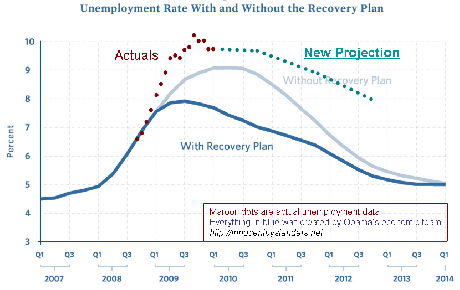
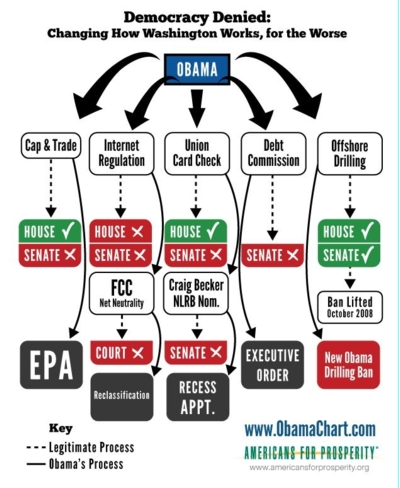
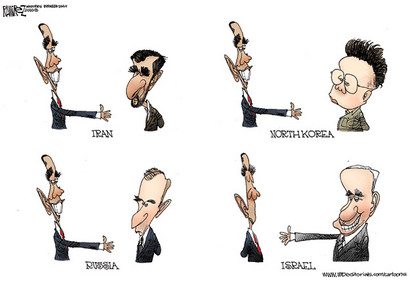
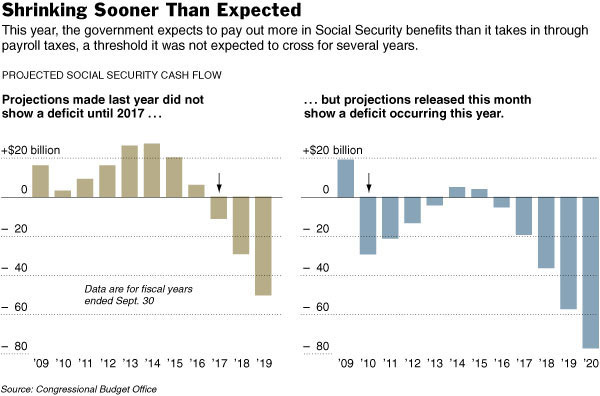
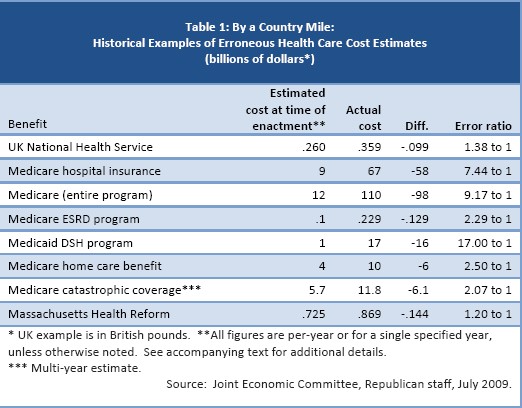
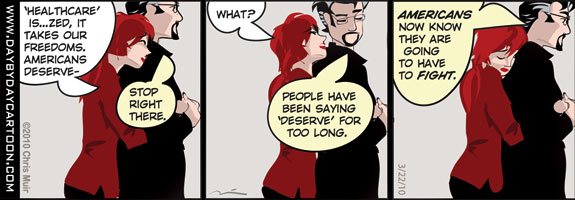
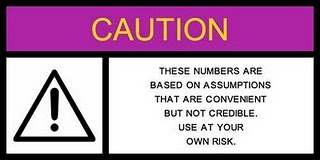
 Internet Scofflaw
You must be logged in to post a comment.