More than two dozen states, including Maryland, as well as the District, have not stocked enough of the emergency supplies of antiviral medications considered necessary to treat victims of swine flu should the outbreak become a full-blown crisis, according to federal records. . .
The Strategic National Stockpile, created during the Clinton administration a decade ago to provide a federally coordinated response to disasters, maintains a massive collection of antibiotics, vaccines, gas masks and other supplies in a dozen secret locations. The program was expanded in 2004 to include drugs needed in a pandemic and is designed to link with stockpiles kept by state governments, pharmaceutical companies and federal agencies.
But the District, Maryland and 26 other states are 10 million dosages short of the levels that the federal government has determined they should have in their stockpiles for a pandemic. The drugs — in this case, Tamiflu and Relenza — would be used to treat the illness, not to prevent it.
Unfortunately, the article does not give the list, beyond saying that Maryland and DC are on it and Virginia is not, and they don’t link to the full list either. That’s quite an omission for a national paper.
A Ravenstahl campaign ad — where the mayor claimed to cut city taxes — is now off the air, while his opponents attack his credibility. . .
Here’s part of the ad:
“Mayor Luke Ravenstahl — he balanced the budget, stopped adding to the city debt, eliminated the city gross receipts tax, and reduced the parking tax.”
But those tax changes were required by the state, and Dowd accused Ravenstahl of voting against the Act 47 plan to implement those tax cuts.
“When the city council actually had to vote for the Act 47 plan, this mayor voted against it twice,” said Dowd in the debate.
Although the ad has been pulled, Dowd has posted it on YouTube.
That’s the allegation of Tom Lauria, a bankruptcy lawyer opposing the Chrysler restructuring plan:
One of my clients was directly threatened by the White House and in essence compelled to withdraw its opposition to the deal under the threat that the full force of the White House Press Corps would destroy its reputation if it continued to fight.
This is a stunning allegation, going to the heart of our supposedly independent press. Personally, I can believe it. Considering how willing the press corps has been to take direction from the administration (the White House spokesman gave them a “strong A”), it’s a very believable threat. And it would be surprising if the bare-knuckles Chicago politicians running the White House would choose to leave a weapon on the table.
The question now is whether the press will investigate this allegation. Their integrity (what’s left of it) is at stake.
UPDATE: The White House denies the allegation, but the client isn’t talking. I’m glad Jake Tapper, at least, is asking questions. (Via Instapundit.)
UPDATE: The client is now denying it too. This doesn’t really prove anything, since no one would want to admit to being bullied by the White House, and it would surely get them all the bad publicity they would have been trying to avoid. However, we’re left with nothing but Lauria’s say-so at this point.
FURTHER UPDATE: After a second look, I agree with the Business Insider that the client, Perella Weinberg, is not denying the allegation. The Weinberg statement merely says that Weinberg did not change his position due to threats; it does not say that no threats were issued. Indeed, it appears to be worded carefully to avoid doing so.
The Obama administration is moving toward reviving the military commission system for prosecuting Guantánamo detainees, which was a target of critics during the Bush administration, including Mr. Obama himself.
Officials said the first public moves could come as soon as next week, perhaps in filings to military judges at the United States naval base at Guantánamo Bay, Cuba, outlining an administration plan to amend the Bush administration’s system to provide more legal protections for terrorism suspects. . .
Senior officials have emphasized that they prefer to prosecute terrorism suspects in existing American courts. When President Obama suspended Guantánamo cases after his inauguration on Jan. 20, many participants said the military commission system appeared dead.
But in recent days a variety of officials involved in the deliberations say that after administration lawyers examined many of the cases, the mood shifted toward using military commissions to prosecute some detainees, perhaps including those charged with coordinating the Sept. 11 attacks.
“The more they look at it,” said one official, “the more commissions don’t look as bad as they did on Jan. 20.”
Obama and members of his administration have embraced the use of rendition. Many of Obama’s most ardent defenders blasted progressives who criticized Obama on rendition as jumping the gun. Today, their arguments look even more problematic than in the past.
Obama has invoked the maligned “state secrets” defense as a complete bar to lawsuits challenging potential human rights and constitutional law violations.
Obama has argued that detainees at Bagram Air Force Base in Afghanistan do not qualify for habeas corpus rights, even though many of the detainees at the facility were not captured in the war or in Afghanistan.
Even though it no longer uses the phrase “enemy combatants,” the Obama administration has taken the position that the government can indefinitely detain individuals, whether or not they engaged in torture and whether or not they fought the United States on the “battlefield.” This logic combined with the denial of habeas to detainees in Afghanistan could make Bagram the functional equivalent of Guantanamo Bay.
If the New York Times article is accurate, then the use of military tribunals issue will join the list of policies that Obama has endorsed, despite the loud liberal criticism that Bush received when he did the same things.
North Korean dictator Kim Jong Il has begun shifting power away from the communist party apparatus and strengthened the authority of his country’s military, veteran watchers of the Stalinist regime have told FOX News.
The 67-year-old Kim, who appeared frail but engaged at a gathering of the Supreme People’s Assembly in Pyongyang on April 9, has wielded ultimate power in his country since 1994, but is now said to be making his first serious moves to establish a clear line of succession. The April gathering was his first public appearance before a large audience since the stroke he is believed to have suffered last August.
Andy McCarthy declines to serve on the President’s Task Force on Detention Policy:
In light of public statements by both you [the Attorney General] and the President, it is dismayingly clear that, under your leadership, the Justice Department takes the position that a lawyer who in good faith offers legal advice to government policy makers—like the government lawyers who offered good faith advice on interrogation policy—may be subject to investigation and prosecution for the content of that advice, in addition to empty but professionally damaging accusations of ethical misconduct. Given that stance, any prudent lawyer would have to hesitate before offering advice to the government. . .
Given your policy of conducting ruinous criminal and ethics investigations of lawyers over the advice they offer the government, and your specific position that the wartime detention I would endorse is tantamount to a violation of law, it makes little sense for me to attend the Task Force meeting.
Bill Whittle gives Jon Stewart a sound beating for his historically illiterate statement that Harry Truman was a war criminal for dropping the atomic bomb. (Via Instapundit.)
Disaster averted. A united GOP and several Democrats decided that this was perhaps not the very best time to strike a major blow against banks and credit markets.
If you can keep your wits about you while all others are losing theirs, your name is not Joe Biden:
Vice president Joe Biden said today he would tell his family members not to use subways in the U.S. and implied schools should be shuttered as the swine flu outbreak spread to 16 states. His remarks quickly caused a stir, drawing a rebuke from New York City Mayor Mike Bloomberg and later leading the White House to apologize.
The uproar began when Biden appeared on NBC’s “Today” show and said he would advise against riding the subway or taking commercial flights and implied schools should be shuttered amid confirmation of the first swine-flu relation death in the U.S.
“I wouldn’t go anywhere in confined places now,” Biden said when Matt Lauer asked whether he would advise family members to use public transportation.
BONUS: No Biden gaffe is complete without the laughable “clarification”:
Biden’s office later sought to clarify his remarks by saying he was only urging sick people to avoid planes and trains.
Right, that explains his advice to his family members.
UPDATE: Robert Gibbs must be frustrated, given such crap to work with:
“What the vice president meant to say was the same thing that many members have said in the last few days,” White House Press Secretary Robert Gibbs said. “And that is, if you feel sick, are exhibiting flu-like symptoms….that you should take precautions, that you should limit your travel.” . . .
“I know what he said, and I am telling you what he meant to say,” he said.
Er, yeah. He meant to be giving a different answer than he gave, in response to a different question than he was asked. Aside from that, he was spot on.
With Arlen Specter switching parties and Justice Souter retiring, a very interesting wrinkle has arisen. It seems that the arcane rules of the Senate Judiciary Committee require at least one minority vote to bring any matter to a vote, so if the minority stands united against a nominee, they can block him from being passed to the full Senate. Until this week, the Democrats could surely have trusted Specter to be that minority vote, but he can no longer serve them in that capacity.
Although it’s interesting to contemplate, it strikes me as very unlikely that the Republicans would exercise this option, particularly for a Supreme Court nominee. But it would be very much in keeping with the escalating conflict over confirmations during the past twenty-two years.
Here’s (hopefully) the scariest story you’ll see in a long time:
Gen. David Petraeus, commander of U.S. Central Command, has told U.S. officials the next two weeks are critical to determining whether the Pakistani government will survive, FOX News has learned.
“The Pakistanis have run out of excuses” and are “finally getting serious” about combating the threat from Taliban and Al Qaeda extremists operating out of Northwest Pakistan, the general added.
But Petraeus also said wearily that “we’ve heard it all before” from the Pakistanis and he is looking to see concrete action by the government to destroy the Taliban in the next two weeks before determining the United States’ next course of action, which is presently set on propping up the Pakistani government and military with counterinsurgency training and foreign aid.
Petraeus made these assessment in talks with lawmakers and Obama administration officials this week, according to individuals familiar with the discussions.
They said Petraeus and senior administration officials believe the Pakistani army, led by Chief of Staff Gen. Ashfaq Kayani, is “superior” to the civilian government, led by President Ali Zardari, and could conceivably survive even if Zardari’s government falls to the Taliban.
Boingboing takes a look at a gadget that the Census Bureau isn’t really using for the 2010 census:
They’re not making a whole lot of friends with this new device. Last year, the Government Accountability Office added the 2010 Census to a list of high-risk programs. Basically, it sounds like requirements changed several times, and Harris ended up very late to market, with a somewhat buggy device. This freaked people out, and the Census quickly announced that they wouldn’t actually be using the devices – they’d use them just to conduct the first stage of the census, checking addresses, while the actual census (conducted door to door, of people who hadn’t sent in the forms themselves) would take place using clipboards and paper.
In other words, the relatively lame device my friendly enumerator was carrying, which cost $600 million, doesn’t actually work well enough to use for its intended purpose.
Just to put this in perspective: simply by not purchasing this “chunky crapgadget,” the Census Bureau alone would have saved the government six times the amount that President Obama is ordering his cabinet to trim from the budget.
President Obama’s nominee for HUD secretary lied to the press about his involvement in a lawsuit over his office’s failure to follow the state’s Public Disclosure Act:
When [King County executive and HUD secretary nominee Ron Sims] was interviewed by a television crew the next day about a $120,000 fine, Sims denied concealing any records or having any personal involvement in the case. He also claimed no records linked him with the case.
“I didn’t conceal anything, so you’re absolutely wrong on that,” he said. “I was not fined $120,000. As a matter of fact, it’s interesting because there is nothing in the court record at all involving me personally. I never was involved in that at all. There’s nothing—nothing regarding my conduct. I didn’t conceal a thing. I did order the release of documents after they were discovered, but I never concealed anything.”
But Washington state court records flatly contradict Sims.
“The office of Ron Sims, King County Executive” was listed as the respondent in a January court ruling. Writing for the majority in Yousoufian v. Sims, Justice Richard Sanders said requested information was withheld from the plaintiff and fines should be levied.
“The unchallenged findings of fact demonstrate King County repeatedly deceived and misinformed Yousoufian for years. King County told Yousoufian it produced all the requested documents, when in fact it had not,” the opinion said.
The U.S. economy contracted at a surprisingly sharp 6.1 percent rate in the first quarter as exports and business inventories plummeted.
The drop in gross domestic product, reported by the Commerce Department on Wednesday, was much steeper than the 4.9 percent annual rate expected by economists and followed a 6.3 percent decline in the fourth quarter.
So the first economic report of the Obama administration is worse than expected, despite a Brobdingnagian “stimulus” package. It’s almost as if throwing away government money to stimulate the economy doesn’t work.
POSTSCRIPT: Let’s not hear any nonsense about how the “stimulus” package was enacted too late (February 17) to have an impact in the first quarter. Virtually all its spending is in the out years anyway, so clearly the theory underlying the stimulus package must be that prospects of future deficit spending stimulate the economy now. Sounds like nonsense? Don’t blame me.
You would think this would be illegal, but in New Jersey, who knows:
Gov. Jon Corzine keeps saying he’s not running a campaign because he’s too busy governing. Apparently his staff didn’t get the memo. At 8:30 a.m. April 3, Corzine’s new deputy chief of staff, Mark Matzen, gathered a group of key agency staffers to go over ways to ensure their departments’ public statements and events were in sync with the governor’s (unofficial, so far) re-election campaign.
Matzen, according to two people familiar with what went on, told the group they need to keep in mind the campaign’s main themes and find events and programs that drive home those ideas. Matzen reiterated how important it is for commissioners and agency chiefs to stress the central plan of the Corzine effort to stay focused on the “Four Es’: economy, ethics, environment (and energy) and education. . .
“This meeting is for selected representatives from the departments. There are no substitutes,” Matzen wrote. He explained that he would “be briefing you on our budget communication plan and how each of you can help.”
Veteran GOP Sen. Arlen Specter of Pennsylvania intends to switch political parties and run in the Democratic primary in 2010, FOX News has confirmed.
Republican voters had sent him to the Senate five times. But faced with the prospect of a strong challenge from conservative Pat Toomey in the GOP primary and the state trending Democratic, Specter jumped ship.
It’s not immediately obvious that this changes much. Democrats didn’t need his vote for the leadership, and he’s been voting more Democrat than Republican on legislation already. But, this might change things if he has to move to the left to secure the Democratic nomination. He says his vote against card check won’t change, but we’ll see.
On other hand, this helps us after the mid-term elections. As much as I want to believe, Toomey isn’t likely to win statewide, which means Pennsylvania is probably electing a Democrat anyway. Better Specter than most other Democrats, I suppose. Also, the GOP won’t be wasting any money defending Specter.
Travel restrictions under consideration by the U.S. to prevent the spread of a new flu virus may be influenced by politics more than science, the World Health Organization’s chief said today.
WHO doesn’t recommend closing borders or restricting the movement of people or goods, Margaret Chan, director-general of the United Nations agency told leaders from health groups around the world in a conference call today. The disease, which may have caused more than 100 deaths and sickened more than 1,000 people, has spread too far and would be impossible to contain by closing borders, she said.
President Obama is still not observing his “sunlight before signing” pledge:
Sunlight Before Signing: Too often bills are rushed through Congress and to the president before the public has the opportunity to review them. As president, Obama will not sign any non-emergency bill without giving the American public an opportunity to review and comment on the White House website for five days.
According to the CATO Institute’s tally, President Obama has kept this promise on just one of eleven bills he has signed. (That one was the DTV Delay Act.) Five of the eleven were never posted at all.
Mayor Bloomberg went ballistic Monday after the U.S. military – without any warning to the public – buzzed New York City with one of the presidential planes trailed by an F-16 fighter jet.
Flying in as low as 1000 feet to 150 feet above New York City and taking photographs along the way, the planes circled the Statue of Liberty and flew over Manhattan, Staten Island, and New Jersey – then vanished.
Before they were gone, hundreds of frightened people had jammed the emergency lines, thousands of terrified people evacuated from buildings in the city and across the river in Jersey, and many New Yorkers had flashbacks to the 9/11 attacks. . .
Angry that an unnamed but “dumb” city official failed to notify him of the Pentagon’s plans, Bloomberg said a flyover so close to Ground Zero was insensitive and showed “poor judgement.” He said the first he knew of it was when his BlackBerry began buzzing.
It “defies the imagination,” said Bloomberg, who insisted he would have tried to stop the shoot had he known about it.
The NYPD confirmed that it had been told of the Pentagon’s “aerial photo mission” last Thursday but ordered to stay quiet about it.
The [FAA] email specifies that the information “only be shared with persons with a need to know” and “shall not be released to the public.” It also says that, “Due to the possibility of public concern regarding [Department of Defense] aircraft flying at low levels, coordination with Federal, State and Local law enforcement agencies…has been accomplished.”
The email’s author, James J. Johnston, of FAA air traffic, declined to comment.
An Obama administration official said the mission was “classified” by the military and that the FAA, which controls much of the airspace over Manhattan, did what the military asked.
Democrats in Congress are joining Republicans in calling for tough new sanctions on Iran and warning the Obama administration that its policy of engagement shouldn’t last too long before turning to harsher steps aimed at halting Tehran’s nuclear program.
This week, as many as 20 senators, including several senior Democrats in the House and Senate, are expected to join in introducing a bill that would authorize sanctions against companies involved in supplying gasoline and other refined petroleum products to Iran.
A similar bill is also in the works in the House. Last month, seven senior Democrats, including Majority Leader Steny Hoyer (D-Md.), warned President Barack Obama against “open-ended engagement with Iran.”
The administration is so far moving on a slower timetable, refusing to commit itself to new sanctions until it sees whether its diplomatic outreach to Iran produces results.
Alphecca points out a column by the Cleveland Plain Dealer’s ombudsman. In it, he justifies the Plain Dealer’s use of the term “assault weapon” by passing the buck to the Associated Press:
Taking its cue from that, the Associated Press Stylebook defines assault weapons as “firearms that feature two or more accessories such as a detachable magazine, folding or telescopic stock, silencer, pistol grip, bayonet mount or a device to suppress the flash emitted while shooting in the dark.”
This is basically the definition of “assault weapon” that was dreamed up by President Clinton in 1994. Many have noted the dishonesty of that definition, since the word is used precisely because of it sounds dangerous, but the actual definition is essentially cosmetic. (ASIDE: Merriam-Webster’s dictionary has a fairly useful definition for “assault rifle”, but sees “assault weapon” as a largely meaningless word.)
On closer look, the Plain Dealer’s definition is not only dishonest, but nonsensical. According to that definition, isn’t nearly any semiautomatic pistol an “assault weapon”? Firearm? Check. Detachable magazine? Check. Pistol grip? Of course! Language clarifying that a pistol’s grip doesn’t count as a “pistol grip”? Apparently not.
So it sure seems like the Plain Dealer and the AP are being profoundly stupid here. But here’s the interesting part, according to Ask the Editor at APStylebook.com (search on “assault weapon”), it’s not true:
What is AP style books definition of an Assault Weapon? And how can a firearm be defined now? Since the Assault Weapons ban sunsetted how can we decribe scary black guns? – from Denver, Co on Mon, May 15, 2006
An assault-style weapon is defined as any semiautomatic pistol, rifle or shotgun originally designed for military or police use with a large ammunition capacity. (See the “weapons” entry in the AP Stylebook.)
This is fairly close to the Merriam-Webster definition of assault rifle, and bears no resemblance to the definition claimed by the Plain Dealer’s ombudsman. Assuming APStylebook.com can be trusted, it looks like two counts of foolishness for the Plain Dealer, and the AP is off the hook.
Four trillion dollars later, President Obama is calling for a return to PAYGO rules.
PAYGO won’t do anything about the deficit we already have. The time to do this would have been before this year’s Democratic spending spree doubled the deficit.
The Washington Post reports that the current CIA director, Leon Panetta, and all of his last four predecessors strongly opposed the release of the interrogation memos. A new Rasmussen poll says that a majority (58%) agree with them. The poll also shows that 70% believe either that “the U.S. legal system worries too much about protecting individual rights when national security is at stake” or that the balance is about right.
Paul Mirengoff points out that, according to the Washington Post’s account, the arguments in favor were all based on what would help President Obama politically. If so, the Rasmussen poll suggests that Obama is making a big mistake. I was particularly struck by this non-sequitur:
A source familiar with White House views said Obama’s advisers are further convinced that letting the public know exactly what the past administration sanctioned will undermine what they see as former vice president Richard B. Cheney’s effort to “box Obama in” by claiming that the executive order heightened the risk of a terrorist attack.
The Obama Administration is stymied, politically and legally, from doing much to prevent legal gun ownership, particularly in the wake of the Heller decision. But they have found one way to hurt gun owners, and never mind if it makes no sense.
For some time the military has sold its spent brass to the private sector, which reprocesses it into ammunition for civilians. The military goes through a tremendous amount of ammunition in training exercises, and selling the spent brass recovers some of that cost. Also, of course, re-use is good for the environment.
The problem is, selling spent brass lowers the cost of civilian ammunition, and if you are an anti-gun ideologue, that’s a bad thing. So now, the DOD has determined that spend brass will be sold only as scrap, to be melted down for raw materials. The Shootist has the details. (Via the Corner.)
This decision costs the government money (the Shootist reports that shredding reduces the value of the brass by 80%), and it hurts the environment (it takes much more energy and resources to make a shell casing from scratch than to reprocess one). And there’s no possible reason to do so other than to drive up the cost of civilian ammunition. But it seems that’s reason enough for the Obama administration, and if it wastes taxpayers’ money and hurts the environment, well those are costs that must be borne. Priorities.
UPDATE: A commenter points out that this decision has been reversed. Good.
I’ve been thinking for a long time about how there ought to be a constitutional amendment to restore federalism and establish proper jurisprudence. Randy Barnett, in a piece for the Wall Street Journal, goes one step further and proposes actual text, and a strategy for getting it adopted:
Section 1: Congress shall have power to regulate or prohibit any activity between one state and another, or with foreign nations, provided that no regulation or prohibition shall infringe any enumerated or unenumerated right, privilege or immunity recognized by this Constitution.
Section 2: Nothing in this article, or the eighth section of article I, shall be construed to authorize Congress to regulate or prohibit any activity that takes place wholly within a single state, regardless of its effects outside the state or whether it employs instrumentalities therefrom; but Congress may define and punish offenses constituting acts of war or violent insurrection against the United States.
Section 3: The power of Congress to appropriate any funds shall be limited to carrying into execution the powers enumerated by this Constitution and vested in the government of the United States, or in any department or officer thereof; or to satisfy any current obligation of the United States to any person living at the time of the ratification of this article.
Section 4: The 16th article of amendment to the Constitution of the United States is hereby repealed, effective five years from the date of the ratification of this article.
Section 5: The judicial power of the United States to enforce this article includes but is not limited to the power to nullify any prohibition or unreasonable regulation of a rightful exercise of liberty. The words of this article, and any other provision of this Constitution, shall be interpreted according to their public meaning at the time of their enactment.
One very clever thing about this proposal is section 1, which actually expands federal power to grant it much of what is has already claimed. The power to regulate interstate commerce has been read expansively to constitute the power to regulate interstate anything, and a lot of important legislation (some of it even worthy) is based on that power. By explicitly giving the federal government such power, it removes one major pressure on the courts to do violence to the Constitution.
Sections 2 and 3 remove powers the federal government was never supposed to have (but explicitly allow it to continue paying social security and the like), and section 5 states that the Constitution means exactly what it says. I suspect that repealing the income tax (section 4) is a bridge too far, but it’s worthwhile as a starting point.
I think the biggest blunder in the framing of the Constitution was its failure to enumerate the federal government’s interstate commerce powers. By giving it a blanket power to regulate interstate commerce, it opened the door for most of the mischief the government practices today. If I could go back in time to the convention, that is what I would try to fix. But given where we are today, Barnett’s proposal is the best I’ve seen.
Three cheers for President Obama’s decision, announced quietly on Monday, to repudiate a campaign promise and not press for new labor and environmental regulations in the North American Free Trade Agreement. The last thing the Western Hemisphere needs are more trade barriers that would snarl supply chains and damage commerce.
Perhaps we should call this Austan Goolsbee’s revenge. Recall that last year the Obama economic adviser had told a Canadian diplomat to ignore Mr. Obama’s Nafta campaign rhetoric; the candidate was merely pandering to Big Labor. When that disclosure became news, Mr. Goolsbee was banished to the campaign’s isolation ward for imperfect spinners. Now we know Mr. Goolsbee — not the candidate — was the one telling the truth.
President Obama is doing to the intelligence services what Democratic presidents always do, demoralize them and discourage initiative. David Ignatius writes:
President Obama promised CIA officers that they won’t be prosecuted for carrying out lawful orders, but the people on the firing line don’t believe him. They think the memos have opened a new season of investigation and retribution.
The lesson for younger officers is obvious: Keep your head down. Duck the assignments that carry political risk. Stay away from a counterterrorism program that has become a career hazard. . .
For a taste of what’s ahead, recall the chilling effects of past CIA scandals. In 1995, then-Director John Deutch ordered a “scrub” of the agency’s assets after revelations of past links to Guatemalan death squads. Officers were told they shouldn’t jettison sources who had provided truly valuable intelligence. But the practical message, recalls one former division chief, was: “Don’t deal with assets who could pose political risks.” A similar signal is being sent now, he warns.
One veteran counterterrorism operative says that agents in the field are already being more careful about using the legal findings that authorize covert action. An example is the so-called “risk of capture” interview that takes place in the first hour after a terrorism suspect is grabbed. This used to be the key window of opportunity, in which the subject was questioned aggressively and his cellphone contacts and “pocket litter” were exploited quickly.
Now, field officers are more careful. They want guidance from headquarters. They need legal advice. I’m told that in the case of an al-Qaeda suspect seized in Iraq several weeks ago, the CIA didn’t even try to interrogate him. The agency handed him over to the U.S. military.
Agency officials also worry about the effect on foreign intelligence services that share secrets with the United States in a process politely known as “liaison.” A former official who remains in close touch with key Arab allies such as Egypt and Jordan warns: “There is a growing concern that the risk is too high to do the things with America they’ve done in the past.”
Anyone who exercises their right to carry a weapon in Milwaukee can expect to be roughed up by police. It’s official policy:
Milwaukee Police Chief Ed Flynn said he’ll continue to tell officers they can’t assume people are carrying guns legally in a city that has seen nearly 200 homicides in the past two years.
“My message to my troops is if you see anybody carrying a gun on the streets of Milwaukee, we’ll put them on the ground, take the gun away and then decide whether you have a right to carry it,” Flynn said.
Secretary Geithner may not know it yet, but his plan for resolving the toxic asset problem is dead. The Treasury department killed it with this announcement:
Treasury Department lawyers have determined that firms participating in a $1 trillion program to relieve banks of toxic assets could be subject to limits on executive compensation, contradicting the Obama administration’s previous public position, according to a report to be released today by a federal watchdog agency. . .
Speaking last month about the initiative to buy toxic assets, Treasury Secretary Timothy F. Geithner said, “The comp conditions will not apply to the asset managers and investors in the program.”
But Treasury lawyers have told the special inspector general for the federal bailout that executives involved with that initiative and another $1 trillion consumer lending program “could be subject to the executive compensation restrictions,” according to the report from Special Inspector General Neil M. Barofsky.
The Geithner plan isn’t even fleshed out yet, and it’s already dead. Healthy trading companies (the kind Geithner needs to participate) are never going to accept these limitations. Even if the Treasury backtracks, no one will trust them now. As the Economist notes:
Is it really that surprising? Banks were pressured to take TARP money last fall and were quickly dismayed when the government started calling the shots on pay and making it harder to hire foreign labour. Now they can’t give the money back.
If you’re against the bailout, the death of the Geithner plan could be a good thing. But if you’re for it, as President Obama presumably is, then this is a disaster. It’s a disaster that is the direct result of the irresponsible populist hysteria promulgated by the president’s party, and by the president himself.
The Democrats simply couldn’t help themselves. They had an opportunity to meddle in private business, to stick it to the rich, and they just couldn’t resist. They were warned of the consequences, but their ideology simply carried them away.
I’m undecided about whether the Geithner plan was a good idea, but I’m delighted by the teaching moment it’s given us. It’s not often that the law of unintended consequences comes into play so quickly, with the same people in charge, and with the issue still fresh in the public’s mind.
POSTSCRIPT: Once you might have thought that the trading companies could be reassured by appropriate legislation to protect them, but no longer. The AIG bonus confiscation fiasco saw to that. The law is no protection any more. Nothing short of a change in lawmakers will reassure them now.
UPDATE: Jennifer Rubin: “At this point any CEO who agrees to do business with the government should be fired.” (Via Instapundit.)
I wish that WordPress either (a) spell-checked your post title, or (b) didn’t use the title in the permalink. The way it works now, even if you fix a typo in a title, it lives on forever in the permalink.
President Obama hints that he is open to prosecuting Bush administration lawyers for their legal advice. (Via Instapundit.)
This is stupid, but more than that, if we start down the path of political prosecutions of the previous administration, we will become a very different country than we have ever been. In the short run, Democrats should not delude themselves that they will never be on the other side. In the long run, if we create a system in which one side no longer feels they can risk losing an election, that will spell the end of the Republic.
UPDATE: Shannon Love takes a contrarian view. She thinks the administration wants to play up the supposed crimes of the Bush administration, but will stop short of any actual trials, which would exonerate them. (Via Instapundit.)
Jim Lindgren observes that the states with the highest unemployment all have high marginal tax rates, or high levels of unionization, or (most of them) both. Obviously, now is the time to hike taxes and pass card check, so that every state can enjoy Oregon’s economy.
IBD is praising President Obama for coming out in support of the Colombia free trade pact. (Via Wizbang, via Instapundit.) Obviously, I think that’s the right position, since the Democrats are opposing the deal for no reason whatsoever.
Still, I’m going to withhold my praise until I see that the president is willing to push congressional Democrats, who have gone so far as to change the House rules to avoid a vote on the pact. Supporting the right position is good, but it’s not enough. After all, President Bush supported the pact too.
Pittsburgh’s mayor, Luke Ravenstahl, is just too darn busy to debate. He had to cancel a debate due to the policy shooting tragedy, and he can’t reschedule it because of, er, all that other stuff he’s doing. When asked if he would release his schedule, so we can see all the stuff he’s doing instead of debating, he refused to answer. Given his predilection for going on junkets, I’m not surprised.
Frankly, Pittsburgh would be better off if the fools that run the city were all debating 24-7.
There’s an email making the rounds alleging that President Obama’s orders regarding the pirate hostage crisis earlier this month extended the crisis and endangered the captain’s life. I first saw it here. (Via Chaos Manor, via Instapundit.) I’m not going to repeat the whole thing, but it (one version, anyway) opens this way:
From some friends with ties to special ops who would like to remain under the radar: Having spoken to some SEAL pals here in Virginia Beach yesterday and asking why this thing dragged out for 4 days, I got the following . . .
This is an urban legend. There’s no way to know whether the underlying allegations are true, as the people who know aren’t saying. But the email is certainly bogus. First of all, these sorts of things nearly always are. Second, we can actually track the evolution of the email over time. If it ever started as a private email from someone with inside contacts (unlikely), it’s definitely not the same email now. Trying to use this to indict President Obama’s handling of the crisis isn’t just wrong, it’s embarrassing.
ASIDE: Incidentally, note that the email isn’t just an attack on the president. It’s also an insult to the SEALs, because it alleges that someone broke operational security.
President Obama didn’t handle the crisis the way I would have preferred. I think it would have been much better to use force as soon as we had a good likelihood of success. (From what we know now, that probably would have been days sooner.) But we cannot be surprised by what happened. Barack Obama is the president, and of course he ordered them to try to find a peaceful resolution first. That’s who he is. But he also gave them the latitude to use force if necessary. In the end, we have to judge the incident by its outcome, and the outcome was good.
Some bloggers on the left are trying to make Obama into some sort of David Palmer over this. That’s silly. Obama isn’t David Palmer; he isn’t even Bill Clinton. But it’s even sillier to try to make this success into a failure. On this occasion, Obama’s approach worked. Let’s not forget that this is a good thing. If we start begrudging the president even his successes, we start to look like the left has looked over the past eight years.
CNN is using bogus copyright claims to try to suppress videos of its reporter Susan Roesgen making an ass of herself at the Chicago Tea Party. (Via Power Line.)
Human Events is reporting that the White House is refusing to accept the findings of the inter-agency review committee on Guantanamo detainees:
White House lawyers are refusing to accept the findings of an inter-agency committee that the Uighur Chinese Muslims held at Guantanamo Bay are too dangerous to release inside the U.S., according to Pentagon sources familiar with the action. . .
After Obama’s promise to close Gitmo, the White House ordered an inter-agency review of the status of all the detainees, apparently believing that many of those held would be quickly determined releasable. The committee — comprised of all the national security agencies — was tasked to start with what the Obama administration believed to be the easiest case: that of the seventeen Uighurs, Chinese Muslims who were captured at an al-Queda training camp. . .
Reviewing the Uighurs detention, the inter-agency panel found that they weren’t the ignorant, innocent goatherds the White House believed them to be. The committee determined they were too dangerous to release because they were members of the ETIM terrorist group, the “East Turkistan Islamic Movement,” and because their presence at the al-Queda training camp was no accident. There is now no ETIM terrorist cell in the United States: there will be one if these Uighurs are released into the United States.
According to Defense Department sources, the White House legal office has told the inter-agency review group to re-do their findings to come up with the opposite answer.
This is a little bit hard to believe. If the committee did find that these people are too dangerous to release, and President Obama releases them into the United States anyway, he’ll be making himself a hostage to fortune. If (when) they subsequently start killing Americans, there will be hell to pay. It will be impossible for Obama to evade personal responsibility for whatever they do.
President Clinton would certainly never have allowed himself into such a situation. I wouldn’t think that Obama would either. If this report is true, he is actually enough of a true believer to bet his presidency that a bunch of terrorists won’t cause trouble. Lord help us if so.
UPDATE (5/30): The Justice Department is now arguing in court that it need not release these people, so if this story were ever true, it’s not any more.
Greg Mankiw puts President Obama’s $100 million spending cut in perspective:
Just to be clear: $100 million represents .003 percent of $3.5 trillion.
To put those numbers in perspective, imagine that the head of a household with annual spending of $100,000 called everyone in the family together to deal with a $34,000 budget shortfall. How much would he or she announce that spending had be cut? By $3 over the course of the year–approximately the cost of one latte at Starbucks.
UPDATE: Even Paul Krugman is calling the president out on this:
$100 million here, $100 million there. “Pretty soon, even here in Washington, it adds up to real money,” says the president.
Except, you know, really it doesn’t. Let’s say the administration finds $100 million in efficiencies every working day for the rest of the Obama administration’s first term. That’s still around $80 billion, or around 2% of one year’s federal spending.
The Obama Administration is signalling that even healthy banks might not be permitted to repay the TARP “loans”, reports the Financial Times:
Strong banks will be allowed to repay bail-out funds they received from the US government but only if such a move passes a test to determine whether it is in the national economic interest, a senior administration official has told the Financial Times.
“Our general objective is going to be what is good for the system,” the senior official said. “We want the system to have enough capital.”
A Ninth Circuit panel has found unanimously that the Second Amendment is incorporated against the states. This creates a split between the Ninth and Second Circuits, so the question may well be headed to the Supreme Court.
The UN racism meeting will be boycotted (so far) by the United States, Canada, Australia, Germany, Sweden, Italy, Holland, Israel, and New Zealand. That’s more than I would have dared hope. (Mostly via LGF.)
[Barack Obama’s campaign architect David] Axelrod was asked on CBS’s “Face the Nation” about the “spreading and very public disaffection” with the president’s fiscal policies seen at the “Tea Party” rallies around the country last week.
“I think any time you have severe economic conditions there is always an element of disaffection that can mutate into something that’s unhealthy,” Axelrod said.
China’s official media and outspoken bloggers on Friday protested over a German advert promoting the use of condoms which shows revolutionary leader Mao Zedong as a sperm cell alongside Adolf Hitler and Osama bin Laden.
The Communist Party’s People’s Daily devoted a page to the storm, quoting internet commentaries which called for the makers of the advert to apologise to China.
Presumably, they are offended by the comparison of Mao — a truly accomplished mass murderer with 77 million murders to his name — with someone like Hitler (whose 21 million murders leave him a distant third place) or bin Laden (who hasn’t even come close to notching his first million, if not for lack of trying). I’m sure they feel that only Stalin (43 million murders) would be a worthy comparison.
POSTSCRIPT: For the record, I think the ad is in very poor taste, but certainly not because of any unfairness to history’s worst murderer.
A new article published in the journal Science claims a breakthrough improving the efficiency of the Fischer-Tropsch process, which converts coal to liquid fuel suitable for engines. The article itself is behind a registration barrier, so I can’t even read the full abstract, but the Armed and Dangerous blog says they’re reporting a 3-fold improvement in efficiency. (Via Instapundit.) The abbreviated abstract also reports a reduction in carbon dioxide emissions.
The United States has by far the world’s largest coal reserves. I’m not sure what level of efficiency is necessary before FT fuel is competitive with imported oil, but this has to get us much closer (at least to sour crude, such as from Venezuela).
Forgetting the first rule of holes, the White House is standing by President Obama’s citation of a bogus statistic on Mexican crime guns. The President said that 90% of guns recovered in Mexico come from the United States. That isn’t remotely true, the real statistic is either 36% or 17% depending on whose analysis you use. Either way, the 90% refers only to guns that are successfully traced, a sample that is heavily biased toward American guns.
The White House says that’s what he meant all along:
“By recovered he means traceable, guns traced back to the United States,” [NSC Spokesman Denis] McDonough said. “These are ATF (Bureau of Alcohol Tobacco and Firearms) numbers. These are the guns submitted to the ATF for tracing. That’s what we mean by recovered.”
Oh, so “recovered” doesn’t mean “recovered”; it means “traceable.” Thanks for clearing that up; otherwise people might have assumed you were speaking English.
Reuters reports that President Obama would like to meet with Colombia’s President Uribe at the Summit of the Americas to discuss the stalled trade pact. (Via the Corner.) I wonder what he would say. All the agreement does is open Colombian markets to U.S. goods, and preserve Colombia’s access to U.S. markets. What could Uribe possibly concede to get Democrats to approve the pact when all its benefits accrue to the U.S. already? Democrats are opposing it for no reason.
ASIDE: Reuters suggests that Democrats want Colombia to harder to protect trade unionists from violence stemming from the civil war. That’s a strange requirement to place on a trade pact, particularly a one-sided one. “You can’t open your markets to our exports unless you comply with our demands!” But anyway, the best way to protect people from the civil war is to win it, and that’s what Uribe is doing.
Keeping all that in mind, read the article’s conclusion:
The U.S. failure to approve the pact is seen in Latin America as a sign of Washington’s indifference to one of its staunchest allies in the region.
I wonder if the Democrats see it that way. Judging by their actions, it seems that Democrats see Colombia as an ally to Republicans, not to America as a whole.
Hugo Chavez’s political rivals continue to be arrested on trumped-up charges. The Economist reports the latest arrests under the heading “Venezuela’s endangered democracy.” Isn’t that a strange heading? Hasn’t Venezuela’s democracy been endangered since Chavez was given the power to rule by decree in 2000?
The only real limit to Chavez’s power has been the prospect that some day he might be forced from office. Now that presidential term limits has been revoked and his rivals are all being taken out of circulation, that prospect is all but gone. Democracy endangered? It’s over. It will take a revolution or a coup to oust him now.
Efforts to eradicate malaria by exterminating mosquitoes have always failed because the mosquitoes have evolved resistances to insecticides. A research group at Penn State has an ingenious idea for how to get around the evolved resistance problem. It turns out that only old female mosquitoes transmit malaria, because they first have to acquire the parasite and allow time for it to develop before they can infect a person. Thus, malaria can be controlled by killing only older mosquitos, and since those older mosquitos would already have reproduced, it would not trigger nearly as great of an evolutionary response.
On what issue can you find Justices Stevens and Scalia on one side, and Justices Kennedy and Breyer on the other? The question of who wrote Shakespeare’s plays. (Via Volokh.)
The Annenberg Political Fact Check has taken on the “Mexican crime guns come from the U.S.” factoid and agree with Fox News that the 90% statistic cited by anti-gun politicians is bogus. They back up Fox News’s central contention that the 90% reflects only the guns that are successfully traced, a sample which is very heavily biased towards guns from the U.S. They estimate the true number at 36%, a bit higher than the 17% calculated by Fox News. (Annenberg says one of the figures Fox was calculating from is wrong.) Either way, it’s a long long way from 90%.
“We have a responsibility to act, too. Some 90 per cent of the guns recovered in Mexico come from the United States,” he said in Mexico on Thursday, acknowledging a figure used by Mr Calderon.
Jonah Goldberg continues his quixotic battle to preserve the lexicon:
How do I say this so people will understand? Fascism isn’t a libertarian doctrine! It just isn’t, never will be and it can’t be cast as one. Anarchism, secessionism, extreme localism or rampant individualism may be bad, evil, wrong, stupid, selfish and all sorts of other things (though not by my lights). But they have nothing to do with a totalitarian vision of the state where individuals and institutions alike must march in step and take orders from the government.
If you think shrinking government and getting it less involved in your life is a hallmark of tyranny it is only because you are either grotesquely ignorant or because you subscribe to a statist ideology that believes the expansion of the state is the expansion of liberty.
He’s right, of course, but what of it? Has an inconvenient definition ever survived? If liberalism can be redefined from individual autonomy to state nannyism, as it has, then why can’t fascism be redefined from totalitarian statism to individualism?
The front-page story of today’s Washington Post is glaringly obvious:
Six months after Washington rescued Wall Street, exasperated banks insist they want to leave the lifeboat.
Jamie Dimon, the chief executive of J.P. Morgan Chase, said yesterday that he regrets accepting $25 billion in federal aid. He called the money “a scarlet letter,” pledged quick repayment and renounced further borrowing from the government, saying, “We’ve learned our lesson about that.”
But the company, which announced a $2.1 billion first-quarter profit yesterday, has not entirely had it with Washington. J.P. Morgan said it plans to continue using a separate federal aid program through which it has borrowed more than $40 billion.
Other large banks are attempting the same combination of breakup and embrace. Even as they clamor to exit the most prominent part of the bailout program by repaying government investments, firms continue to rely on other federal programs to raise even larger amounts of money. . .
The chief executives of several large banks at a meeting last month urged President Obama to accept repayments. But no company has similarly pledged to leave the government’s other aid programs.
The explanation appears to be simple: Only the capital investments by the Treasury require the companies to make significant sacrifices, such as restricting executive pay.
(Emphasis mine.)
Of course! Despite their proclamations of virtue, big businesses are happy to take money from the government, when there are no strings attached. But when the government starts mucking with their business, they want out. This is a front page story?
ASIDE: It is worth noting, however, that there’s a big discrepancy in size between the two programs. According to the article, the $40 billion in loan guarantees have a value of $400 million to JP Morgan (and cost the government nothing if they stay afloat). That’s a tiny fraction of the Treasury’s $25 billion equity investment. The story doesn’t say what the value is of taking emergency loans from the Fed rather than the market, but with interest rates so low, I bet it’s fairly small too.
Steven Rattner, the leader of the Obama administration’s auto task force, was one of the executives involved with payments under scrutiny in a probe of an alleged kickback scheme at New York state’s pension fund, according to a person familiar with the matter. . .
A spokeswoman for the Treasury, which is in charge of the auto task force, said that “during the transition, Mr. Rattner made us aware of the pending investigation.”
Michael Hayden (the previous CIA director) and Michael Mukasey (the previous Attorney General) have an op-ed shredding any case for releasing the OLC interrogation memos. They make excellent points including (1) the lack of any necessity to release them, (2) the damage done by releasing them, and (3) the fact that coercive interrogation really is effective, notwithstanding claims to the contrary. But I think their conclusion is the most important:
In his book “The Terror Presidency,” Jack Goldsmith describes the phenomenon we are now experiencing, and its inevitable effect, referring to what he calls “cycles of timidity and aggression” that have weakened intelligence gathering in the past. Politicians pressure the intelligence community to push to the legal limit, and then cast accusations when aggressiveness goes out of style, thereby encouraging risk aversion, and then, as occurred in the wake of 9/11, criticizing the intelligence community for feckless timidity. He calls these cycles “a terrible problem for our national security.” Indeed they are, and the precipitous release of these OLC opinions simply makes the problem worse.
Think back to the summer of 2002. With elections approaching, the Democrats needed to bring down President Bush’s stratospheric approval ratings. They decided to take on their problem directly and accuse the Administration of having been insufficiently vigorous in protecting the United States from attack. It didn’t work, in part because the Democrats were seen as unserious on the issue (particularly once Republicans fought back), but they did succeed in politicizing the war on terror. Over the following years, when no additional attacks occurred, the national consensus faded, and the campaign against terror became a Republican thing. It wasn’t long until Democrats were accusing the Administration of being excessively vigorous in protecting the United States from attack. Democrats have been back to September 10 for some time, but now they’re in ascendance. This is very dangerous.
IRS compliance employees have reported that taxpayers occasionally are citing the Geithner case when asked to pay their tax bills. “It’s making the compliance conversation harder,” she said.
Those who want to restrict guns in America keep pushing the canard that most guns used in Mexican crimes come from the United States, such as in this AP story:
Mexico is the main hub for cocaine and other drugs entering the U.S., and the United States is the primary source of guns used in Mexico’s drug-related killings.
Despite its vigorous repetition by dishonest politicians and press, it’s not remotely true, unless 17% is considered most.
This is just an instance of the classic story of looking for your keys under the lamppost because the light is better there. U.S. law requires guns to have markings that often make it possible to trace them, so while the vast majority of Mexican crime guns can’t be traced, the tiny fraction that are successfully traced usually come from the the U.S.
Georgetown University hid a religious inscription representing the name of Jesus during President Obama’s address there Tuesday, FOXNews.com has confirmed, because White House staff asked the school to cover up all religious symbols and signs while the president was on stage.
The monogram IHS, whose letters spell out the name of Jesus, and which normally perches above the stage in Gaston Hall where the president spoke, was covered over with what appeared to be black wood during the address.
I don’t know that the Georgetown flap is that huge a story, but what I find most striking about it is how unnecessary it was. D.C. is chock-a-block with venues for speeches. American University and The George Washington University are five minutes away from G-town (at least by presidential motorcade). If Obama doesn’t want to give a speech with a (vaguely) religious backdrop, he shouldn’t speak at Georgetown. If Georgetown wants to be a Catholic university, maybe that should mean losing a forgettable presidential speech every now and then if the president refuses to be seen at a podium with Christian symbols on it.
Yes, I’m much more offended by Georgetown than by the White House, of which I expect little in the first place. However, this is a reminder that, despite claims to the contrary, President Obama is not a Christian.
In an AP story on the DHS “rightwing extremism” report, the writer seems not to have actually read the report in question. The story describes a key footnote this way:
In a footnote in the report, right-wing extremism was defined as hate-motivated groups and movements, such as hatred of certain religions, racial or ethnic groups. It went on to say, “It may include groups and individuals that are dedicated to a single issue, such as opposition to abortion or immigration.”
The footnote is hardly the limit of the report’s shoddiness, but it is one of its key offensive elements, and the AP’s description makes the footnote sound better than it is. After all, hate groups are bad. If they’re the only ones getting slandered by the DHS, maybe it’s not something to get exercised about. But the report’s definition of right-wing extremism is not limited to “hate-motivated groups and movements.” The footnote, in its entirety, reads:
Rightwing extremism in the United States can be broadly divided into those groups, movements, and adherents that are primarily hate-oriented (based on hatred of particular religious, racial or ethnic groups), and those that are mainly antigovernment, rejecting federal authority in favor of state or local authority, or rejecting government authority entirely. It may include groups and individuals that are dedicated to a single issue, such as opposition to abortion or immigration.
(Emphasis mine.) So the report casts its net much wider than hate groups. According to it, anyone who supports federalism is a potential terrorist.
The DHS was warned of problems in their “rightwing extremism” report, but it was issued anyway:
Civil liberties officials at the Homeland Security Department flagged language in a controversial report on right-wing extremists, but the agency issued the report anyway. . .
Homeland Security spokeswoman Amy Kudwa said the report was issued before officials resolved problems raised by the agency’s civil rights division about analysts’ definition of right-wing extremism.
Rep. Jan Schakowsky thinks it’s wrong to protest Democratic fiscal policies:
Rep. Jan Schakowsky (D-Ill.) blasted “tea party” protests yesterday, labeling the activities “despicable” and shameful.”
“The ‘tea parties’ being held today by groups of right-wing activists, and fueled by FOX News Channel, are an effort to mislead the public about the Obama economic plan that cuts taxes for 95 percent of Americans and creates 3.5 million jobs,” Schakowsky said in a statement.
“It’s despicable that right-wing Republicans would attempt to cheapen a significant, honorable moment of American history with a shameful political stunt,” she added. “Not a single American household or business will be taxed at a higher rate this year.”
ASIDE: Her statement that no one’s taxes will go up this year is both false and irrelevant. It’s false because Obama has hiked taxes already, and that’s before cap-and-trade or health care “reform”. It’s irrelevant because the tea parties are protesting runaway spending, which is to say future taxes, not current taxes.
Meanwhile, her husband has a simple strategy for dealing with taxes, don’t pay them:
The husband of an Illinois congresswoman pleaded guilty Wednesday to tax violations and bank fraud for writing rubber checks and failing to collect withholding tax from an employee.
Robert Creamer, a political consultant married to four-term U.S. Rep. Jan Schakowsky, could face four years in prison on the two felony counts when he is sentenced Dec. 21. . .
The indictment alleged Creamer caused a series of insufficiently funded checks and wire transfers to be drawn on accounts he controlled as executive director of the Illinois Public Action Fund. According to the indictment, he allegedly then used the inflated balances to pay the group’s expenses and own salary.
Incidentally, the Chicago Sun-Times (story excerpted here) calls the Illinois Public Action Fund the state’s largest public interest group, with strong ties to labor and Mayor Daley.
NBC is worried about bias on one of its cable networks. Not at MSNBC, the network of anti-Republican screedmongers Chris Matthews and Keith Olbermann, which never even saw the need to apologize for Matthews editorializing “oh god” when Bobby Jindal responded to the president’s budget address. No, the problem is CNBC, where a couple of hosts have been critical of the president’s insanely reckless fiscal policy. The NY Post reports:
THE top suits and some of the on-air talent at CNBC were recently ordered to a top-secret meeting with General Electric CEO Jeffrey Immelt and NBC Universal President Jeff Zucker to discuss whether they’ve turned into the President Obama-bashing network, Page Six has learned.
“It was an intensive, three-hour dinner at 30 Rock which Zucker himself was behind,” a source familiar with the powwow told us. “There was a long discussion about whether CNBC has become too conservative and is beating up on Obama too much. There’s great concern that CNBC is now the anti-Obama network. The whole meeting was really kind of creepy.”
Russia may have to borrow money from international markets next year for the first time in a decade, Finance Minister Alexei Kudrin said Tuesday, as the government seeks to conserve cash amid a severe recession.
Russia last turned to foreign lenders in 2000. Since then, it had stashed windfall oil profits — helped by a surge in commodity prices — into a reserve fund and accumulated the third-largest foreign currency reserves in the world.
When oil prices were sky-high, Russia thought it could afford to invade neighboring Georgia. Now they’ve blown their wad and oil prices are back to normal, plus they’ve made themselves a pariah to foreign investors to boot. It couldn’t happen to a nicer tyrant.
President Evo Morales ended a five-day hunger strike after Bolivia’s congress broke a deadlock, approving a law that lets him run for reelection in December.
Ezra Klein, associate editor at the American Prospect, fails inequalities. (Via Instapundit.) It turns out that 25.8 > 17.6, even when that contradicts your point.
The Department of Homeland Security is being justly savaged for their recent report warning of the rise of “rightwing extremism” as a likely source of domestic terrorism. What is striking about the report is its vagueness. It reads as though some leftists sat back in their chairs and made it up after watching Keith Olbermann. The DHS concedes that it is has no intelligence to support its warning:
“DHS has no specific information that domestic right-wing terrorists are currently planning acts of violence, but right-wing extremists may be gaining new recruitments by playing on their fears about several emerging issues,” [DHS spokeswoman Sara] Kuban said.
and the report casts its net amazingly wide to identify extremists:
Rightwing extremism in the United States can be broadly divided into those groups, movements, and adherents that are primarily hate-oriented (based on hatred of particular religious, racial or ethnic groups), and those that are mainly antigovernment, rejecting federal authority in favor of state or local authority, or rejecting government authority entirely.
That’s right, if you support federalism, you may be a terrorist. (Like these guys.)
The DHS argues that they’re not singling out conservatives for suspicion:
Some critics have said the DHS is equating conservative views to right-wing terrorism, but a DHS official countered that earlier this year, the department issued a mirror intelligence assessment of left-wing extremist groups.
But, as Michelle Malkin points out, the DHS’s bulletins on leftwingers have specifically identified particular terrorist groups (e.g., the ELF), not labelled all Americans of a particular political bent as potential terrorists. And Fox News points out that even those particular groups are marked as threats to cyber infrastructure, not to human life.
BONUS: Not only does the report list no intelligence supporting future threats, its research regarding past incidents is shoddy. At least one of the very small number of incidents they cite is basically an urban legend. (Via Hot Air.)
UPDATE: DHS Secretary Janet Napolitano has issued a partial apology for the report, apologizing for singling out veterans as potential terrorists, but she stood by the rest of the report:
“Let me be clear: we monitor the risks of violent extremism taking root here in the United States,” Napolitano said in a statement. “We don’t have the luxury of focusing our efforts on one group; we must protect the country from terrorism whether foreign or homegrown, and regardless of the ideology that motivates its violence.”
It’s interesting that she has rediscovered the word “terrorism,” which she previously refused to use, preferring the peculiar term “man-made disasters.” Apparently the word is more appropriate when applied to hypothetical right-wing extremists, than when applied to real terrorist networks actively plotting attacks against the United States.
Putting down Somalian piracy is going to take more than rescuing one captain and killing three pirates:
Somali pirates fired grenades and automatic weapons at an American freighter loaded with food aid but the ship managed to escape the attack and was heading Wednesday to Kenya under U.S. Navy escort, officials said.
In defiance of President Barack Obama’s vow to halt their banditry, pirates have seized four vessels and over 75 hostages off the Horn of Africa since Sunday’s dramatic rescue of an American freighter captain.
One pirate declared Wednesday they are grabbing more ships and hostages to prove they are not intimidated by Obama’s pledge.
The civilian and military heads of the Air Force have published an apologia for shutting down the F-22 program. I have to say, it’s not especially convincing. Here’s the key bit:
Based on different warfighting assumptions, the Air Force previously drew a different conclusion: that 381 aircraft would be required for a low-risk force of F-22s. We revisited this conclusion after arriving in office last summer and concluded that 243 aircraft would be a moderate-risk force. Since then, additional factors have arisen.
First, based on warfighting experience over the past several years and judgments about future threats, the Defense Department is revisiting the scenarios on which the Air Force based its assessment. Second, purchasing an additional 60 aircraft to get to a total number of 243 would create an unfunded $13 billion bill just as defense budgets are becoming more constrained.
This makes it clear that a 183-plane force was considered high-risk. What’s changed? Two things. First, we’ve been fighting asymmetric wars lately and they expect to be doing so in the future. This is the classic military fallacy of planning to fight the last war. Sure, we haven’t had the need for an air superiority fighter in our last few conflicts. Does that mean that we’ll never fight anyone with an effective air force again? From your mouth to God’s ear, guys.
Second, they can’t get the money. That’s no reason at all. It may be the case that Congress won’t pony up the $13 billion, despite spending an astounding $800 billion on “stimulus”. But that has no bearing on whether it’s a responsible decision.
However, they do make one point that we should note:
The F-22 and F-35 will work together in the coming years. Each is optimized for its respective air-to-air and air-to-ground role, but both have multi-role capability, and future upgrades to the F-22 fleet are already planned. We considered whether F-22 production should be extended as insurance while the F-35 program grows to full production. Analysis showed that overlapping F-22 and F-35 production would not only be expensive but that while the F-35 may still experience some growing pains, there is little risk of a catastrophic failure in its production line.
Much rides on the F-35’s success, and it is critical to keep the Joint Strike Fighter on schedule and on cost.
Whatever wisdom there is in shutting down the F-22 program depends on keeping the F-35 on track. Although the F-35 was not designed as an air superiority fighter, and will be a poor substitute for the F-22 even once it’s in production, we are now depending on it to fill the gap left by the incomplete F-22 program. But there’s been talk of shutting down the F-35 as well. Now, more then ever, we can’t risk that.
Essentially, the Act would federalize critical infrastructure security. Since many of our critical infrastructure systems (banks, telecommunications, energy) are in the hands of the private sector, the bill would create a major shift of power away from users and companies to the federal government. This is a potentially dangerous approach that favors the dramatic over the sober response.
One proposed provision gives the President unfettered authority to shut down Internet traffic in an emergency and disconnect critical infrastructure systems on national security grounds goes too far. Certainly there are times when a network owner must block harmful traffic, but the bill gives no guidance on when or how the President could responsibly pull the kill switch on privately-owned and operated networks.
Furthermore, the bill contains a particularly dangerous provision that could cripple privacy and security in one fell swoop:
The Secretary of Commerce— shall have access to all relevant data concerning (critical infrastructure) networks without regard to any provision of law, regulation, rule, or policy restricting such access…
In other words, the bill would give the Commerce Department absolute, non-emergency access to “all relevant data” without any privacy safeguards like standards or judicial review. The broad scope of this provision could eviscerate statutory protections for private information, such as the Electronic Communications Privacy Act, the Privacy Protection Act, or financial privacy regulations. Even worse, it isn’t clear whether this provision would require systems to be designed to enable access, essentially a back door for the Secretary of Commerce that would also establish a primrose path for any bad guy to merrily skip down as well.
In addition to the obvious problems, there’s a technical one as well. There’s no way to shut the Internet down. That’s the point; the Internet was designed to survive a nuclear war. To make it possible would require the installation of remote-accessible kill switches on routers throughout the country (and probably the world). We certainly don’t want to be doing that.
Since everyone from left to right is coming out against this, perhaps it can be nipped in the bud.
The turning point for Stephan Jung came in February, around the time bonus checks were slashed. A veteran of UBS, one of many banks tarnished by the financial crisis, Mr. Jung realized that the old Wall Street would not be bouncing back any time soon. It was time to head for the new.
“After 10 years, I did not see a future for myself,” said Mr. Jung, 42, who quit to parlay his sales expertise into a career at Aladdin Capital, a small but rising investment firm run by others who had also left some of the most venerable names in finance.
There is an air of exodus on Wall Street — and not just among those being fired. As Washington cracks down on compensation and tightens regulation of banks, a brain drain is occurring at some of the biggest ones. They are some of the same banks blamed for setting off the worst downturn since the Depression.
Top bankers have been leaving Goldman Sachs, Morgan Stanley, Citigroup and others in rising numbers to join banks that do not face tighter regulation, including foreign banks, or start-up companies eager to build themselves into tomorrow’s financial powerhouses.
The populists will no doubt proclaim that these banks are getting their just deserts. Non-idiots, on the other hand, will remember that the point to the bailout was to strengthen the banking system, which is hardly accomplished by driving its major players into the ground. Besides, we the taxpayers own those banks now, so it would be better if they succeeded.
U.S. forces killed three pirates and rescued cargo ship Capt. Richard Phillips, held hostage in a lifeboat since Wednesday, after seeing him in “imminent danger,” a senior defense official told CNN.
The official contradicted earlier reports that the captain jumped into the water off Somalia on Sunday.
Three of the pirates on the lifeboat with Phillips were shot and killed, the official said. A fourth pirate was aboard the nearby USS Bainbridge negotiating Phillips’ fate when the shootings occurred, he said.
The latest report makes this sound less like a rescue mission, and more like an improvisation by the SEALs at hand. Either way, well done.
I was set to say much the same thing, but this latest report makes it sound more like an improvisation than a rescue mission ordered at the highest level. If this was ordered by the President, then bravo to him too.
In any case, I agree with his following remarks wholeheartedly:
Now I have two questions. What will we do with the prisoner? Do we believe that this action is sufficient to restore deterrence against piracy?
I fear that, with this rescue, the President will put a mark in the win column and move on. Until the next time. I hope he’ll prove me wrong.
UPDATE: Fox News is reporting that President Obama did authorize the operation. Well done.
The Rendell administration appears to be going out of its way to block public access to government documents. At least that is the impression left on the state’s new open-records czar.
Terry Mutchler, executive director of Pennsylvania’s Office of Public Records, has written to Gov. Rendell questioning whether top administration officials share the view that government should be open and transparent.
In the three-page letter, obtained by The Inquirer, Mutchler revealed a list of her concerns over how the administration has dealt with her and her staff – as well as individual records requests – since she was tapped to lead the open-records office in June.
According to her letter, the situation has gotten so bad that lawyers in Rendell’s office have put representatives of every state agency on notice not to even take her calls. Everything has to be in writing, the lawyers insist.
As a casual follower of the NFL, I’ve long known the story of the Baltimore Colts, who secretly packed up in the middle of the night and moved to Indianapolis without warning. This was usually portrayed as the ultimate insult to the fans. What I didn’t know was the fascinating story behind their move.
It turns out that the Colts franchise was at an impasse in its negotiations with the city of Baltimore, and what the city could not retain by negotiation, it sought to retain by theft. The Maryland legislature was on the verge of passing a bill that would give Baltimore the power to condemn the franchise and give it to someone else, someone that would keep it in Baltimore. This bizarre abuse was made possible by court rulings that had allowed the city of Oakland to do the same with the Raiders.
The night before the legislature was due to pass the bill, the Colts packed up and moved out of state. Once they had escaped from Maryland, the city couldn’t touch them.
So this isn’t the story of a team paying the ultimate insult to its fans. Who knows? If Baltimore hadn’t played dirty and forced the Colts’ hand, maybe they could have come to an agreement. This is the story of a property owner heroically standing up against a government determined to rob it.
It’s also a story that illustrates the foolishness of trying to condemn mobile assets. Amazingly, Maryland learned nothing from the Colts fiasco and is at it again. It seems that the Preakness Stakes is considering moving out of state, and Maryland is once again thinking of condemning it to keep it in the state. It would be particularly foolish this time. First, because they’ve already seen what can happen. Second, because the Preakness Stakes is mostly intellectual property that can be moved even more easily than the Colts. And third, because the owners are currently leaning against moving it. It would be the height of folly for the state to give them an incentive to move overnight when they are currently planning to stay. But, no one ever accused the Maryland legislature of wisdom.
Instapundit links an article at Cracked.com that says that speed bumps, by delaying emergency traffic, kill 85 people for every one they save. Cracked cites “a study in Boulder, Colorado” and quips:
Holy [expletive]! We think landmines have a better ratio.
For some reason, I didn’t want to accept Cracked.com as a primary source, so I tracked down the study. A little googling found that the study was authored by one Ronald Bowman and it is cited throughout the internet by speed bump opponents everywhere. The link, unfortunately, has gone bad (it was hosted at a defunct AOL site), but it’s in the Internet Archive here. I don’t know Bowman’s credentials, but the study exists and looks plausible.
Also widely cited on the internet is a master’s thesis from the University of Texas, Austin by Leslie Bunte, Jr., the assistant fire chief of Austin. That link has also gone stale, but it can be found on the Internet Archive here. It is much more detailed that the Bowman study, but arrives at a similar result (page 152). (Note: if you have trouble opening the file within your browser, try saving it to the desktop.)
The war of words between Karl Rove and Joe Biden escalated over Biden’s tales of issuing courageous private rebukes to President Bush:
Republican strategist Karl Rove called Vice President Biden a “liar” on Thursday, dramatically escalating a feud between Biden and aides to former President George W. Bush over Biden’s claims to have rebuked Bush in private meetings. . .
Biden’s office did not immediately respond to a request for comment, although Biden spokesman Jay Carney told Fox on Wednesday: “The vice president stands by his remarks.”
I suppose people’s opinions of the truth here will fall generally along partisan lines. A few points from the story seem relevant though, like this:
Rove’s skepticism was echoed by a variety of other Bush aides, including former White House press secretary Ari Fleischer, chief of staff Andy Card and legislative liaison Candida Wolff.
and this:
Carney declined to specify the dates of his boss’s purported Oval Office scoldings of Bush. Nor would he provide witnesses or notes to corroborate the episodes.
and of course this:
Throughout his career, Biden has often been accused of boasting about his accomplishments, embellishing his credentials and even stealing the words of others. He dropped out of the 1988 presidential race after being accused of plagiarizing British Labor Party leader Neil Kinnock.
Last July, Biden came under fire for telling a questionable story about being “shot at” in Iraq. When questioned by the Hill newspaper, Biden backpedaled by saying: “I was near where a shot landed.” . . .
In September, Biden again raised eyebrows with another story about his exploits in war zones — this time on “the superhighway of terror between Pakistan and Afghanistan, where my helicopter was forced down.” . . . But it turns out that inclement weather, not terrorists, prompted the chopper to land in an open field during Biden’s visit to Afghanistan in February 2008.
POSTSCRIPT: On the topic of courageous stands that never happened, I’m reminded of this:
Go to your local used-book store and dig up a copy of Robert Reich’s Locked in the Cabinet. In his memoirs of serving as Bill Clinton’s labor secretary, Reich recounts his experiences fighting the malefactors of great wealth who were determined to undermine progressive policies. . .
It was all dramatic — nay, heroic — stuff. Except none of it happened — none of the drama or heroism, at least. Jonathan Rauch checked the videotapes of the meetings and hearings and it was all as real as a teenage boy’s tale of his super-hot swimsuit-model girlfriend who, alas, can’t make it to the prom because she lives in Canada. When confronted, Reich said, “Look, the book is a memoir. It’s not investigative journalism.” “Did you just make them up?” Rauch asked. Reich snapped, “They’re in my journal,” adding, “I claim no higher truth than my own perceptions.”
One of the weirdest things about quantum mechanics (perhaps the weirdest thing) is how it reacts to measurement. A quantum mechanical system contains more information than can be measured, and when a measurement is made, the extra information is destroyed and replaced with the result of the measurement.
Together with the “no cloning” theorem, which says that a quantum system cannot be duplicated, this means that one can never learn the actual state of a system. You are limited to a single measurement, and that one measurement cannot reveal everything.
Or so it’s been thought. But new research might suggest that it is possible to learn something about a quantum system without measuring it:
[Two teams of researchers] managed to do what had previously been thought impossible: they probed reality without disturbing it. Not disturbing it is the quantum-mechanical equivalent of not really looking. So they were able to show that the universe does indeed exist when it is not being observed.
The reality in question—admittedly rather a small part of the universe—was the polarisation of pairs of photons, the particles of which light is made. The state of one of these photons was inextricably linked with that of the other through a process known as quantum entanglement.
The polarised photons were able to take the place of the particle and the antiparticle in Dr Hardy’s thought experiment because they obey the same quantum-mechanical rules. Dr Yokota (and also Drs Lundeen and Steinberg) managed to observe them without looking, as it were, by not gathering enough information from any one interaction to draw a conclusion, and then pooling these partial results so that the total became meaningful.
This result is so surprising that it seems likely the Economist is garbling the story, or that I’m misunderstanding its significance. I am reminded, however, of a counterintuitive result in computer science theory that shows how information can be extracted from a complete lack of information. If this story is right, I wonder if they used anything like it.
The construction goes like this: Consider a room containing an odd number of people, each of whom has a bit (zero or one) imprinted on his forehead. No one can see his own bit, and they are not allowed to communicate. The people in the room want to determine the overall parity of the room (whether the bits’ sum is even or odd), but with no way to learn their own bits, no one can do any better than flip a coin.
No one individually has any information about the parity, and yet there exists a strategy whereby they can usually determine it by voting. Each person looks at the room and sees which bit is in the majority for the people he can see. He then determines what the parity would be if he had the same bit as the majority, and votes for that answer.
Individually, each person is just as likely to be wrong as right, but collectively, the majority of people belong to the majority. Thus, the people who are voting for the correct answer will outvote those who are voting incorrectly.
The only time the result fails is when the room is nearly evenly balanced. If the room contains n zero bits, and n-1 one bits then when the people in the majority look at the room, they see a room that is evenly divided. They have to flip a coin to decide how to vote, and half of them on average will vote incorrectly. In the minority, everyone will vote incorrectly, so the incorrect result will win.
In all other cases, the majority remains the majority even with the loss of one person, so the strategy succeeds in generating information where none existed individually.
The civil action against Janssen [a division of Johnson & Johnson] is being prosecuted on behalf of the state by Bailey, Perrin & Bailey, a Houston law firm. And it turns out that Pennsylvania Governor Ed Rendell’s Office of General Counsel was negotiating this potentially lucrative no-bid contingency fee contract with Bailey Perrin at the same time that the firm’s founding partner, F. Kenneth Bailey, was making repeated campaign contributions totaling more than $90,000 to the Democratic Governor’s 2006 re-election bid. . .
Asked about the timing of Mr. Bailey’s political donations, Rendell spokesman Chuck Ardo says Bailey Perrin was selected because of “their experience in these kinds of legal matters.” Mr. Ardo says the Governor was aware of the campaign contributions but “had nothing to do with the selection.” Asked why the Governor thought the case should be handled by his office rather than by the state AG, Mr. Ardo says, “the suit involves agencies directly under the Governor’s control, and the General Counsel’s Office believed it could eliminate a lot of unnecessary work by dealing with those agencies directly.” Readers can decide if they buy that one.
Under terms of the contingency-fee contract, Bailey Perrin receives up to 15% of any settlement or judgment. Even better for the lawyers, the state is barred from settling for nonmonetary relief “unless the settlement also provides reasonably for the compensation of [Bailey Perrin] by [Janssen] for the services provided by the law firm under this contract.” . . .
Mr. Rendell’s office insists that “we have nothing to hide in this matter,” but details of the contingency-fee arrangement were obtained by Janssen through a freedom of information request.
At the exact same time as Perrin’s founding partner is making large campaign contributions (the editorial lays out the timeline), Perrin is hired to prosecute a case that the state would ordinarily prosecute itself, and is promised one-sixth of the settlement. Better yet, the state promises not to settle for nonmonetary relief. Good return on a $90k investment.
I didn’t blog about President Obama bowing to Saudi Arabia’s King Abdullah because I didn’t see it as such a big deal. There was certainly a time when Americans needed to make a point of not bowing to royalty, but today the United States is the most powerful nation in the world, so guarding our prerogatives doesn’t seem so essential. I’d rather he hadn’t done it, but I’ll save my outrage for more important things.
The White House is denying that the president bowed to King Abdullah of Saudi Arabia at a G-20 meeting in London, a scene that drew criticism on the right and praise from some Arab outlets.
“It wasn’t a bow. He grasped his hand with two hands, and he’s taller than King Abdullah,” said an Obama aide, who spoke on the condition of anonymity.
I can understand why the aide wants to be anonymous, because his explanation is ridiculous. It doesn’t work at all if you’ve seen the video:
He bows, stands up, then grasps the king’s hand.
UPDATE: Amazingly, the White House is still denying the bow, and with a named official now. (I guess Robert Gibbs doesn’t mind looking ridiculous.) They haven’t a leg to stand on, so they ought to let this one go. By continuing to deny the undeniable, they’re making something out of nothing.
American crew members aboard a U.S.-flagged ship hijacked by Somali pirates Wednesday were able to regain control of the vessel, but the ship’s captain is still being held hostage, FOX News confirms.
U.S. officials said American warships are steaming toward the hijack scene. U.S. Navy officials told FOX News Wednesday afternoon that its closest ship was 300 miles away, which would place it 15 hours from the vessel.
This is great, but I still think some strong retaliatory action is required.
POSTSCRIPT: This is weird, though:
“All the crew members are trained in security detail in how to deal with piracy,” Maersk CEO John Reinhart told reporters. “As merchant vessels we do not carry arms. We have ways to push back, but we do not carry arms.”
There’s nobody but pirates for hundreds of miles, and these guys are unarmed? That doesn’t make any sense.
Whenever you’re depressed about judicial activism in America, just take a look at Canada. A Quebec court has upheld the power of the courts to intervene in family discipline:
A Quebec father who was taken to court by his 12-year-old daughter after he grounded her in June 2008 has lost his appeal.
Quebec Superior Court rejected the Gatineau father’s appeal of a lower court ruling that said his punishment was too severe for the wrongs he said his daughter committed. . .
In its ruling, issued Monday, the province’s court of appeal declared the girl was caught up in a “very rare” set of circumstances, and her father didn’t have sufficient grounds to contest the court’s earlier decision.
Cyberspies have penetrated the U.S. electrical grid and left behind software programs that could be used to disrupt the system, according to current and former national-security officials.
The spies came from China, Russia and other countries, these officials said, and were believed to be on a mission to navigate the U.S. electrical system and its controls. The intruders haven’t sought to damage the power grid or other key infrastructure, but officials warned they could try during a crisis or war.
“The Chinese have attempted to map our infrastructure, such as the electrical grid,” said a senior intelligence official. “So have the Russians.” . . .
Many of the intrusions were detected not by the companies in charge of the infrastructure but by U.S. intelligence agencies, officials said. Intelligence officials worry about cyber attackers taking control of electrical facilities, a nuclear power plant or financial networks via the Internet.
If this story is accurate, a new research paper finds that the “toxic assets” are correctly priced already. That would be very bad news for the Geithner plan, which presumes those assets are underpriced and tries to correct that. If those assets are correctly priced already, the Geithner plan will simply be throwing taxpayer money away.
The trade war instigated by the Democrats is now under way:
Exports of Northwest pears to Mexico have ground to a halt because of a new tariff.
Mexico last week imposed tariffs of 20 percent on pears, cherries, apricots, Christmas trees, frozen potatoes and other products. The tariffs are in retaliation for the U.S. ending a pilot program that allowed some Mexican trucks to transport goods in the U.S. as part of the North American Free Trade Agreement.
The Washington Post reports that the Pentagon is looking very closely at the 2006 Israel-Hezbollah war. (Via Hot Air.) At stake is the future shape of the US military.
Barack Obama is the most polarizing president in the modern era, reports the Pew Center, eclipsing George W. Bush even without a divisive contested election. (Via RCP, via Hot Air.)
Everyone knows now that his talk of bipartisanship and moderation was all just talk.
60 Minutes’ piece on Ahmad Batebi is worth watching. Batebi is the Iranian dissident who was arrested and tortured for nine years after his picture appeared on the cover of the Economist.


 Posted by K. Crary
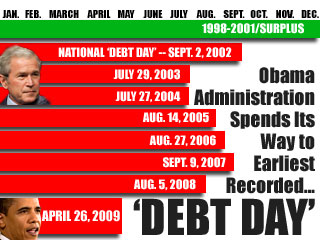
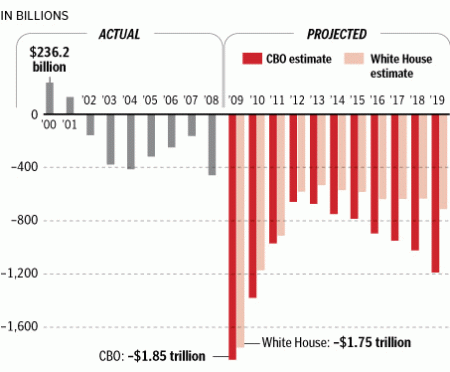
 Internet Scofflaw
You must be logged in to post a comment.