Another case of eminent domain abuse in New York City.
How to steal legally
January 7, 2010
 Leave a Comment » |
  Legal, Political |
  Permalink
 Posted by K. Crary
Geithner told AIG to hide payments
January 7, 2010The New York Times reports:
Starting in November 2008, the Federal Reserve Bank of New York under Timothy Geithner began urging American International Group, the huge insurer that the government had bailed out, to limit disclosure on payments made to banks at the height of the financial crisis. . .
The e-mail exchange between the bailed-out insurance giant and its regulator portray a strange reversal of roles, with A.I.G. staff arguing for the disclosure of certain details on payments for credit-default swaps to major banks, only to be discouraged by officials at, or representing, the Federal Reserve. . .
In a draft of one regulatory filing, A.I.G. stated that it had paid banks . . . the full value of C.D.O.’s, or collateralized debt obligations, that they had bought from the company. In the response to that draft from the law firm Davis Polk and Wardwell, which represented the New York Fed, that crucial sentence was crossed out, and did not appear in the final version filed on Dec. 24, 2008.
By the end of that month, A.I.G. had become the proxy in a tug-of-war between government agencies, with the Securities and Exchange Commission asking the company to revise its disclosure, which the regulator saw as falling short of full compliance.
Geithner’s appointment keeps looking worse and worse.
(Via the Corner.)
Leave a Comment » | Legal, Political | Permalink
Posted by K. Crary
Tome raider
January 1, 2010More opposition to Google’s book-stealing enterprise.
Leave a Comment » | Legal | Permalink
Posted by K. Crary
Interpol granted diplomatic immunity
December 23, 2009President Obama has issued an executive order that gives Interpol full diplomatic immunity.
Why? It’s not a rhetorical question; I really don’t get it. There’s an obvious downside: an international police force that is not answerable to the law. But what is the upside? Even looking for a cynical political benefit, I can’t see one. Steve Schippert thinks it’s a part of a scheme to get America into the International Criminal Court.
(Via the Corner.)
POSTSCRIPT: “Diplomatic immunity” is probably a term of art with someone. I’m not using it that way. (You can read the article to find out exactly what the order does.) But the order definitely gives Interpol privileges that no police force should have, especially an international one.
Leave a Comment » | Legal, Political | Permalink
Posted by K. Crary
Pennsylvania Democrats paid political operatives with taxpayer funds
December 23, 2009AP reports:
The majority leader of the Pennsylvania House directed campaign activities by legislative employees and raised campaign funds from inside the Capitol, according to witness testimony in transcripts obtained by The Associated Press.
The witnesses in the widening probe, which has reached top levels of the state General Assembly, allege conduct by Todd Eachus similar to that for which 25 others have been charged.
Eachus has not been charged, and the allegations date to before he was elected majority leader a year ago.
John Paul Jones, a $62,000-a-year legislative research specialist until December 2007, told the grand jury that Eachus, D-Luzerne, brought him onto the state payroll after the November 2006 election, which returned Democrats to the majority in the House, with a cover story about his legislative work.
“That was sort of like the code of, here’s what I do, but really I was solely there as a political guy,” Jones said.
Jones testified that Eachus told him he considered the General Assembly’s capability to produce public service announcements a free tool to help incumbents get re-elected.
For nearly three years, state Attorney General Tom Corbett has been investigating whether state lawmakers and their aides used legislative employees and state-owned equipment for campaign purposes.
The scandal began with news that millions in bonuses had been quietly handed out to employees of the General Assembly, and a series of five grand jury reports has alleged that many of those bonuses were part of a conspiracy that also involved state contracts and computer equipment, as well as some of the highest-ranking members of the state House and aides. . .
In a May 2008 grand jury appearance, Jones said that while he was working for the House Democratic Campaign Committee in the run-up to that pivotal 2006 election, he and another campaign committee employee worked closely with Eachus out of an office in the Capitol’s East Wing.
He said they helped Eachus phone Democratic state representatives to pressure them either to donate to the campaign committee or promise to spend a certain amount on their own races.
“As Todd would often say, he wanted to spend what he called soft dollars, which were government dollars, on public service announcements so that we had to ultimately spend less hard campaign dollars,” Jones testified.
Jones said that for a time he and two other legislative aides spent nearly all day on political matters, raising money and performing other campaign-related duties.
(Via Instapundit.)
Leave a Comment » | Legal, Political | Permalink
Posted by K. Crary
Speech ban overturned
December 6, 2009Alberta’s Court of Queen’s Bench (a provincial appeals court), has overturned the astonishing lifetime speech ban against Stephen Boissoin, a pastor who wrote a letter to editor of his local paper criticizing the “wicked” homosexual agenda. The Alberta “Human Rights” Commission had ordered that Boissoin refrain from any disparaging remarks about homosexuals in any venue, including the pulpit.
I’d like to call this a big victory for freedom of speech and religion in Canada, but I think the chilling effect is already in place, particularly since it took over a year for the court to overturn the travesty. Still, at least we can say that freedom of speech and religion aren’t dead in Canada yet.
Columbia’s land theft blocked
December 5, 2009A year ago I noted that Columbia University was abusing eminent domain to try to steal property adjoining the university. Basically, they were buying up property in the area, letting that property fall into disrepair, and then seeking to condemn the whole neighborhood as blighted. The scheme was shockingly cynical, as well as immoral and short-sighted.
Now a New York State appellate court has blocked the scheme, ruling that there is no evidence of any real blight. I’m glad to see it.
Leave a Comment » | Academic, Legal, Political | Permalink
Posted by K. Crary
Noted fugitive makes bail
November 26, 2009Fox News reports:
The Swiss government says it will release Roman Polanski on bail and place him under house arrest at his chalet in the Alps. . . A Swiss court has granted Polanski release on a bail of $4.5 million and under condition of electronic monitoring and house arrest.
What could go wrong?
Leave a Comment » | Legal | Permalink
Posted by K. Crary
ACORN mismanages grant money
November 21, 2009Well here’s a shocker:
A report Friday by the Justice Department’s independent inspector general revealed that ACORN won approval for nearly $200,000 in Justice grants since 2002 and mismanaged some of the money.
Leave a Comment » | Legal, Political | Permalink
Posted by K. Crary
Show trials
November 19, 2009The worst aspect of the upcoming Khalid Sheikh Muhammed trial isn’t the foolishness about Miranda warnings. The deeper problem with trying KSM is the question of what happens if he is acquitted. If he is acquitted, will he be released? If so, then they are insane. The man was the mastermind of 9/11; he can’t be released. (Furthermore, every future atrocity perpetrated by KSM would become the personal responsibility of President Obama and AG Holder, so a purely political calculation indicates that he can’t be released.) But if not, the whole trial is a sham. Rather than upholding the rule of law, the trial is a mockery of it.
And it’s no use to argue that the evidence against KSM is so strong that he wouldn’t be acquitted. Holder makes precisely that argument in this video, although he makes it in regards to Bin Laden rather than KSM. Firstly, you never know what will happen in a court of law. (Remember OJ Simpson.) Secondly, even if it were true, the certainty of conviction not only fails to address the matter of principle, it aggravates it. Holder is saying that civilian trials for terrorists are okay because they will certainly result in conviction. In other words, we will hold show trials in civilian court, all in the name of upholding the rule of law!
UPDATE: Eric Posner seems to agree broadly that this is a show trial, but he sees it as a positive rather than a negative. He suggests that we are creating a two-tiered system: civilian trials for strong cases and military trials for weak cases. Doing so, Posner says, will improve the system’s credibility, since we won’t be using “low-quality” trials for everyone.
This makes no sense to me at all. How is holding a few “high-quality” trials going to do anything to improve credibility for the rest? If a “low-quality” trial lacks credibility, how is it going to gain credibility from a “high-quality” trial for someone else? All it proves is at least some of the accused terrorists are guilty, and, frankly, anyone who would otherwise think that not one of them is guilty isn’t going to believe the “high-quality” trials either.
Plus, whatever minute credibility might be obtained by holding a few “high-quality” trials will be forfeit the first time a terrorist is acquitted but not released.
UPDATE: Krauthammer makes much the same point.
Leave a Comment » | Legal, Military, Political | Permalink
Posted by K. Crary
Holder on the KSM trial
November 19, 2009In this video, Lindsey Graham absolutely demolishes Eric Holder on the KSM trial:
In it, Graham presses Holder on whether Osama Bin Laden or other terrorists would have to be given a Miranda warning at the time of capture. A fanciful idea? Apparently not. He says that it would depend.
But it can’t! Bin Laden could be captured tomorrow. He probably won’t, but the one thing we can be sure is, when he is captured, we will not have a few weeks advance notice to make the necessary legal determination. Our soldiers need to now, today, what to do when they capture a terrorist on a foreign battlefield.
(Via Instapundit.)
UPDATE: Split this post into two. The second is here.
Leave a Comment » | Legal, Military, Political | Permalink
Posted by K. Crary
ACORN sues over defunding
November 12, 2009Fox News reports:
In an attempt to regain the millions in funding it lost in the wake of a hidden-camera scandal, ACORN is suing the federal government over congressional legislation that cut off funding to the community organizing group.
Representatives for ACORN sued the federal government Thursday morning in an attempt to regain the millions of dollars in funding the community organizing group lost after filmmakers videotaped its workers offering advice on how to commit tax fraud and various other felonies.
The suit charges Congress with violating the Constitution when it passed legislation in September that specifically targeted ACORN to lose federal housing, education and transportation funds.
A case can be made that defunding ACORN specifically is an unconstitutional bill of attainder. I don’t buy it; I don’t believe that refusing funding is a form of punishment, but you never know what the courts will do. (Eugene Volokh explores the matter here.)
But there are a couple of remarks that must be made: Firstly, to the best of my knowledge, ACORN’s defunding has not yet become law, so this lawsuit seems premature. The courts can hardly entertain lawsuits over everything Congress ever contemplates. Secondly, if you want to be all constitutional about it, Congress has no power to fund ACORN in the first place.
Leave a Comment » | Legal | Permalink
Posted by K. Crary
Gladney beating report obtained
November 10, 2009Big Government has obtained the police report from the incident at a Russ Carnahan (D-MO) town hall in which Kenneth Gladney was attacked by SEIU thugs. The report puts the lie to the spin put out by the SEIU and its enablers in the blogosphere left. It shows that Gladney was attacked viciously and without provocation:
As I walked up to the crowd, several people approached me and were saying the above suspects, McCowan and Molens, had just assaulted a black male who was still around the back side of the school. . . Suspect Molens had his back to me and I observed him yelling and pointing at several individuals. . .While waiting for additional units to make it to my location I attempted to detains Suspects Molens and McCowan for a further investigation into the incident. I had to tell Suspects Molens and McCowan to remain in front of me several times, as they tried numerous times to get lost in the crowd and get past me.
The three above listed witnesses contacted me and stated that they would wait until the scene was brought under control prior to providing me with witness information. . .
I then contacted Witness #1, Harris Himes. Witness H. Himes stated that as he was leaving the school gymnasium, he saw Suspect McCowan talking to Victim Gladney. He stated that he saw Suspect McCowan reach over the table and punch Victim Gladney in the face. This assault knocked the victim off balance. Suspect Molens then went around the table and pulled Victim Gladney over the table backwards by the back of his shirt collar. He began to punch and kick Victim Gladney. Witness H. Himes added that while Suspect Molens was kicking and punching Victim Gladney, Suspect McCowan then joined in on the assault.
Witness #2’s, Sandra Himes’, statement of the incident concurred with Harris’ account of the incident. She did add that Victim Gladney did nothing to provoke this assault.
At this time I was contacted by the victim, Kenneth E. Gladney. . . Victim Gladney appeared shaken and his clothes were in disarray. . .
Gladney stated that he was handing out pens and buttons outside the gym. He stated that is when Suspects Molens and McCowan, along with a third suspect who is unidentified at this time, walked by his table. Suspect McCowan picked up one of the buttons from Gladney’s table and said, “Who’s sellin this shit?” Victim Gladney stated, “I’m not selling anything. It’s free.” At this time Suspect McCowan said, “What kind of nigger are you?” Suspect McCowan then reached across the table and punched Victim Gladney in the face. Victim Gladney added that Suspect Molens grabbed him from behind, at which time he was struck several times and taken to the ground. At this time he was struck several more times. . .
I was then contacted by Witness #3, [redacted], gave a similar account of the original assault. I would like to add that when I originally walked up to the crowd, Witness [redacted] was one of the individuals being yelled at by Suspect Molens. . .
Suspects Molens and McCowan were arrested for the charges of Assault 3rd and Interfering with the Duties of a Police Officer. . .
This case will be presented to the St. Louis County Counselor’s Office for consideration reference the above noted criminal charges.
It’s clear from the report that these two men perpetrated a vicious and unprovoked assault. Why haven’t they been prosecuted? Unfortunately, the St. Louis district attorney, Bob McCulloch, has a history of abusing the power of his office for political purposes. During the 2008 presidential election campaign, Bob McCulloch joined the “Barack Obama Truth Squad“, a coalition of Missouri law enforcement formed “to target anyone who lies or runs a misleading television ad during the presidential campaign”. As we’ve seen clearly during the past year, “misleading” is very much in the eye of the beholder.
(Via Instapundit.)
Leave a Comment » | Legal, Political | Permalink
Posted by K. Crary
ACORN takes the fifth
November 1, 2009The New York Post reports:
A City Council hopeful won’t cough up documents related to whether the Working Families Party is scamming the campaign finance system — because the case could involve “criminal liability,” according to documents released yesterday.
The bombshell development was revealed at a court hearing where lawyers for the WFP and the campaign of Staten Island candidate Debi Rose tried to get a suit against them tossed. . .
The WFP and Rose had tried Thursday to buck a discovery request saying they had to produce documents and campaign finance records.
A lawyer for the campaign said Rose’s treasurer, David Thomas, wouldn’t produce them because they “may implicate criminal liability and his client would therefore have Fifth Amendment rights protecting him from having to make any such compelled disclosure,” according to the affidavit, which quoted a deputy clerk in the Appellate Division.
The “Working Families Party” is one of the organizations in the ACORN network.
(Via Instapundit.)
Leave a Comment » | Legal, Political | Permalink
Posted by K. Crary
Pay czar unconstitutional
October 30, 2009I already thought so, but Michael McConnell (formerly an judge with the 10th Circuit Court of Appeals) makes the case much more carefully.
(Via Instapundit.)
Leave a Comment » | Legal | Permalink
Posted by K. Crary
Obama can accept Nobel prize
October 28, 2009Some people are saying that President Obama cannot accept the Nobel prize without Congressional authorization. This isn’t true; he already is authorized under existing law, provided he turns the prize over to the government.
Leave a Comment » | Legal | Permalink
Posted by K. Crary
Judge rules email not protected by Fourth Amendment
October 28, 2009Apparently the ruling hinges on the fact that email is stored outside the home. But snail mail is protected when it’s sitting in a mailbox, or even en route. Why should email be different?
I’m also confused how to reconcile this decision with Warshak v. US, which says email is protected under the Fourth Amendment. Is this just a circuit split?
UPDATE (11/8): To muddy the waters a little bit more, see the correction here. As a non-lawyer it’s now not clear at all what this ruling means, although it still doesn’t sound good.
Leave a Comment » | Legal, Technological | Permalink
Posted by K. Crary
Great moments in judicial idiocy
October 23, 2009The Kansas Supreme Court rules that while using violence in self-defense is legal, threatening violence in self-defense is not.
ILLEGAL: “Stop or I’ll shoot!”
LEGAL: Bang!
Leave a Comment » | Legal | Permalink
Posted by K. Crary
This can’t be right
October 21, 2009A woman and her daughter trespassing on a man’s property at 5:30 in the morning look in the man’s window and see him naked. The man gets arrested.
(Via Instapundit.)
Leave a Comment » | Legal | Permalink
Posted by K. Crary
Corruption
October 18, 2009AP reports:
The mayor of Alabama’s largest city is facing a federal bribery trial that could drive him from office and send him to prison if he’s convicted.
Prosecutors say Birmingham Mayor Larry Langford took clothing, a Rolex watch and other bribes totaling some $235,000 while serving on the Jefferson County Commission. In exchange, they say Langford steered $7.1 million in county bond business to a political crony’s investment firm. . .
Langford says everything that changed hands were gifts between friends. He also claims his prosecution is part of a Republican scheme to target Democrats in Alabama.
Leave a Comment » | Legal, Political | Permalink
Posted by K. Crary
Hope! Theft! Lies!
October 17, 2009Shepard Fairey, artist of the famous Obama Hope poster, admits he lied to the court in the copyright infringement lawsuit resulting from the poster:
In a strange twist to an already complicated legal situation, artist Shepard Fairey admitted today to legal wrongdoing in his ongoing battle with the Associated Press.
Fairey said in a statement issued late Friday that he knowingly submitted false images and deleted others in the legal proceedings, in an attempt to conceal the fact that the AP had correctly identified the photo that Fairey had used as a reference for his “Hope” poster of then-Sen. Barack Obama. . .
In February, the AP claimed that Fairey violated copyright laws when he used one of their images as the basis for the poster. In response, the artist filed a lawsuit against the AP, claiming that he was protected under fair use. Fairey also claimed that he used a different photo as the inspiration for his poster.
After Fairey’s admission, a spokesman for the Associated Press issued a statement saying that Fairey “sued the AP under false pretenses by lying about which AP photograph he used.”
Fairey said that his lawyers have taken the steps to amend his court pleadings to reflect the fact that “the AP is correct about which photo I used as a reference and that I was mistaken.”
(Via Instapundit.)
Here’s what “mistaken” means in this case:
Fairey’s counsel has now admitted that Fairey tried to destroy documents that would have revealed which image he actually used. Fairey’s counsel has also admitted that he created fake documents as part of his effort to conceal which photo was the source image, including hard copy printouts of an altered version of the Clooney Photo and fake stencil patterns of the Hope and Progress posters.
Incidentally, it seems that to those who have been paying attention to the case, it was obvious all along that Fairey was lying.
UPDATE: This guy is a real piece of work. Not being into the underground art scene, I didn’t know that before the Hope poster, Fairey was best known for, shall we say, unsanctioned public art. But he doesn’t want graffiti on his own property.
(Via Deceiver.com.)
UPDATE: The AP is amending its countersuit, claiming purposeful deceit. (Via Instapundit.)
Leave a Comment » | Legal | Permalink
Posted by K. Crary
“Cost-neutral” red-right cameras again ruled illegal in California
October 5, 2009California law bars municipalities from rewarding operators of red-light cameras based on the amount of revenue they extract from motorists. Over fifty municipalities have tried to finesse that rule with a billing scheme called “cost-neutrality”, in which a supposedly fixed fee is reduced if insufficient revenue is generated to cover it. In essence, the scheme gives the operator a cut of the revenue up to some ceiling.
The scheme was ruled illegal in a case last December, but due to some legal issue I don’t understand, it didn’t establish a precedent. Now a second California court has ruled the same way. The opinion, quoted in its entirety, reads:
“REVERSED”
I think there’s only way to set up a red-light camera system that avoids their corrupt incentives: to forbid the authority that institutes the cameras from receiving any of the revenue. The natural way to do this is to require that all the revenue goes to the state. If red-light cameras were really about safety, municipalities would have no problem with such a rule.
This was attempted in Washington’s proposition I-985. Unfortunately, I-985 failed (it would have done a lot more than just reform red-light cameras), but it elicited some revealing comments from local officials, who were very opposed to it.
(Via Instapundit.)
Leave a Comment » | Legal | Permalink
Posted by K. Crary
Court to rule on gun rights
September 30, 2009The Supreme Court has agreed to hear McDonald v. Chicago, which hopefully will result in a ruling on whether the Second Amendment applies to the states.
(Via Instapundit.)
Leave a Comment » | Legal | Permalink
Posted by K. Crary
No judicial review for red-light cameras
September 24, 2009In Baton Rouge, Louisiana, you can’t beat a ticket from a red-light camera, even when you’re obviously innocent. As far as a local news team could determine, there is no court that will review them.
ASIDE: The title of the story isn’t quite apt. This isn’t a case of “guilty until proven innocent”; it’s “guilty even if proven innocent”.
(Via Instapundit.)
Leave a Comment » | Legal, Political | Permalink
Posted by K. Crary
ACORN to sue O’Keefe and Giles
September 23, 2009Suing is the stupidest thing ACORN could possibly do right now. I honestly thought that would keep them from doing it. Bring on the discovery!
UPDATE: Some legal commentary here.
UPDATE: Some more legal analysis here.
Leave a Comment » | Legal, Political | Permalink
Posted by K. Crary
Anglicans win another one
September 19, 2009In the second major victory this week for Anglicans seeking to leave the Episcopal Church, the South Carolina Supreme Court has ruled in favor of All Saints Parish Waccamaw, against the Episcopal Church USA and the Diocese of South Carolina. There are two main parts to the ruling:
First, the court applied “neutral principles” to the case. This means that the case is judged in exactly the same manner as if it were a secular organization. In the older “deference” approach (which has been deprecated but not forbidden by the US Supreme Court), the court must determine if the church is “hierarchical” or “congregational”, and defer to the ecclesiastical authorities in the former case and to the congregation in the latter. Since the Episcopal Church would presumably be found to be hierarchical, a deference approach would favor the Episcopal Church.
Second, the court found that Episcopal Church cannot impose a trust over property to which it has no title, as it purported to do with the Dennis Canon:
Furthermore, we hold that neither the 2000 Notice nor the Dennis Canon has any legal effect on title to the All Saints congregation’s property. A trust “may be created by either declaration of trust or by transfer of property….” Dreher v. Dreher, 370 S.C. 75, 80, 634 S.E.2d 646, 648 (2006). It is an axiomatic principle of law that a person or entity must hold title to property in order to declare that it is held in trust for the benefit of another or transfer legal title to one person for the benefit of another. . .
For the aforementioned reasons, we hold that title to the property at issue is held by All Saints Parish, Waccamaw, Inc., [and] the Dennis Canons had no legal effect on the title to the congregation’s property.
This is huge. In South Carolina it looks like a conclusive victory for Anglicans, nullifying the Dennis Canon.
(Via Stand Firm in Faith.)
Leave a Comment » | Legal | Permalink
Posted by K. Crary
Appeals court overturns another campaign finance regulation
September 18, 2009Jonathan Adler has the story.
Leave a Comment » | Legal | Permalink
Posted by K. Crary
Court rules for Anglicans in Fort Worth case
September 17, 2009Dioceses seeking to leave the Episcopal Church have scored a major victory:
In a hearing today in the 141st District Court, Judge John Chupp granted the Diocese partial relief under Rule 12 of the Texas Rules of Civil Procedure. He ruled that attorneys Jonathan Nelson and Kathleen Wells do not represent the diocese or the corporation which have realigned under the Province of the Southern Cone. He denied a second aspect of Rule 12 relief which would have removed the plaintiffs’ diocese and corporation from the lawsuit filed April 14, 2009.
The judge also ruled that neither the Constitution and Canons of The Episcopal Church nor the Constitution and Canons of this diocese prohibit withdrawal from TEC and realignment under another province. Further, he found that the Diocese had done so at its November 2008 annual convention, saying that “they [the members] took the diocese with them.” The action of the November convention was not, he said, ultra vires and void, as the suit’s plaintiffs have argued. He declared, too, that the Diocese had taken its property with it in realignment. He said he did not consider any court ruling concerning a realigning parish to be applicable in the present case, and he said that he considered it “self-serving on [the part of TEC] to say that [Bishop Iker] abandoned his job.” . . .
Commenting on today’s ruling, Bishop Iker said, “We are pleased that Judge Chupp has recognized the legitimacy of the vote of our Diocesan Convention in November 2008 to withdraw from the General Convention of The Episcopal Church and has ruled that we had the legal right to amend our Constitution in order to do so.”
Leave a Comment » | Legal | Permalink
Posted by K. Crary
ACORN video #4
September 15, 2009James O’Keefe has released yet another video of ACORN criminal behavior. That makes four now: Baltimore, DC, Brooklyn, and now San Bernadino, California. I’d say he has pretty well demolished ACORN’s claim that this is just a few bad apples.
And Hannah Giles hints of more to come:
- Ask A Question: What if a “prostitute” and her alleged law school boyfriend walk into ACORN seeking housing for an underage brothel to fund his future congressional campaign?
- Do Background Research:
- Learn as much about ACORN housing procedures and protocol as possible.
- History of ACORN and their effect on the United States
- Construct a Hypothesis: ACORN is corrupt and it is in their nature to promote and disguise illegal behavior.
- Experiment: Baltimore, DC, Brooklyn, San Bernardino, and…
- Analyze and draw a conclusion.
(Emphasis mine.) (Previous post.)
Leave a Comment » | Legal, Political | Permalink
Posted by K. Crary
Sex offender registration
September 15, 2009I’ve long been uncomfortable with the idea of registering sex offenders who have served their full sentence. Whatever the courts may have ruled, it doesn’t seem constitutional to impose penalties on criminals beyond what the criminal courts impose.
The Economist points out another problem: existing laws go much further than can be justified on public safety grounds, registering people who are no threat to society. Not only do they needlessly ruin lives, but they also make sex-offender registries ineffective, because it’s impossible to tell who the real dangers are.
Leave a Comment » | Legal, Political | Permalink
Posted by K. Crary
ACORN illegal in Maryland
September 15, 2009There’s a new wrinkle in the ACORN scandal; ACORN has no license to operate in Maryland:
STATE OF MARYLAND
Department of Assessments and Taxation . . .I FURTHER CERTIFY THAT ASSOCIATION OF COMMUNITY ORGANIZATIONS FOR REFORM NOW, INC., A ARKANSAS CORPORATION, IS NOT IN GOOD STANDING WITH THIS DEPARTMENT FOR THE FOLLOWING REASONS:
THE AUTHORITY OF THIS CORPORATION TO DO BUSINESS IN MARYLAND WAS FORFEITED BY THIS DEPARTMENT ON NOVEMBER 16, 2006.
Leave a Comment » | Legal, Political | Permalink
Posted by K. Crary
The ACORN scandal
September 15, 2009(I’m late in reporting this story, because I didn’t have the time to give it the treatment it deserves. And my how the story has grown in the meantime.)
ACORN, the community-organizing and voter-fraud organization, has long been savaged for its various criminal activities. On September 9, they hoped they had gotten in front of their bad reputation when they turned in eleven of their workers for forging voter registrations. This, they argued, was proof that ACORN could police itself:
“Over the last five years thousands of dedicated people have worked or volunteered with Florida ACORN. . . Fortunately, our quality control managers and the systems we developed ensured their ability to spot the isolated wrongdoing by these 11 workers who tried to pass off phony forms instead of doing their work.”
The very next day, James O’Keefe went public with the results of his hidden camera investigation. (Transcript here.) O’Keefe went to an ACORN office in Baltimore posing as a pimp. He brought along Hannah Giles who posed as a prostitute. They spun a tail of various criminal activities, including fraud, child prostitution, and human trafficking. ACORN was all too happy to help. For example, the ACORN consultant suggested that Hannah list her occupation as “performance artist”, she recommended that they understate their income to the IRS, and she gave them advice on how to conceal their underage prostitutes (imported from El Salvador) from the authorities.
ACORN denied everything:
A spokesman for ACORN, Scott Levenson, when asked to comment on the videotape, said: “The portrayal is false and defamatory and an attempt at gotcha journalism. This film crew tried to pull this sham at other offices and failed. ACORN wants to see the full video before commenting further.”
ACORN’s denial proved premature. First, it rang hollow when ACORN quickly fired the staffers. Then, O’Keefe released his second hidden camera investigation, in which he and Giles told the same story at an ACORN office in DC. (Transcript here.) Again, the staffers were happy to help. ACORN quickly fired those staffers as well.
Desperate to get in front of the scandal, ACORN issued a statement accusing Fox News of racism. (ACORN erroneously gave Fox credit/blame for O’Keefe’s work, presumably because Fox News is unpopular among its base of support.) That’s right, ACORN abets trafficking in underage prostitutes, and Fox News is somehow racist for reporting the scandal. The small consolation for ACORN is that most of the media was not so “racist”, and ignored the whole affair. At first.
ACORN still had its supporters. The state attorney in Baltimore issued an amazing statement indicating that it had no plans to prosecute ACORN, but it would investigate criminal wrongdoing by O’Keefe! (It seems that hidden microphones are illegal under Maryland law, but the state attorney had not previously prosecuted journalists for hidden camera investigations.) It’s not surprising to learn that Patricia Jessamy, the state attorney in question, is a Democrat who served on a steering committee for the Obama campaign.
But the Census Bureau, which had a controversial deal with ACORN to assist in the census, had heard enough. Citing “worsening negative perceptions” (I’d say so!), it cancelled its deal with ACORN.
ACORN continued to try to defend itself. It issued a statement threatening legal action against Fox News. That is almost certainly a bluff (and a clumsy one), because — aside from having no case — the last thing ACORN wants is for someone to have the opportunity for discovery. The statement also said:
“This recent scam, which was attempted in San Diego, Los Angeles, Miami, New York, Philadelphia to name a few places, had failed for months before the results we’ve all recently seen.”
This turned out to be a lie, at the very least in regards to New York, as we learned when O’Keefe released his third video. In the third video, O’Keefe and Giles told the same story (fraud, underage prostitution, human trafficking) at an ACORN office in New York, and again received their assistance.
That was finally too much for Congress. The Senate voted 83-7 to cut off funding for ACORN and the House is due to consider similar action shortly. (Among the seven who voted with ACORN was Pennsylvania’s Bob Casey. His father must be rolling in his grave. Roland Burris (D-IL), who is only in the Senate because Democratic leaders quashed proposals for a special election, is another.) Meanwhile, the Brooklyn DA’s office says they will be taking a look, and ACORN may be vulnerable under RICO as well. (It’s hard to imagine Eric Holder approving an investigation of ACORN though.)
The question now is, what happens next?
UPDATE: What happens next is a fourth video.
Leave a Comment » | Legal, Political | Permalink
Posted by K. Crary
Religious freedom in politics upheld
September 12, 2009A New York federal court has rejected a truly odious separation-of-church-and-state lawsuit. In Incantalupo v. Lawrence Free School District, the plaintiffs sought to bar a school board from enacting a policy (tax cuts) that were generally favored by Orthodox Jews and generally opposed by others. They alleged that cutting taxes would give Orthodox Jews more money to spend on private religious schooling, and therefore the tax cuts violate the separation of church and state.
The court rightly rejected this appalling argument:
Indeed, by objecting to lower taxes because they might help some people afford yeshiva education, Plaintiffs’ Complaint, on its clear face, seeks to create , not cure, a First Amendment Equal Protection violations. Plaintiffs do not claim, nor could they, that supporting lower taxes and less school spending by itself violates the First or Fourteenth Amendment. Thus, under Plaintiffs’ reasoning, no claim would lie against political conservatives who ideologically disfavor spending on public schools, or retirees who have no children in the public school system and want lower taxes to boost their discretionary income.
Rather, Plaintiffs believe that the School Board’s actions are problematic entirely because the School Board members are Orthodox Jews who are motivated, in part, to help other Orthodox Jews pay yeshiva tuition by lowering their tax burden. In short, Plaintiffs seek to deny Orthodox Jews political rights possessed by every other group in the United States: the right to mobilize in support of religiously neutral government policies, and then have those policies enacted through normal democratic processes.
I’m glad to see that the court made the right decision in this case, but it’s not the only such case in the pipeline, or even the worst. In this case the plaintiffs were just a bunch of bigoted yahoos, but there’s a similar case filed by the ACLU against the U.S. Conference of Catholic Bishops. In that case, the ACLU seemed to argue that an organization receiving government money could not refuse to spend that money on abortion, if its refusal would be for religious reasons.
Leave a Comment » | Legal | Permalink
Posted by K. Crary
Above the law
September 11, 2009Andrew Sullivan, after being caught possessing marijuana in a national park, got the charges dropped while similar cases were prosecuted. The judge is not happy:
In the Court’s view, in seeking leave to dismiss the charge against Mr. Sullivan, the United States Attorney is not being faithful to a cardinal principle of our legal system, i.e., that all persons stand equal before the law and are to be treated equally in a court of justice once judicial processes are invoked. It is quite apparent that Mr. Sullivan is being treated differently from others who have been charged with the same crime in similar circumstances.
If there were a legitimate reason for the disparate treatment, the Court would view the matter differently. But the United States Attorney refused to allow the Court to inquire into why, in the circumstances of this case where Mr. Sullivan had already been charged with the crime, either a forfeiture of collateral or an adjudication would make a difference in the immigration application.
But there is more. If, in fact, a determination that Mr. Sullivan had possessed marijuana is a factor which, under immigration law, the immigration authorities are legally charged with taking into account when deciding Mr. Sullivan’s application, why should the United States Attorney make a judgment that, despite the immigration law, the charge should be dismissed because it would “adversely affect” his application? If other applicants for a certain immigration status have had their applications “adversely affected” by a conviction or a forfeiture of collateral for possession of marijuana, then why should Mr. Sullivan, who is in the same position, not have to deal with the same consequences?
In short, the Court sees no legitimate reason why Mr. Sullivan should be treated differently, or why the Violation Notice issued to him should be dismissed. The only reasons given for the dismissal flout the bedrock principle of our legal system that all persons stand equal before the law.
(Via Instapundit.)
Last April, Sullivan wrote:
My view is that no one is above the law, and that when a society based on law prosecutes the powerless and excuses the powerful, it is corroding its own soul.
Indeed.
POSTSCRIPT: I stopped paying attention to Andrew Sullivan long before last April, but Sullivan being who he is, I knew he must have said something like this at some point. It wasn’t hard to google up this instance. There’s probably more.
UPDATE: Patterico offers another stunning hypocrisy on Sullivan’s part. (Warning: link quotes a vulgar advertisement).
3 Comments | Legal | Permalink
Posted by K. Crary
Staying the course on book-banning power
September 11, 2009In the Supreme Court’s rehearing of Citizens United v. FEC, the Obama administration stuck by its guns, arguing that a government power to ban political books is consistent with the First Amendment. Beyond that, the administration argued that the power to ban electronically transmitted books (such as Kindle books) is already present in the statute in question.
Got that? The government says that, under existing law, it has the power to ban political e-books in some circumstances.
The administration argues that we can trust them not to do so, to which Chief Justice Roberts replied, “we don’t put our First Amendment rights in the hands of FEC bureaucrats.” And well we don’t, because in the administration lawyer’s very next breath, she said that pamphlets are different; they might very well ban a pamphlet.
To summarize: under the Obama administration’s argument, our right to publish books is not absolute. It depends on a variety of factors including (1) content, (2) length, (3) means of transmission, and (4) means of financing. I think I like the First Amendment better.
How these people can call themselves liberals is beyond me.
Leave a Comment » | Legal, Political | Permalink
Posted by K. Crary
Austin and McConnell on the chopping block
September 10, 2009The Supreme Court has taken oral arguments on Citizens United v. FEC (again) and it seems that two egregious precedents in campaign finance law are likely to fall. (Via Volokh.) I certainly hope so.
This is the infamous case in which the Obama adminstration argued that it has the power, in some cases, to ban political books, signs, and YouTube videos.
Leave a Comment » | Legal | Permalink
Posted by K. Crary
DOJ to investigate Black Panther case dimissal
September 10, 2009The Washington Times reports.
UPDATE: In light of this, there’s good reason to worry that the DOJ’s internal investigation isn’t real, and is merely intended to run interference against the Commission on Civil Rights’s investigation. Hans van Spakovsky agrees.
Leave a Comment » | Legal, Political | Permalink
Posted by K. Crary
Canadian hate speech law unconstitutional
September 2, 2009A victory for free expression in Canada:
The Canadian Human Rights Tribunal on Wednesday ruled that Section 13, Canada’s much maligned human rights hate speech law, violates the Charter right to free expression because it carries the threat of punitive fines.
The shocking decision by Tribunal member Athanasios Hadjis leaves several hate speech cases in limbo, and appears to strip the Canadian Human Rights Commission of its controversial legal mandate to pursue hate on the Internet, which it has strenuously defended against complaints of censorship.
It also marks the first major failure of Section 13(1) of the Canadian Human Rights Act, an anti-hate law that was conceived in the 1960s to target racist telephone hotlines, then expanded in 2001 to the include the entire Internet, and for the last decade used almost exclusively by one complainant, activist Ottawa lawyer Richard Warman.
(Via Instapundit.)
Leave a Comment » | Legal | Permalink
Posted by K. Crary
The fix is in
September 1, 2009The Ecuadorean lawsuit against Chevron was already a travesty. Now it’s been shown to be a complete sham. A series of videos show that the judge has been bribed and has promised to rule against Chevron. The Ecuador’s execrable president, Rafael Correa, also stands to profit personally from the scheme.
I don’t know if the revelation will be enough to save Chevron in Ecuador, but I assume it should make it impossible for Ecuador to collect in US court.
Leave a Comment » | Legal, Political | Permalink
Posted by K. Crary
Supreme Court will re-hear campaign speech case
August 30, 2009The Supreme Court will re-hear Citizens United v. FEC this fall. This is the infamous case in with the Obama administration argued that the government has the power, under some circumstances, to ban political books, signs, and YouTube videos. The ACLU and the Reporters Committee for Freedom of the Press both filed briefs opposing the government’s position.
UPDATE: I’ve corrected the name of the case.
Leave a Comment » | Legal | Permalink
Posted by K. Crary
Only the little people pay taxes
August 26, 2009For the rest of us, the Geithner defense (“it’s the software’s fault”) is no defense at all. (Via Instapundit.)
Leave a Comment » | Legal, Political | Permalink
Posted by K. Crary
Obama’s first rendition
August 23, 2009The LA Times reports:
Reporting from Alexandria, Va. – A Lebanese citizen being held in a detention center here was hooded, stripped naked for photographs and bundled onto an executive jet by FBI agents in Afghanistan in April, making him the first known target of a rendition during the Obama administration.
Unlike terrorism suspects who were secretly snatched by the CIA and harshly interrogated and imprisoned overseas during the George W. Bush administration, Raymond Azar was flown to this Washington suburb for a case involving inflated invoices. . .
Joanne Mariner, terrorism and counter-terrorism director at Human Rights Watch, called the case “bizarre.”
“He was treated like a high-security terrorist instead of someone accused of a relatively minor white-collar crime,” she said.
Justice Department lawyers have denied any misconduct in the case.
(Via Volokh.)
Let’s see if I understand the Obama administration position. Rendition is wrong for terrorists. But rendition is appropriate for white-collar criminals. I hope we’re missing part of the story, because this is just bizarre.
Leave a Comment » | Legal, Political | Permalink
Posted by K. Crary
Health-insurance mandate unconstitutional
August 22, 2009So say David Rivkin and Lee Casey in the Washington Post, pointing out that health care is not an economic activity that would fall under the authority of Congress’s interstate commerce power.
I love enumerated-powers arguments. They’re so quaint. James Madison would surely agree, but five members of today’s Supreme Court? Not likely.
(Via Instapundit.)
Leave a Comment » | Legal | Permalink
Posted by K. Crary
In our face
August 18, 2009One of the guests at the White House party to celebrate the Sonia Sotomayor’s confirmation to the Supreme Court was John DeStefano, the mayor of New Haven. If that name rings a bell, it’s because DeStefano was the defendant in Ricci v. DeStefano, the notorious racial discrimination case in which Sotomayor was recently overturned 9-0 after failing to bury the case.
It’s not hard to see the message that the White House is sending vis-a-vis racial preferences.
Leave a Comment » | Legal, Political | Permalink
Posted by K. Crary
California won’t accept its own IOUs
August 10, 2009This really takes the cake. The State of California pays its suppliers in fake money, then expects them to turn around and pay sales tax in real money:
Small businesses that received $682 million in IOUs from the state say California expects them to pay taxes on the worthless scraps of paper, but refuses to accept its own IOUs to pay debts or taxes. . .
Lead plaintiff Nancy Baird filled her contract with California to provide embroidered polo shirts to a youth camp run by the National Guard, but never was paid the $27,000 she was owed. She says California “paid” her with an IOU that two banks refused to accept – yet she had to pay California sales tax on the so-called “sale” of the uniforms.
I think Baird has a strong case. She hasn’t been paid yet, so no sales tax is due. California’s position seems to be that she should pay the state for privilege of supplying it.
Leave a Comment » | Legal, Political | Permalink
Posted by K. Crary
Flag me
August 7, 2009David Hardy says that the White House’s plan to collect reports of dissident activity is illegal, assuming records are kept.
(Via Instapundit.) (Previous post.)
UPDATE: More:
The White House strategy of turning supporters into snitches when they see “fishy” information about the health care debate may run afoul of the law, legal experts say.
“The White House is in bit of a conundrum because of this privacy statute that prohibits the White House from collecting data and storing it on people who disagree with it,” Judge Andrew Napolitano, a FOX News analyst, said Friday.
“There’s also a statute that requires the White House to retain all communications that it receives. It can’t try to rewrite history by pretending it didn’t receive anything,” he said.
“If the White House deletes anything, it violates one statute. If the White House collects data on the free speech, it violates another statute.”
It would seem that the only way to follow the law would be not to ask for the information in the first place.
Leave a Comment » | Legal, Political | Permalink
Posted by K. Crary
Baseless lawsuit threat = extortion
August 7, 2009An interesting case in New Hampsire.
Leave a Comment » | Legal | Permalink
Posted by K. Crary
Amazon sued over Orwell-Kindle affair
August 5, 2009Eugene Volokh thinks the plaintiff has a case.
Leave a Comment » | Legal, Technological | Permalink
Posted by K. Crary
Justice #3 dismissed voter intimidation case
July 30, 2009The Washington Times has a lengthy account of how the Black Panther voter intimidation case came to be dismissed, after Justice Department lawyers had already won the case. Thomas Perrelli, the #3 official at the Justice Department (and a political appointee, of course), made the final decision that a suitable penalty for flagrant voter intimidation was an injunction against doing it again.
(Via the Corner.) (Previous post.)
UPDATE: More here. This keeps smelling worse and worse. (Via the Corner.)
Leave a Comment » | Legal, Political | Permalink
Posted by K. Crary
How Ricci was discovered
July 17, 2009Stuart Taylor relates the story behind how a federal judge revived the Ricci case, which Sonia Sotomayor tried (almost successfully) to bury. Taylor concludes that Sotomayor’s action may have violated the Second Circuit’s rules. (Via the Corner.)
Leave a Comment » | Legal | Permalink
Posted by K. Crary
34 states urge Second Amendment incorporation
July 7, 2009Alabama, Alaska, Arkansas, California, Colorado, Florida, Idaho, Indiana, Georgia, Kansas, Kentucky, Louisiana, Maine, Michigan, Minnesota, Mississippi, Missouri, Montana, Nebraska, New Hampshire, New Mexico, North Carolina, North Dakota, Ohio, Oklahoma, Pennsylvania, South Carolina, South Dakota, Utah, Texas, Virginia, Washington, West Virginia, Wyoming have all submitted an amicus brief to the Supreme Court arguing that the Second Amendment should apply to the states. California wrote its own; the other states collaborated on theirs.
California is the big surprise. Its brief is signed by Jerry Brown, California Attorney General and noted liberal.
Incidentally, 34 states is just four short of the number needed to ratify a constitutional amendment, should one be necessary.
Leave a Comment » | Legal | Permalink
Posted by K. Crary
“Cyber-bullying” case dimissed
July 3, 2009The judge in the case against Lori Drew has dismissed the case. Regardless of how contemptible Drew is, this is a good thing. What she did wasn’t against the law, and the proper response is to fix the law, not to trump up charges against her. The trumped-up charges they came up with — criminalizing violations of click-through terms-of-use agreements — threaten us all. Orin Kerr explained, back when this travesty began.
UPDATE: The judge sums up the case thusly:
“It basically leaves it up to a website owner to determine what is a crime,” said [Judge] Wu on Thursday, echoing what critics of the case have been saying for months. “And therefore it criminalizes what would be a breach of contract.”
Leave a Comment » | Legal | Permalink
Posted by K. Crary
Ricci and Sotomayor
June 30, 2009In its Ricci decision, the Supreme Court ruled 5-4 for Ricci, but 9-0 against Sotomayor. Paul Mirengoff explains:
First, her panel issued a summary order in a case that ended up being heard by the Supreme Court and generating a 5-4 decision with nearly 100 pages worth of opinions.
Second, Sotomayor’s panel was sharply criticized by her mentor, Judge Cabranes, for its “perfunctory disposition” of the case, in an opinion which suggests that Cabranes believed that Sotomayor and her fellow panel members were attempting to bury the matter.
Third, the Supreme Court reversed the panel.
Fourth, even the dissenting Justices blew off the reasoning of Sotomayor’s panel in a footnote, and fashioned their own, different standard for deciding the case.
Fifth, the dissenting Justices made it clear they would have disposed of the case differently than the way Sotomayor’s panel disposed of it. The panel affirmed the district court’s grant of summary judgment in favor of the City of New Haven, which would have ended the matter. The dissenters, in the panel’s position, would have remanded the case to the district court for further proceedings under the different standard for deciding the matter that it articulated.
The final point, regarding the disposition of the Ricci case, seems to have become a matter of confusion, but I think the dissenters were clear. Justice Ginsburg wrote that because the “lower courts,” including Sotomayor’s panel, applied an “intent” standard rather than considering whether the City of New Haven had “good cause” to act as it did (the dissent’s standard), “ordinarily a remand would be in order.” In other words, had the dissenters been sitting on the Second Circuit panel, they would have ordered a remand instead of affirming the district court, as Judge Sotomayor’s panel summarily did.
Not only was Sotomayor overturned, but her position was beyond where even the liberal justices were willing to go.
Leave a Comment » | Legal | Permalink
Posted by K. Crary
CCAC free speech update
June 19, 2009CCAC has responded to FIRE’s allegations that CCAC trampled a student’s free speech rights when she tried to form a gun-rights student organization. CCAC’s response is here, and FIRE’s subsequent press release is here. (CCAC earlier admitted that they did not reply to FIRE in a timely fashion.)
CCAC’s response falls quite a bit short of what might be hoped. It proclaims their support for free speech and claims that the student has not been disciplined. However, it reiterates its position that any mention of CCAC in a student’s literature, even with an explicit disclaimer of any affiliation, constitutes a claim of endorsement by CCAC that they must suppress. This argument is hardly defensible. Moreover, as FIRE points out, what then can be made of all the other organizations (such as the College Democrats) that CCAC does permit to use its name?
More troublingly, CCAC fails to rebut the two most serious allegations: First, the student was threatened with charges of academic misconduct. Second, CCAC’s dean said “You may want to discuss this topic but the college does not, and you cannot make us,” making clear the college’s desire to suppress the student’s speech.
Leave a Comment » | Academic, Legal | Permalink
Posted by K. Crary
Circus in Albany
June 10, 2009Two New York State Senators have switched parties, switching control of the chamber from Democrat to Republican. Such occasions are rare, but they do happen, most notably in the US Senate in 2001.
But in New York State there’s a twist. The Democrats are refusing to recognize that they have lost control of the chamber. They claim that it’s somehow illegal, and they still control the chamber, despite being the minority. Needless to say, they have yet to produce a legal theory that justifies their claim.
Ironically, however, one law has certainly been broken, by the Democrats. In an effort to delay their ouster, Democrats put the chamber into recess and locked the doors. This violates the New York State constitution, which says “The doors of each house shall be kept open, except when the public welfare shall require secrecy.”
Leave a Comment » | Legal, Political | Permalink
Posted by K. Crary
SCOTUS delays Chrysler sale
June 9, 2009AP reports.
UPDATE: The delay didn’t last long. I guess the justices weren’t persuaded by Lauria’s argument. I wish they would have issued an opinion explaining why not, but to do so they would have had to take the case.
This editorial from the Evansville Courier and Press expresses my sentiments pretty well.
Leave a Comment » | Legal | Permalink
Posted by K. Crary
Wecht charges dropped
June 3, 2009The US Attorney has dropped all charges against Cyril Wecht, the corrupt former coroner of Allegheny County. This was expected after the trial judge, reversing a ruling of the previous trial judge, granted a motion to suppress most of the prosecution’s evidence.
The ruling found that, although investigators obtained a search warrant and operated in good faith, the warrant was overly broad. Judge Sean McLaughlin said his decision was not “constitutional hair-splitting or a mere legal technicality,” but that’s exactly what it was. Although the warrant application proposed to seize a particular set of boxes, and although that particular set of boxes is exactly what was seized, the warrant that authorized them to do so merely referred to “boxes (approximately 20) and contents containing private autopsy files” and failed to specify exactly which such boxes. Because that specification, which was present in the warrant application, was left out of the warrant itself, the judge ruled that the warrant was overly broad, and suppressed the proceeds of the search.
As a result, Cyril Wecht gets off again.
Leave a Comment » | Legal | Permalink
Posted by K. Crary
Appeals court halts Chrysler deal
June 3, 2009Good news: the Second Circuit has halted the Chrysler bankruptcy to hear Indiana’s appeal.
UPDATE: The appeals court will permit the sale to go forward.
Leave a Comment » | Legal, Political | Permalink
Posted by K. Crary
Justice Department winks at voter intimidation
May 30, 2009The Justice Department says this is no big deal:
The Washington Times reports:
Justice Department political appointees overruled career lawyers and ended a civil complaint accusing three members of the New Black Panther Party for Self-Defense of wielding a nightstick and intimidating voters at a Philadelphia polling place last Election Day, according to documents and interviews.
The incident – which gained national attention when it was captured on videotape and distributed on YouTube – had prompted the government to sue the men, saying they violated the 1965 Voting Rights Act by scaring would-be voters with the weapon, racial slurs and military-style uniforms.
Career lawyers pursued the case for months, including obtaining an affidavit from a prominent 1960s civil rights activist who witnessed the confrontation and described it as “the most blatant form of voter intimidation” that he had seen, even during the voting rights crisis in Mississippi a half-century ago.
The lawyers also had ascertained that one of the three men had gained access to the polling place by securing a credential as a Democratic poll watcher, according to interviews and documents reviewed by The Washington Times.
The career Justice lawyers were on the verge of securing sanctions against the men earlier this month when their superiors ordered them to reverse course, according to interviews and documents. The court had already entered a default judgment against the men on April 20.
A Justice Department spokesman on Thursday confirmed that the agency had dropped the case, dismissing two of the men from the lawsuit with no penalty and winning an order against the third man that simply prohibits him from bringing a weapon to a polling place in future elections. . .
The three men named in the complaint – New Black Panther Chairman Malik Zulu Shabazz, Minister King Samir Shabazz and Jerry Jackson – refused to appear in court to answer the accusations over a near-five month period, court records said. . .
Court records show that as late as May 5, the Justice Department was still considering an order by U.S. District Judge Stewart Dalzell in Philadelphia to seek judgments, or sanctions, against the three Panthers because of their failure to appear. But 10 days later, the department reversed itself and filed a notice of voluntary dismissal from the complaint for Malik Zulu Shabazz and Mr. Jackson.
(Via Instapundit.)
Apparently, President Obama’s political appointees at the Justice Department think that a suitable penalty for blatant voter intimidation (by Democrats) is a court order not to do it any more.
This scandal may have legs. Rep. Lamar Smith (R-TX), the ranking member on the House Judiciary Committee, is demanding answers.
Leave a Comment » | Legal, Political | Permalink
Posted by K. Crary
San Diego suppresses prayer meetings
May 29, 2009A San Diego TV station reports:
A local pastor and his wife claim they were interrogated by a San Diego County official, who then threatened them with escalating fines if they continued to hold Bible studies in their home, 10News reported.
Attorney Dean Broyles of The Western Center For Law & Policy was shocked with what happened to the pastor and his wife.
Broyles said, “The county asked, ‘Do you have a regular meeting in your home?’ She said, ‘Yes.’ ‘Do you say amen?’ ‘Yes.’ ‘Do you pray?’ ‘Yes.’ ‘Do you say praise the Lord?’ ‘Yes.'”
The county employee notified the couple that the small Bible study, with an average of 15 people attending, was in violation of County regulations, according to Broyles.
Broyles said a few days later the couple received a written warning that listed “unlawful use of land” and told them to “stop religious assembly or apply for a major use permit” — a process that could cost tens of thousands of dollars.
(Via Reason, via Instapundit.)
I’m sure San Diego County will back away from this very quickly. But more than that, someone should be fired. It’s not good enough simply to back away from intimidation when you’re called on it.
UPDATE: The county is indeed backing down. They’re not admitting any wrongdoing yet, but claim to be investigating.
There’s a fact not to lose sight of here. The county says that this was a routine code enforcement gone awry. Indeed, it went very far awry if the county official was investigating the religious practice of the participants. But set that aside; let’s suppose it didn’t happen that way, or consider a hypothetical case in which the official behaved “properly.” The county is still on very shaky ground. According to my understanding of the law, strict scrutiny applies even for unintentional impairment of freedom of religion. That is to say, the county must make accommodations for religious gatherings that it might not make for other gatherings.
Leave a Comment » | Legal | Permalink
Posted by K. Crary
Free speech is “academic misconduct” at CCAC
May 27, 2009The Community College of Allegheny County (CCAC) has ordered a student to cease her efforts to organize a student group supporting gun rights, and labeled those efforts “academic misconduct”:
FIRE Press Release
PITTSBURGH, May 27, 2009—A student who wants to form a gun-rights group at the Community College of Allegheny County (CCAC) has been threatened with disciplinary action for her efforts. Student Christine Brashier has turned to the Foundation for Individual Rights in Education (FIRE) for help after reporting that administrators banned her informational pamphlets, ordered her to destroy all copies of them, and told her that further “academic misconduct” would not be tolerated. . .
In April, CCAC student Christine Brashier created pamphlets to distribute to her classmates encouraging them to join her in forming a chapter of the national Students for Concealed Carry on Campus (SCCC) organization at CCAC. The handbill states that the group “supports the legalization of concealed carry by licensed individuals on college campuses.” She personally distributed copies of the flyer, which identified her as a “Campus Leader” of the effort to start the chapter.
On April 24, Jean Snider, Student Development Specialist at CCAC’s Allegheny Campus, summoned Brashier to a meeting that day with Snider and Yvonne Burns, Dean of Student Development. According to Brashier, the deans told Brashier that passing out her non-commercial pamphlets was prohibited as “solicitation.” They told Brashier that trying to “sell” other students on the idea of the organization was prohibited.
CCAC also told Brashier that the college must pre-approve any distribution of literature to fellow students, and that pamphlets like hers would not be approved, even insisting that Brashier destroy all copies of her pamphlet. . .
When Brashier stated that she wanted to be able to discuss this policy freely on campus, she was told to stop doing so without the permission of the CCAC administration. Dean Burns reportedly said, “You may want to discuss this topic but the college does not, and you cannot make us.” Brashier was then told to cease all activities related to her involvement with SCCC at CCAC and that such “academic misconduct” would not be tolerated.
FIRE wrote CCAC President Alex Johnson on April 29 about these violations of Brashier’s First Amendment speech and association rights, pointing out that her free speech in no way constituted solicitation, that CCAC is obligated to permit students to distribute literature and may not ban it on the basis of viewpoint or content, and that if CCAC recognizes student organizations at all, it must recognize an organization that supports concealed carry on campus. FIRE requested a response by May 13, and CCAC responded only by promising a reply from either CCAC or the Allegheny County Solicitor’s office at some “reasonable” future time. Two weeks have passed since that promise, leaving the First Amendment in jeopardy at CCAC.
(Via Instapundit.)
Suppressing free speech is disgraceful. And, at a public college, illegal as well. But even worse is threatening students with bogus charges of academic misconduct. Anyone who would do that has no business at all running an academic institution.
Leave a Comment » | Academic, Legal | Permalink
Posted by K. Crary
FCC claims power to conduct warrantless searches
May 22, 2009This sounds wrong:
You may not know it, but if you have a wireless router, a cordless phone, remote car-door opener, baby monitor or cellphone in your house, the FCC claims the right to enter your home without a warrant at any time of the day or night in order to inspect it.
That’s the upshot of the rules the agency has followed for years to monitor licensed television and radio stations, and to crack down on pirate radio broadcasters. And the commission maintains the same policy applies to any licensed or unlicensed radio-frequency device.
“Anything using RF energy — we have the right to inspect it to make sure it is not causing interference,” says FCC spokesman David Fiske. That includes devices like Wi-Fi routers that use unlicensed spectrum, Fiske says. . .
George Washington University professor Orin Kerr, a constitutional law expert, also questions the legalilty of the policy.
“The Supreme Court has said that the government can’t make warrantless entries into homes for administrative inspections,” Kerr said via e-mail, refering to a 1967 Supreme Court ruling that housing inspectors needed warrants to force their way into private residences. The FCC’s online FAQ doesn’t explain how the agency gets around that ruling, Kerr adds. . .
Refusing the FCC admittance can carry a harsh financial penalty. In a 2007 case, a Corpus Christi, Texas, man got a visit from the FCC’s direction-finders after rebroadcasting an AM radio station through a CB radio in his home. An FCC agent tracked the signal to his house and asked to see the equipment; Donald Winton refused to let him in, but did turn off the radio. Winton was later fined $7,000 for refusing entry to the officer.
(Via Volokh.)
Leave a Comment » | Legal | Permalink
Posted by K. Crary
Indiana objects to Chrysler deal
May 21, 2009The Obama administration succeeded in bullying Chrysler’s major private creditors out of objecting to the Chrysler-UAW deal, but the state of Indiana is objecting on behalf of the retirement plans of its teachers and state police.
This is very good news. Despite the deal being illegal, the administration was on the verge of getting away with it, and setting a terrible precedent in the process. Now there should be a real hearing in court.
Leave a Comment » | Legal, Political | Permalink
Posted by K. Crary
Obama tries to straddle on photos
May 14, 2009President Obama is right that releasing more photos of detainee abuse would make the war effort harder and would not help increase our understanding of what had happened there. All it would do is provide more propaganda ammunition to America’s enemies. I was going to post to that effect, but before I got a chance to do so, I read an eye-opening analysis by Andy McCarthy.
The background is the question of whether the Obama administration is bringing a new argument to the court or simply taking up the Bush administration’s case. The question is important because the court already ruled against the Bush argument, and the Obama administration failed to appeal. McCarthy explains that the answer is the latter (despite Robert Gibbbs’s hapless efforts to argue otherwise), which places the administration into an awkward legal position. He then continues:
Why all the legerdemain? Because . . . Obama is using this litigation as a smokescreen. He’s now getting plaudits for reversing himself and his Justice Department (which, in contrast to the Bush Justice Department, didn’t want to fight this case at all — just wanted to release the photos). But he is still trying to get away with voting present — which is to say, he is hiding behind the judges.
It is in Obama’s power, right this minute, to end this debacle by issuing an executive order suppressing disclosure of the photos due to national security and foreign policy concerns. As I’ve noted, there’s no need to get into a Bush-era debate over the limits of executive power here. In the Freedom of Information Act, indeed, in FOIA’s very first exemption, Congress expressly vests him with that authority. . .
Besides being simple, issuing such an order would be a strong position and the screamingly obvious right thing to do. But it would also be a fully accountable thing to do, and that’s why President Obama is avoiding it. He realizes — especially after he surrendered details of our interrogation methods to the enemy — that he can’t afford to undermine the war effort again so quickly and so blatanly; but his heart is with the Left on this — that’s why he agreed to the release of the photos in the first place and why he is trying to prevent mutiny within his base. So here’s the game: Obama tells those of us who care about national security that he is taking measures to protect the troops and the American people, but he also tells the Left that he hasn’t made any final decisions about the photos and that the question is really for the courts to decide. That’s why he carefully couched yesterday’s reversal as a “delay” in the release of the photos.
We’re happy as long as the photos stay under wraps, but the wink to the Left is his signal that if, after further review, the courts continue to hold that disclosure is required under the FOIA section the government has invoked — which is not the executive order provision but a section relating to the withholding of records “compiled for law enforcement purposes”— he may just shrug his shoulders and release the photos.
It doesn’t seem that the straddle is working. Not only is President Obama being savaged by the left, but he’s going to run into real trouble in court. McCarthy summarizes:
One last thing: I think the court rulings have been bad so far, but good or bad, I can assure you that federal judges don’t like to be toyed with. Supreme Court justices may not mind if the administration treats the media like a lap-dog and the public like we’re a bunch of rubes; but, regardless of their political leanings, the justices have goo-gobs of self-esteem, and they will not take kindly to being treated like pawns in the Obamaestro’s game.
UPDATE (5/22): It appears that Congress may bail out the president on this issue.
Leave a Comment » | Legal, Political | Permalink
Posted by K. Crary
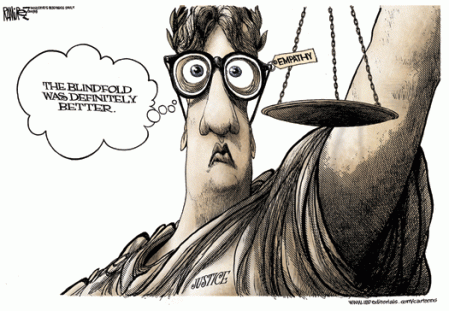
Our lawless Justice Department
May 11, 2009The leaks from the Justice Department’s Office of Professional Responsibility in the investigation of John Yoo and Jay Bybee not only violate Justice Department rules but also violate federal law. The OPR is permitted to release only the final report, and even that only after Yoo and Bybee’s attorney’s have had a chance to comment. The leaks issuing from the “Office of Professional Responsibility” are not only unethical, but criminal. (George Orwell, call your office.)
So, let’s review the status of the investigation into the “torture memos”:
- The OPR leaks are a criminal violation of the Privacy Act.
- John Yoo cannot be sanctioned anyway, because too much time has elapsed for a complaint against him.
- Professional sanction would have been (and is, for Bybee) extremely unlikely in any case, as it would require a finding that no reasonable lawyer could have produced their reasoning. That finding is nearly impossible, if for no other reason than:
- The Obama-Holder Justice Department has argued the legal theory propounded in the “torture memos” in its filing in Demjanjuk v. Holder.
- And, by a 10-3 margin, the Third Circuit Court of Appeals has adopted that same legal theory in Pierre v. Attorney General.
What we are watching cannot be described in any terms other than as a partisan witch-hunt.
POSTSCRIPT: The Washington Post argues that the leaks in the case are insufficient, and the OPR should release all the raw material from its investigation. I wouldn’t be surprised if the Post gets its wish, but let’s not forget that what they’re asking violates federal law.
Leave a Comment » | Legal, Political | Permalink
Posted by K. Crary
Yoo can’t be disbarred
May 7, 2009ABC News reports:
It appears John Yoo cannot be disciplined or disbarred for writing those memos, even if the Office of Professional Responsibility says it has evidence he should be.
That’s because OPR’s five-year investigation—carefully timed for release only as Bush was leaving the White House and Obama was coming in—dragged on too long. As a result of that timing, OPR blew the deadline for referring possible misconduct allegations against Yoo.
John Yoo is admitted to the bar in Pennsylvania. But the Pennsylvania Disciplinary Board, which would investigate any complaints against him, imposes a four-year limitation for complaints.
Yoo wrote the memos in 2002 and 2003. This is 2009. You do the math.
(Via the Corner.)
The OPR delayed its report to a time when it would generate maximum political impact, but could no longer result in any consequences. Obviously, there is only one way that makes sense, and that’s if the sole purpose of the investigation is the political impact.
The “Office of Professional Responsibility” is sounding profoundly ill-named.
Leave a Comment » | Legal, Political | Permalink
Posted by K. Crary
Torture hypocrisy
May 6, 2009The Obama adminstration is using the “torture memos” in court. That’s right, the same legal reasoning that was so bad its authors should be prosecuted, or at least disbarred, forms the legal basis of the DOJ’s filing in Demjanjuk v. Holder.
Andrew McCarthy explains that the core of the 2002 Office of Legal Counsel argument is that torture is a “specific intent” crime, meaning that it requires an “evil motive to inflict severe pain and suffering.” Although the memo’s legal guidance was officially withdrawn in 2004, the Obama administration is still using its reasoning, even while publicly excoriating it.
McCarthy also makes an another interesting observation. Last year, the Third Circuit Court of Appeals, sitting en banc, adopted that same 2002 OLC reasoning by a vote of 10-3 in Pierre v. Attorney General. Indeed, they were fully aware that they were doing so.
One gets the idea from the media that the torture memos are thoroughly discredited. It’s hard to reconcile that with the fact that the Obama administration is still using their legal theory, and indeed that theory is binding legal precedent in Pennsylvania, Delaware, and New Jersey. It’s also hard to believe the kind of hypocrisy that would publicly press for prosecution and/or disbarment for authoring a legal theory one is using in court oneself.
(Via Instapundit.)
Leave a Comment » | Legal | Permalink
Posted by K. Crary
Chrysler bankruptcy plan is unconstitutional
May 4, 2009Thomas Lauria, attorney for Chrysler creditors that are refusing to accept the Obama administration’s plan (in which senior creditors would give up their claims in order to feather the bed of the UAW), has filed a motion arguing that the administration’s scheme is unconstitutional.
I’m not a lawyer, but I have to say that the argument sounds compelling. It seems that the Supreme Court, in Louisville Joint Stock Land Bank v. Radford, found that creditors have a 5th Amendment right to property that cannot be set aside by a change to the law (such as TARP):
1. The bankruptcy power, like the other great substantive powers of Congress, is subject to the Fifth Amendment.
2. Under the bankruptcy power, Congress may discharge the debtor’s personal obligation because, unlike the States, it is not prohibited from impairing the obligation of contracts; but it cannot take for the benefit of the debtor rights in specific property acquired by the creditor prior to the Act.
3. The Fifth Amendment commands that, however great the Nation’s need, private property shall not be taken even for a wholly public use without just compensation.
4. If the public interest requires, and permits the taking of property of individual mortgagees in order to relieve the necessities of individual mortgagors, resort must be had to proceedings by eminent domain, so that, through taxation, the burden of the relief afforded in the public interest may be borne by the public.
5. The provisions added to § 75 of the Bankruptcy Act by the Act of June 28, 1934, known as the Frazier-Lemke Act, operate, as applied in this case, to take valuable rights in specific property from one person and give them to another, in violation of the Constitution.
I’ll be looking for commentary from the law bloggers, but this makes it sound as though the senior creditors’ position is very strong. The Chrysler deal looks to me likely to go down.
POSTSCRIPT: Can you imagine furor if the government were to (as the Radford decision says they must) use tax money to compensate the creditors, all for the benefit of the UAW? It’s hard to picture that happening. Still, many things have already happened during the past year that seemed impossible.
Leave a Comment » | Legal | Permalink
Posted by K. Crary
DOJ to investigate Google Books settlement
May 2, 2009Reports the New York Times. Obviously, I think that’s appropriate.
(Via Volokh.) (Previous post.)
POSTSCRIPT: In a conversation yesterday, I mentioned that Google has abandoned its “don’t be evil” slogan. My friend remarked that he thinks now it’s “don’t be evil, on net.” Is Google still in the black, so to speak? I think they probably are, but they may need a moral bailout soon.
Leave a Comment » | Legal, Technological | Permalink
Posted by K. Crary
Al-Marri guilty
May 2, 2009AP reports:
A man whose case sparked a furious legal debate over whether the government can hold terrorism suspects indefinitely entered a surprise guilty plea, admitting to training in al-Qaida camps and coming to the nation’s heartland a day before Sept. 11.
Ali al-Marri, 43, pleaded guilty Thursday to one count of conspiring to provide material support or resources to a foreign terrorist organization. A second charge of providing material support or resources to a foreign terrorist organization was dropped.
(Via Volokh.)
Leave a Comment » | Legal, Military | Permalink
Posted by K. Crary
Obama to revive military commissions
May 2, 2009The NYT reports:
The Obama administration is moving toward reviving the military commission system for prosecuting Guantánamo detainees, which was a target of critics during the Bush administration, including Mr. Obama himself.
Officials said the first public moves could come as soon as next week, perhaps in filings to military judges at the United States naval base at Guantánamo Bay, Cuba, outlining an administration plan to amend the Bush administration’s system to provide more legal protections for terrorism suspects. . .
Senior officials have emphasized that they prefer to prosecute terrorism suspects in existing American courts. When President Obama suspended Guantánamo cases after his inauguration on Jan. 20, many participants said the military commission system appeared dead.
But in recent days a variety of officials involved in the deliberations say that after administration lawyers examined many of the cases, the mood shifted toward using military commissions to prosecute some detainees, perhaps including those charged with coordinating the Sept. 11 attacks.
“The more they look at it,” said one official, “the more commissions don’t look as bad as they did on Jan. 20.”
(Via Instapundit.)
Barack Obama’s principled opposition to military commissions was just empty pandering? Who could have predicted it?
UPDATE: A good summary from Darren Hutchinson:
- Obama and members of his administration have embraced the use of rendition. Many of Obama’s most ardent defenders blasted progressives who criticized Obama on rendition as jumping the gun. Today, their arguments look even more problematic than in the past.
- Obama has invoked the maligned “state secrets” defense as a complete bar to lawsuits challenging potential human rights and constitutional law violations.
- Obama has argued that detainees at Bagram Air Force Base in Afghanistan do not qualify for habeas corpus rights, even though many of the detainees at the facility were not captured in the war or in Afghanistan.
- Even though it no longer uses the phrase “enemy combatants,” the Obama administration has taken the position that the government can indefinitely detain individuals, whether or not they engaged in torture and whether or not they fought the United States on the “battlefield.” This logic combined with the denial of habeas to detainees in Afghanistan could make Bagram the functional equivalent of Guantanamo Bay.
If the New York Times article is accurate, then the use of military tribunals issue will join the list of policies that Obama has endorsed, despite the loud liberal criticism that Bush received when he did the same things.
(Via Instapundit.)
Leave a Comment » | Legal, Military, Political | Permalink
Posted by K. Crary
No thank you
May 1, 2009Andy McCarthy declines to serve on the President’s Task Force on Detention Policy:
In light of public statements by both you [the Attorney General] and the President, it is dismayingly clear that, under your leadership, the Justice Department takes the position that a lawyer who in good faith offers legal advice to government policy makers—like the government lawyers who offered good faith advice on interrogation policy—may be subject to investigation and prosecution for the content of that advice, in addition to empty but professionally damaging accusations of ethical misconduct. Given that stance, any prudent lawyer would have to hesitate before offering advice to the government. . .
Given your policy of conducting ruinous criminal and ethics investigations of lawyers over the advice they offer the government, and your specific position that the wartime detention I would endorse is tantamount to a violation of law, it makes little sense for me to attend the Task Force meeting.
Leave a Comment » | Legal, Political | Permalink
Posted by K. Crary
A federalism amendment
April 24, 2009I’ve been thinking for a long time about how there ought to be a constitutional amendment to restore federalism and establish proper jurisprudence. Randy Barnett, in a piece for the Wall Street Journal, goes one step further and proposes actual text, and a strategy for getting it adopted:
Section 1: Congress shall have power to regulate or prohibit any activity between one state and another, or with foreign nations, provided that no regulation or prohibition shall infringe any enumerated or unenumerated right, privilege or immunity recognized by this Constitution.
Section 2: Nothing in this article, or the eighth section of article I, shall be construed to authorize Congress to regulate or prohibit any activity that takes place wholly within a single state, regardless of its effects outside the state or whether it employs instrumentalities therefrom; but Congress may define and punish offenses constituting acts of war or violent insurrection against the United States.
Section 3: The power of Congress to appropriate any funds shall be limited to carrying into execution the powers enumerated by this Constitution and vested in the government of the United States, or in any department or officer thereof; or to satisfy any current obligation of the United States to any person living at the time of the ratification of this article.
Section 4: The 16th article of amendment to the Constitution of the United States is hereby repealed, effective five years from the date of the ratification of this article.
Section 5: The judicial power of the United States to enforce this article includes but is not limited to the power to nullify any prohibition or unreasonable regulation of a rightful exercise of liberty. The words of this article, and any other provision of this Constitution, shall be interpreted according to their public meaning at the time of their enactment.
(Via Instapundit.)
One very clever thing about this proposal is section 1, which actually expands federal power to grant it much of what is has already claimed. The power to regulate interstate commerce has been read expansively to constitute the power to regulate interstate anything, and a lot of important legislation (some of it even worthy) is based on that power. By explicitly giving the federal government such power, it removes one major pressure on the courts to do violence to the Constitution.
Sections 2 and 3 remove powers the federal government was never supposed to have (but explicitly allow it to continue paying social security and the like), and section 5 states that the Constitution means exactly what it says. I suspect that repealing the income tax (section 4) is a bridge too far, but it’s worthwhile as a starting point.
I think the biggest blunder in the framing of the Constitution was its failure to enumerate the federal government’s interstate commerce powers. By giving it a blanket power to regulate interstate commerce, it opened the door for most of the mischief the government practices today. If I could go back in time to the convention, that is what I would try to fix. But given where we are today, Barnett’s proposal is the best I’ve seen.
Leave a Comment » | Legal, Political | Permalink
Posted by K. Crary
Poisoning the well
April 22, 2009President Obama hints that he is open to prosecuting Bush administration lawyers for their legal advice. (Via Instapundit.)
This is stupid, but more than that, if we start down the path of political prosecutions of the previous administration, we will become a very different country than we have ever been. In the short run, Democrats should not delude themselves that they will never be on the other side. In the long run, if we create a system in which one side no longer feels they can risk losing an election, that will spell the end of the Republic.
UPDATE: The Wall Street Journal weighs in.
UPDATE: Shannon Love takes a contrarian view. She thinks the administration wants to play up the supposed crimes of the Bush administration, but will stop short of any actual trials, which would exonerate them. (Via Instapundit.)
Leave a Comment » | Legal, Political | Permalink
Posted by K. Crary
Ninth Circuit incorporates Second Amendment
April 20, 2009A Ninth Circuit panel has found unanimously that the Second Amendment is incorporated against the states. This creates a split between the Ninth and Second Circuits, so the question may well be headed to the Supreme Court.
Leave a Comment » | Legal | Permalink
Posted by K. Crary
SCOTUS on Shakespeare
April 18, 2009On what issue can you find Justices Stevens and Scalia on one side, and Justices Kennedy and Breyer on the other? The question of who wrote Shakespeare’s plays. (Via Volokh.)
Leave a Comment » | Legal | Permalink
Posted by K. Crary
The flight of the Baltimore Colts
April 11, 2009As a casual follower of the NFL, I’ve long known the story of the Baltimore Colts, who secretly packed up in the middle of the night and moved to Indianapolis without warning. This was usually portrayed as the ultimate insult to the fans. What I didn’t know was the fascinating story behind their move.
It turns out that the Colts franchise was at an impasse in its negotiations with the city of Baltimore, and what the city could not retain by negotiation, it sought to retain by theft. The Maryland legislature was on the verge of passing a bill that would give Baltimore the power to condemn the franchise and give it to someone else, someone that would keep it in Baltimore. This bizarre abuse was made possible by court rulings that had allowed the city of Oakland to do the same with the Raiders.
The night before the legislature was due to pass the bill, the Colts packed up and moved out of state. Once they had escaped from Maryland, the city couldn’t touch them.
So this isn’t the story of a team paying the ultimate insult to its fans. Who knows? If Baltimore hadn’t played dirty and forced the Colts’ hand, maybe they could have come to an agreement. This is the story of a property owner heroically standing up against a government determined to rob it.
It’s also a story that illustrates the foolishness of trying to condemn mobile assets. Amazingly, Maryland learned nothing from the Colts fiasco and is at it again. It seems that the Preakness Stakes is considering moving out of state, and Maryland is once again thinking of condemning it to keep it in the state. It would be particularly foolish this time. First, because they’ve already seen what can happen. Second, because the Preakness Stakes is mostly intellectual property that can be moved even more easily than the Colts. And third, because the owners are currently leaning against moving it. It would be the height of folly for the state to give them an incentive to move overnight when they are currently planning to stay. But, no one ever accused the Maryland legislature of wisdom.
Leave a Comment » | Legal, Political | Permalink
Posted by K. Crary
Quebec court upholds grounding decision
April 8, 2009Whenever you’re depressed about judicial activism in America, just take a look at Canada. A Quebec court has upheld the power of the courts to intervene in family discipline:
A Quebec father who was taken to court by his 12-year-old daughter after he grounded her in June 2008 has lost his appeal.
Quebec Superior Court rejected the Gatineau father’s appeal of a lower court ruling that said his punishment was too severe for the wrongs he said his daughter committed. . .
In its ruling, issued Monday, the province’s court of appeal declared the girl was caught up in a “very rare” set of circumstances, and her father didn’t have sufficient grounds to contest the court’s earlier decision.
(Via the Corner.)
Quebec, it seems, is a very silly place.
Leave a Comment » | Legal | Permalink
Posted by K. Crary
Holder’s Justice
April 2, 2009Attorney General Holder refuses to release the OLC opinion that concluded the DC voting act is unconstitutional. I’m sure the Democratic leadership won’t issue a subpoena, but there are surely several Freedom of Information Act requests on their way.
Perhaps he should listen to Dawn Johnsen, the President Obama’s nominee to head the OLC, who wrote:
OLC should follow a presumption in favor of timely publication of its written legal opinions. Such disclosure helps to ensure executive branch adherence to the rule of law and guard against excessive claims of executive authority. Transparency also promotes confidence in the lawfulness of governmental action.
(Via the Corner.) (Previous post.)
Leave a Comment » | Legal, Political | Permalink
Posted by K. Crary
DC voting rights
April 1, 2009An article (pdf) by Jonathan Turley in the George Washington Law Review argues convincingly that the DC voting rights bill is unconstitutional (that’s easy), and further that DC cannot constitutionally be made into a state either.
The problem can be resolved legally only by moving the residents of the District of Columbia into a state (such as by retrocession), or by a constitutional amendment. Retrocession seems preferable to me, as it would fix not only the problem of representation, but also the more general problem of which representation is an symptom: the bizarre special status of DC.
An obstacle to retrocession is the fact that years of mismanagement make Washington, D.C. an unattractive addition to any state. That obstacle could possibly be resolved through a federal pledge to cover Maryland’s DC-related costs for several years to come.
Either way, retrocession or amendment, Democrats will have to lower their sights. Retrocession would add one Democratic representative (in Maryland), but it would end the DC representation debate. It would not set a precedent that would lead ultimately to two additional Democratic senators. The same is true of any amendment that would be likely to pass. For that reason, DC representation will not happen until all the other schemes (unconstitutional but more attractive to Democrats) have been conclusively eliminated by the Supreme Court.
Leave a Comment » | Legal, Political | Permalink
Posted by K. Crary
Holder’s Justice
April 1, 2009It doesn’t get more blatant than this:
Justice Department lawyers concluded in an unpublished opinion earlier this year that the historic D.C. voting rights bill pending in Congress is unconstitutional, according to sources briefed on the issue. But Attorney General Eric H. Holder Jr., who supports the measure, ordered up a second opinion from other lawyers in his department and determined that the legislation would pass muster. . .
In deciding that the measure is unconstitutional, lawyers in the department’s Office of Legal Counsel matched a conclusion reached by their Bush administration counterparts nearly two years ago, when a lawyer there testified that a similar bill would not withstand legal attack.
Holder rejected the advice and sought the opinion of the solicitor general’s office, where lawyers told him that they could defend the legislation if it were challenged after its enactment.
Democratic and Republican Justice Department veterans said it is unusual, though not unprecedented, for the solicitor general, who backs the administration’s position before the Supreme Court, to be asked to weigh in before a case makes its way into a courtroom.
(Via Instapundit.)
I thought it was bad to politicize the Justice Department, or to override the OLC. What’s changed?
Anyway, Holder, bringing the chutzpah, actually claims this wasn’t political:
Through a spokesman, Holder portrayed the basis for his override of the OLC ruling as grounded in law, not politics.
Yeah, right. With a bill less blatantly unconstitutional, you could make this argument fly. This is not such a bill; it sets aside Article 1, Section 2 (the Constitution’s second sentence after the preamble) and creates a new House of Representatives in its place. It’s not even close. There’s no way this decision had anything to do with the law.
This is also a misuse of the solicitor general’s office. The solicitor general’s job is to argue the administration’s opinion in court, not to render judgements on the law. Rendering judgements on the law is the job of the Office of Legal Counsel, which they did, twice, in two different administrations.
UPDATE: Jonah Goldberg notes that the solicitor general’s office recently argued before the Supreme Court that book banning is constitutional, which indicates that they are a particularly bad judge of what is constitutional.
UPDATE: Jonathan Adler expands on the inappropriateness of going to the solicitor general’s office for a second opinion when you don’t like the first. Adler notes that Holder’s action violates a recent paper, Principles to Guide the Office of Legal Counsel, written by President Obama’s OLC nominee and nineteen other former OLC attorneys.
UPDATE: Andy McCarthy notes a double standard in Holder’s application of the defensibility standard:
When enforcement of a patently defensible statute would undermine the progressive agenda, the statute goes under the bus; when enforcement of a patently unconstitutional statute would further the progressive agenda, the presumption of validity lives and the statute need only pass the laugh-test (though I don’t think the D.C. voting-rights bill meets even that low bar).
But other than that, Holder would never play politics with the law, nosiree.
Leave a Comment » | Legal, Political | Permalink
Posted by K. Crary
Charges against Stevens dropped
April 1, 2009Reuters reports:
The U.S. Justice Department asked a federal judge on Wednesday to throw out the corruption conviction of former Alaskan Senator Ted Stevens because prosecutors withheld helpful evidence from his lawyers.
Attorney General Eric Holder said he decided to abandon the case against Stevens, a Republican who narrowly lost his bid for re-election last year amid heavy publicity over the case, after a review showed prosecutors did not turn over to the defense information that might have helped Stevens’ case.
(Via Instapundit.)
Shall we re-do the election now?
Leave a Comment » | Legal, Political | Permalink
Posted by K. Crary
Google makes deal to steal books
March 31, 2009If Lynn Chu’s Wall Street Journal op-ed is accurate, the class-action lawsuit against Google for digitizing and posting copyrighted books is reaching a horrifying conclusion. Apparently, Google has reached a settlement in which Google gets to post books, and a new entity is created that decides how much the authors will be paid. (Also, the class-action lawyers make $30 million.) Shockingly, this arrangement would apply to authors who are not a party to the litigation and have not consented to the settlement.
This can’t be right, can it? The comments to Jonathan Adler’s strongly suggest it is, at least to some extent (it’s hard to know what a 385-page legal settlement actually means). Lynn Chu expands on authors’ options here.
Leave a Comment » | Legal | Permalink
Posted by K. Crary
Massachusetts gun storage law found unconstitutional
March 27, 2009A Massachusetts court has found that a law requiring guns to be stored in a fashion that renders them unusable is unconstitutional.
Leave a Comment » | Legal | Permalink
Posted by K. Crary
Dawn Johnsen
March 26, 2009The Justice Department’s Office of Legal Counsel is important because it interprets the law for the executive branch before the fact. That is, the OLC’s purpose is not to litigate to defend the administration’s actions, but to ensure that it obeys the law in the first place.
The OLC has been particularly controversial in recent years because the OLC issued a number of memos that have been construed as expanding presidential power. (This may be true; I don’t have the legal background to say.) Most notorious was the so-called “torture memo” which sought to establish what constitutes torture and is therefore illegal. (Many disagreed with the memo’s conclusions, and construed it as justifying torture. The memo was later rescinded, and new legislation later clarified the law somewhat.)
Dawn Johnsen is President Obama’s nominee for the Justice Department’s Office of Legal Counsel. Johnsen was an outspoken critic of expanding presidential power during the Bush administration, but was a strong proponent of expanding presidential power during the Clinton administration, explains Andrew McCarthy:
Particularly rich is Johnsen’s diatribe against Bush’s purportedly outlandish claim of power to ignore statutes that encroach on executive authority. When Johnsen served in the Clinton administration (which invented extraordinary rendition, detained Cuban refugees without trial at Guantanamo Bay, conducted warrantless national-security searches, and attacked a foreign country without congressional authorization), OLC’s official position was that “the President has enhanced responsibility to resist unconstitutional provisions that encroach upon the constitutional powers of the Presidency.” The office opined that several statutes (including privacy provisions in the federal wiretap law) could not bind the president, and Johnsen herself authored a 1997 OLC opinion concluding that presidents were above consumer-credit-disclosure laws. In that case, she broadly asserted that “statutes that do not expressly apply to the President must be construed as not applying to him if such application would involve a possible conflict with his constitutional prerogatives.”
So, Johnsen isn’t so much an opponent of expanded presidential power, as she is an opponent of expanded Republican presidential power.
In a similar fashion, she opposes politicization of the justice department by the right, but supports it (explicitly!) by the left:
A parallel hypocrisy is illustrated by Johnsen’s rants about how the Bush administration “politicized” the Justice Department. Her solution to this problem: Politicize the Justice Department. She argues that job applicants who may have been passed over by the Bush administration for holding leftist political views should get “special consideration” in DOJ hiring but, at the same time, maintains that nominees for the federal judiciary should be rejected out of hand if they embrace constitutional originalism or are members of the judicially conservative Federalist Society
Not only is Johnsen a partisan gunslinger, but she also has a history of making outlandish legal arguments. In 1989, as part of an argument for government funding of abortion, she infamously argued that unwanted pregnancy is tantamount to slavery, and restrictions on abortion violate the 13th Amendment. This year, when questioned by the Senate Judiciary Committee about that argument, she denied that she had ever made it, until her words were quoted back to her.
Most of the OLC’s opinions are never tested in court, so it’s important that it be giving sober, non-partisan legal advice. With her record, it seems unlikely that Johnsen will give advice that is either sober or non-partisan. It’s not even clear that she wants to.
Leave a Comment » | Legal, Political | Permalink
Posted by K. Crary
Obama Administration argues for book banning power
March 25, 2009The Obama Administration argued before the Supreme Court Tuesday that the government has the power to ban political books, signs, and YouTube videos. Alas, this is no joke:
By the end of an exceptionally lively argument at the Supreme Court on Tuesday, it seemed at least possible that five justices were prepared to overturn or significantly limit parts of the court’s 2003 decision upholding the McCain-Feingold campaign finance law, which regulates the role of money in politics.
Several of the court’s more conservative justices reacted with incredulity to a series of answers from a government lawyer about the scope of Congressional authority to limit political speech. The lawyer, Malcolm L. Stewart, said Congress has the power to ban political books, signs and Internet videos, if they are paid for by corporations and distributed not long before an election. . .
Justice Samuel A. Alito Jr. asked . . . whether a campaign biography in book form could be banned. Mr. Stewart said yes, so long as it was paid for with a corporation’s general treasury money, as opposed to its political action committee.
“That’s pretty incredible,” Justice Alito said. . .
Chief Justice John G. Roberts Jr. asked whether it would make a difference if a 500-page book had a single sentence in it that said “vote for X.” Then he asked about “a sign held up in Lafayette Park saying vote for so and so.”
If corporate money were used to pay for the book or the sign, Mr. Stewart said, Congress would have the power to ban them before elections.
(Via Althouse, via Instapundit.)
The real culprit here is McCain-Feingold, which established the principle that the government could suppress speech based on extrinsic conditions such as how it was paid for. The First Amendment says Congress will make no law “abridging the freedom of speech, or of the press.” There is no proviso in the First Amendment saying that Congress can abridge freedom of speech in a manner that is not content-based. McCain-Feingold created that proviso, and the Supreme Court accepted it in the 5-4 McConnell v. FEC decision. (Wherein, incidentally, the majority was made up of the “liberal” justices.)
Once McCain-Feingold was upheld, the government had the power to ban speech. It was only a matter of time until the next step was taken, to extend the government’s speech-suppressing power from TV to other media. The Obama Administration has now taken that step.
The good news is that it seems the administration’s new censorship regime is too much for the Supreme Court to stomach. Several justices (the conservative justices and Souter) seemed horrified by the administration’s claim to have the power to ban books. It looks as though Deputy Solicitor General Stewart’s efforts may have backfired, and may even lead to a reconsideration of McCain-Feingold.
That would be good news. Ironically, the administration’s position might inadvertently end up as a big victory for free speech.
(More analysis here.)
Leave a Comment » | Legal | Permalink
Posted by K. Crary
The bill of attainder
March 23, 2009It seems obvious to me that the AIG bonuses confiscation bill is unconstitutional. The Constitution says:
No bill of attainder or ex post facto Law shall be passed.
The dictionary defines bill of attainder:
a legislative act that imposes punishment without a trial
That’s exactly what the bill is, so it’s unconstitutional, right? Well, I’m relying here on the plain meaning of the Constitution. That, I suppose, is what lawyers call a “naive argument.” To find out what the Constitution really means, you can’t look at its text, you have to look at centuries of case law.
The legal scholars seem split. On the constitutional side, you have Laurence Tribe (last week) and Jack Balkin. On the unconstitutional side, you have Laurence Tribe (this week), Erik Jensen, and Jonathan Adler. (Via Instapundit, JustOneMinute, and Asymmetrical Information.)
The one thing everyone (except Congress) seems to agree on is this is terrible policy. Not just because it would undercut Treasury’s ability to deal with the financial crisis, but because it’s a terrible precedent to say that the government can confiscate any income it thinks is too much.
The rush to do this, despite it obviously being a bad idea, is because the Democrats are exposed. They made this happen, and now they need cover.
Leave a Comment » | Legal, Political | Permalink
Posted by K. Crary
Study confirms ABA bias against conservative nominees
March 18, 2009The National Law Journal has the story. The study also finds bias against minorities, and against former congressional staffers. (Via Volokh.)
Leave a Comment » | Legal, Scientific | Permalink
Posted by K. Crary
Second verse, same as the first
March 14, 2009President Obama has determined that the United States will no longer hold enemy combatants, er, in the sense that we will no longer use the word “enemy combatant.” In substance, the policy remains essentially unchanged. In the new policy, disclosed Friday, President Obama claims an ever so slightly broader authority to hold Al Qaeda and Taliban fighters, and an ever so slightly narrower authority to hold others. Scotusblog has the rundown. (Via Instapundit.)
I think Ed Whelan has the right idea. Next we can resolve the Guantanamo problem in a similar manner, by renaming Guantanamo.
Leave a Comment » | Legal, Military, Political | Permalink
Posted by K. Crary
Alito on signing statements
March 12, 2009The increasing use of presidential signing statements began in the Reagan Administration and continued into the administrations that followed. The primary historical use of signing statements was to point out constitutional problems and direct the executive branch in how to deal with them. So has there been a great increase in unconstitutional legislation? Quite possibly, but there is another reason why the use of signing statements has grown.
When interpreting the law, courts frequently go back to its legislative history to get a sense of its authors’ intent. This leads to an imbalance between the branches of government, because the legislative and judicial branches both get their say regarding the meaning of the law, but not the executive branch. To address that imbalance, Samuel Alito (then Deputy Assistant Attorney General) proposed in a 1986 memo (pdf) to expand the use of signing statements:
Our primary objective is to ensure that Presidential signing statements assume their rightful place in the interpretation of legislation. In the past, Presidents have issued signing statements when presented with bills raising constitutional problems. [Office of Legal Counsel] has played a role in this process, and the present proposal would not substantively alter that process.
The novelty of the proposal previously discussed by this Group is the suggestion that Presidential signing statements be used to address questions of interpretation. Under the Constitution, a bill becomes law only when passed by both houses of Congress and signed by the President (or enacted over his veto). Since the President’s approval is just as important as that of the House or Senate, it seems to follow that the President’s understanding of the bill should be just as important as that of Congress. Yet in interpreting statutes, both courts and litigants (including lawyers in the Executive branch) invariably speak of “legislative” or “congressional” intent. Rarely if ever do courts or litigants inquire into the President’s intent. Why is this so?
Part of the reason undoubtedly is that Presidents, unlike Congress, do not customarily comment on their understanding of bills. Congress churns out great masses of legislative history bearing on its intent–committee reports, floor debates, hearings. Presidents have traditionally created nothing comparable. Presidents have seldom explained in any depth or detail how they interpreted the bills they have signed. Presidential approval is usually accompanied by a statement that is often little more than a press release. From the perspective of the Executive Branch, the issuance of interpretive signing statements would have two chief advantages. First, it would increase the power of the Executive to shape the law. Second, by forcing some rethinking by courts, scholars, and litigants, it may help to curb some of the prevalent abuses of legislative history.
Alito accurately predicted that Congress would not take kindly to the proposal:
It seems likely that our new type of signing statement will not be warmly welcomed by Congress. The novelty of the procedure and the potential increase of presidential power are two factors that may account for this anticipated reaction. In addition, and perhaps most important, Congress is likely to resent the fact that the President will get in the last word on questions of interpretation.
I’m not aware of an occasion in which an expanded signing statement has been tested in court, so it’s too soon to say whether Alito’s experiment has succeeded.
Leave a Comment » | Legal, Political | Permalink
Posted by K. Crary
Signing statements are good now
March 12, 2009Three days ago, President Obama took a stand against signing statements:
President Obama tried to overturn his predecessor again on Monday, saying he will not use bill signing statements to tell his aides to ignore provisions of laws passed by Congress that he doesn’t like. . . Obama sent a two-page memo to department heads saying he would only raise constitutional issues in his signing statements and do so in “limited circumstances.” These statements “should not be used to suggest that the president will disregard statutory requirements on the basis of policy disagreements,” the memo said.
Bush’s tactics were not cited specifically. Obama also instructed agencies to consult Attorney General Eric Holder before relying on any previous signing statement as a basis for “disregarding, or otherwise refusing to comply with any provision of a statute.” . . .
In his memo, Obama asked aides to work out constitutional problems before Congress acts.
Michelle Boardman, a deputy assistant attorney general in the Bush administration, said the Bush White House tried to do just that. She said it is the executive branch’s responsibility to point out conflicts between newly passed laws and the Constitution.
Obama “will discover for himself just how infrequently Congress shows any interest in removing unconstitutional provisions,” she said.
Boardman’s remark was prophetic, because President Obama issued his first signing statement just two days later:
President Barack Obama, sounding weary of criticism over federal earmarks, defended Congress’ pet projects Wednesday as he signed an “imperfect” $410 billion measure with thousands of examples. . . On another potentially controversial matter, the president also issued a “signing statement” with the bill, saying several of its provisions raised constitutional concerns and would be taken merely as suggestions. He has criticized President George W. Bush for often using such statements to claim the right to ignore portions of new laws, and on Monday he said his administration wouldn’t follow those issued by Bush unless authorized by the new attorney general.
(Via Instapundit.)
So the Obama Administration’s position on substantive signing statements is identical to that of the Bush Administration (and others as far back as the Monroe Administration), to use them to identify constitutional problems in legislation and to direct the executive branch how to deal with them. The only difference is a new president bringing new ideology.
This is expected. Regardless of what they say on the campaign trail, presidents invariably are fans of presidential power. Senator Obama may have chafed at presidential signing statements, but President Obama is going to use them all he likes. The only surprising thing is that anyone would be surprised.
There is something new here, though. Before issuing his first signing statement, President Obama did issue a memo overturning all previous signing statements. As far as I know, that hadn’t been done before. It makes sense, though, from Obama’s point of view. He need not support his predecessors’ executive power in order to exercise his own. Posturing aside, all his memo Monday did was order the executive branch to follow his signing statements, but not to follow anyone else’s without checking first.
In this, Obama has surely set a new precedent. The next Republican president no doubt will issue a similar memo overturning all previous signing statements. On that day, there will be much hue and cry from Democrats, and the signing statement will become bad again. Until the next Democrat.
POSTSCRIPT: More in the next post.
Leave a Comment » | Legal, Political | Permalink
Posted by K. Crary
ACLU opposes judicial independence
March 11, 2009Andy McCarthy notes that the ACLU is a fair-weather supporter of judicial independence:
The chutzpah here is stunning, even by ACLU standards. Since they were first announced in 2001, the military commissions have been condemned as illegitimate by the ACLU because the judges are not independent like civilian court judges — they are military officers, and thus they answer to the Defense Department’s convening authority, the Secretary of Defense and, ultimately, the President. Now, the ACLU is complaining that the military judge is defying the commander-in-chief, and wondering whether Secretary Gates is asleep at the switch in allowing such insubordination.
McCarthy goes on to point out that the ACLU also misunderstands the facts; that the judge in question actually is not defying any orders.
Leave a Comment » | Legal, Military | Permalink
Posted by K. Crary
Another gun rights victory
March 10, 2009Bloomberg (heh!) reports:
The U.S. Supreme Court left intact lower court decisions shielding Smith & Wesson Holding Corp., Sturm, Ruger & Co. and other gunmakers from lawsuits pressed by New York City and shooting victims in Washington, D.C.
The justices, without comment, rejected appeals that sought to revive the two suits and challenged the constitutionality of a federal law signed in 2005 by then-President George W. Bush to protect the industry from a wave of lawsuits.
The New York and Washington suits were among dozens that sought to hold the firearms industry accountable for urban violence, claiming that manufacturers knew their weapons would fall into the hands of criminals. Most of those suits have been dismissed.
(Via Alphecca, via Instapundit.)
Leave a Comment » | Legal | Permalink
Posted by K. Crary
Joe-gate figures sued
March 6, 2009Joe “the plumber” Wurzelbacher is suing three Ohio officials for illegally searching his records after he rose to prominence for asking Barack Obama an inconvenient question during the presidential campaign. One might think that he has a slum-dunk case, since the Ohio Inspector-General already determined that the search was illegitimate, but under the doctrine of official immunity it’s not so clear. They might be held to be immune from lawsuits for any misconduct perpetrated in an official capacity.
I’m also surprised that the suit targets specifically those who searched Wurzelbacher’s records at the Department of Job and Family Services. Five other Ohio departments investigated him, including the Ohio Attorney General’s office. Why aren’t they also being sued?
Leave a Comment » | Legal, Political | Permalink
Posted by K. Crary
Pleasant Grove v. Summum
February 28, 2009The Supreme Court ruled unanimously this week that a government, when it accepts a donated monument for a public park, has not in so doing turned that park into a public forum on which anyone can place a monument. The opinion is here (pdf). I particularly liked this bit:
Respondent contends that [the issue of unwieldy proliferation of monuments] “can be dealt with through content-neutral time, place and manner restrictions, including the option of a ban on all unattended displays.” . . . On this view, when France presented the Statue of Liberty to the United States in 1884, this country had the option of either (a) declining France’s offer or (b) accepting the gift, but providing a comparable location in the harbor of New York for other statues of a similar size and nature (e.g., a Statue of Autocracy, if one had been offered by, say, the German Empire or Imperial Russia).
The monument in question would have declared the “seven aphorisms” of an obscure cult. Given that religion was involved, it’s inevitable that people would look carefully at what the decision means in the ongoing legal battles over the Ten Commandments and Christmas trees and so forth. Both those in favor of religion displays and those opposed to them claim to be happy with the result.
Both sides must be peering deeply into the tea leaves, because I don’t see anything in the decision that would give comfort to either side. The majority opinion hinged entirely on the idea of government speech; neither Freedom of Religion nor the Establishment clause arose in it. If we look to the concurrences, we can find one (by Scalia and Thomas) that speaks positively about the legality of religious displays; one (by Souter) that is negative; and one (by Stevens and Ginsberg) that is deliberately vague, but seems negative. The remaining four justices do not commit themselves. (Breyer adds another concurring opinion whose significance I am unable to discern.) So Pleasant Grove seems only to narrow the range of possibility to somewhere between 7-2 and 3-6.
Leave a Comment » | Legal | Permalink
Posted by K. Crary
California video-game law overturned
February 20, 2009The Ninth Circuit Court of Appeals confirms that video games are speech.
Leave a Comment » | Legal, Recreational | Permalink
Posted by K. Crary
White House defends new gun rule
February 18, 2009A reader sends me this, and asks “Am I dreaming?”:
The Obama administration is legally defending a last-minute rule enacted by President George W. Bush that allows concealed firearms in national parks, even as it is internally reviewing whether the measure meets environmental muster.
In a response Friday to a lawsuit by gun-control and environmental groups, the Justice Department sought to block a preliminary injunction of the controversial rule. The regulation, which took effect Jan. 9, allows visitors to bring concealed, loaded guns into national parks and wildlife refuges; for more than two decades they were allowed in such areas only if they were unloaded or stored and dismantled.
No, not dreaming, but this hardly indicates a major turnaround in President Obama’s position on gun control. The legal grounds on which this rule is being attacked are extraordinarily flimsy; they are claiming that the environmental impact assessment was inadequate. Everyone knows that this is not about the environment, it’s about gun control. I wouldn’t be at all surprised if the Administration eventually reverses the rule, but it’s going to want a non-preposterous basis for doing so.
Leave a Comment » | Legal, Political | Permalink
Posted by K. Crary
Columbia imminent-domain-abuse update
February 11, 2009Reason has the latest on Columbia’s land-theft effort. (Via Instapundit.)
Leave a Comment » | Academic, Legal, Political | Permalink
Posted by K. Crary
It’s on
February 11, 2009The Second Circuit Court of Appeals has ruled that the Second Amendment, unlike most of the Bill of Rights, is not incorporated against the states by the 14th Amendment. Thus, the Second Amendment does not limit gun laws at the state or local level. The case law for incorporation is pretty much incoherent, I understand, so it’s hard to predict how this will come out. (Via Instapundit.)
POSTSCRIPT: I do fit it a little bit amusing that, before Heller, the anti-gun line was that the Second Amendment had everything to do with the states. Now the anti-gun line is the Second Amendment has nothing to do with the states.
Leave a Comment » | Legal | Permalink
Posted by K. Crary
 Internet Scofflaw
You must be logged in to post a comment.