Spite

June 28, 2009

Here’s an interesting and revealing quote from Barack Obama during the presidential campaign last year:

After ABC’s Charlie Gibson noted that the record shows increased taxes on capital gains — which would affect 100 million Americans — would likely lead to a decrease in government revenues: “Well, Charlie, what I’ve said is that I would look at raising the capital gains tax for purposes of fairness.”

(Via Sense of Events.)

The President’s stated position is that favors higher taxes on investors, even when those taxes actually decrease revenues! The government should actually spend money just to hurt investors.

In what world is this a reasonable policy? It’s spite, pure and simple.


EPA suppresses skeptical report

June 28, 2009

CNET reports:

The Environmental Protection Agency may have suppressed an internal report that was skeptical of claims about global warming, including whether carbon dioxide must be strictly regulated by the federal government, according to a series of newly disclosed e-mail messages.

Less than two weeks before the agency formally submitted its pro-regulation recommendation to the White House, an EPA center director quashed a 98-page report that warned against making hasty “decisions based on a scientific hypothesis that does not appear to explain most of the available data.”

The EPA official, Al McGartland, said in an e-mail message (PDF) to a staff researcher on March 17: “The administrator and the administration has decided to move forward…and your comments do not help the legal or policy case for this decision.”

The e-mail correspondence raises questions about political interference in what was supposed to be an independent review process inside a federal agency–and echoes criticisms of the EPA under the Bush administration, which was accused of suppressing a pro-climate change document. . .

E-mail messages released this week show that [the report’s author] was ordered not to “have any direct communication” with anyone outside his small group at EPA on the topic of climate change, and was informed that his report would not be shared with the agency group working on the topic.

(Via Instapundit.)


Phantom bill

June 28, 2009

The cap-and-trade bill that the House just passed doesn’t even exist. Nowhere is the thing written down in one place. The House of Representatives voted on and passed a phantom bill.

I guess I shouldn’t be surprised, as the Democrats have already shown in the past their complete disdain for parliamentary procedure.


The patient clearly needs more leeches

June 27, 2009

Fox News reports:

President Obama blamed health care costs for the mounting federal deficit, saying Tuesday the country will spend $1 out of every $5 on health care within the next 10 years if the government does not mandate reform.

Describing the need to control costs as the administration’s “top priority,” the president said health costs as the “primary driver” of the federal deficit.

“The U.S. government is not going to be able to afford Medicare and Medicaid on its current trajectory,” Obama told reporters during his fourth solo news conference Tuesday.

Health care spending is sucking the life out of the federal budget, so clearly the solution is a massive expansion of government health care spending. Good thinking.

POSTSCRIPT: By the way, the bailouts and “stimulus” package might have contributed a wee little bit to the deficit as well, mightn’t they?


“Sunlight” abandoned

June 27, 2009

The White House has officially abandoned its “sunlight before signing” campaign promise, which it never observed anyway.

(Previous post.)


Fruits of nationalization

June 27, 2009

When the government runs an auto company, it decisions will be made for political reasons, not business reasons. Thus, GM’s new small car will be manufactured in Michigan, rather than its more efficient plants in Wisconsin or Tennessee. The more efficient plants will be closed. (Via Kausfiles, via Instapundit.)

In fact, the small car initiative itself is foolishness. As the Wall Street Journal pointed out, Detroit ought to be focusing on expensive cars, which could dilute their high labor costs better. But they cannot, because CAFE standards require them to manufacture lots of light (i.e., cheap) cars. Now that the government controls GM, it’s pushing GM further in the wrong direction.


Thermodynamic scofflaws

June 24, 2009

I’m not back to regular blogging yet, but stupidity of this magnitude necessitates some comment. I held out hope that “cap and trade” might somehow be averted, but it seems very unlikely, now that Democrats have come to an accord.

Democrats are trumpeting a new EPA analysis that says that cap and trade will increase average household energy cost “only” about $100 a year. That seems like a lot to me. In 2005, the average household spent $1063.20 on electricity, so we’re talking about roughly a 10% increase in household electric prices.

Politicians care about household electric bills because voters see those directly, but household electricity is just the tip of the iceberg. Everything uses energy: manufacturing, transportation, services. Under cap and trade, the price of everything will increase. Dramatically.

The bottom line is that our lives require energy. We cannot maintain our current standard of living, or anything close to it, without significant carbon emissions. Plus, there are significant sources of carbon emissions outside of energy, such as food.

An MIT study shows the impossibility of what Democrats are trying to achieve. President Obama’s target is to cut per capita emissions to 2.5 tons by 2050. The United States never had a carbon footprint so small, even in colonial times. The only nations to “achieve” that level today are impoverished ones, such as Belize, Mauritius, Jordan, Haiti and Somalia.

In fact, an American homeless person sleeping in shelters and eating in soup kitchens has a carbon footprint of 8.5 tons. The president wants to cut the average carbon footprint to under a third of a homeless person’s. Without multiple unforeseen technological breakthroughs, or reducing Americans to abject poverty, it simply cannot be done.

UPDATE: The EPA analysis is a rosy one too. The CBO analysis is nearly double: $175 per year. That’s a 17% increase. Other estimates are higher still.


California considers a flat tax

June 19, 2009

This would sure be something.


Corruption

June 18, 2009

Monica Conyers, Detroit city councilwoman and wife of the chairman of the House Judiciary Committee (!), is facing multiple bribery charges and is looking at prison time. (Via the Corner.)


Gov’t considers crippling mobile innovation

June 18, 2009

Idiots:

The most important developments in mobile technology have required creative funding streams that have necessitated carrier exclusivity agreements. For example, the iPhone’s “natural” cost would be well north of $600, were Apple not able to create a subsidy for purchasers through an exclusive partnership with AT&T.

Exclusive and exciting technology generates more subscribers to the carrier, which allows it to subsidize the technology on the front end. Further, exclusivity creates incentives for new phones to be developed in partnership with competing carriers. (Case in point: the Palm Pre.)

Enter the dark clouds of FCC regulation. The Commission is set to determine whether these private contracts between providers and manufacturers are “anticompetitive” and “contrary to the public interest,” which would be a reversal of its own decision in 1992. Unfortunately, the Senate seems eager for such a reversal; today the Commerce Committee is holding hearings on the subject.

If the iPhone had cost $600 it never would have existed. With this regulation, the next great idea won’t exist.


Chutzpah

June 18, 2009

Canada’s chief censor is complaining that her critics are chilling the free speech of the pro-censorship crowd.


Democrats won’t investigate Pelosi allegations

June 17, 2009

No surprise here.

Glenn Reynolds comments:

Like Pelosi tabled the Murtha inquiry. And we’re not hearing much about Dodd, Moran, or Visclosky, either. And what about Charles Rangel? I’m beginning to think all that “draining the swamp” talk was just a bunch of campaign lies!


Expensive, but at least it won’t work

June 17, 2009

The Senate health care bill will cost $1.6 trillion over 10 years. For that, we can cut the proportion of insured by 6%. (Via Instapundit.)


New tax kills business, lowers tax revenue

June 17, 2009

Amazon says they will shut down their Amazon Associates program (in which people can advertise Amazon products and earn commissions) in North Carolina if its legislature goes through with a new tax on “digital click-throughs.” (Via Instapundit.)

If they don’t care about denying income to North Carolina residents during a tough time, they ought to care about hurting the state’s bottom line. Under current law, those commissions are already taxable income; under the new law, those commissions will cease to exist. Brilliant.


Stimulus includes Obama pork

June 16, 2009

The “stimulus” plan is funding a program that the Democrats specifically promised to exclude:

It became a sort of poster child for fiscal responsibility — a clean-coal power plant in Illinois that was one of then-Sen. Barack Obama’s pet projects.

Democrats insisted they were so serious about keeping pork out of the stimulus bill that it was President Obama himself who blocked the FutureGen project from the massive spending package.

“It shows that we’re serious about it,” Brendan Daly, House Speaker Nancy Pelosi’s spokesman, said at the time. “The speaker said it, and the president said it: There will not be earmarks in this bill.”

Earmarks? Perhaps not. But funding for FutureGen? Absolutely, to the tune of $1 billion.

The Department of Energy on Friday announced that the FutureGen project is on track after all, committing federal stimulus money to advance the project to its next stage. One reason: It was the only shovel-ready project that fits the requirements of the stimulus bill.

Administration officials and the project’s other big backer, Sen. Dick Durbin (D-Ill.), insist that’s not an earmark at all, as promised — because the stimulus bill doesn’t specifically name the FutureGen project as a recipient of the money.

But others say that’s a distinction without a difference — that FutureGen is merely an earmark by another name, a project that had powerful patrons, funding straight out of the stimulus bill and requirements for the money targeted so narrowly that only a few projects would fit the bill.

(Via Instapundit.)

Since the omission of FutureGen was put forward by Democrats as a demonstration that they were serious, but instead FutureGen got the most expensive earmark in history (according to Senator Tom Coburn), it seems fair to say this proves they were not serious.

POSTSCRIPT: By the way, how dishonest is Dick Durban? He perfectly well knows that earmarks are often not specified by name, but by very narrow description, just as in this case.


CBO scores health care “reform”

June 15, 2009

It’s not just expensive and a horrific expansion of government, it won’t even work:

If the government did nothing new, CBO says the uninsured would be 19% of the non-elderly population in 2019. If they implemented the Democrats’ proposal, the uninsured would be 13% of the non-elderly population.

There will be more scoring documents to come, as there are a large numbers of provisions to take account of that haven’t been counted here, but this is a pretty rough start for the Democrats. They expected the CBO score to produce some painful cost numbers that would complicate their efforts, and it has. But I don’t think they expected the upside to be quite so unimpressive. It makes it difficult to argue for the value of all that spending, taxing, and growth of government.


Delphi deal overturned

June 15, 2009

A bankruptcy judge has aborted the government’s Delphi deal. Megan McArdle comments on the deal:

If true, this is an even more heavy-handed intervention than Chrysler, and considerably more disturbing. Debtor-in-Possession financing, or DIP, is the financing that allows companies to reorganize in bankruptcy. It’s senior to everything else because if it weren’t, no one would be willing to lend money to companies that definitionally have a high probability of failure. Stiffing those creditors in order to make GM, or even Delphi, better off, is incredibly short-sighted.

It also has some potentially scary implications for our political economy. The quasi-legitimate argument in favor of the government’s interventions in favor of the UAW was that Uncle Sam was the only available debtor-in-possession financier, and therefore had a right to call the tune. Screwing over the DIP providers would, of course, make it harder for other companies to get DIP. What new rights could the government discover in those bankruptcies?

In this case, however, the bankruptcy judge wasn’t buying. He ordered Delphi to put its assets up for auction. Now we get to test the theory that the government is acting in ways that actually make all the creditors getting cramdowns better off. If the government has indeed been acting in everyone’s best interest, the auction will be a dismal failure.

(Via Instapundit.)


More on the Americorps IG firing

June 15, 2009

Byron York has been investigating the firing of the Americorps Inspector General. It’s now clear that it was because he refused to go easy on well-connected corruption.

(Via Instapundit.) (Previous post.)


Disgusting

June 15, 2009

I guess questioning your opponents’ patriotism is okay now?

CIA Director Leon Panetta says former Vice President Dick Cheney’s criticism of the Obama administration’s approach to terrorism almost suggests “he’s wishing that this country would be attacked again, in order to make his point.”

UPDATE: A CIA spokeman is walking back the claim now.


Our ruling class

June 14, 2009

When they talk about Congress breeding rats, they usually don’t mean it literally:

John Bailey thought it was great when his neighbor was elected to the U.S. House of Representatives in 2007.

“Not everyone lives next door to a congresswoman,” he said.

But two years later, he doesn’t feel so lucky. The congresswoman’s house is abandoned and in disrepair, “a blight on the neighborhood,” Bailey said.

He said he thinks the way Rep. Laura Richardson, D-Calif., has treated her home tells far more about her than her voting record. . .

Things got so bad that in the fall of 2008 rats began breeding in Richardson’s backyard and soon moved into a house next door.

The congresswoman has gained a degree of infamy in the Sacramento neighborhood. The two-story house, gray with red trim, is badly in need of paint. The front lawn is a patchwork of grass and weeds with brown splotches of dirt. Much of the once lush ivy covering the chain-link fence has died. The red wooden gate sprawls on the lawn, unless someone props it up. A toilet sits on the back patio.

The backyard weeds, which neighbors said had grown three or four feet high, were cut a day after the Los Angeles Times wrote about them a few months ago. Dead leaves have gathered behind the hot tub. Rosebushes are struggling from lack of water, since the sprinklers are never turned on. Brown paper covers many windows. There is no furniture inside. Two beer cans are in the kitchen sink surrounded by dirt. The countertop and cabinets have been pulled out. . .

Richardson bought the house in early 2007 for $535,000. She already owned two other houses that she had defaulted on six times. . .

In April 2008, Bailey sent a letter complaining about the condition of Richardson’s house to Pelosi, then-state Democratic Party chief Art Torres and his congresswoman, Doris Matsui, a Democrat from Sacramento. Pelosi’s was the only response he received. She said she couldn’t comment.

More recently, Peter Thomsen sent Richardson an e-mail telling her that she should be responsible and fix the house for the sake of the neighborhood.  He received a response saying that he didn’t reside in her district.

(Via Instapundit.)


Some people never learn

June 13, 2009

The Canadian “Human Rights” Commission’s latest attempt to censor Ezra Levant backfires in a big way. Watch here (nearly 15 minutes long).

(Via Instapundit.)


Fiscal fantasy

June 12, 2009

The indispensable Megan McArdle takes a look at the latest effort to blame President Bush for the appalling deficits that President Obama is racking up. (Via Instapundit.) The latest is a piece at the New York Times that takes a look at projected federal deficit over 2009-2012 and examines how that projection has changed from 2000 to today. Not surprisingly, the NYT piece finds the President Bush is to blame for most of the change.

McArdle makes a number of good points. An “under current law” comparison is bogus because it ignores changes that everyone knows are going to be made. For example, the annual AMT fix is going to happen, and the government is always going to spend whatever surplus it acquires. She also points out that it’s nonsensical to blame Bush (from the left anyway) for spending increases that Democrats attacked as insufficient.

But I think McArdle didn’t clearly make the central point (although her “under current law” critique gets at it). All the NYT piece does is compare fantasies. It takes a four-year period (2009-2012), three years of which have not been budgeted yet, and examines how projections of that period changed from 2000 to today.

We make a big show of making multi-year budget projections, but we budget just one year at a time. A spending plan for 2009 written in 2000 had nothing to do with reality. Likewise a spending plan for 2012 written in 2009 has nothing to do with reality.

President Obama tells us that we’re going to spend an insane amount of money this year and next, but then we’re going to start paring it back. (Diet starts tomorrow!) When you average out all four years, it doesn’t look as bad (particularly if you use OMB numbers). That’s what the NYT piece does to minimize Obama’s deficit impact.

Who actually believes that the President and the Democratic Congress, after spending trillions on ever liberal hobby horse and pork barrel, are really going to start dramatically cutting spending next year? I sure don’t.

The only reality is years that are already budgeted. Everything else is fantasy. As it happens, both Bush and Obama submitted budgets for 2009 and we can compare them. Bush’s 2009 budget was based on revenue predictions before the financial crisis, so we have to discard its bottom line, but we can still look at what would have happened under his spending plan, and compare it to Obama’s spending plan.

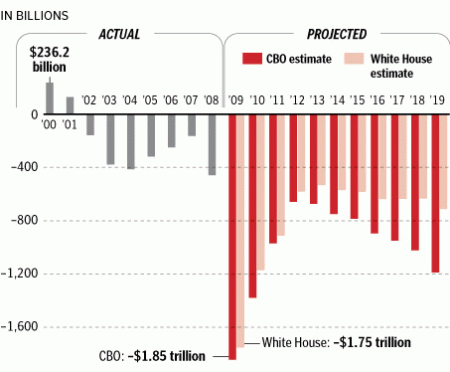
As I calculated here in March, Bush’s austerity budget cut spending (from the baseline) and would have ended with a $1 trillion deficit. Obama’s “stimulus” budget increased spending and would have ended with a $1.75 trillion deficit. (We’ll accept the OMB numbers for present purposes.) Something close to Obama’s budget was enacted by Congress.

President Obama has nearly doubled the deficit in one year. That’s the reality. He says that he’ll start cutting it soon. That’s fantasy.

obama-deficit


Responses to terror

June 12, 2009

The horrifying shooting at the Holocaust Museum earlier this week has evinced a familiar pattern. While the right responds to terror by attacking terrorists, the left often responds to terror by attacking the right. (Via Instapundit.) The news that the Museum shooter was a white supremacist indicated to the left that this incident belonged to them. They quickly settled on a narrative, suggesting that the outrageous DHS report from April, which tarred conservatives, libertarians, and veterans as potential terrorists, wasn’t so outrageous after all.

That argument is crap anyway, but it turns out that the facts in this case don’t even harmonize with their argument. As Politico put it, the shooter is “too far on the fringe to fit into conventional political classification.” He is a white supremacist, but he also hates “neocons” and believes that 9/11 was an inside job. In fact, the FBI uncovered evidence that the conservative Weekly Standard may have been on his list of targets.

This doesn’t mean that the right should now turn around and pin this atrocity on the left. Instead of turning on each other, we really should just fight the terrorists.


Obama fires AmeriCorps IG

June 12, 2009

This sounds shady:

Some strange and potentially suspicious events tonight concerning the Obama White House and the AmeriCorps program. I’ve been told that on Wednesday night the AmeriCorps inspector general, Gerald Walpin, received a call from the White House counsel’s office telling him that he had one hour to either resign or be fired. The White House did not cite a reason. “The answer that was given was that it’s just time to move on,” one Senate source told me tonight. “The president would like to have someone else in that position.”

Inspectors General are part of every federal department. They are given the responsibility of independently investigating allegations of waste, fraud, and corruption in the government, without fear of interference by political appointees or the White House. Last year Congress passed the Inspectors General Reform Act, which added new protections for IGs, including a measure requiring the president to give Congress 30 days prior notice before dismissing an IG. The president must also give Congress an explanation of why the action is needed. Then-Sen. Barack Obama was one of the co-sponsors of the Act. . .

The White House is going ahead with firing Walpin. The firing apparently stems from Walpin’s investigation of a non-profit group, St. HOPE Academy, run by Kevin Johnson, the former NBA star who is now mayor of Sacramento, California (and a big Obama supporter). “[Walpin] found that Johnson, a former all-star point guard for the Phoenix Suns, had used AmeriCorps grants to pay volunteers to engage in school-board political activities, run personal errands for Johnson and even wash his car,” the AP reports. In April, the U.S. attorney declined to file any criminal charges in the matter and criticized Walpin’s investigation. But at the same time Johnson and St. HOPE agreed to repay about half of the $850,000 it had received from AmeriCorps.

Bottom line: The AmeriCorps IG accuses prominent Obama supporter of misusing AmeriCorps grant money. Prominent Obama supporter has to pay back more than $400,000 of that grant money. Obama fires AmeriCorps IG.

(Via Hot Air.)


State of the Union

June 11, 2009

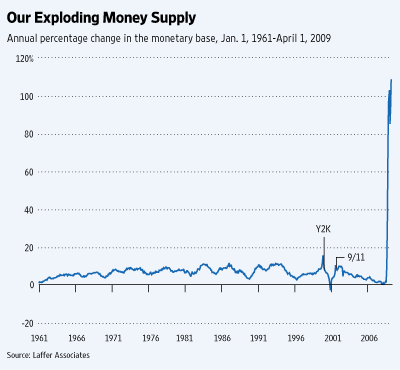
The market is losing confidence in US Treasury debt. (Via Instapundit.) Hmm, I wonder why. Well, there’s this telling chart from Arthur Laffer:

money-supply-april-2009

(Via Hot Air.) And of course, there’s always this:

obama-deficit

The bond market has good reason to begin worrying that US Treasury debt won’t be paid off, at least not in real money.


Liberal misogyny

June 11, 2009

An important part of liberalism is respect for women and their right to play an equal role in business, media, and government.

Ha ha! Just kidding. An important part of liberalism is respect for liberal women and their right to play an equal role in business, media, and government. Conservative or libertarian women, on the other hand, can be attacked in the crudest possible terms, and the left will remain silent. Even the feminist left will not make a peep. Don Surber reviews several recent examples. (Via Instapundit.)

Leftist feminism isn’t about women making their own choices; it’s about women making liberal choices.

(Previous post.)

UPDATE: The National Organization for Women actually did come out and condemn Letterman for his Willow/Bristol Palin joke. Good for them.

Removing that example certainly undercuts my point a bit.  That said, searching NOW’s Hall of Shame doesn’t turn up any hits for any of Surber’s other examples, even the Playboy article on raping conservative women. And, they felt the need to go back 15 years to find a somewhat (but not really) similar example to Letterman on the right. (Why they feel the need to credentialize is beyond me.) So just one cheer for NOW.


Circus in Albany

June 10, 2009

Two New York State Senators have switched parties, switching control of the chamber from Democrat to Republican. Such occasions are rare, but they do happen, most notably in the US Senate in 2001.

But in New York State there’s a twist. The Democrats are refusing to recognize that they have lost control of the chamber. They claim that it’s somehow illegal, and they still control the chamber, despite being the minority. Needless to say, they have yet to produce a legal theory that justifies their claim.

Ironically, however, one law has certainly been broken, by the Democrats. In an effort to delay their ouster, Democrats put the chamber into recess and locked the doors. This violates the New York State constitution, which says “The doors of each house shall be kept open, except when the public welfare shall require secrecy.”


45% say cancel stimulus

June 10, 2009

A new Rasmussen poll reveals that a near majority support terminating the stimulus plan immediately:

Forty-five percent (45%) of Americans say the rest of the new government spending authorized in the $787-billion economic stimulus plan should now be canceled. A new Rasmussen Reports national telephone survey found that just 36% disagree and 20% are not sure.

According to news reports, only $36 billion of the stimulus plan had been spent as of late May.

(Via Instapundit.)


Stimulus isn’t working

June 10, 2009

Decent, but I think his other two videos were better.

(Via Instapundit.) (Previous post.)


Heinlein on Detroit’s mess

June 10, 2009

Brian Doherty notices that Heinlein’s comments on the future of the auto industry in his 1956 novel The Door into Summer (one of my favorite books) seem particularly relevant today. (Via Instapundit.)


Congress strips federal investigators of their weapons

June 10, 2009

Gun control run amok:

Investigators with the Library’s Office of the Inspector General have raised a string of objections after Congress stripped them of their ability to buy and carry firearms.

Though the office has carried firearms in the course of its duties for the past 15 years, and inspector general agents at other federal agencies do the same, lawmakers inserted language into the fiscal year 2009 omnibus spending bill, which was signed into law in March, that prohibited the library’s officers from using federal funds to “purchase, maintain or carry” firearms.

They cited an apparent “separation of powers” concern — the library’s investigators are deputized by the U.S. Marshals, which falls under the executive branch, but they investigate abuses in the Library of Congress, which falls under the legislative branch. . .

The office wrote in its semiannual report to Congress in March that the decision would “impede” investigations. It also received an opinion in April from the Government Accountability Office that there is no legitimate “separation of powers” concern. . .

Crimes against the Library of Congress take many forms. The IG’s office investigated child pornography, embezzlement, identity theft and credit card fraud in the last fiscal year, according to its own accounting. . . While investigating crimes in and against the Library of Congress might not sound like the most dangerous job, another official in the inspector general’s office said most of their investigations take them off site, into some dangerous neighborhoods in the District of Columbia, Maryland, Virginia and other states.

I’m sympathetic to separation of powers concerns, but if there’s a problem in the legal status of the Library of Congress, it can hardly be corrected by disarming its investigators.


A fable

June 9, 2009
Once upon a time there was a woman named Alice.  Alice was smart,
talented, and hard-working, and consequently she had a lot of nice
things.  Living next door to Alice was a man named Bob.  Bob was smart
too, but he didn’t have the sort of talents that were appreciated in
the market, so he didn’t have a lot of nice things.
Bob looked over at Alice’s house with envy.  But Bob knew that the
market didn’t appreciate his talents the way it did Alice’s.  If he
wanted the things Alice had, he would have to work really, really hard,
and would probably still come up short.
But Bob had an idea.  He thought to himself, “It’s not fair that Alice
has so many nice things and I don’t.  I should go over there and take
some of her things.”  So that’s what he did.
Stealing worked so well that Bob decided to steal from Alice’s friends
as well.  Pretty soon, he had just as many nice things as Alice, but
Alice kept working and getting more nice things, so Bob had to keep
stealing from Alice and her friends to keep up.  Besides, Bob was
starting to think he was smarter than Alice (just look at how hard she
worked for her nice things!), so why should he have only as much as she
did?
Now stealing was dangerous work, so in time Bob decided to hire some
of his friends to steal for him.  That worked well, but there was
still the ever-present danger that he could be arrested.  Besides, Bob
was getting older and wanted respectability.  If only there were a
legitimate way that Bob could steal.
One day Bob had his first brainstorm.  Instead of hiring his friends
to steal for him, he should hire the government to do it.  Bob knew a
woman named Nancy who was a magistrate in the government.  So Bob went
to Nancy and paid her to steal for him.  Then Nancy used her revenue
agents and other bureaucrats to take things from Alice and her friends
and give them to Bob.
“Hey!” Alice complained, “This is no different than before.  Bob is
still taking my things, he’s just using government agents instead of
thugs to do it.  Bob shouldn’t be allowed to hire the government to
steal for him!”  A lot of people agreed with Alice, so the government
changed the rules to make it much harder to bribe magistrates.
At first Bob was disappointed by this development, but then he had his
second brainstorm.  He didn’t need to bribe Nancy; just being a
magistrate was better than any bribe.  She got a nice salary, even
better benefits, and when she left the government, she would have good
retirement benefits and could get a great job as a lobbyist.  The
longer she was in the government, the better her retirement benefits
and her lobbying job would be.  Like many of her colleagues, Nancy
didn’t have Alice’s talents, or even Bob’s talents, but she was making
a killing as a magistrate.
Bob realized that merely helping Nancy to win elections was better
than any bribe, and it was completely legal.  So that’s what Bob did;
he helped Nancy and her friends to win elections, and they kept
stealing Alice’s things for him.
Bob had a lot of ways to help Nancy win elections.  He could rig the
elections, but that was illegal and slightly risky, so he only did a
little of that.  He could also contribute money to Nancy’s campaign,
and he could run his own advertisements attacking Nancy’s opponent.
But the most effective thing that Bob did was organize a bunch of his
friends.  They would all vote for Nancy, and in return, the government
would give them all some nice things that it took from Alice.  Bob’s
friends never got nearly as much as Bob did, of course, but it only
took a little to buy their votes.
Alice noticed that despite all the government’s ethics reforms, it
still kept taking her things and giving them to Bob.  Alice complained
that it didn’t matter how the government was elected, it shouldn’t
have the power to steal from her.  But Alice’s cries fell on deaf
ears.  A lot of Nancy’s friends were magistrates too now, and none of
them were going to risk their livelihoods by cutting back their work
for Bob.
So Alice went to the public instead, and argued that it was wrong for
the government to steal.  They should kick Nancy out of office.  More
importantly, they should limit the government’s power so it couldn’t
steal for Bob any more.
But Alice was too late.  Bob had already anticipated her argument.
“Alice is greedy!” her proclaimed.  “She has so many nice things, and
my friends have so few.  It’s not fair that she should have so much
and they should have so little.”  Bob didn’t mention that Alice had
earned all of her nice things.  Neither did he mention that, by now,
he had much more than either Alice or any of his friends.
Bob’s ploy worked.  Many people were taken in by his argument, and
thought that Alice, rather than Bob, was the greedy one.  Some people
even thought that Alice was trying to steal from Bob and his friends.
Nancy was re-elected, and kept giving Alice’s things to Bob.
Every year, Nancy took a little bit more from Alice than the previous
year.  Alice and her friends grew angrier every year, but at the same
time, Bob and his friends grew increasingly shrill.
How does the story end?
Some say that one day Alice won the debate.  People noticed that
Nancy’s government was organized for theft, and wasn’t any good at
anything else.  Eventually, even many of Bob’s friends came to
understand that the government’s large-scale robbery was running their
society into the ground.
But others say that society was indeed run into the ground.
Eventually Alice gave up fighting Bob, but she knew that Bob would
take whatever she earned, so she gave up working hard too.  Alice’s
friends followed suit.  In the end, there was nothing left for Bob to
steal.
Bob blamed Alice.

Once upon a time there was a woman named Alice. Alice was smart, talented, and hard-working, and consequently she had a lot of nice things. Living next door to Alice was a man named Bob. Bob was smart too, but he didn’t have the sort of talents that were appreciated in the market, so he didn’t have a lot of nice things.

Bob looked over at Alice’s house with envy. But Bob knew that the market didn’t appreciate his talents the way it did Alice’s. If he wanted the things Alice had, he would have to work really, really hard, and would probably still come up short.

But Bob had an idea. He thought to himself, “It’s not fair that Alice has so many nice things and I don’t. I should go over there and take some of her things.” So that’s what he did.

Stealing worked so well that Bob decided to steal from Alice’s friends as well. Pretty soon, he had just as many nice things as Alice, but Alice kept working and getting more nice things, so Bob had to keep stealing from Alice and her friends to keep up. Besides, Bob was starting to think he was smarter than Alice (just look at how hard she worked for her nice things!), so why should he have only as much as she did?

Now stealing was dangerous work, so in time Bob decided to hire some of his friends to steal for him. That worked well, but there was still the ever-present danger that he could be arrested. Besides, Bob was getting older and wanted respectability. If only there were a legitimate way that Bob could steal.

One day Bob had his first brainstorm. Instead of hiring his friends to steal for him, he should hire the government to do it. Bob knew a woman named Nancy who was a magistrate in the government. So Bob went to Nancy and paid her to steal for him. Then Nancy used her revenue agents and other bureaucrats to take things from Alice and her friends and give them to Bob.

“Hey!” Alice complained, “This is no different than before. Bob is still taking my things, he’s just using government agents instead of thugs to do it. Bob shouldn’t be allowed to hire the government to steal for him!” A lot of people agreed with Alice, so the government changed the rules to make it much harder to bribe magistrates.

At first Bob was disappointed by this development, but then he had his second brainstorm. He didn’t need to bribe Nancy; just being a magistrate was better than any bribe. She got a nice salary, even better benefits, and when she left the government, she would have good retirement benefits and could get a great job as a lobbyist. The longer she was in the government, the better her retirement benefits and her lobbying job would be. Like many of her colleagues, Nancy didn’t have Alice’s talents, or even Bob’s talents, but she was making a killing as a magistrate.

Bob realized that merely helping Nancy to win elections was better than any bribe, and it was completely legal. So that’s what Bob did; he helped Nancy and her friends to win elections, and they kept stealing Alice’s things for him.

Bob had a lot of ways to help Nancy win elections. He could rig the elections, but that was illegal and slightly risky, so he only did a little of that. He could also contribute money to Nancy’s campaign, and he could run his own advertisements attacking Nancy’s opponent.

But the most effective thing that Bob did was organize a bunch of his friends. They would all vote for Nancy, and in return, the government would give them all some nice things that it took from Alice. Bob’s friends never got nearly as much as Bob did, of course, but it only took a little to buy their votes.

Alice noticed that despite all the government’s ethics reforms, it still kept taking her things and giving them to Bob. Alice complained that it didn’t matter how the government was elected, it shouldn’t have the power to steal from her. But Alice’s cries fell on deaf ears. A lot of Nancy’s friends were magistrates too now, and none of them were going to risk their livelihoods by cutting back their work for Bob.

So Alice went to the public instead, and argued that it was wrong for the government to steal. They should kick Nancy out of office. More importantly, they should limit the government’s power so it couldn’t steal for Bob any more.

But Alice was too late. Bob had already anticipated her argument. “Alice is greedy!” he proclaimed. “She has so many nice things, and my friends have so few. It’s not fair that she should have so much and they should have so little.” Bob didn’t mention that Alice had earned all of her nice things. Neither did he mention that, by now, he had much more than either Alice or any of his friends.

Bob’s ploy worked. Many people were taken in by his argument, and thought that Alice, rather than Bob, was the greedy one. Some people even thought that Alice was trying to steal from Bob and his friends. Nancy was re-elected, and kept giving Alice’s things to Bob.

Every year, Nancy took a little bit more from Alice than the previous year. Alice and her friends grew angrier every year, but at the same time, Bob and his friends grew increasingly shrill.

How does the story end?

Some say that one day Alice won the debate. People noticed that Nancy’s government was organized for theft, and wasn’t any good at anything else. Eventually, even many of Bob’s friends came to understand that the government’s large-scale robbery was running their society into the ground.

But others say that society was indeed run into the ground. Eventually Alice gave up fighting Bob, but she knew that Bob would take whatever she earned, so she gave up working hard too. Alice’s friends followed suit. In the end, there was nothing left for Bob to steal.

Bob blamed Alice.


Stimulus isn’t working

June 7, 2009

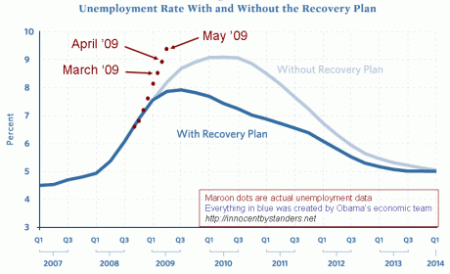
What would an utterly failed stimulus plan look like? Something like this, perhaps:

stimulus-vs-unemployment-may-corrected

Not only has the stimulus not worked as well as advertised, it’s actually made things quite a bit worse than the predicted baseline. Meanwhile, with a completely straight face:

US President Barack Obama said Wednesday his mammoth 787 billion dollar stimulus plan had saved or created 150,000 jobs in the first 100 days since it cleared Congress.

Of course, the president will claim that things would have been even worse with the stimulus package. That claim has the great virtue (for a politician) of being untestable and therefore unrefutable. But, it does completely contradict the predictions he used to sell the package.

(Via Instapundit.) (Previous post.)

UPDATE: Even Democrats are starting to mock the “save or create” line. (Via Instapundit.)

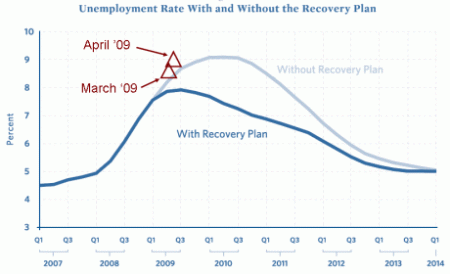
UPDATE: The author of the graph above has revised the graph, saying he was off by one month. This doesn’t change much, but makes the stimulus package’s performance look a tiny bit worse. I’ve replaced the graph with the new one.


Government in action

June 7, 2009

Most people think that we have a well-meaning but imperfect government. I think it’s more useful to look at government as us versus them. Exhibit A:

He sleeps under a bridge, washes in a public bathroom and was panhandling for booze money 11 months ago, but now Larry Moore is the best-dressed shoeshine man in the city. When he gets up from his cardboard mattress, he puts on a coat and tie. It’s a reminder of how he has turned things around.

In fact, until last week it looked like Moore was going to have saved enough money to rent a room and get off the street for the first time in six years. But then, in a breathtakingly clueless move, an official for the Department of Public Works told Moore that he has to fork over the money he saved for his first month’s rent to purchase a $491 sidewalk vendor permit.

(Via Don Surber, via Instapundit.)

On his own, this man pulls together a business and saves enough to get off the street, and the government of America’s most famously “liberal” city kicks him back out to the curb.

The good news is that, after a firestorm of bad publicity, the city of San Francisco relented in this case. Alas, most of our government’s outrages don’t get aired so broadly.


Sotomayor’s race-based justice

June 5, 2009

Sonia Sotomayor’s notorious “wise Latina” statement, arguing that Latina women make better judges than white men, turns out to be far from an isolated misstatement:

Reams of documents . . . reveal [Sonia Sotomayor] has spoken repeatedly about how her gender and Latina heritage affect her judging.

The federal appeals court judge divulged new details about her finances and provided three decades of writings, speeches and rulings that give both supporters and critics fresh fodder for the coming debate on her confirmation. They include more instances in which she said she hopes a “wise Latina” would reach a better decision than a man without that experience.

The comments in 2002 and 2003 echo a much-criticized remark she made in 2001 at the University of California-Berkeley law school that has prompted a furor among conservatives who say they suggest President Barack Obama’s first Supreme Court nominee brings a personal bias to her legal decisions.

Obama has said he is “sure she would have restated it.” In fact, she said it almost precisely the same way in speeches to the Princeton Club in 2002 and one at Seton Hall law school in 2003, according to copies she sent the Senate.

(Previous post.)

BONUS: In her senior thesis at Princeton, Sotomayor refused to refer to the U.S. Congress by its correct name, preferring the term “North American Congress.” K.C. Johnson remarks that that terminology, although (not to put too fine a point on it) incorrect, “was very trendy, and not uncommon, among the Latin Americanist fringe of the academy” at the time. (Via Instapundit.)


Pay czar

June 5, 2009

The United States has a pay czar now.  That’s just swell.


Hoplophobia

June 4, 2009

In light of the new law repealing federal prohibitions on carrying guns in national parks, David Kopel does his part to promote mental health. (Via Volokh.)


Due diligence

June 3, 2009

Harry Reid on Sonia Sotomayor:

I understand that during her career, she’s written hundreds and hundreds of opinions. I haven’t read a single one of them, and if I’m fortunate before we end this, I won’t have to read one of them.

(Via the Corner.)


Appeals court halts Chrysler deal

June 3, 2009

Good news: the Second Circuit has halted the Chrysler bankruptcy to hear Indiana’s appeal.

(Previous post.)

UPDATE: The appeals court will permit the sale to go forward.


Blood for oil

June 2, 2009

How many human lives is it worth to conserve oil?

President Obama wants to raise CAFE standards from 27.5 to 39 mpg, meaning that the average new car would have to achieve 39 miles to the gallon. In order to do so, automakers must manufacture lighter cars, and lighter cars make automobile accidents more likely to be fatal.

Many studies have shown the danger of lighter cars. By some calculations (via Power Line), CAFE standards have killed 46,000 people since they were instituted in 1975. That works out to over 1300 lives per year snuffed out to conserve oil. For perspective, around 700 Americans have died in the Iraq War each year since it began. So CAFE standards have been about twice as deadly as the Iraq War. However, unlike the Iraq War, CAFE standards show no sign of ending.

President Obama wishes not only to continue CAFE requirements, but to tighten them dramatically. Make no mistake, this will kill people. How many? No one knows. Not many even seem to care. The President didn’t mention the issue in his speech, nor did the White House press release.


Green for thee, not for me

May 31, 2009

In the typical manner of modern liberalism, Laurie David, the producer of environmental agitprop An Inconvenient Truth, is not so concerned about the environment when it comes to her own property. (Via Instapundit.)


The Illinois Way

May 30, 2009

Is anything honest in the State of Illinois? The University of Illinois admits that it bows to political pressure in admissions. (Via The New Editor, via Instapundit.)


Too true

May 30, 2009

PJ O’Rourke explains why the love affair with cars is over; they’re just too important now:

Cars didn’t shape our existence; cars let us escape with our lives. We’re way the heck out here in Valley Bottom Heights and Trout Antler Estates because we were at war with the cities. We fought rotten public schools, idiot municipal bureaucracies, corrupt political machines, rampant criminality and the pointy-headed busybodies. Cars gave us our dragoons and hussars, lent us speed and mobility, let us scout the terrain and probe the enemy’s lines. And thanks to our cars, when we lost the cities we weren’t forced to surrender, we were able to retreat.

(Via Instapundit.)

Truer words were never spoken.


White House: Sotomayor misspoke

May 30, 2009

The White House is starting to recognize that there might be a problem with Sonia Sotomayor’s contention that Latina women make better judges. (Via Instapundit.)

The President and his spokesman both admitted that Sotomayor spoke poorly when she said “I would hope that a wise Latina woman with the richness of her experiences would more often than not reach a better conclusion than a white male who hasn’t lived that life.” However, both said that her statement was taken out of context. The problem with that contention is Sotomayor’s statement was not an isolated one. It’s from her peroration in an entire speech dedicated to the impact of race and gender on judging. This was basically the thesis of the entire speech.

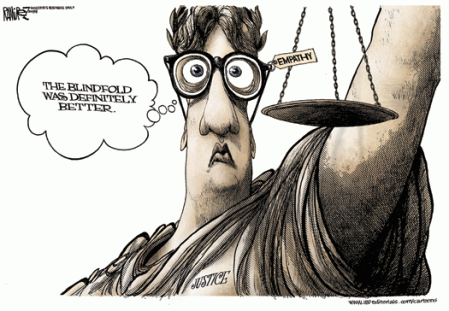
The bottom line is, this is exactly what the president said he wanted, a justice whose life experience gave her “empathy.” The problem is she expressed it in too direct a fashion, making it clear how ugly the idea is.

The right tack for Republicans to take is not to try to block Sotomayor’s appointment. They can’t do it anyway. Also, who’s to say that the next nomination would be better? Rather, as Glenn Reynolds suggested on PJM Political, the Republicans should use this as a teaching moment. They should open a debate on whether justice should be guided by race and gender, or whether perhaps impartial justice might be better. That’s a debate that Republicans can win, and start to correct the misapprehension that many Americans have of this administration.


Justice Department winks at voter intimidation

May 30, 2009

The Justice Department says this is no big deal:

The Washington Times reports:

Justice Department political appointees overruled career lawyers and ended a civil complaint accusing three members of the New Black Panther Party for Self-Defense of wielding a nightstick and intimidating voters at a Philadelphia polling place last Election Day, according to documents and interviews.

The incident – which gained national attention when it was captured on videotape and distributed on YouTube – had prompted the government to sue the men, saying they violated the 1965 Voting Rights Act by scaring would-be voters with the weapon, racial slurs and military-style uniforms.

Career lawyers pursued the case for months, including obtaining an affidavit from a prominent 1960s civil rights activist who witnessed the confrontation and described it as “the most blatant form of voter intimidation” that he had seen, even during the voting rights crisis in Mississippi a half-century ago.

The lawyers also had ascertained that one of the three men had gained access to the polling place by securing a credential as a Democratic poll watcher, according to interviews and documents reviewed by The Washington Times.

The career Justice lawyers were on the verge of securing sanctions against the men earlier this month when their superiors ordered them to reverse course, according to interviews and documents. The court had already entered a default judgment against the men on April 20.

A Justice Department spokesman on Thursday confirmed that the agency had dropped the case, dismissing two of the men from the lawsuit with no penalty and winning an order against the third man that simply prohibits him from bringing a weapon to a polling place in future elections. . .

The three men named in the complaint – New Black Panther Chairman Malik Zulu Shabazz, Minister King Samir Shabazz and Jerry Jackson – refused to appear in court to answer the accusations over a near-five month period, court records said. . .

Court records show that as late as May 5, the Justice Department was still considering an order by U.S. District Judge Stewart Dalzell in Philadelphia to seek judgments, or sanctions, against the three Panthers because of their failure to appear. But 10 days later, the department reversed itself and filed a notice of voluntary dismissal from the complaint for Malik Zulu Shabazz and Mr. Jackson.

(Via Instapundit.)

Apparently, President Obama’s political appointees at the Justice Department think that a suitable penalty for blatant voter intimidation (by Democrats) is a court order not to do it any more.

This scandal may have legs. Rep. Lamar Smith (R-TX), the ranking member on the House Judiciary Committee, is demanding answers.

(Previous post.)


How dare you petition the government?

May 30, 2009

With a professor of constitutional law as president, one might have hoped for better than this. On the blog of the special counsel to the president for ethics and government reform, he indicates that the White House will restrict the manner in which citizens can petition their government:

Section 3 of the Memorandum required all oral communications between federally registered lobbyists and government officials concerning Recovery Act policy to be disclosed on the Internet; barred registered lobbyists from having oral communications with government officials about specific Recovery Act projects or applications and instead required those communications to be in writing; and also required those written communications to be posted on the Internet. . .

Following OMB’s review, the Administration has decided to make a number of changes to the rules that we think make them even tougher on special interests and more focused on merits-based decision making.

First, we will expand the restriction on oral communications to cover all persons, not just federally registered lobbyists. For the first time, we will reach contacts not only by registered lobbyists but also by unregistered ones, as well as anyone else exerting influence on the process.

(Emphasis mine.) (Via Mark Tapscott, via Instapundit.)

Apparently, the White House intends to prohibit citizens from speaking to their government about the stimulus bill. Let’s never hear any more nonsense about the left and its concern for civil liberties.

ASIDE: It’s telling that an administration with very little regard for transparency (other than lip service galore) would suddenly see the light when the spectre of public comment rears its ugly head.

Beyond restricting the manner of public comment, the White House also wishes to restrict its content:

Second, we will focus the restriction on oral communications to target the scenario where concerns about merit-based decision-making are greatest –after competitive grant applications are submitted and before awards are made. Once such applications are on file, the competition should be strictly on the merits. To that end, comments (unless initiated by an agency official) must be in writing and will be posted on the Internet for every American to see.

(Emphasis mine.) Who could argue with limiting public discourse to the merits? Well, there’s the question of who determines merit in public discourse. The White House, presumably. But beyond that, the Constitution authorizes no such restriction anyway. If I want to criticize a project on some worthless grounds like astrology or numerology, that’s my right.

The best that can be said about this is their means (posting comments publicly) is unlikely to achieve their ends (restricting discourse). But look out for their future means.

(CREDIT: Title borrowed from ShopFloor.)

UPDATE (7/26): The policy has been reversed. (Via Instapundit.)


Stepping back from the brink

May 27, 2009

Australia may be backing away from nationwide internet censorship:

THE Rudd Government has indicated that it may back away from its mandatory internet filtering plan.

Communications Minister Stephen Conroy today told a Senate estimates committee that the filtering scheme could be implemented by a voluntary industry code.

Senator Conroy’s statement is a departure from the internet filtering policy Labor took into the October 2007 election to make it mandatory for ISPs to block offensive and illegal content.

Responding to questions from shadow communications minister Nick Minchin on how the government may go about imposing the internet filtering scheme, Senator Conroy said that legislation may not be required and ISPs may adopt an industry consensus to block restricted content on a voluntary basis.

(Via Slashdot, via Instapundit.)

I sure hope so.  We’ve already seen the system used to suppress political content.

(Previous post.)


Tokenism over talent

May 27, 2009

Out of the three people frequently considered to be on President Obama’s short list (Sotomayor, Diane Wood, and the formidable Elena Kagan), it’s interesting that Obama chose by far the least talented. It’s also interesting how open he was about the paramount role played by biography in that decision. And if there’s any doubt what he was getting at with all the biography talk, Sotomayor has made it explicit.


The Laffer curve in action

May 26, 2009

Last week Arthur Laffer had a column on the ease for wealthy individuals to move to escape excessive state taxation. Today’s there’s a coda to that column. After Maryland instituted a millionaires’ tax their millionaires are disappearing:

Maryland couldn’t balance its budget last year, so the state tried to close the shortfall by fleecing the wealthy. Politicians in Annapolis created a millionaire tax bracket, raising the top marginal income-tax rate to 6.25%. And because cities such as Baltimore and Bethesda also impose income taxes, the state-local tax rate can go as high as 9.45%. Governor Martin O’Malley, a dedicated class warrior, declared that these richest 0.3% of filers were “willing and able to pay their fair share.” The Baltimore Sun predicted the rich would “grin and bear it.”

One year later, nobody’s grinning. One-third of the millionaires have disappeared from Maryland tax rolls. . . On those missing returns, the government collects 6.25% of nothing. Instead of the state coffers gaining the extra $106 million the politicians predicted, millionaires paid $100 million less in taxes than they did last year — even at higher rates. . .

No doubt the majority of that loss in millionaire filings results from the recession. . . The Maryland state revenue office says it’s “way too early” to tell how many millionaires moved out of the state when the tax rates rose. But no one disputes that some rich filers did leave. It’s easier than the redistributionists think. Christopher Summers, president of the Maryland Public Policy Institute, notes: “Marylanders with high incomes typically own second homes in tax friendlier states like Florida, Delaware, South Carolina and Virginia. So it’s easy for them to change their residency.”


Obama calls for Scare Force One investigation

May 26, 2009

Fox News reports:

President Obama has asked for an internal investigation of a photo-op featuring the presidential jet that sent thousands of New Yorkers running for their lives — and sent officials in Washington, D.C., running for political cover.

White House spokesman Robert Gibbs said Tuesday Obama was “furious” when he heard about the incident and has ordered a deputy chief of staff of find out “why that decision was made and to ensure that it never happens again.”

Perhaps the White House’s decision to change the White House military office director from a career military position to a political appointment might have played a role?


President Bizarro

May 26, 2009

In a statement that can only be described as bizarre, President Obama claims that our fiscal problems are the result of our failure to establish universal health care:

Well, we are out of money now. We are operating in deep deficits, not caused by any decisions we’ve made on health care so far. This is a consequence of the crisis that we’ve seen and in fact our failure to make some good decisions on health care over the last several decades.

(Via Instapundit.)

In the real world, massive entitlement programs cost the government money. In the Obama world, apparently they somehow save money.


Cheney wins debate

May 26, 2009

Last week’s pair of national-security speeches from President Obama and former Vice-President Cheney amounted to something of a debate. Like the Lincoln-Douglas debates, the participants spoke at length on a single topic, and did so back-to-back. With modern technology, a joint appearance was not necessary for the press to cover both speeches as a single event.

Since Cheney’s speech was scheduled first, and then the president decided to schedule his at the exact same time, the White House must have thought that a debate served their purposes. Perhaps that’s because he had the advantage of staging (setting his own speech at the national archives) and knew that the press would edit his remarks more favorably than Cheney’s. Nevertheless, the president seems to be losing the debate.

A new Rasmussen poll, out today (via Instapundit), indicates that the public disagree with the president decision to close the Guantanamo prison by a 49-38 margin, and disagree with the president’s contention that the prison has damaged national security by a 51-25 margin.  By a 57-28 margin the public opposes moving the Guantanamo detainees to US prisons. The poll didn’t ask about releasing them in the United States (as proposed by the Attorney General), but given these numbers it seems safe to assume that public opinion would be overwhelmingly against it.

Support for the president’s position has been steadily eroding since Inauguration Day. In January 42% supported keeping the prison open. The number has risen to 46% in April, and then to 49% today. Meanwhile, the number who believe the prison will “very likely” be closed has dropped to 15%, down from 49% last November.

I’m delighted to see a real debate take place in American politics. The events that we call “debates” with their two-minute statements are truly shabby affairs, designed for sound bites rather than substance. In a real debate, the strength of the case is paramount. I wish this would happen more often.

POSTSCRIPT: In a related item, another poll seems to show “the more Dick Cheney talks, the more Americans seem to like him.”  (Via Instapundit.)

(Previous post.)


Gitmo releasees return to terrorism

May 23, 2009

A Pentagon report concludes that one in seven of those detainees released from the Guantanamo prison have already returned to terrorism. This is all the more troubling when you consider that those were the detainees that were considered safe to release. More troubling still, the report’s release is being held up for political reasons, reports the New York Times:

An unreleased Pentagon report concludes that about one in seven of the 534 prisoners already transferred abroad from the detention center in Guantánamo Bay, Cuba, are engaged in terrorism or militant activity, according to administration officials.

The conclusion could strengthen the arguments of critics who have warned against the transfer or release of any more detainees as part of President Obama’s plan to shut down the prison by January. Past Pentagon reports on Guantánamo recidivism have been met with skepticism from civil liberties groups and criticized for their lack of detail.

The Pentagon promised in January that the latest report would be released soon, but Bryan Whitman, a Pentagon spokesman, said this week that the findings were still “under review.”

Two administration officials who spoke on condition of anonymity said the report was being held up by Defense Department employees fearful of upsetting the White House, at a time when even Congressional Democrats have begun to show misgivings over Mr. Obama’s plan to close Guantánamo.

The NYT dutifully relates the skepticism of civil liberties groups for the report’s lack of detail, adding:

Among the 74 former prisoners that the report says are again engaged in terrorism, 29 have been identified by name by the Pentagon, including 16 named for the first time in the report. The Pentagon has said that the remaining 45 could not be named because of national security and intelligence-gathering concerns. . .

The Pentagon has provided no way of authenticating its 45 unnamed recidivists, and only a few of the 29 people identified by name can be independently verified as having engaged in terrorism since their release. Many of the 29 are simply described as associating with terrorists or training with terrorists, with almost no other details provided.

Of course, you would expect that much of the report would be based on sensitive information that the Pentagon would not want to make public. Nevertheless Thomas Joscelyn points out that several recidivists can be verified through public sources. And these recidivists are costing human lives. For instance, one detonated a suicide bomb in Mosul, killing 13 Iraqis and wounding 42 others.

Remember, the releasees so far are the ones that were deemed safe to release. What happens when we start releasing the others?

(Via Power Line.)


The national archives speech

May 23, 2009

Charles Krauthammer puts the president’s speech at the national archives in a nutshell:

Well, Obama really didn’t really want to give this speech. He had to. I mean, he wasn’t elected to be a national security president. He is a domestic president, and that’s his agenda.

But his hand was forced because there was an open rebellion in Congress over the Guantanamo issue. The senators wanted a decision, and he gave them an essay. The senators wanted a president, and he gave them a professor.

What he did was he outlined the five categories of prisoners in Guantanamo, an interesting exercise that you would expect out of a graduate student, in which you have got those who can be tried in regular courts and those who have to be in military tribunals, and those that will not be taken by allies, as if any allies are taking them, et cetera, et cetera. I mean, a freshman in college could tell you that.

And then he says the fifth category, those whom you cannot try, either because the crimes are committed but the evidence is tainted, or because they have not yet committed a crime but they sure as hell will if released, there are those whom you cannot try and you cannot release. And then he says, “And that’s the really difficult issue.”

No kidding. I mean, who would have thought that was the problem about these prisoners? Of course everybody knows that.

So what was his answer? He doesn’t have an answer. What he says is he is going to work with Congress and work out a framework of detaining these people.

I think that’s right. We’ve frequently seen polls say that the public likes President Obama much more than his policies. This was an effort by the president to paste an extra measure of his personal popularity onto a policy no one wants.

Plus, Peter Wehner notices the hypocrisy of the president’s choice of venue:

I couldn’t help but notice that during his speech yesterday, President Obama spoke in reverential terms about the Constitution. Yet when it comes to his own judicial philosophy — and, I expect, to his Supreme Court nominee — the Constitution will be viewed with a great deal less veneration. It will be seen as a “living” document, one that has no fixed meaning and can be reinterpreted for any reason at all, with new rights being manufactured out of thin air and rights enumerated in the Constitution conveniently ignored.


Recess appointments are good again

May 22, 2009

You knew this was coming.


Unions become even more costly

May 21, 2009

In the wake of the Chrysler-UAW deal, investors are becoming reluctant to lend to heavily unionized firms.


Hegira

May 21, 2009

Arthur Laffer (yes, that Laffer) takes a look at capital mobility and state taxes.  His results should be no surprise:

Here’s the problem for states that want to pry more money out of the wallets of rich people. It never works because people, investment capital and businesses are mobile: They can leave tax-unfriendly states and move to tax-friendly states.

And the evidence that we discovered in our new study for the American Legislative Exchange Council, “Rich States, Poor States,” published in March, shows that Americans are more sensitive to high taxes than ever before. The tax differential between low-tax and high-tax states is widening, meaning that a relocation from high-tax California or Ohio, to no-income tax Texas or Tennessee, is all the more financially profitable both in terms of lower tax bills and more job opportunities.

Updating some research from Richard Vedder of Ohio University, we found that from 1998 to 2007, more than 1,100 people every day including Sundays and holidays moved from the nine highest income-tax states such as California, New Jersey, New York and Ohio and relocated mostly to the nine tax-haven states with no income tax, including Florida, Nevada, New Hampshire and Texas. We also found that over these same years the no-income tax states created 89% more jobs and had 32% faster personal income growth than their high-tax counterparts.

Did the greater prosperity in low-tax states happen by chance? Is it coincidence that the two highest tax-rate states in the nation, California and New York, have the biggest fiscal holes to repair? No. Dozens of academic studies — old and new — have found clear and irrefutable statistical evidence that high state and local taxes repel jobs and businesses.

(Via Instapundit.)


Indiana objects to Chrysler deal

May 21, 2009

The Obama administration succeeded in bullying Chrysler’s major private creditors out of objecting to the Chrysler-UAW deal, but the state of Indiana is objecting on behalf of the retirement plans of its teachers and state police.

This is very good news.  Despite the deal being illegal, the administration was on the verge of getting away with it, and setting a terrible precedent in the process.  Now there should be a real hearing in court.


Air quality improved during Bush administration

May 21, 2009

And not just by a little either.


DC issues tickets in driveways

May 21, 2009

Wow. Whenever you think you’ve heard it all, you’re wrong:

Beverly Anderson is mad as hell. She just started to get tickets for parking in her own driveway. That’s right. The District of Columbia is ticketing people who park their cars in their own driveways. . .

What does the law say?

“Any area between the property line and the building restriction line shall be considered as private property set aside and treated as public space under the care and maintenance of the property owner.”

Basically what that means is most property owners in the District don’t own the land between their front door and the sidewalk, but they are responsible for taking care of it. It’s why you can get a ticket for drinking beer on your front porch in the Nation’s Capital. You’re technically on public space. It’s also why the city can ticket you for parking in your own driveway if you don’t pull your car deep enough into the driveway beyond the façade of your house or building.

To be clear, we’re not talking about people who park in shallow driveways and let the rear of their cars block the sidewalk. The cars are off the road, off the sidewalk and in the driveway – just not far enough back for the city. . .

When Anderson complained to a supervisor at DPW she was told that she could lease the property from the District and avoid future tickets.

The District of Columbia wants to lease people their own driveways. This is what happens when a government has no fear of its constituents.


California is screwed, or perhaps we all are

May 20, 2009

Megan McArdle tells it like it is:

So what about California? A reader asks. Ummm, that’s a tough one. No, wait, it’s not: California is completely, totally, irreparably hosed. And not a little garden hose. More like this. Their outflow is bigger than their inflow. You can blame Republicans who won’t pass a budget, or Democrats who spend every single cent of tax money that comes in during the booms, borrow some more, and then act all surprised when revenues, in a totally unprecedented, inexplicable, and unforeseaable chain of events, fall during a recession. You can blame the initiative process, and the uneducated voters who try to vote themselves rich by picking their own pockets. Whoever is to blame, the state was bound to go broke one day, and hey, today’s that day!

California must be allowed to suffer the consequences of its bizarre irresponsibility and go bankrupt. If the federal government bails out California it will be beginning of the end of our federal system. California will become a subsidiary of the federal government, and in return will obtain a massive subsidy from the responsible and only-moderately-irresponsible states.

Worse, once California has shown that there’s no need to manage your own budget, other states will surely follow the same path, and ultimately be taken over as well.  The precedent will be set that states effectively can exchange local control for a massive federal subsidy.  In time, independent state government will be just too expensive for all but the reddest of red states.

UPDATE: Rasmussen finds that the public opposes a California bailout by a 59-24 margin.  That means it can’t happen, right?  Oh.  (Via Instapundit.)


Subsidizing irresponsibility

May 20, 2009

Government rhetoric:

We’ve become accustomed to our economic dominance in the world, forgetting that it wasn’t reckless deals and get-rich-quick schemes that got us there; but hard work and smart ideas -quality products and wise investments. So we started taking shortcuts. We started living on credit, instead of building up savings.

President Obama, ASU commencement address

Government policy:

Credit cards have long been a very good deal for people who pay their bills on time and in full. Even as card companies imposed punitive fees and penalties on those late with their payments, the best customers racked up cash-back rewards, frequent-flier miles and other perks in recent years.

Now Congress is moving to limit the penalties on riskier borrowers, who have become a prime source of billions of dollars in fee revenue for the industry. And to make up for lost income, the card companies are going after those people with sterling credit.

Banks are expected to look at reviving annual fees, curtailing cash-back and other rewards programs and charging interest immediately on a purchase instead of allowing a grace period of weeks, according to bank officials and trade groups.

“It will be a different business,” said Edward L. Yingling, the chief executive of the American Bankers Association, which has been lobbying Congress for more lenient legislation on behalf of the nation’s biggest banks. “Those that manage their credit well will in some degree subsidize those that have credit problems.”

(Via Hot Air.)

It’s a basic principle that anyone (even a politician) should be able to understand that you get more of whatever you subsidize.

UPDATE: The bill passed the House 361-64, so I suppose this has to be considered bipartisan foolishness.

UPDATE: Yingling also made this key point, quoted by the Washington Post but not the NYT:

“This bill fundamentally changes the entire business model of credit cards by restricting the ability to price credit for risk,” said Edward L. Yingling, the chief executive of the American Bankers Association. He said that lending would become more risky and that, “It is a fundamental rule of lending that an increase in risk means that less credit will be available and that the credit that is available will often have a higher interest rate.”


Gitmo prison to stay open, for now

May 19, 2009

Rhetoric meets reality:

Senate Democrats have decided to pull $80 million from the $91 billion war spending request — money President Obama had requested to close the Guantanamo Bay detention facility by Jan. 22, 2010.

A senior Democratic Senate aide told FOX News the caucus will pull the money and await a plan for closing Guantanamo before putting forward any funding. The caucus pulled back after it was hit hard in recent weeks by criticism from Republicans about the lack of a plan for closing the prison. . .

The House withholds all funding in its supplemental bill.


Commons Speaker resigns in scandal

May 19, 2009

The Wall Street Journal reports:

Britain’s parliamentary expense scandal claimed its biggest casualty on Tuesday when the speaker of the House of Commons, Michael Martin, announced his resignation after politicians broke centuries of protocol and demanded he step down.

Mr. Martin, who has become a symbol of politician’s attempts to stop details of their expense claims being made public, made a short statement to the House of Parliament Tuesday afternoon announcing he will resign on 21 June. . .

On Monday, Mr. Martin — who as speaker heads the body that administers Parliament and has responsibility for politicians’ expenses — had dug to hold on to the post, even as MPs from all political parties called for his resignation. . .

Mr. Martin’s resignation marks the first time that a speaker has been forced from office since 1695; the role dates back to the 13th century. But allies of the speaker said that politicians were making him a scapegoat for a scandal that they are all involved in. . .

Mr. Martin’s near nine-year rule as speaker has been controversial for many years. Mr. Martin, who as speaker also acts as a moderator in House of Commons debates, was accused of showing bias towards MPs of his former party, the Labour Party, in debate. This year Mr. Martin hit the headlines after allowing police in to search the Common’s office of Conservative immigration spokesman Damian Green, who was accused of leaking information.

But it was his attempts to keep expense information out of the public domain that have led to his recent troubles. Mr. Martin even took the case to the U.K.’s high court in a bid to stop details coming out.


Krugman concedes

May 18, 2009

After earlier saying that questioning President Obama’s growth forecasts was wrong (indeed, somehow “evil”), Paul Krugman finally admits that a trampoline recovery is unlikely.

(Via Greg Mankiw, via the Right Coast.)


Away game

May 18, 2009

Tickets at the new taxpayer-financed Yankee Stadium are a wee bit overpriced:

Ticket prices at the new Yankee Stadium are so high that if a New Yorker wants to watch a Mariners/Yankees game from the best seats, it would be a lot cheaper to fly to Seattle, stay in a nice hotel, eat fancy dinners, and see two games.

  • Option 1: Two tickets to Tuesday night, June 30, Mariners at Yanks, cost for just thetickets, $5,000.
  • Option 2: Two round-trip airline tickets to Seattle, Friday, Aug. 14, return Sunday the 16th, rental car for three days, two-night double occupancy stay in four-star hotel, two top tickets to both the Saturday and Sunday Yanks-Mariners games, two best-restaurant-in-town dinners for two. Total cost, $2,800. Plus-frequent flyer miles.

Joe Biden: idiot

May 17, 2009

Well, I guess we didn’t really need a secret bunker for the Vice-President:

Vice President Joe Biden, well-known for his verbal gaffes, may have finally outdone himself, divulging potentially classified information meant to save the life of a sitting vice president.

According to a report, while recently attending the Gridiron Club dinner in Washington, an annual event where powerful politicians and media elite get a chance to cozy up to one another, Biden told his dinnermates about the existence of a secret bunker under the old U.S. Naval Observatory, which is now the home of the vice president.

The bunker is believed to be the secure, undisclosed location former Vice President Dick Cheney remained under protection in secret after the 9/11 attacks.

The small justice to be found here is that this time Biden is only endangering himself.  Of course, it won’t stay that way for long.  No doubt they’ll soon be breaking ground on a new secret bunker, at significant cost.  Perhaps Biden’s spin should be that this is his contribution to the stimulus effort.

I’ll bet the President wishes he could keep Biden in a secure, undisclosed location.

UPDATE: A Biden aide is denying the story, saying it’s just a room, not a secret bunker. But Eleanor Clift’s story was quite explicit.  We’ll see what she says now.


Road trip

May 17, 2009

(Via Volokh.) (Previous post.)


Old money, new money

May 17, 2009

History professor Peter Baldwin has a piece on the similarities between America and Europe.  One interesting bit, quoted by Reason (via Instapundit), observes:

Income is more disproportionately distributed in the US than in Western Europe. In 1998, for example, the richest 1 per cent of Americans took home 14 per cent of total income, while in Sweden the figure was only about 6 per cent. Wealth concentration is another matter, however. The richest 1 per cent of Americans owned about 21 per cent of all wealth in 2000. Some European nations have higher concentrations than that. In Sweden-despite that nation’s egalitarian reputation-the figure is 21 per cent, exactly the same as for the Americans. And if we take account of the massive moving of wealth offshore and off-book permitted by Sweden’s tax authorities, the richest 1 per cent of Swedes are proportionately twice as well off as their American peers.

I think this underscores the fact that America is the nation of new money, while Europe (or Sweden at least) is about old money.  In America, the land of opportunity, an entrepreneur can start a business that makes his or her fortune, and literally millions do.  Opportunity leads to income inequality, because most people (due to lesser talent or inclination) will not become entrepreneurs.  In Europe, great wealth tends to be inherited to a much greater extent.  You can see this in the numbers above; how else can you get wealth inequality without income inequality?

What this illustrates is that income equality shouldn’t even be a goal. All income equality does is keep people from becoming rich.  It bars the gates to affluence.  Instead, the goal ought to be freedom, to place no obstacles in front of any person’s right to realize his or her potential. Naturally, some people will become rich.  That’s a good thing.

POSTSCRIPT: Yes, I realize that by using Baldwin’s numbers to highlight a difference rather than a similarity I am missing his point.


Second verse, same as the first

May 17, 2009

President Obama’s military tribunals are the same as President Bush’s. That’s a good thing.  (Via Instapundit.)

UPDATE: Andy McCarthy explains further.


Buyer’s remorse

May 16, 2009

The Economist is continuing to discover that it backed the wrong candidate.  In its latest issue, they lament President Obama’s decision to intervene in the Chrysler bankruptcy:

The collapse of Detroit’s giants is a tragedy, affecting tens of thousands of current and former workers. But the best way to offer them support is directly, not by gerrymandering the rules. The investors in these firms are easily portrayed as vultures, but many are entrusted with the savings of ordinary people, and in any case all have a legal claim that entitles them to due process. In a crisis it is easy to put politics first, but if lenders fear their rights will be abused, other firms will find it more expensive to borrow, especially if they have unionised workforces that are seen to be friendly with the government.

It may be too late for Chrysler’s secured creditors and if GM’s lenders cannot reach a voluntary agreement, they may face a similar fate. That would establish a terrible precedent. Bankruptcy exists to sort legal claims on assets. If it becomes a tool of social policy, who will then lend to struggling firms in which the government has a political interest?

and his effort to crack down on business taxes:

No one doubts that America’s corporate-tax system is a Byzantine mess of high statutory rates and oodles of exemptions. But much of that complexity is caused by the divergence between America’s system of taxing its firms (and citizens) on their worldwide income and the territorial system used by most other countries. Mr Obama’s proposals, particularly his partial reversal of firms’ ability to defer taxes, would add yet more complexity. Nor is there much evidence that they would boost domestic job creation, as the administration claims. In fact, by raising the tax bills of American firms and putting them at a disadvantage beside their foreign peers, Mr Obama’s tax changes may reduce domestic job creation and even induce companies to move offshore.

In truth this plan is less an economic downpayment than a political one. Mr Obama needs more tax revenue, and corporate America’s foreign profits are an appealing pot of cash.


Magic beans

May 16, 2009

It seems that President Obama’s fiscal policies are modeled after his personal finances:

A close examination of their finances shows that the Obamas were living off lines of credit along with other income for several years until 2005, when Obama’s book royalties came through and Michelle received her 260% pay raise at the University of Chicago. This was also the year Obama started serving in the U.S. Senate. . .

In April 1999, they purchased a Chicago condo and obtained a mortgage for $159,250. In May 1999, they took out a line of credit for $20,750. Then, in 2002, they refinanced the condo with a $210,000 mortgage, which means they took out about $50,000 in equity. Finally, in 2004, they took out another line of credit for $100,000 on top of the mortgage.

Tax returns for 2004 reveal $14,395 in mortgage deductions. If we assume an effective interest rate of 6%, then they owed about $240,000 on a home they purchased for about $159,250.  This means they spent perhaps $80,000 beyond their income from 1999 to 2004. . .

The Obama family apparently had little or no savings during this period since there was virtually no taxable interest shown on their tax returns.

In 2003, they reported almost $24,000 in child care expenses and, in 2004, about $23,000. They also paid about $3,400 in household employment taxes each year. And as Michelle stated, they spent $10,000 a year on “extracurriculars” for the children.

These numbers clearly show the Obamas were living beyond their means and they might have suffered financially during the decline in housing prices had they relied on taking ever larger amounts of equity from their home to pay the bills.

But in 2005, Obama’s book sales soared and the royalties poured in. Michelle explained, “It was like Jack and his magic beans.”

Without those magic beans, the Obama family would have eventually suffered the consequences of too much debt.

It seems that the president is relying on magic beans to do the same for our country as they did his family.

BONUS: In light of Mr. Obama’s reliance on magic beans to save his finances, James Taranto sees some chutzpah in Obama’s ASU commencement address:

We’ve become accustomed to our economic dominance in the world, forgetting that it wasn’t reckless deals and get-rich-quick schemes that got us where we are, but hard work and smart ideas–quality products and wise investments. We started taking shortcuts. We started living on credit, instead of building up savings.

(Via Instapundit.)


Pelosi doubles down

May 15, 2009

Having been definitively contradicted by the CIA, Pelosi is now accusing the CIA of lying. This is very much the pot calling the kettle black, since we now know that Pelosi was indeed told about waterboarding, despite her claims to the contrary. She’s clearly hoping that by counterattacking she’ll be able to distract the press from her own lies.

(Previous post.)

UPDATE: On Pelosi’s press conference, Charles Krauthammer comments:

Well, her news conference today was an utter disaster. She was nervous. She was shifty. Her syntax was incomprehensible. And there were times when she had had to refer to her original statement because she couldn’t remember what the current truth — her current truth was.

It reminds me of a line in a Graham Greene novel in which a spy says “I prefer to tell the truth. It’s easier to memorize.” Well, she didn’t have it memorized. You had a sense that if you’d attached a lie detector to her in that news conference, it would have short circuited.

Look, her problem was this. She was internally contradictory with one point. Within 30 seconds she contradicted her own statement on what she had heard from her staff in February ’03. She was contradicted by the evidence of others like Porter Goss.

Her charge of the CIA lying to her is utterly implausible. Why would it lie to her and tell all the others the truth? It makes no sense at all.

UPDATE: Steny Hoyer won’t back Pelosi’s allegations.

UPDATE: Leon Panetta backs the CIA:

Panetta, President Obama’s pick to run the clandestine agency and President Clinton’s former chief of staff, wrote in a memo to CIA employees Friday that “CIA officers briefed truthfully on the interrogation of Abu Zubaydah, describing ‘the enhanced techniques that had been employed,'” according to CIA records.

(Via Instapundit.) (Previous post.)

UPDATE: The WSJ comments:

On the merits, it seems highly implausible that the CIA would have lied to Mrs. Pelosi. Briefings are attended by more than one agency official, and a legislative liaison typically writes up a summary memo describing significant exchanges. Agency careerists hardly loved the Bush Administration after the Iraq WMD fiasco, and the controversy over “torture” has raged for years. If the CIA had misled Congress on a matter that was so politicized, surely someone in the agency would have leaked it long before now, if only to deflect blame onto the unpopular (and soon to depart) Republicans.

Mrs. Pelosi is now caught in a humiliation of her own design that will only escalate if she insists on an interrogation “truth commission.” To adapt a famous phrase, we’re not sure her reputation can handle the truth.


OMB concedes to CBO

May 15, 2009

This Washington Post chart, showing that our national fiscal outlook is either terrible (if you believe the White House) or appalling (if you believe the CBO), has been popular throughout the blogosphere:

obama-deficit

Last March, the OMB director insisted that his estimate was better than the CBO estimate.  But now, the OMB concedes that the CBO estimate was right, at least for this year, and next year is creeping up toward the CBO estimate as well:

This week, the Obama administration revised its own budget estimates and raised the projected deficit for this year to a record $1.84 trillion, up 5 percent from the February estimate. The revision for the 2010 fiscal year estimated the deficit at $1.26 trillion, up 7.4 percent from the February figure.

(Via Instapundit.)


Listening to the generals

May 15, 2009

It’s an article of faith among the left — promoted during John Kerry’s failed presidential campaign — that General Eric Shinseki, formerly Army Chief of Staff and now VA Secretary, was fired for testifying to Congress that several hundred thousand troops would be needed to stabilize Iraq.  If only President Bush had listened to General Shinseki, they cluck, Iraq might never have become such a mess.

Of course, the story is false.  General Shinseki retired when his term as Chief of Staff ended on schedule.  Also, Shinseki was wrong; the Surge stabilized Iraq with 160 thousand troops, far less than any reasonable interpretation of “several hundred thousand.”

Nevertheless, Shinseki had a point.  Defeating the insurgency in Iraq ultimately required an increase in troop levels.  The Surge was primarily a change in tactics, but it required additional troops to carry it out.  Although he was wrong about the magnitude, he was right that we needed more than we had.

With this in mind, consider three facts:

  • Today we are trying to replicate the Surge in Afghanistan.
  • General David McKiernan, the US commander in Afghanistan, says he needs 30 thousand additional troops.  President Obama agreed to send 17 thousand, a little more than half of what General McKiernan requested.
  • General McKiernan was fired on Monday.  (For real, unlike General Shinseki.)

Defense Secretary Gates says that McKiernan was not fired over his troop requests.  Whether that’s true is anyone’s guess.  (Personally, I’m inclined to believe it, because I’m inclined to believe Gates is an honorable man.)  But the parallel between this true story and the Shinseki myth is striking.

Whatever the reason McKiernan was fired, the fact remains that the commander on the ground says we need more troops than the President is willing to send.  This story is feeling awfully familiar.

UPDATE (12/5): Corrected the number of US troops at the peak of the surge to 160 thousand, which does not affect the argument in any material way.


Obama tries to straddle on photos

May 14, 2009

President Obama is right that releasing more photos of detainee abuse would make the war effort harder and would not help increase our understanding of what had happened there.  All it would do is provide more propaganda ammunition to America’s enemies.  I was going to post to that effect, but before I got a chance to do so, I read an eye-opening analysis by Andy McCarthy.

The background is the question of whether the Obama administration is bringing a new argument to the court or simply taking up the Bush administration’s case.  The question is important because the court already ruled against the Bush argument, and the Obama administration failed to appeal.  McCarthy explains that the answer is the latter (despite Robert Gibbbs’s hapless efforts to argue otherwise), which places the administration into an awkward legal position.  He then continues:

Why all the legerdemain? Because . . . Obama is using this litigation as a smokescreen. He’s now getting plaudits for reversing himself and his Justice Department (which, in contrast to the Bush Justice Department, didn’t want to fight this case at all — just wanted to release the photos). But he is still trying to get away with voting present — which is to say, he is hiding behind the judges.

It is in Obama’s power, right this minute, to end this debacle by issuing an executive order suppressing disclosure of the photos due to national security and foreign policy concerns. As I’ve noted, there’s no need to get into a Bush-era debate over the limits of executive power here. In the Freedom of Information Act, indeed, in FOIA’s very first exemption, Congress expressly vests him with that authority. . .

Besides being simple, issuing such an order would be a strong position and the screamingly obvious right thing to do. But it would also be a fully accountable thing to do, and that’s why President Obama is avoiding it. He realizes — especially after he surrendered details of our interrogation methods to the enemy — that he can’t afford to undermine the war effort again so quickly and so blatanly; but his heart is with the Left on this — that’s why he agreed to the release of the photos in the first place and why he is trying to prevent mutiny within his base. So here’s the game: Obama tells those of us who care about national security that he is taking measures to protect the troops and the American people, but he also tells the Left that he hasn’t made any final decisions about the photos and that the question is really for the courts to decide. That’s why he carefully couched yesterday’s reversal as a “delay” in the release of the photos.

We’re happy as long as the photos stay under wraps, but the wink to the Left is his signal that if, after further review, the courts continue to hold that disclosure is required under the FOIA section the government has invoked — which is not the executive order provision but a section relating to the withholding of records “compiled for law enforcement purposes”— he may just shrug his shoulders and release the photos.

It doesn’t seem that the straddle is working.  Not only is President Obama being savaged by the left, but he’s going to run into real trouble in court.  McCarthy summarizes:

One last thing: I think the court rulings have been bad so far, but good or bad, I can assure you that federal judges don’t like to be toyed with. Supreme Court justices may not mind if the administration treats the media like a lap-dog and the public like we’re a bunch of rubes; but, regardless of their political leanings, the justices have goo-gobs of self-esteem, and they will not take kindly to being treated like pawns in the Obamaestro’s game.

UPDATE (5/22): It appears that Congress may bail out the president on this issue.


Pelosi was told about waterboarding

May 13, 2009

Nancy Pelosi’s already-threadbare denial that she was briefed on enhanced interrogation techniques such as waterboarding is now completely tattered.  Last week, her hair-splitting denial (claiming that she was told only of the possibility of future use of EITs, not past use) was proven false by CIA memos.  Then, she revised her denial to say that she was never told about the use of waterboarding specifically.

That was never very plausible, since the CIA memos said the briefing included “a description of particular EITs that had been employed,” and therefore must have included waterboarding.  But this point was still not conclusively resolved since the memo did not actually list the EITs that were discussed.

Until now:

A source close to House Speaker Nancy Pelosi now confirms that Pelosi was told in February 2003 by her intelligence aide, Michael Sheehy, that waterboarding was actually used on CIA detainee Abu Zubaydah.

This appears to contradict Pelosi’s account that she was never told waterboarding actually happened, only that the administration was considering using it.

Sheehy attended a briefing in which waterboarding was discussed in February 2003, with Rep. Jane Harman, D-California, who took over Pelosi’s spot as the ranking Democrat on the House Intelligence Committee.

The latest version of Pelosi’s denial is that she was never briefed personally about waterboarding:

This source says Pelosi didn’t object when she learned that waterboarding was being used because she had not been personally briefed about it — only her aide had been told.

As noted above, this is almost certainly untrue.  Also, even if it is true, her previous denials were still lies.  Her earlier denial of “we were not, I repeat, we were not told” contained none of the current provisos.

More to the point, it’s pathetic.  You have to be told personally to take action?  No, she knew what has happening and did nothing.

(Via Instapundit.) (Previous post.)

UPDATE: The long chain of updates regarding Pelosi’s bizarre allegation that the CIA lied to her was getting unwieldy, so I lifted it out to a separate post.


Stimulus isn’t working

May 12, 2009

Last January, the President’s economic advisors made some predictions about the course of the economy with and without the President’s stimulus plan.  This may have been unwise, because it gives us a benchmark by which to measure how well the stimulus is working.  As noted on the Innocent Bystanders blog (via Instapundit), we are just about where we were predicted to be without the stimulus package:

stimulus-vs-unemployment-april

As you can see, unemployment is tracking the “Without Recovery Plan” curve predicted by the President’s own team.  In fact, we’re slightly worse.

This will come as no surprise to those who heard economist Robert Barro’s caution that for peacetime stimulus, the Keynes multiplier is “insignificantly different than zero.”  That means that spending all that “stimulus” money accomplishes nothing at all, other than spending the money.  All that has been accomplished is a massive accumulation of debt, unprecedented in history without a world war:

obama-deficit

UPDATE: Ed Morrissey expands on this.  (Via the Corner.)


More on Murtha’s no-bid contracts

May 12, 2009

The Washington Post is continuing to dig into the no-bid government contracts obtained by John Murtha’s nephew, Robert Murtha.  The younger Murtha’s claims that his influential uncle was not involved turn out (surprise!) to be untrue:

[Robert Murtha] has maintained that his uncle played no role in his defense-related work, much of it secured without competition. Newly obtained documents, however, show Robert Murtha mentioning his influential family connection as leverage in his business dealings and holding unusual power with the military. . .

In e-mails obtained by The Post, Robert Murtha told a business partner in 2001 that there were conditions for “keeping funds flowing.” Part of the federal work, he said, must be channeled to Johnstown, Pa., his uncle’s home town.

“This has been a requirement for what I do to get dollars through,” Robert Murtha wrote in an e-mail to a senior official with NMS Imaging of Silver Spring, the lead contractor on a project to produce biological test kits. . .

He warned in an e-mail that failing to move work to Johnstown could jeopardize “financial rewards” for all parties. “Everyone on your side and on my side benefit from this, without having invested anything,” he wrote.

(Via the Corner.) (Previous post.)

UPDATE: Meanwhile, Democrats block ethics investigation.  (Via Instapundit.)


Empathy

May 11, 2009

Michael Ramirez nails it again:

Michael Ramirez, 5/11/09

(Via Power Line.)


Politicized military office led to Scare Force One

May 11, 2009

An interesting wrinkle in the Scare Force One incident, courtesy of the LA Times:

In a statement, the White House said President Obama accepted the resignation of military office director Louis Caldera. Caldera, a former Army secretary, took responsibility for the Air Force flyover that sparked 9/11-echo panic in lower Manhattan on April 27. . .

The political cost can’t yet be calculated. Obama supporters won’t care. But the fact is against advice from the outgoing Bush administration, Obama’s team changed Caldera’s White House job classification from a career military officer to a political appointee.

(Emphasis mine.)  (Via LGF.)

POSTSCRIPT: Questions are also being raised about what they were trying to accomplish in the first place.  It hardly seems possible that the plan really was for a fighter pilot to take pictures out of the cockpit of his F-16 in flight.  That’s so stupid it strains credulity.  (Via Instapundit.)

(Previous post.)


Our lawless Justice Department

May 11, 2009

The leaks from the Justice Department’s Office of Professional Responsibility in the investigation of John Yoo and Jay Bybee not only violate Justice Department rules but also violate federal law.  The OPR is permitted to release only the final report, and even that only after Yoo and Bybee’s attorney’s have had a chance to comment.  The leaks issuing from the “Office of Professional Responsibility” are not only unethical, but criminal.  (George Orwell, call your office.)

So, let’s review the status of the investigation into the “torture memos”:

  1. The OPR leaks are a criminal violation of the Privacy Act.
  2. John Yoo cannot be sanctioned anyway, because too much time has elapsed for a complaint against him.
  3. Professional sanction would have been (and is, for Bybee) extremely unlikely in any case, as it would require a finding that no reasonable lawyer could have produced their reasoning. That finding is nearly impossible, if for no other reason than:
  4. The Obama-Holder Justice Department has argued the legal theory propounded in the “torture memos” in its filing in Demjanjuk v. Holder.
  5. And, by a 10-3 margin, the Third Circuit Court of Appeals has adopted that same legal theory in Pierre v. Attorney General.

What we are watching cannot be described in any terms other than as a partisan witch-hunt.

POSTSCRIPT: The Washington Post argues that the leaks in the case are insufficient, and the OPR should release all the raw material from its investigation.  I wouldn’t be surprised if the Post gets its wish, but let’s not forget that what they’re asking violates federal law.


Worlds longest undefended border is no more

May 10, 2009

It seems that it has become national policy that our homeland security efforts shall in no way be allocated according to where the risks are. For example, keep an eye on those returning veterans, who are all likely to become terrorists.

And, if you’re going to beef up security at the Mexican border, at points along which it is literally a war zone, you have to beef up security at the Canadian border as well:

High above the rugged border, an unmanned Predator B drone equipped with night-vision cameras and cloud-piercing radar scanned the landscape for signs of smugglers, illegal immigrants or terrorists.

Armed agents checked the identification of border crossers while radiation sensors and other devices monitored vehicles entering by road. Soon, a new network of telescopic and infrared video cameras mounted atop 80-foot-tall metal towers will rise above critical locations.

The beefed-up border security is not taking place along America’s chaotic southern border – riven by drug smuggling, gun running and illegal immigration – but, rather, its traditionally boring northern boundary with Canada. . .

Homeland Security Secretary Janet Napolitano made the get-tough policy clear in recent comments.

“One of the things that we need to be sensitive to is the very real feeling among southern border states and in Mexico that if things are being done on the Mexican border, they should also be done on the Canadian border,” Napolitano told a conference in Washington.

“In other words, we shouldn’t go light on one and heavy on the other.”

(Via the Corner.)

In addition to uselessly offending our Canadian neighbors, this idiocy costs real money.  They would have done better just burning piles of money, but they were probably concerned about the carbon emissions.


Busted!

May 8, 2009

Nancy Pelosi is lying about not being briefed on enhanced interrogations.  CIA memos show that Pelosi was briefed specifically on instances in which waterboarding had been used, contradicting even her hair-splitting denial.  Fox News has the story:

The CIA now says that Nancy Pelosi was briefed about the use of enhanced interrogation techniques, like waterboarding, back in 2002, which seems to contradict what Speaker Pelosi said at a news conference two weeks ago:

We were not, I repeat, we were not told that waterboarding or any other of these other enhanced interrogations methods were used.

A CIA memo also describes an intelligence briefing where Pelosi was present when enhanced interrogation techniques (or EITs) were discussed. It reads:

Briefing on EITs including use of EITs on Abu Zubaydah, background on authorities, and a description of particular EITs that had been employed.

. . .

Until recently Ms Pelosi’s office had always acknowledged that she had been briefed in September 2002 on the enhanced interrogation techniques. It was only recently that she offered a different account suggesting that she knew they were going to be used but not that they had been used. But the official record of the briefings released by the Director of National Intelligence indicates the briefings were indeed on the particular techniques that had already been used on Abu Zubayda. . .

The bigger story here . . . is how many other lawmakers who are now critical of the program were fully briefed themselves and raised no objections at the time. . .

There were 40 briefings in all, starting early on with the top Democrats and Republicans on the intelligence committees. Sen. Jay Rockefeller for instance was repeatedly briefed, as was Jane Harman who took over Pelosi’s spot on the House intelligence committee. In one briefing after another, . . . the official log shows the techniques were “described in considerable detail including how the waterboard was used.” . . .

In fact, from the beginning of the program in 2002 until it became public in the fall of 2006, . . . the house held 13 votes to authorize intelligence funds without anyone demanding changes or even raising objections. Only when it leaked out did those who already knew about it start saying how horrible it had been.

(Transcript mine.)

Glenn Reynolds has a roundup.

President Obama’s decision to release the “torture memos” is looking like a major political blunder (and it is clear it was a political decision). Soft on terror but standing on high moral principle may be a workable position.  Soft on terror but dishonest and hypocritical is not.

And don’t forget, this isn’t the last revelation.  The administration is still refusing to release any of the results of those interrogations.  That has allowed the administration to cling to the second leg of their two-legged stool, the idea that the interrogations didn’t accomplish anything anyway.  How long until that information leaks?

(Previous post and a related post.)

UPDATE: Even more busted, if that’s possible:

A top aide to House Speaker Nancy Pelosi attended a CIA briefing in early 2003 in which it was made clear that waterboarding and other harsh techniques were being used in the interrogation of an alleged al-Qaeda operative, according to documents the CIA released to Congress on Thursday. . . Michael Sheehy, a top Pelosi aide, was present for a classified briefing that included Rep. Jane Harman (D-Calif.), then the ranking minority member of the House intelligence committee, at which agency officials discussed the use of waterboarding on terrorism suspect Abu Zubaida.

A Democratic source acknowledged yesterday that it is almost certain that Pelosi would have learned about the use of waterboarding from Sheehy.

(Via Instapundit.)


Global Online Freedom Act reintroduced

May 8, 2009

Rep. Christopher Smith (R-NJ) is making another try at the Global Online Freedom Act, which is intended to keep US companies from assisting with oppression in other countries.  The legislation is prompted in part by Yahoo’s cooperation in identifying Chinese dissidents, which resulted in long prison sentences for the dissidents.

Assuming the 2009 version is similar to the 2007 one, the legislation is pretty mild, actually.  It does very little on the censorship front, merely requiring that companies keep track of their censorship and report it to the US government.  It also forbids them from blocking web sites supported by the US government.

It does better in regard to personally identifiable information, prohibiting its release in Internet-restricting countries, except for legitimate law enforcement purposes, which specifically do not include “control, suppression, or punishment of peaceful expression of political or religious opinion.”  It also gives victims a right of action against the company in federal court, without regard to citizenship.  All this is limited, however, by an authority given to the president to waive the provisions for any country.

Smith’s last effort passed the House Foreign Affairs Committee in 2007 and was placed on the calendar, but never reached the House floor (which was controlled by Democrats).

(Related post.)


Clinton fundraiser pleads guilty

May 8, 2009

ABC News reports:

Disgraced top Democratic Party fundraiser, Norman Hsu, pled guilty Thursday to charges of running a Ponzi scheme that defrauded investors of at least $20 million. The government asserted that Hsu intertwined his scheme with his political activity and pressured his investors to contribute to his favorite political candidates, including then Senator Hillary Clinton’s presidential campaign. . .

Hsu, 58, has been in jail since his arrest in 2007. He told a federal judge that he is pleading to ten counts of mail and wire fraud.

Hsu was indicted after a suspicious pattern of bundled campaign contributions in 2007 raised alarms. At that time it was also discovered that Hsu had been a fugitive from a 1992 warrant, a fact that had escaped notice for 15 years despite his high profile political fundraising.

(Via Instapundit.)


Don’t cry for me

May 8, 2009

Megan McArdle comments on the folly of default:

A government, of course, can default whenever it wants, under any terms it wants. It is limited only by the prospect of future difficulties in borrowing money. But in times of duress, politicians–especially in emerging markets–are willing to deal with that comfortably far-off possibility, rather than find the money to pay the creditors now.

One of the big whiffs of my career–and every journalist has one of these eventually–was the time I wrote and filed a piece stating that Argentina was of course not going to default on its debt to the IMF, because that would be so obviously, phenomenally, stupid. Three hours later, Argentina defaulted on its debt to the IMF, and I stayed up half the night rewriting.

I also wrote that I thought it probably wouldn’t actually make good on its threats to squeeze its foreign creditors down to less than thirty cents on the dollar, because that was so clearly going to starve the country of capital as it tried to recover from a financial crisis. Argentina willfully flouted my impeccable reasoning, and wrote its foreign creditors down to less than thirty cents on the dollar. I call that spite.

And for a while, it all seemed to be working. . . [Now,] the government is running out of money–not in the vaguely doom-ridden sense in which you and I talk about coming Medicare deficits, but in the sense that it is now looting its pension system because that’s the only remaining source of ready cash. . . Argentina has no access to the credit markets at all except through state agencies with real assets. That means that it may very shortly have to run an aggressively contractionary fiscal policy in a contracting economy. Financial assets are fleeing the country, and the yield on its existing debt has risen to levels that signal a horrifyingly high risk of default.

What Argentina did wasn’t different in kind from what other emerging markets have done. It was different in degree. It bought short term prosperity at long term risk. Argentina didn’t use the respite to build a more productive economy; it used it to do social spending that kept the Kirchner’s in power. Now its citizens will pay the price.

(Via Instapundit.)

She goes on to make a worrying comparison to Chrysler.


Microscopic budget cuts

May 7, 2009

The White House has announced its budget cuts.  I can’t tell if it’s simply bad reporting, but every cut mentioned in the Washington Post’s story (and NPR’s story is similar) is very small: $400 million (that’s the big one), $142 million, $66 million, $35 million, $1 million, and $632 thousand (!).

Then there’s this:

The proposed cuts, if adopted by Congress, would not actually reduce government spending. Obama’s budget would increase overall spending; any savings from the program terminations and reductions would be shifted to the president’s priorities.

But the more likely outcome, budget analysts said, is that few to none of the programs targeted by Obama will be terminated. Presidents from both parties have routinely rolled out long lists of spending cuts — and lawmakers from both parties routinely ignore them.

Sheesh.  Come back when you’re serious.

(Via Instapundit.) (Previous post.)


White House won’t deny new threat allegations

May 7, 2009

The Business Insider reports:

Earlier this week, we ran a number of stories about how Steve Rattner allegedly threatened hedge funds that refused to drop their opposition to the Obama administration’s Chrysler plan.

We asked the White House to comment, and after three days it has become apparent that they have no plans to respond. The White House has denied earlier charges that it threatened to use the White House press corps to ruin the reputation of a firm that was opposing its Chrysler plans.

By refusing to comment on our subsequent story about additional threats, the White House appears to be backing away from its earlier denial. If the threats weren’t made, why not just repeat the earlier denial? That would be easy enough.

(Via Instapundit.)  (Previous post.)

UPDATE: So why won’t the press investigate?  (Via Instapundit.)


Yoo can’t be disbarred

May 7, 2009

ABC News reports:

It appears John Yoo cannot be disciplined or disbarred for writing those memos, even if the Office of Professional Responsibility says it has evidence he should be.

That’s because OPR’s five-year investigation—carefully timed for release only as Bush was leaving the White House and Obama was coming in—dragged on too long. As a result of that timing, OPR blew the deadline for referring possible misconduct allegations against Yoo.

John Yoo is admitted to the bar in Pennsylvania. But the Pennsylvania Disciplinary Board, which would investigate any complaints against him, imposes a four-year limitation for complaints.

Yoo wrote the memos in 2002 and 2003. This is 2009. You do the math.

(Via the Corner.)

The OPR delayed its report to a time when it would generate maximum political impact, but could no longer result in any consequences. Obviously, there is only one way that makes sense, and that’s if the sole purpose of the investigation is the political impact.

The “Office of Professional Responsibility” is sounding profoundly ill-named.


Eco-ship rescued by oil tanker

May 7, 2009

Hah.  Ha hah.  Hah ha ha ha:

An expedition team which set sail from Plymouth on a 5,000-mile carbon emission-free trip to Greenland have been rescued by an oil tanker. . .

The team, which left Mount Batten Marina in Plymouth on 19 April in a boat named the Fleur, aimed to rely on sail, solar and man power on a 580-mile (933km/h) journey to and from the highest point of the Greenland ice cap. The expedition was followed by up to 40 schools across the UK to promote climate change awareness.

But atrocious weather dogged their journey after 27 April, culminating with the rescue on 1 May after the boat was temporarily capsized three times by the wind.

(Via the Corner.)


Pelosi briefed on interrogations

May 7, 2009

ABC News reports:

House Speaker Nancy Pelosi was briefed on the use of “enhanced interrogation techniques” on terrorist suspect Abu Zubaydah in September 2002, according to a report prepared by the Director of National Intelligence’s office and obtained by ABC News.

The report, submitted to the Senate Intelligence Committee and other Capitol Hill officials Wednesday, appears to contradict Pelosi’s statement last month that she was never told about the use of waterboarding or other special interrogation tactics. Instead, she has said, she was told only that the Bush administration had legal opinions that would have supported the use of such techniques.

(Via Instapundit.)


Our banking mess

May 7, 2009

Megan McArdle and Glenn Reynolds, with apologies for the nested quotation:

THE KING’S SHILLING:

This is troubling, because it’s now clear that the worry many of us had at the time of the bank bailouts has come true: the government is using its intervention in the banking system to pressure banks to give special deals to the government’s special friends. . . . Countries that use their banking systems this way don’t get good results.

Not for the country. For the political crowd in charge it can be pretty sweet.

Plus this:

We are hardly Zimbabwe, or even Venezuela. But if we keep using TARP to create a sort of ‘Most Favored Borrower’ status, we’ll erode the safeguards that keep election to office in America from being the kind of giant spoils system that’s common in much of the world.

We didn’t used to be a place where it was necessary to remind people that we are not Zimbabwe or Venezuela. But we’ve crossed that line already . . .

I have nothing to add to that.


No oversight for bailout and stimulus

May 6, 2009

Who is charge of oversight for the bailout and stimulus?  We are.  It sounds like an Iowahawk satire, but it’s not:

So just who’s tracking that $787 billion in taxpayer money that President Obama and the Democrat-led Congress are doling out? You are. Or you’re supposed to be, anyway.

“We are, in essence, deputizing the entire American citizenry to help with the oversight of this program,” said Rep. Brad Miller, chairman of the House Committee on Science and Technology’s subcommittee on investigations and oversight.

So, too, said Earl Devaney, the ex-cop who’s now chairman of the Recovery Act Accountability and Transparency Board, charged with tracking the torrent of cash now pouring out of federal coffers.

“I’m going to have millions of citizens to help me,” he said, comparing run-of-the-mill Americans to inspectors general, the high-ranking officials charged with ferreting out waste and abuse in federal agencies.

“I’m going to have a million little IGs running around,” the chairman said Tuesday after his testimony before the subcommittee.

And perhaps that’s just as well, given the turnout of the panel tasked with keeping track of thousands of millions of dollars. Just three of the 10 members bothered to show up for the subcommittee’s second meeting, dramatically titled “Follow the Money Part II.”

(Via Instapundit.)

Five of seven Democrats skipped the meeting.  One of three Republicans skipped it, and another attended just part of the meeting.


Mass shooting averted

May 6, 2009

An armed student saves the day:

A group of college students said they are lucky to be alive and they’re thanking the quick-thinking of one of their own. Police said a fellow student shot and killed one of two masked me who burst into an apartment.

Channel 2 Action News reporter Tom Jones met with one of the students to talk about the incident.

“Apparently, his intent was to rape and murder us all,” said student Charles Bailey.

Bailey said he thought it was the end of his life and the lives of the 10 people inside his apartment for a birthday party after two masked men with guns burst in through a patio door.

“They just came in and separated the men from the women and said, ‘Give me your wallets and cell phones,’” said George Williams of the College Park Police Department.

Bailey said the gunmen started counting bullets. “The other guy asked how many (bullets) he had. He said he had enough,” said Bailey.

That’s when one student grabbed a gun out of a backpack and shot at the invader who was watching the men. The gunman ran out of the apartment.

The student then ran to the room where the second gunman, identified by police as 23-year-old Calvin Lavant, was holding the women.

“Apparently the guy was getting ready to rape his girlfriend. So he told the girls to get down and he started shooting. The guy jumped out of the window,” said Bailey.

(Via Instapundit.)

The gunman said he had enough bullets.  Had this been a “gun-free” zone, such as most college students live in, these ten students would be dead.


Chrysler won’t repay government loan

May 6, 2009

You knew this was coming.


“How I beat Canada’s ‘human rights’ censors”

May 5, 2009

Ezra Levant’s story is well worth reading.  (Via Instapundit.)


New allegations of White House threats

May 5, 2009

It’s not just one person alleging White House threats over the administration’s Chrysler plan any more.  The Business Insider reports:

Creditors to Chrysler describe negotiations with the company and the Obama administration as “a farce,” saying the administration was bent on forcing their hands using hardball tactics and threats.

Conversations with administration officials left them expecting that they would be politically targeted, two participants in the negotiations said.

Although the focus has so been on allegations that the White House threatened Perella Weinberg, sources familiar with the matter say that other firms felt they were threatened as well. None of the sources would agree to speak except on the condition of anonymity, citing fear of political repercussions.

The sources, who represent creditors to Chrysler, say they were taken aback by the hardball tactics that the Obama administration employed to cajole them into acquiescing to plans to restructure Chrysler. One person described the administration as the most shocking “end justifies the means” group they have ever encountered. Another characterized Obama was “the most dangerous smooth talker on the planet- and I knew Kissinger.” Both were voters for Obama in the last election.

(Via Hot Air.)

Whether or not the White House made the threats, it has certainly followed through.

(Previous post.)


White House to keep publicity photos under wraps

May 5, 2009

The New York Post reports:

The $328,835 snapshots of an Air Force One backup plane buzzing lower Manhattan last week will not be shown to the public, the White House said yesterday.

“We have no plans to release them,” an aide to President Obama told The Post, refusing to comment further.

The sole purpose of the secret photo-op, which sent thousands of New Yorkers running for cover, was to take new publicity shots of the presidential jet over the city.

Via Best of the Web, which adds, “apparently the Obama administration’s policy is to release photos only when doing so might pose a danger to national security.”

(Via Instapundit.) (Previous post.)

UPDATE: Bowing to inevitability, the White House has released a photo. They also dismissed a scapegoat.


More Murtha corruption

May 5, 2009

John Murtha’s nephew is receiving millions in no-bid defense contracts:

Last year, Murtech received $4 million in Pentagon work, all of it without competition, for a variety of warehousing and engineering services. With its long corridor of sparsely occupied offices and an unmanned reception area, Murtech’s most striking feature is its owner — Robert C. Murtha Jr., 49. He is the nephew of Rep. John P. Murtha, the Pennsylvania Democrat who has significant sway over the Defense Department’s spending as chairman of the House Appropriations defense subcommittee.

Robert Murtha said he is not at liberty to discuss in detail what his company does, but for four years it has subsisted on defense contracts, according to records and interviews. . .

Over the years, John Murtha has proudly claimed credit for using his Appropriations Committee seat to steer hundreds of millions in Pentagon work to companies in his district, many of them fledgling enterprises run by campaign contributors. . .

Murtha’s power has had beneficial effects within his family. His brother, Robert C. “Kit” Murtha, built a longtime lobbying practice around clients seeking defense funds through the Appropriations Committee and became one of the top members of KSA, a lobbying firm whose contractor clients often received multimillion-dollar earmarks directed through the committee chairman. Robert C. Murtha Jr. of Murtech is Kit Murtha’s son. . .

Murtech received its contracts primarily from the Army Space and Missile Defense Command in Huntsville, Ala., which has been generous to companies in John Murtha’s district and enjoys a close relationship with the congressman through a mutual interest in breast cancer research. . . The command awarded its first storage contract to Murtech without competitive bidding, paying $1.4 million a year.

(Via Instapundit.)