The earth is round. Alger Hiss was a Soviet spy. Lee Harvey Oswald acted alone. Neil Armstrong walked on the moon. Al Qaeda terrorists perpetrated 9/11. Barack Obama was born in Honolulu.
Anyone who says otherwise is a fool. Please stop.
The earth is round. Alger Hiss was a Soviet spy. Lee Harvey Oswald acted alone. Neil Armstrong walked on the moon. Al Qaeda terrorists perpetrated 9/11. Barack Obama was born in Honolulu.
Anyone who says otherwise is a fool. Please stop.
 Leave a Comment » |
  Political |
  Permalink
 Posted by K. Crary
Or perhaps “and the patient died” would be more appropriate. A typically horrifying tale, coming soon to a nation near you.
Leave a Comment » | Political | Permalink
Posted by K. Crary
The stimulus bill has spent almost nothing on infrastructure yet:
Stimulus spending on infrastructure projects is moving slowly and many projects won’t get started before the summer construction season ends, complicating the Obama administration’s efforts to tout the impact of the $787 billion economic recovery act.
- The General Services Administration has decided how to spend $1 billion on federal building upgrades, but only about 1% of that money has been spent. The GSA will approve another $1 billion by year’s end, but Anthony Costa, acting commissioner of the GSA’s public buildings services, said it will take until 2011 before the agency picks projects for all of the $5.5 billion it was allocated for infrastructure work.
- The Federal Transit Administration has spent about $500 million of the $8.4 billion it received.
- The Coast Guard has decided to spend the majority of its $240 million on four bridges, but a spokesman said the money “won’t transfer hands for a while.”
- California’s transportation department has decided how to spend $1.7 billion of the $2.6 billion it is getting for highway infrastructure projects, but the agency says its spending on such projects probably won’t peak until next year. . .
The gradual start means many projects won’t get under way before the beginning of the fall, when many construction projects in the northern half of the country typically halt before the winter rain and snow. That is providing fodder to critics of the recovery act who say it was overhyped as a way to quickly boost the economy. . .
The White House Recovery Office said Tuesday that government agencies have decided how to spend about $31 billion of the $73 billion going directly to construction projects, but it couldn’t offer a figure on how much has actually been spent.
On a related note, the administration is now revising its earlier arguments, saying that the stimulus was never supposed to give a quick jolt to the economy.
Leave a Comment » | Political | Permalink
Posted by K. Crary
The Consumer Product Safety Improvement Act is achieving what decades of censors could not: a ban on countless children’s books, because their ink might contain a little bit of lead. Libraries and thrift stores are particularly hard hit, and the American Library Association is recommending that libraries ignore the law. (Via Volokh.)
The Act was a bipartisan atrocity. It passed last year in a rush with strong support from both parties and little deliberation during a frenzy of lead scares. But whatever excuse Congress might have had last year, it has no longer. We now know what the Act does. Unfortunately, Jim DeMint’s (R-SC) budget amendment to fix the Act failed, and his bill to do so has been languishing in Jay Rockefeller’s (D-WV) Senate Commerce committee since February. Incidentally, the bill has seven cosponsors, all Republicans.
Leave a Comment » | Political | Permalink
Posted by K. Crary
The “cash for clunkers” program is simply crazy. It’s spending billions of taxpayer dollars to encourage people to give up perfectly serviceable cars, and then to destroy them. That’s right, the government is spending our money to destroy capital. It’s also (as Scrivener points out) putting the squeeze on lower-income Americans by reducing the stock of used cars.
The program is a big success, in the sense that it blew through its first billion within days. I have an idea for another “successful” government plan: dropping thousand-dollar bills from helicopters. (Start in Pittsburgh, please.)
We’re told that the program is popular, which it is, among those who are able to take advantage of it. (My program would also be popular among those standing beneath the helicopter.) But is the program popular with the general public?
No. In a shocking development, a Rasmussen poll found that the public is against throwing taxpayer money away. (Via the Corner.) The program is opposed by 54% and supported by just 35%.
There’s no way of knowing what, if anything, the program is actually accomplishing, because the Obama administration is refusing to release its records on the program. (Via the Corner.) Nevertheless, the administration has successfully rushed Congress to inject $2 billion more. You don’t have to be very cynical to infer that the president wanted the bill passed before the data became public.
We used to have to rely on wear-and-tear and natural disasters to destroy our capital, but no longer. What geniuses we are!
Leave a Comment » | Political | Permalink
Posted by K. Crary
Tim Geithner is fed up with independent agencies not doing as they’re told:
Treasury Secretary Timothy Geithner blasted top U.S. financial regulators in an expletive-laced critique last Friday as frustration grows over the Obama administration’s faltering plan to overhaul U.S. financial regulation, according to people familiar with the meeting. . .
Mr. Geithner told the regulators Friday that “enough is enough,” said one person familiar with the meeting. Mr. Geithner said regulators had been given a chance to air their concerns, but that it was time to stop, this person said. . .
Friday’s roughly hourlong meeting was described as unusual, not only because of Mr. Geithner’s repeated use of obscenities, but because of the aggressive posture he took with officials from federal agencies generally considered independent of the White House. Mr. Geithner reminded attendees that the administration and Congress set policy, not the regulatory agencies.
This is typical of how this administration does business. They listen to your objections, disregard them, and then you’re supposed to go along with they wanted to do all along. If you continue to object, it gets nasty.
Leave a Comment » | Political | Permalink
Posted by K. Crary
A recent AP “factcheck” article contains several major errors:
CLAIM: Health care revisions would lead to government-funded abortions. . .
THE FACTS: The proposed bills would not undo the Hyde Amendment, which bars paying for abortions through Medicaid, the government insurance program for the poor. But a health care overhaul could create a government-run insurance program, or insurance “exchanges,” that would not involve Medicaid and whose abortion guidelines are not yet clear.
Obama recently told CBS that the nation should continue a tradition of “not financing abortions as part of government-funded health care.”
(Via Newsbusters.)
In fact, President Obama said nothing of the sort. What he said was:
As you know, I’m pro choice. But I think we also have a tradition of, in this town, historically, of not financing abortions as part of government funded health care. Rather than wade into that issue at this point, I think that it’s appropriate for us to figure out how to just deliver on the cost savings, and not get distracted by the abortion debate at this station.
That is, he cited the existence of the tradition, but didn’t give any indication that we should continue it. In fact, he pointedly refused to say.
Moreover, another AP story out a few days later reported that the legislation would indeed cover abortions, and uses an accounting fig leaf to try to hide the fact.
The factcheck flubs another one as well:
CLAIM: Americans won’t have to change doctors or insurance companies.
“If you like your plan and you like your doctor, you won’t have to do a thing,” Obama said on June 23. “You keep your plan; you keep your doctor.”
THE FACTS: The proposed legislation would not require people to drop their doctor or insurer. But some tax provisions, depending on how they are written, might make it cheaper for some employers to pay a fee to end their health coverage. Their workers presumably would move to a public insurance plan that might not include their current doctors.
I’m glad that it rebuts the claim, but it does so much too weakly. The tax provisions are unsettled and beside the point. The bill would ban private health insurance. Existing coverage is grandfathered, but plans could not sign new customers or even make changes to the plan. Under such conditions, existing coverage would not survive for long.
Leave a Comment » | Media Failure, Political | Permalink
Posted by K. Crary
A major determining factor in a person’s political views is the frame in which he or she thinks about an issue. Nevertheless people often assume (either honestly or for rhetorical purposes) that their political opponents evaluate issues in the same frame as they do.
This happens on both sides. Many conservatives and libertarians say erroneously that liberals are trying to destroy our liberties. In fact, most liberals are earnestly trying to improve the world according to their own standards, and their policies’ destructive effect on personal liberty is either an unconsidered side-effect or a necessary (to them) evil. Very few people are evil in their own eyes.
I was struck by this once again while watching Sen. Barbara Boxer’s (D-CA) dismissal of concerns about the Democratic health care “reform” plan:
BOXER: . . . All of this is a diversion by the people who want to, frankly, hurt President Obama. You’ve heard the Republican senator Jim DeMint say it, Let’s make this Obama’s Waterloo. Let’s break him.
MATTHEWS: Yes.
BOXER: That’s what this is about. . .
BOXER: This is all planned. It’s to hurt our president and it’s to change the Congress.
And you know what? We went to the White House today. We heard President Obama. It was wonderful to hear him. He’s so calm and cool about this. He says, We got to be tougher. We got to be stronger.
(ASIDE: This interview also made news because of Boxer’s contention that well-dressed protesters cannot possibly be sincere.)
This is certainly revealing of Senator Boxer’s frame. To her, apparently, this debate is all about Barack Obama. But for us, her opponents, that’s not the frame at all. We oppose nationalization of medicine because it will lead to health care rationing and the loss of our freedom to make our own health care decisions. It doesn’t matter who is pushing it, we opposed it under Clinton and we oppose it under Obama.
Another example is Janeane Garofalo’s dismissal of the tea party movement:
Let’s be very honest about what this is about. It’s not about bashing Democrats, it’s not about taxes, they have no idea what the Boston tea party was about, they don’t know their history at all. This is about hating a black man in the White House. This is racism straight up. That is nothing but a bunch of teabagging rednecks.
Again, it is revealing that Garofalo sees the debate over runaway spending as being primarily about the president’s race. I do pity her for having such a blinkered view of the world. It is certainly not ours. For the tea party movement, the issue is reckless fiscal policy that began under President Bush and accelerated horrifically under President Obama. The issue is our government uselessly running up a huge debt that it can never repay without catastrophic tax increases or inflation.
UPDATE: In a column yesterday, Paul Krugman writes that opponents of health care “reform” are racist. (Via Hot Air.)
Leave a Comment » | Political | Permalink
Posted by K. Crary
David Hardy says that the White House’s plan to collect reports of dissident activity is illegal, assuming records are kept.
(Via Instapundit.) (Previous post.)
UPDATE: More:
The White House strategy of turning supporters into snitches when they see “fishy” information about the health care debate may run afoul of the law, legal experts say.
“The White House is in bit of a conundrum because of this privacy statute that prohibits the White House from collecting data and storing it on people who disagree with it,” Judge Andrew Napolitano, a FOX News analyst, said Friday.
“There’s also a statute that requires the White House to retain all communications that it receives. It can’t try to rewrite history by pretending it didn’t receive anything,” he said.
“If the White House deletes anything, it violates one statute. If the White House collects data on the free speech, it violates another statute.”
It would seem that the only way to follow the law would be not to ask for the information in the first place.
Leave a Comment » | Legal, Political | Permalink
Posted by K. Crary
And Freddie Mac is probably not far behind, AP reports:
Fannie Mae plans to tap $11 billion in new government aid after posting another massive quarterly loss as the taxpayer bill from the housing market bust keeps growing. . .
Fannie Mae’s new request for $10.7 billion from the Treasury Department will bring the total for Fannie and Freddie to nearly $96 billion. Freddie is expected to report its quarterly results on Friday.
(Via Instapundit.)
Fannie and Freddie are doing such a terrific job, they are the model for the cooperatives being considered for health reform on the Senate side.
Leave a Comment » | Political | Permalink
Posted by K. Crary
The “public option,” in the words of its own supporters:
When these people say you can keep your current health care, they are lying. You may keep it at first, but eventually everyone will be forced into the government plan. That’s not a side-effect. That’s the point.
(Via the Corner.)
UPDATE: There’s also Barney Frank:
I’ve been a co-sponsor of single payer for a very long time. . . If we get a good public option, it could lead to single-payer, and that’s the best way to reach single payer.
Leave a Comment » | Political | Permalink
Posted by K. Crary
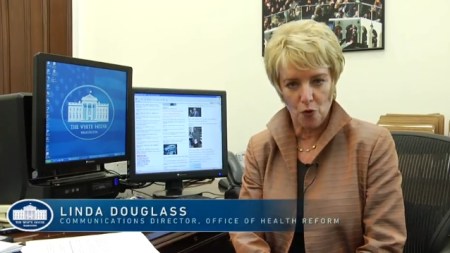
The White House is upset about “disinformation”:
Scary chain emails and videos are starting to percolate on the internet, breathlessly claiming, for example, to “uncover” the truth about the President’s health insurance reform positions.
In this video, Linda Douglass, the communications director for the White House’s Health Reform Office, addresses one example that makes it look like the President intends to “eliminate” private coverage, when the reality couldn’t be further from the truth.
As proof that health reform will not eliminate private coverage, Douglass offers us the president’s promises. He said he wouldn’t! Proof!
Never mind that the actual bill being prepared by the president’s allies in Congress would eliminate private coverage. Contradicting the president’s promises constitutes “disinformation”. Let’s keep this in mind as we read on:
There is a lot of disinformation about health insurance reform out there, spanning from control of personal finances to end of life care. These rumors often travel just below the surface via chain emails or through casual conversation. Since we can’t keep track of all of them here at the White House, we’re asking for your help. If you get an email or see something on the web about health insurance reform that seems fishy, send it to flag@whitehouse.gov.
(Emphasis mine.)
If you hear any disinformation, which is to say anything that contradicts the president’s rhetoric, even in private conversation, they want you to report it to the White House. In short, the White House is asking asking us to report anyone that disagrees with the president.
That sounds a bit sinister, but it gets worse. Lawyers for the Senate Judiciary Committee have determined that the information collected would probably not be covered by the Privacy Act (meaning that the White House can keep records on our protected speech without our permission), would not be covered by the Freedom of Information Act (meaning that we can not find out what records they are keeping), but would be covered by the Presidential Records Act (meaning that the records must be permanent).
To sum up: the White House is collecting a secret, permanent database of incidents in which people contradict the president, even in private conversation.
(Via the Corner.)
Leave a Comment » | Political | Permalink
Posted by K. Crary
Roll Call reports:
Last year, lawmakers excoriated the CEOs of the Big Three automakers for traveling to Washington, D.C., by private jet to attend a hearing about a possible bailout of their companies.
But apparently Congress is not philosophically averse to private air travel: At the end of July, the House approved nearly $200 million for the Air Force to buy three elite Gulfstream jets for ferrying top government officials and Members of Congress.
The Air Force had asked for one Gulfstream 550 jet . . . but the House Appropriations Committee, at its own initiative, added to the 2010 Defense appropriations bill another $132 million for two more airplanes and specified that they be assigned to the D.C.-area units that carry Members of Congress, military brass and top government officials.
(Via Instapundit.)
Oh, come on. The automakers are horribly mismanaged, operate in the red, suffer under huge legacy costs, and are dependent on the taxpayer to survive. How can you compare them to the government?
Leave a Comment » | Political | Permalink
Posted by K. Crary
The Wall Street Journal reports:
The White House’s acting cybersecurity czar [Melissa Hathaway] announced her resignation Monday, in a setback to the Obama administration’s efforts to better protect the computer networks critical to national security and the global economy.
The resignation highlights the difficulty the White House has had following through on its cybersecurity effort. President Barack Obama first outlined his cybersecurity plans in a high-profile speech May 29, announcing his intention to create a top White House cybersecurity post — a position he has yet to fill. . .
In the past year, intelligence officials have grown increasingly concerned about Chinese and Russian cyberspies surveilling U.S. infrastructure and military networks.
People familiar with the matter said Ms. Hathaway has been “spinning her wheels” in the White House, where the president’s economic advisers sought to marginalize her politically. . .
Ms. Hathaway had initially been considered a leading contender to fill the cyber post permanently. She lost favor with the president’s economic team after she said it should consider options for regulating some private-sector entities to ensure they secure their networks, said cybersecurity specialists familiar with the discussions. Being a holdover from the Bush administration didn’t help either, they said.
In February, the White House tapped Ms. Hathaway, a senior intelligence official who had launched President George W. Bush’s cybersecurity initiative, to lead a 60-day cybersecurity policy review. Ms. Hathaway completed her review in April, but the White House spent another 60 days debating the wording of her report and how to structure the White House cyber post. National Economic Adviser Larry Summers argued forcefully that his team should have a say in the work of the new cyber official.
If our enemies bring down our computer infrastructure, at least we can be reassured that cybersecurity wasn’t run by a Bush administration holdover, and that President Obama’s economic team had their say.
Leave a Comment » | Political, Technological | Permalink
Posted by K. Crary
According a 1977 book co-written by John Holdren, President Obama’s science advisor, trees should have the legal standing to sue:
Since the 1970s, some radical environmentalists have argued that trees have legal rights and should be allowed to go to court to protect those rights.
The idea has been endorsed by John P. Holdren, the man who now advises President Barack Obama on science and technology issues.
Giving “natural objects” — like trees — standing to sue in a court of law would have a “most salubrious” effect on the environment, Holdren wrote the 1970s.
“One change in (legal) notions that would have a most salubrious effect on the quality of the environment has been proposed by law professor Christopher D. Stone in his celebrated monograph, ‘Should Trees Have Standing?’” Holdren said in a 1977 book that he co-wrote with Paul R. Ehrlich and Anne H. Ehrlich.
“In that tightly reasoned essay, Stone points out the obvious advantages of giving natural objects standing, just as such inanimate objects as corporations, trusts, and ships are now held to have legal rights and duties,” Holdren added. . .
“Slight changes in the legal notions and diligent application of the legal machinery are all that are necessary to induce a great reduction in pollution in the United States,” Holdren added.
Holdren has previously distanced himself from his 1977 book, when it was discovered that the book endorsed forced abortions, universal sterilization, and a “Planetary Regime” to administer natural resources and human population. He now claims that he never held the views in his book.
Leave a Comment » | Political | Permalink
Posted by K. Crary
Jay Nordlinger, at the Corner, has written a lot about the diminishing number of safe zones, places where people of different political persuasions can interact amiably. One big non-safe-zone is academia, where the majority ideology tends to be liberal, and where liberals delight in injecting political attacks into matters having nothing to do with politics.
Case in point: At a faculty meeting yesterday, we were discussing the process by which the department would fill an important position that is soon to become vacant. One person joked that Sarah Palin should get the job. Most of the room dutifully laughed.
I was perplexed. The joke was not at all funny, it was just weird. Sarah Palin is just one of countless people who would be inappropriate for the job, and who wouldn’t want it, and who weren’t relevant to the conversation. It would have made just as much sense to joke that Sidney Crosby should get the job, or any other name one might draw from a hat.
So why does the Sarah Palin “joke” elicit a laugh, while the Sidney Crosby “joke” would presumably elicit only an uncomfortable silence? I think that members of this particular political mindset have been conditioned to believe that Sarah Palin is inherently funny. Her very name is a joke for all contexts.
I was reminded of what C. S. Lewis wrote about flippancy in the Screwtape Letters. For any readers who may not be familiar with the Screwtape Letters (I like to pretend), they are a series of letters written by a senior devil to a junior devil, giving advice on how to tempt a young man away from the “Enemy” (i.e., God). In chapter eleven, Uncle Screwtape takes on the topic of laughter and recommends flippancy as the best form for the devils’ purposes:
But flippancy is the best of all. In the first place it is very economical. Only a clever human can make a real Joke about virtue, or indeed about anything else; any of them can be trained to talk as if virtue were funny. Among flippant people the Joke is always assumed to have been made. No one actually makes it; but every serious subject is discussed in a manner which implies that they have already found a ridiculous side to it. If prolonged, the habit of Flippancy builds up around a man the finest armour plating against the Enemy that I know, and it is quite free from the dangers inherent in the other sources of laughter. It is a thousand miles away from joy; it deadens, instead of sharpening, the intellect; and it excites no affection between those who practise it.
1 Comment | Political, Theological | Permalink
Posted by K. Crary
AP reports:
House Democrats have declined to subpoena available records that might reveal whether other members of Congress got discounted VIP mortgages from subprime lender Countrywide Financial Corp. similar to the sweetheart deals given Democratic Sens. Chris Dodd and Kent Conrad. . .
Any subpoena must be issued by the committee’s chairman. But because Democrats control Congress, there are no Republican committee chairmen. . . Daniel Frahm, a Bank of America spokesman, said the bank is ready to turn over the Countrywide VIP documents if it receives a subpoena.
(Via Instapundit.)
Leave a Comment » | Political | Permalink
Posted by K. Crary
Keith Hennessey has turned the CBO analysis of the House Democrats’ horrifying health care bill into a horrifying chart:
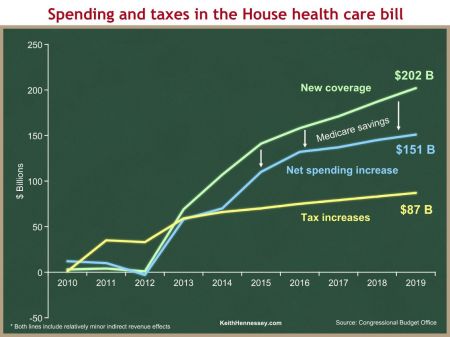
You can see the huge tax increase outstripped by the even huger spending increase. In the long run, the outlook is even more horrifying:
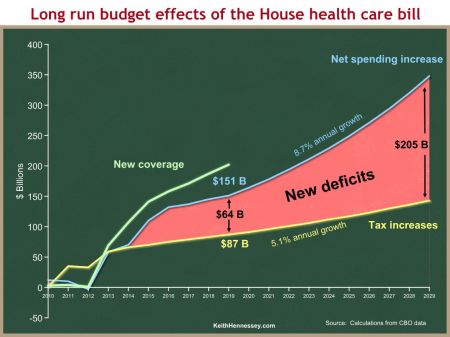
These are the official CBO numbers. The true story is worse still. The marginal tax rates being contemplated (around 50%) are well up the Laffer curve, so the new taxes won’t bring in nearly as much money as predicted by the CBO’s model.
(Via Hot Air.)
Leave a Comment » | Political | Permalink
Posted by K. Crary
The Washington Times has a lengthy account of how the Black Panther voter intimidation case came to be dismissed, after Justice Department lawyers had already won the case. Thomas Perrelli, the #3 official at the Justice Department (and a political appointee, of course), made the final decision that a suitable penalty for flagrant voter intimidation was an injunction against doing it again.
(Via the Corner.) (Previous post.)
UPDATE: More here. This keeps smelling worse and worse. (Via the Corner.)
Leave a Comment » | Legal, Political | Permalink
Posted by K. Crary
The blows keep coming. The bill’s $239 billion cost over 10 years is the good news. The bad news is what comes after the first ten years.
Leave a Comment » | Political | Permalink
Posted by K. Crary
We’re seeing a lot of “White House defends Biden” stories, like this one:
White House Press Secretary Roberts Gibbs on Monday called Vice President Biden an “enormous asset to the administration,” insisting that the loose-lipped No. 2 is not a distraction even after the State Department had to walk back his thorny comments on Russia. . . The latest surprise came when [Biden] suggested that Russia will cooperate with the United States on a range of issues because the country is a mess.
“I think we vastly underestimate the hand that we hold,” Biden said during an interview with The Wall Street Journal at the end of his trip to Georgia and Ukraine. “Russia has to make some very difficult, calculated decisions. They have a shrinking population base, they have a withering economy, they have a banking sector and structure that is not likely to be able to withstand the next 15 years, they’re in a situation where the world is changing before them and they’re clinging to something in the past that is not sustainable.”
This drew a swift rebuke from the Kremlin, as the Obama administration has repeatedly said it wants to “reset” relations with Russia. The two countries produced a string of agreements on nuclear stockpile reduction and other matters following Obama’s recent trip to Moscow.
He’s right about Russia’s tough situation, but is it smart to be taunting them? I think the whole “reset” idea is foolishness, but if we’re going to try it, we ought to really try it.
Leave a Comment » | Geopolitical, Political | Permalink
Posted by K. Crary
Charles Rangel (D-NY), tax cheat:
Ever notice that those who endorse high taxes and those who actually pay them aren’t the same people? Consider the curious case of Ways and Means Chairman Charlie Rangel, who is leading the charge for a new 5.4-percentage point income tax surcharge and recently called it “the moral thing to do.” About his own tax liability he seems less, well, fervent.
Exhibit A concerns a rental property Mr. Rangel purchased in 1987 at the Punta Cana Yacht Club in the Dominican Republic. The rental income from that property ought to be substantial since it is a luxury beach-front villa and is more often than not rented out. But when the National Legal and Policy Center looked at Mr. Rangel’s House financial disclosure forms in August, it noted that his reported income looked suspiciously low. In 2004 and 2005, he reported no more than $5,000, and in 2006 and 2007 no income at all from the property.
The Congressman initially denied there was any unreported income. But reporters quickly showed that the villa is among the most desirable at Punta Cana and that it rents for $500 a night in the low season, and as much as $1,100 a night in peak season. Last year it was fully booked between December 15 and April 15.
Mr. Rangel soon admitted having failed to report rental income of $75,000 over the years. First he blamed his wife for the oversight because he said she was supposed to be managing the property. Then he blamed the language barrier. “Every time I thought I was getting somewhere, they’d start speaking Spanish,” Mr. Rangel explained.
Mr. Rangel promised last fall to amend his tax returns, pay what is due and correct the information on his annual financial disclosure form. But the deadline for the 2008 filing was May 15 and as of last week he still had not filed. His press spokesman declined to answer questions about anything related to his ethics problems.
There’s more.
Leave a Comment » | Political | Permalink
Posted by K. Crary
Rasmussen reports:
Public opposition to the auto bailouts may translating into consumer buying decisions, with 46% of Americans now saying they are more likely to buy a car from Ford because it did not take government money to stay in business. . .
At the same time, nearly one-out-of-five Americans (19%) say someone in their family or a friend has chosen not to buy a car from GM or Chrysler because they took bailout money. . .
One-out-of-three investors (33%) say it is very likely that the government will give an unfair advantage to the bailed-out automakers.
(Via Instapundit.) (Related item.)
UPDATE: Here’s a contrarian view.
Leave a Comment » | Political | Permalink
Posted by K. Crary
The House Democrats’ health care bill isn’t going with liberty. (Via Instapundit.)
Leave a Comment » | Political | Permalink
Posted by K. Crary
A new study shows that, contrary to the the popular impression that upside-down mortgages are generally due to adverse market movements and resetting ARMs, most are actually due to reckless choices made by the borrower:
In crafting programs to prevent foreclosures, policymakers have assumed that the primary reason homeowners owe more on their home than it is worth is that they bought at the top of the market. In other words, they’ve lost equity primarily through forces beyond their control.
A new study challenges this premise and finds that excessive borrowing may have played as great a role.
Michael LaCour-Little, a finance professor at California State University at Fullerton, looked at 4,000 foreclosures in Southern California from 2006-08. He found that, at least in Southern California, borrowers who defaulted on their mortgages didn’t purchase their homes at the top of the market. Instead, the average acquisition was made in 2002 and many homes lost to foreclosure were bought in the 1990s. More than half of all borrowers who lost their homes had already refinanced at least once, and four out of five had a second mortgage.
The original loan-to-value ratio for these borrowers stood at a reasonable 84%, but second and third liens left homeowners with a combined loan-to-value ratio of about 150% by the time of the foreclosure sale date.
Borrowers, meanwhile, took out around $2 billion in equity from their homes, or nearly eight times the $262 million that they put into their homes. Lenders lost around four times as much as borrowers, seeing $1 billion in losses.
That last figure is staggering: these borrowers took eight times the amount of money out of their houses as they put in. Now the government is going to step in to try to “save” them?
Leave a Comment » | Political | Permalink
Posted by K. Crary
Democrats are considering a video game tax to fund their health care catastrophe and to discourage inactive lifestyles. It’s hard to imagine that a video game tax could bring in much money, and I’m not aware of any study that supports the hypothesis that taxing video games would result in healthier lifestyles.
Out of my gaming companions, most do not live sedentary lives. In fact, a surprising number are firefighters. On-duty firefighters need something to do while they wait around in the station for a call and video games fit the bill. I also understand that video games are popular among soliders deployed to inhospitable locations like Afghanistan and Iraq. (I generally don’t game with them, though, due to time differences and network latency.) Firefighters and soldiers would be surprised to learn of their inactive lifestyles.
This is all anecdotal, of course. But again, as far as I’m aware, these proposals are being made on mere conjecture. One would also get different anecdotes from children, I’m sure, but children are actually a small segment of the video game market:
As younger generations grow and have children of their own, more parents are playing video games than ever before – 36% of parents play video games. “Families that play together stay together” can now mean playing video games.
Eighty percent of gamer parents play video games with their kids.
Forty-seven percent of video game players are between the ages of 18 and 49. The fastest growing demographic is the 50-plus crowd. This doesn’t mean that kids aren’t playing video games anymore; far from it… they still represent 28% of all gamers out there.
More and more older Americans are playing video games than ever before. Video games are perfect activities for seniors by providing activity without physical stress. They offer health benefits with coordination, balance and endurance. 24% of Americans over age 50 played video games last year, and that number should only increase.
The average game buyer is 38 years old, five years older than the average player. This gap in age represents the scores of parents buying games for their children, and the tremendous influence parents have on sales.
Leave a Comment » | Political, Recreational | Permalink
Posted by K. Crary
AP reports:
Despite their denials, influential Democratic Sens. Kent Conrad and Chris Dodd were told from the start they were getting VIP mortgage discounts from one of the nation’s largest lenders, the official who handled their loans has told Congress in secret testimony.
Both senators have said that at the time the mortgages were being written they didn’t know they were getting unique deals from Countrywide Financial Corp., the company that went on to lose billions of dollars on home loans to credit-strapped borrowers. Dodd still maintains he got no preferential treatment.
Dodd got two Countrywide mortgages in 2003, refinancing his home in Connecticut and another residence in Washington. Conrad’s two Countrywide mortgages in 2004 were for a beach house in Delaware and an eight-unit apartment building in Bismarck in his home state of North Dakota.
(Via Instapundit.)
Leave a Comment » | Political | Permalink
Posted by K. Crary
I’m not that much of a student of history, but I knew that Emperor Hirohito did not attend the Japanese surrender ceremony at the end of World War Two. Oops:
President Obama has put securing Afghanistan near the top of his foreign policy agenda, but “victory” in the war-torn country isn’t necessarily the United States’ goal, he said Thursday in a TV interview.
“I’m always worried about using the word ‘victory,’ because, you know, it invokes this notion of Emperor Hirohito coming down and signing a surrender to MacArthur,” Obama told ABC News.
(Via Gateway Pundit, via Instapundit.)
Leave a Comment » | Political | Permalink
Posted by K. Crary
The Washington Post, under the headline “A Case of Getting What You Pay For”, reports:
The evolution of heart attack treatment over the past three decades is a story of doing more things to more people at greater expense with better results. It is a portrait in miniature of medicine in the United States.
Although inappropriate care, high administrative costs, inflated prices and fraud all add to the country’s gigantic medical bill, the biggest driver of the upward curve of health spending has been the discovery of new and better things to do when someone gets sick.
“Money matters in health care as it does in few other industries,” wrote Harvard University health economist David Cutler in 2004. “Where we have spent a lot, we have received a lot in return.”
Beyond heart attack treatment, similar stories can be told about cancer, premature birth, arthritis, HIV infection, mental illness and innumerable other common conditions. The trend in all of them toward more intensive, expensive and better treatment is not likely to change with health-care reform, however constituted.
Providing health insurance to the 47 million Americans who don’t have it — the key feature of the bills before Congress — is likely to expand heart attack treatment and increase spending on it, not pare it back and reduce the cost.
(Via Kausfiles, via Instapundit.)
Pay more to get more? Who ever heard of such a thing?
Leave a Comment » | Political | Permalink
Posted by K. Crary
Good for them. Related item here.
Leave a Comment » | Political | Permalink
Posted by K. Crary
(Via Instapundit.)
Then here’s this related item.
2 Comments | Political | Permalink
Posted by K. Crary
Politico reports:
For the second time this month, congressional budget analysts have dealt a blow to the Democrat’s health reform efforts, this time by saying a plan touted by the White House as crucial to paying for the bill would actually save almost no money over 10 years.
A key House chairman and moderate House Democrats on Tuesday agreed to a White House-backed proposal that would give an outside panel the power to make cuts to government-financed health care programs. White House budget director Peter Orszag declared the plan “probably the most important piece that can be added” to the House’s health care reform legislation.
But on Saturday, the Congressional Budget Office said the proposal to give an independent panel the power to keep Medicare spending in check would only save about $2 billion over 10 years- a drop in the bucket compared to the bill’s $1 trillion price tag.
“In CBO’s judgment, the probability is high that no savings would be realized … but there is also a chance that substantial savings might be realized. Looking beyond the 10-year budget window, CBO expects that this proposal would generate larger but still modest savings on the same probabilistic basis,” CBO Director Douglas Elmendorf wrote in a letter to House Majority Leader Steny Hoyer on Saturday.
(Via Instapundit.)
This “plan” is really a plan to have a plan. It doesn’t identify any savings; it creates a commission to find those savings. And that idle speculation is how health care reform is supposed to pay for itself. (I’ll be impressed if the panel finds enough savings to pay for its expenses.)
It also strikes me that the plan is constitutionally dubious. It sounds to me as though the plan would delegate legislative power to the proposed panel, which is unconstitutional.
Leave a Comment » | Political | Permalink
Posted by K. Crary
I have to say, I am greatly enjoying the spectacle of President Obama’s ill-advised decision to wade into the Gates affair. The president called his news conference to try to rally support for his increasingly unpopular effort to “reform” health care. The last thing he should have done was change the subject. When asked about it, he should have said (as Charles Krauthammer suggests) something like “I am a friend of Gates, and therefore I’m inclined to believe his story. But since there’s no way I can know what actually happened, I’ll decline a comment.”
But he just couldn’t help himself. True to form, he had to opine, whether he was conversant with the facts or not. And, at the risk of sounding cynical, it’s fortunate that he did. The top story the next day wasn’t health care, but the president’s attack on the Cambridge police. He blunted any impact his press conference might have had.
POSTSCRIPT: Regarding the affair itself, the facts are in dispute. The police might have behaved inappropriately, or maybe not. (Power Line argues that their actions might well have been reasonable.) But one thing is clear; Gates was foolish. The police have the power to arrest people on the flimsiest justification, and they often do. Whether or not his anger was justified, arguing with the police was likely to get him in trouble. That’s not the way things should be; it’s just the way they are.
Leave a Comment » | Political | Permalink
Posted by K. Crary
French anti-work activists are opposing a proposed law that would make it legal to work on Sunday. They plan to protest, once they get back from their summer holiday:
Jean Dionnot, a former boxing champion, founded The Collective of Sunday Friends in 2006 to lobby against modifying Sunday trading rules. He said he was appalled by the new law. “Now people will spend their Sundays wandering in malls,” he said.
Mr. Dionnot said he was pausing his campaign for a while, but would resume his fight in September. “It’s the holiday break now,” he said.
Leave a Comment » | Political | Permalink
Posted by K. Crary
The latest Rasmussen poll shows that, for the first time, a majority disapproves of President Obama’s job performance, 51% to 49%. He also faces an eight point deficit among those who feel strongly, 38%-30%. Only 37% of independents approve.
Other polls have also shown a sharp drop in the president’s numbers, but still have him in the mid-fifties. Why is Rasmussen’s result different? They explain:
When comparing Job Approval data from different firms, it’s important to keep in mind that polls of likely voters and polls of all adults will typically and consistently yield different results. In the case of President Obama, polls by all firms measuring all adults typically show significantly higher approval ratings than polls of likely voters. Polls of registered voters typically fall in the middle. Other factors are also important to consider when comparing Job Approval ratings from different polling firms.
Most polls use a broader sample most of the time, even during election campaigns, and shift to likely voters just before the election takes place. I think Rasmussen does better by being consistent.
It’s also worth nothing that Rasmussen did the best job at predicting the outcome of the 2008 election, tied with Pew Research. (CNN did slightly better with its actual prediction, but had a much wider margin of error, giving it a greater average error.)
(Via Power Line.)
UPDATE: What Rasmussen calls the approval index (strong approval vs. strong disapproval) hits double digits at -11, with 29% strongly approving and 40% strongly disapproving.
Doing the arithmetic, that means 29% strongly approve, 20% weakly approve, 11% weakly disapprove, and 40% strongly disapprove. Wow.
UPDATE: For what it’s worth (not much), Zogby has Obama down as well, at 48% approval against 51% disapproval. But Zogby is usually a left-leaning poll, so it might be worth something. In the 2008 election Zogby over-estimated Obama’s margin of victory more than nearly any other major poll (only CBS/NYT and Newsweek did worse). Even the Fair model, which does no polling and doesn’t even know who the candidates are, did better.
(Via Hot Air.)
Leave a Comment » | Political | Permalink
Posted by K. Crary
Fox News reports:
[John Holdren] was confirmed with little fanfare on March 19 as director of the White House’s Office of Science and Technology Policy, a 50-person directorate that advises the president on scientific affairs, focusing on energy independence and global warming.
But many of Holdren’s radical ideas on population control were not brought up at his confirmation hearings; it appears that the senators who scrutinized him had no knowledge of the contents of a textbook he co-authored in 1977, “Ecoscience: Population, Resources, Environment,” a copy of which was obtained by FOXNews.com.
The 1,000-page course book, which was co-written with environmental activists Paul and Anne Ehrlich, discusses and in one passage seems to advocate totalitarian measures to curb population growth, which it says could cause an environmental catastrophe. . . Holdren and his co-authors spend a portion of the book discussing possible government programs that could be used to lower birth rates.
Those plans include forcing single women to abort their babies or put them up for adoption; implanting sterilizing capsules in people when they reach puberty; and spiking water reserves and staple foods with a chemical that would make people sterile.
To help achieve those goals, they formulate a “world government scheme” they call the Planetary Regime, which would administer the world’s resources and human growth, and they discuss the development of an “armed international organization, a global analogue of a police force” to which nations would surrender part of their sovereignty.
Holdren now says that he does not hold the views expressed in the book he co-wrote, and never did. He has not explained why then he allowed his name to be attached to the book.
Leave a Comment » | Political | Permalink
Posted by K. Crary
According to a new Rasmussen poll, more people (31%) say that the stimulus has hurt the economy than helped (25%). When you combine that with the 36% who say it has had no impact, that’s a 67% majority. But it sure did provide a lot of pork.
(Via Instapundit.)
Leave a Comment » | Political | Permalink
Posted by K. Crary
A thoughtful comment by Paul Mirengoff:
At the risk of repeating a point made by others, I think it’s worth noting that President Obama is going about overhauling our health care system in a strange manner. One would expect a leader, particularly one who is considered highly cerebral by many, to carefully craft a health care reform plan after a period of intense study. One would expect further that the leader would fight for his plan, compromising only around the edges and under extreme duress. One would not expect a leader to defer to others in his party simply to get a plan, any plan, passed by a certain date.
But Obama is, in the words of David Brooks, deferring to the Old Bulls in Congress on health care reform. He appears to be engaged in an ad hoc process whereby proposals are being cobbled together more or less on the fly and then adjusted in response to the political circumstances as they appear on a given day. . .
It is shocking that Obama would attempt to overhaul our health care system — this vast and critical portion of our economy — on such a short timetable and in such a haphazard fashion. The public senses the absurdity of his approach. It expects Obama to act like the careful, studious leader it voted for. Plainly, though, he has shed that cover.
Yes, Obama has made it clear (almost in as many words) that it is more important to do something, anything, than to do the right thing.
Leave a Comment » | Political | Permalink
Posted by K. Crary
This clip is very revealing of President Obama’s attitude toward health care rationing:
Helen Smith, who knows a thing or two about heart arrhythmia, is aghast. (Via Instapundit.)
Leave a Comment » | Political | Permalink
Posted by K. Crary
“The time for talking is through,” but the time for reading has apparently not yet arrived. In a conference call yesterday, President Obama admitted that he doesn’t know what’s in the bill for which he’s trying to rally support:
During the call, a blogger from Maine said he kept running into an Investors Business Daily article that claimed Section 102 of the House health legislation would outlaw private insurance. He asked: “Is this true? Will people be able to keep their insurance and will insurers be able to write new policies even though H.R. 3200 is passed?” President Obama replied: “You know, I have to say that I am not familiar with the provision you are talking about.”
(Via Hot Air.) (Previous post.)
Leave a Comment » | Political | Permalink
Posted by K. Crary
The Problem
Lobbyists Write National Policies: For example, Vice President Dick Cheney’s Energy Task Force of oil and gas lobbyists met secretly to develop national energy policy. . .
Barack Obama and Joe Biden’s Plan . . .
- Make White House Communications Public: Obama will amend executive orders to ensure that communications about regulatory policymaking between persons outside government and all White House staff are disclosed to the public.
- Conduct Regulatory Agency Business in Public: Obama will require his appointees who lead the executive branch departments and rulemaking agencies to conduct the significant business of the agency in public, so that any citizen can see in person or watch on the Internet these debates.
Obama administration officials have rejected a watchdog group’s request for a list of healthcare industry executives who’ve been meeting secretly in the White House with Obama staffers to discuss pending healthcare changes being drafted there and in Congress.
According to the Citizens for Ethics and Responsibility in Washington, which is suspicious of the influence of health industry lobbyists and company officers, it received a letter from the Secret Service citing an Obama Justice Dept. directive and denying access to visitor logs under the “presidential communications privilege.”
(Via Instapundit.)
It’s not just Obama and Bush, either. The Clinton administration also had secret meetings with health care lobbyists, and there was a lawsuit in that case too. Transparency is much more popular with presidential candidates than with presidents.
Leave a Comment » | Political | Permalink
Posted by K. Crary
Sheldon Richman writes:
A rule we can rely on to be unfailingly applied is this: No matter how much the government controls the economic system, any problem will be blamed on whatever small zone of freedom that remains. This of course is evidence of a rigged game. The government can’t possibly monitor and regulate absolutely every transaction that takes place in a country. Stalin and Hitler couldn’t do it by a long shot. So anything that displeases the ruling regime can easily be laid at the doorstep of freedom and be used as an excuse for stamping out whatever traces of liberty still exist.
(Via Instapundit.)
Leave a Comment » | Political | Permalink
Posted by K. Crary
AP reports:
President Obama has irked close allies in Congress by declaring he has the right to ignore legislation on constitutional grounds after having criticized George W. Bush for doing the same.
Four senior House Democrats on Tuesday said they were “surprised” and “chagrined” by Obama’s declaration in June that he doesn’t have to comply with provisions in a war spending bill that puts conditions on aid provided to the World Bank and International Monetary Fund.
In a signing statement accompanying the $106 billion bill, Obama said he wouldn’t allow the legislation to interfere with his authority as president to conduct foreign policy and negotiate with other governments.
Earlier in his six-month-old administration, Obama issued a similar statement regarding provisions in a $410 billion omnibus spending bill. He also included qualifying remarks when signing legislation that established commissions to govern public lands in New York, investigate the financial crisis and celebrate Ronald Reagan’s birthday.
“During the previous administration, all of us were critical of (Bush’s) assertion that he could pick and choose which aspects of congressional statutes he was required to enforce,” the Democrats wrote in their letter to Obama. “We were therefore chagrined to see you appear to express a similar attitude.” . . .
Obey and the other House lawmakers said this week that Obama’s signing statement on the war bill will make it tougher in the future to persuade other lawmakers to support the World Bank and IMF.
If Congress can’t place conditions on the money, “it will make it virtually impossible to provide further allocations for these institutions,” they wrote.
Welcome guys, to the ranks of the rubes.
Leave a Comment » | Political | Permalink
Posted by K. Crary
Let me be clear. Israel’s security is sacrosanct. It is non-negotiable. The Palestinians need a state that is contiguous and cohesive, and that allows them to prosper — but any agreement with the Palestinian people must preserve Israel’s identity as a Jewish state, with secure, recognized and defensible borders. Jerusalem will remain the capital of Israel, and it must remain undivided.
The Obama Administration, thirteen months later:
The United States views East Jerusalem as no different than an illegal West Bank outpost with regard to its demand for a freeze on settlement construction, American sources have informed both Israel and the Palestinian Authority.
(Via Volokh.)
Now that Barack Obama no longer needs to court Jewish voters, East Jerusalem has gone from part of the undivided capital of Israel to an illegal West Bank outpost. Another one for the “who are the rubes” file.
Leave a Comment » | Geopolitical, Political | Permalink
Posted by K. Crary
I noted yesterday that George Miller, chairman of the House Education and Labor committee, was claiming that the CBO scored his bill as revenue-neutral over ten years, when in truth the CBO scored it as adding $239 billion to the deficit over ten years.
Today, Politico has an explanation for Miller’s story, sort of. Apparently $245 billion of the bill’s spending is for Medicare payments to doctors, and was put there to gain the support of the AMA. The Democrats argue that that part of the bill doesn’t count. Voila, $6 billion surplus.
In my own budget, the only way to make spending not count is not to spend the money. I wish I were as clever as the Democrats.
UPDATE: In the original post, I said the Democrats were planning to use accounting gimmicks to hide the $245 billion. That’s what I understood the Politico article to be saying with its reference to “new accounting rules,” but now it looks like I misunderstood. The chicanery the Democrats are attempting is political, not accounting. (I’ve corrected the post accordingly, but the mistake lingers on in the permalink.)
This statement from the Energy and Commerce committee explains the Democratic argument a little bit better:
The bill’s long-term reform of Medicare’s physician fee schedule to eliminate the potential 21 percent cut in fees, and put payments on a sustainable basis for the future, will cost about $245 billion. Those costs, however, are not included in the net calculations above, as they will be absorbed under the upcoming statutory “pay go” legislation that is pending in the House.
So the $245 billion doesn’t count because it also appears in some other bill that’s under consideration. Well, at least I understand what they’re saying now.
The Democrats are trying to have it both ways. If they don’t want to count the $245 billion, they can simply take it out of the bill. Leave it in the other bill and pass that one. (Or better yet, don’t.) But that’s exactly what they cannot do. The $245 billion fee adjustment was the AMA’s price for supporting the bill. If they take it out, they risk losing the AMA’s support. It’s a package deal.
The CBO doesn’t score a bill based on what else might be done in other political realities. If it’s in the bill, it counts. It’s ridiculous to pretend otherwise.
UPDATE: This AP article lays things out pretty well.
Leave a Comment » | Political | Permalink
Posted by K. Crary
Oh well. The planes are still in the House bill, but I don’t expect they’ll survive. Hopefully we’ll never have to fight anyone with an air force again.
(Via the Corner.)
Leave a Comment » | Military, Political | Permalink
Posted by K. Crary
The last issue of the Economist had a special report on Texas and California. In short, Texas is cleaning California’s clock. Texas is flourishing due to its business-friendly policies; even in the recession Texas is doing better than most. California is just the opposite. The report’s opening article concludes:
How Texas responds to these forces will determine its future. Get it right, and the state will remain business-friendly and globally competitive, with high employment and a rising standard of living. Get it wrong, and Texas could follow California (which “flipped” from Republican to Democratic control in part thanks to rapid immigration) down the road of high taxes and excessive regulation. This route has bankrupted California and is prompting a net 100,000 people to leave each year. Many of them head for Texas. One simple statistic tells that tale: it costs nearly three times as much to rent a self-drive van for a one-way journey from Los Angeles to Houston as the other way around.
That’s just two states, but National Review has a broader analysis (subscription required). They charted unemployment against political preference (as measured by presidential elections) across the states and found a clear correlation between Democrats and unemployment:
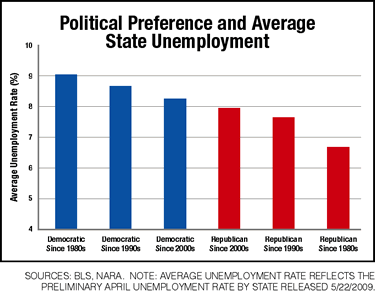
The longer a state has been Republican, the better off it is. The longer a state has been Democratic, the worse off it is.
Leave a Comment » | Political | Permalink
Posted by K. Crary
Three months ago President Obama ordered his cabinet to find ways to cut the federal budget $100 million (that is, 0.003%) within 90 days. The order to cut such a tiny amount was widely derided, even on the left. Paul Krugman pointed out that Obama could cut $100 million every day for his entire term and still not make a dent in the budget.
But now it seems that even $100 million was too much for this administration to cut:
On April 20, President Obama challenged his Cabinet to cut $100 million in spending over the next 90 days.
The deadline came — and went — without a report from the White House on whether or not that promise was fulfilled.
Asked about the spending cuts, White House spokesman Robert Gibbs said Monday that information still was being compiled.
(Via the Corner.)
This is becoming a pattern for this president. He makes an announcement with great fanfare, but doesn’t actually have a plan to accomplish it. He sets a deadline by which a plan will be devised, and the deadline passes silently with no plan. The crazy thing is that this goal (unlike, say, closing Guantanamo) is easy, or at least it should have been.
In the early days of the Obama administration, the president announced — with great fanfare — that he was overturning all the Bush administration detention policies. He didn’t have new policies to replace them with, though. In reality, he was just announcing a plan to have a plan.
It turns out that even the plan to have a plan wasn’t so rigid:
The Obama administration on Monday pushed back its own deadline for devising new anti-terrorism policies.
The decision had been expected, as presidentially appointed task forces have failed to meet a six-month schedule for making policy recommendations on how terror suspects should be interrogated, held in custody or handed over to other countries.
Senior administration officials said Monday that the report on detention will be delayed six months and the report on interrogation and transfer policy will be delayed two months.
The cynics who suggested that intending to change policies was much easier than actually changing policies have been pretty well vindicated. Not that anyone is paying attention any more.
Leave a Comment » | Political | Permalink
Posted by K. Crary
In the latest Rasmussen poll, 50% approve of President Obama, against 49% disapproving. Among those who feel strongly, 30% approve and 37% disapprove.
Leave a Comment » | Political | Permalink
Posted by K. Crary
The CBO has scored the House Democrats’ health care bill and it’s a disaster. By 2019 the deficit would be widened $65 billion per year and the gap continues to grow each year, despite a massive tax hike. That’s assuming that the tax hike brings in as much revenue as projected, which it won’t. Also, despite the cost, the plan does not achieve universal coverage; it reaches only two-thirds of the uninsured.
But there’s a curious fact about the House Democrats’ plan. The tax hike is effective in 2011, but the new spending is not effective until 2013. Why is that? I think it’s to make the short-term outlook better. Since they’ll run up $49 billion in new taxes before the spending kicks in, it will take until 2016 for the plan to start losing money. (Again, assuming the tax hike works as predicted.)
So tomorrow’s Democratic spin will be that the plan cuts the deficit. The qualifier “through 2015” will be mumbled when it’s said at all. The further qualifier “after which it’s a catastrophe” won’t even be hinted at.
(Via Dmarron, via Instapundit.)
UPDATE: Alternatively, they might just lie. From the office of George Miller, chairman of the House Education and Labor committee, comes this press release:
The Congressional Budget Office (CBO) released estimates this evening confirming for the first time that H.R. 3200, America’s Affordable Health Choices Act, is deficit neutral over the 10-year budget window – and even produces a $6 billion surplus.
(Via the Corner.)
This is an outright lie. The CBO scoring (linked above) says it would generate a $239 billion deficit over ten years, not a $6 billion surplus. The longest window over which it would generate a surplus ($4 billion) is six years.
UPDATE: Miller’s number is based on the notion that $245 billion of the bill doesn’t count.
AP reports:
The White House is being forced to acknowledge the wide gap between its once-upbeat predictions about the economy and today’s bleak landscape.
The administration’s annual midsummer budget update is sure to show higher deficits and unemployment and slower growth than projected in President Barack Obama’s budget in February and update in May, and that could complicate his efforts to get his signature health care and global-warming proposals through Congress.
The release of the update – usually scheduled for mid-July – has been put off until the middle of next month, giving rise to speculation the White House is delaying the bad news at least until Congress leaves town on its August 7 summer recess.
(Via Instapundit.)
This White House is hoping Democrats can pass one more disaster before the public finds out what a mess they’ve made already.
Leave a Comment » | Political | Permalink
Posted by K. Crary
Politico reports that Obama is dropping his August deadline for health care reform (Via Instapundit.)
And if that’s not enough evidence that he doesn’t have the votes, Democrats are talking about using a variant of the nuclear option to prevent a filibuster. Fox News reports that Democrats are talking about using reconciliation to pass health care reform. Reconciliation is a parliamentary maneuver that allows a budget to pass the Senate with only a majority vote. Under the Byrd Rule, reconciliation does not apply to non-budget legislation. The Byrd Rule barred it from being used to pass health care reform in 1993, and it still bars it today. Nevertheless, Democrats may try, and with control of the chamber, they can do whatever they want.
Why do I liken this to the nuclear option? Here’s how I see this playing out. To satisfy the Byrd Rule, Democrats would have to strip out all non-budget items, including individual and employer mandates, and the government insurance scheme. The bill that would be left over isn’t what the Democrats want. So, the chair (Harry Reid) rules that the full bill is permitted under reconciliation, Byrd Rule notwithstanding. After a point of order, the chair’s ruling is sustained by a majority vote (without the support of Republicans, moderate Democrats, or Robert Byrd). That’s precisely the nuclear option.
Democrats would be making a huge mistake to carry out this strategy. The spectacle of the Democrats breaking the Senate rules to pass a controversial bill the the public doesn’t even want will cost them dearly at the polls. But with so many true-believers in the Democratic caucus, they may decide it’s worth it.
2 Comments | Political | Permalink
Posted by K. Crary
A recent article by Sam Kazman in National Review on CAFE fuel-economy standards made a point I hadn’t seen before. It’s obvious in retrospect, so I’m sure it was already out there and I just missed it. In any case, it’s worthy of notice.
Because of the law of demand, it’s not clear whether CAFE standards actually reduce fuel consumption. Improving fuel economy makes driving cheaper, and making a commodity cheaper causes people to consume more of it. More driving means more fuel used.
So fuel economy has an indeterminate effect on fuel usage. The direct effect reduces usage, but the indirect effect (by encouraging driving) increases it. Which effect is greater depends on the shape of the demand curve. For some people (like me), fuel costs have little effect on driving habits, but for others it has a great effect. Without empirical data, there’s no way to say which dominates.
POSTSCRIPT: An additional knock against CAFE standards is they regulate average fuel economy, when it’s the numerator that policymakers care about. One way that automakers can (and do) meet CAFE standards is by selling cheap, light cars at a loss in order to counterbalance the less fuel-efficient vehicles that are their main business. This improves the average fuel economy, but it does so by putting more cars on the road, which increases fuel usage. When you combine this effect with the previous one, it seems very likely indeed that CAFE standards do nothing to conserve fuel.
And then there’s always the thousands of people killed every year by CAFE standards.
Leave a Comment » | Political | Permalink
Posted by K. Crary
50%-35%, and even more among independents.
Leave a Comment » | Political | Permalink
Posted by K. Crary
A conservative plan for health care reform would include some kind of malpractice reform. Doing so would cut costs for malpractice insurance (which get passed on, of course) and reduce the incentive for overly defensive medical tests. Opinions differ as to how much a difference this one reform would make, but there’s no question it would help (and in some specialties, such as obstetrics, help a lot).
However, the Democrats seem to think that there aren’t enough lawsuits! The Democratic health care bill would allow freelance lawyers to file lawsuits on behalf of Medicare, without obtaining the government’s approval (!), and keep a share of the money if they win.
So let’s not have any more nonsense about how “reform” is going to cut health care costs. We already knew that it won’t (from the CBO analysis, if nothing else), but it is now clear that it’s not even supposed to.
Leave a Comment » | Political | Permalink
Posted by K. Crary
Not in Iran, but St. Louis, Missouri. When a tea party group protested outside Senator Claire McCaskill’s office, they locked the doors, closed the blinds, and called the cops. (Via Instapundit.)
UPDATE: McCaskill has issued a statement on her blog, saying that it was a neighboring office, not hers, that was making obscene gestures at the protesters, and adding:
I still regret the way we handled the protest, and hope that all those that want to express themselves feel free to protest peacefully at our office anytime.
She doesn’t explain how the police were called, which makes her claim to welcome protesters ring a bit hollow.
(Via Instapundit.)
Leave a Comment » | Political | Permalink
Posted by K. Crary
The fruits of nationalization:
Sen. Tom Harkin said he wants Congress to use a climate bill to force auto companies to make new cars and trucks capable of running on 85 percent ethanol as well as conventional gasoline.
“We own the automobile companies. Why not? I think that will be an easy one,” Harkin said Thursday, referring to the government interests in Chrysler and General Motors.
As government coercion goes, this isn’t necessarily such a bad policy, since by some estimates this would cost only $100 per new car. Nevertheless, he should be prepared to fight for his policy. Using nationalized industries to short-circuit political opposition is wrong, and inimical to democracy.
Leave a Comment » | Political | Permalink
Posted by K. Crary
This seems significant:
Instead of saving the federal government from fiscal catastrophe, the health reform measures being drafted by congressional Democrats would increase rather than reduce public spending on health care, potentially worsening an already bleak budget outlook, the director of the nonpartisan Congressional Budget Office said this morning.
Under questioning by members of the Senate Budget Committee, CBO director Douglas Elmendorf said bills crafted by House leaders and the Senate health committee do not propose “the sort of fundamental changes that would be necessary to reduce the trajectory of federal health spending by a significant amount.”
“On the contrary,” Elmendorf said, “the legislation significantly expands the federal responsibility for health-care costs.”
Though President Obama and Democratic leaders have said repeatedly that reining in the skyrocketing growth in spending on government health programs such as Medicaid and Medicare is their top priority, the reform measures put forth so far would not fulfill their pledge to “bend the cost curve” downward, Elmendorf said. Instead, he said, “The curve is being raised.”
(Via the Corner.)
Leave a Comment » | Political | Permalink
Posted by K. Crary
Anyone who doubted that the Democrats mean to nationalize everyone’s health coverage need doubt no longer. The Democratic health care bill bans private individual health covarage.
The provision grandfathers those with existing coverage, but by preventing any insurer from taking on new customers, it ensures that the days of private insurance are numbered. People will not be able to switch insurers, and when their plan inevitably folds, they will be forced into the government plan.
(Via Instapundit.)
UPDATE: Power Line has some more details.
Leave a Comment » | Political | Permalink
Posted by K. Crary
A new press release from Media Matters has a little bit of accidental transparency:
Greetings,
I wanted to make sure you had seen Media Matters’ latest research on the media ignoring allegations that surfaced during Sen. Jeff Sessions’ 1986 nomination to the U.S. district court. As reported by the Associated Press, Sessions’ “nomination originally drew fire from civil rights groups because of his [1985] prosecution … of three west Alabama civil rights activists on vote fraud charges. The three were acquitted by a federal court jury, prompting civil rights leaders to charge that the prosecution was an attempt to intimidate black voters.” Doesn’t the fact that we quote the AP undermine the idea that the media is ignoring the story? Could we say, “research on much of the media ignoring…”
Please feel free to contact me with any questions or if you would like additional information.
Jessica Levin
Press Secretary
Media Matters for America
(Emphasis added.) (Via the Corner.)
Yes, I would say it does undermine the idea. Good point, Media Matters. (Seriously though, would ignoring this 23-year-old smear really be so unreasonable?)
Leave a Comment » | Political | Permalink
Posted by K. Crary
According to a consulting firm I’ve never heard of, the economy is growing at a 2.4% rate in the third quarter. (Via Instapundit.) This needs to be taken with many grains of salt, since this isn’t based on any official numbers, and besides, we’re just two weeks into the third quarter. But let’s suppose it’s true, and remains so. Is the recession over?
In the old days, sure. A recession was defined as two or more quarters of negative growth. If growth is positive, you’re not in a recession.
But we’ve abandoned the old definition, which actually meant something, in favor of one based on rulings from the self-appointed arbiters of recession, the NBER. They ruled that we have been in a recession since the fourth quarter of 2007, despite two quarters of positive growth in the first half of 2008. Growth was actually 2.8% in the second quarter of 2008, greater than the 2.4% we are supposedly experiencing now, but according to the NBER, we were in recession nevertheless.
So whatever the numbers end up saying, it’s too early to say the recession is over, at least if you take the NBER’s ruling as definitive.
Leave a Comment » | Political | Permalink
Posted by K. Crary
The AP fact-checks Patrick Leahy:
In endorsing Supreme Court nominee Sonia Sotomayor, Senate Judiciary Committee Chairman Patrick Leahy did some creative rewriting of history. And he put quote marks around it.
Trying to head off criticism of a controversial comment, Leahy misquoted Sotomayor’s own words in kicking off the second day of her confirmation hearings. . .
LEAHY SAID: “You said that, quote, you ‘would hope that a wise Latina woman with the richness of her experiences would reach wise decisions.'”
THE FACTS: If that’s all Sotomayor said, the quote would barely have mattered to opponents of her nomination. The actual quote . . . was: “I would hope that a wise Latina woman with the richness of her experiences would more often than not reach a better conclusion than a white male who hasn’t lived that life.”
Leahy’s revision dropped the controversial part of the phrase, the part that has attracted charges of reverse racism.
UPDATE: Leahy says that that he working from memory, and misremembered. Well, one shouldn’t put “quote” in front if one isn’t able to quote. But it’s worse than that; the video shows that he was reading from his notes as he spoke. (Via Power Line.)
Leave a Comment » | Political | Permalink
Posted by K. Crary
The Washington Post gets it right:
THERE IS a serious case to be made that the U.S. income tax system should become more progressive. . . In principle, higher taxes for the well-heeled could make sense — as part of a broader rationalization of the unduly complex tax code.
If you say so.
But there is no case to be made for the House Democratic majority’s proposal to fund health-care legislation through an ad hoc income tax surcharge for top-earning households. . .
The traditional argument against sharp increases in the marginal tax rates of a very narrow band of Americans is that it could distort their economic behavior — most likely by encouraging them to put more of their money into tax shelters as opposed to productive investments. . . The deeper issue, though, is whether it is wise to pay for a far-reaching new federal social program by tapping a revenue source that would surely need to be tapped if and when Congress and the Obama administration get serious about the long-term federal deficit.
That moment may be approaching faster than they would like. Even if Congress pulls off a budget-neutral expansion of health care, the gap between federal revenue and expenditures will reach 7 percent of gross domestic product in 2020, according to the Congressional Budget Office. And that’s assuming that the economy returns to full employment between now and then. The long-term deficit is driven by the aging of the population as well as by growing health-care costs, both contributing to Social Security and Medicare expenses. There is simply no way to close the gap by taxing a handful of high earners. The House actions echo President Obama’s unrealistic campaign promise that he can build a larger, more progressive government while raising taxes on only the wealthiest.
(Via Instapundit.)
The tax code is already the most progressive it has ever been. In 2006 (the latest year for which data seem to be available), the top 1% paid 40% of all taxes, while earning just 22% of all income. What percentage is progressive enough?
I wish the Democrats would be forced to answer that question. Their answer seems only to be, as high as possible. Even the peak of the Laffer curve is no limit. President Obama has spoken of raising taxes on the rich even when doing so would actually reduce revenue, in the interest of “fairness”.
Leave a Comment » | Political | Permalink
Posted by K. Crary
The consensus seems to be that she did just about as badly yesterday as she could have, and she did not endanger her chances of confirmation. That’s certainly an indictment of our political landscape.
I thought the fact that Sotomayor did not understand the Kelo decision was particularly telling.
Leave a Comment » | Political | Permalink
Posted by K. Crary
The Senate has amended the defense bill to buy seven more F-22s. It’s far from certain that the provision will become law, since President Obama has pledged a veto, but it’s reason for hope. As I’ve written before, the arguments against the F-22 are very unconvincing. Basically, its opponents argue that we don’t need an air superiority force any more, because our last few wars have been against opponents without an effective air force. Moreover, the idea that we cannot afford $10 billion or so to secure our national defense is preposterous, particularly given our current “stimulus” budget.
Leave a Comment » | Military, Political | Permalink
Posted by K. Crary
When President Obama abandoned his sunlight before signing promise, the White House said it would institute new sunlight rules that would be even better:
Now, in a tacit acknowledgment that the campaign pledge was easier to make than to fulfill, the White House is changing its terms. Instead of starting the five-day clock when Congress passes a bill, administration officials say they intend to start it earlier and post the bills sooner.
“In order to continue providing the American people more transparency in government, once it is clear that a bill will be coming to the president’s desk, the White House will post the bill online,” said Nick Shapiro, a White House spokesman. “This will give the American people a greater ability to review the bill, often many more than five days before the president signs it into law.”
Mr. Shapiro said the move would provide more transparency because the White House site drew so much traffic. It also stretches out the time in which a bill will be posted, making it easier for Mr. Obama to abide by the pledge.
Currently, after a bill passes Congress, the White House posts it by linking to the site of the Library of Congress. From now on, the White House plans to link to the site earlier, though Mr. Shapiro did not specify when.
The move marks a departure in the White House position on the pledge. Since January, when Mr. Obama broke the pledge with the first bill he signed, the administration has said it would implement it “in full soon.”
The new promise is largely meaningless (probably by design). As we have been frequently reminded in recent days, bills are often put together just moments before they are voted on (sometimes not even then). This is particularly true for controversial bills. Such bills cannot be posted until about the same time as they pass, at which point they are already being posted by the Library of Congress.
But, it turns out that the White House isn’t even keeping the new promise. Not one of the last nine bills signed by the president have been posted at the White House web site.
Leave a Comment » | Political | Permalink
Posted by K. Crary
Glenn Reynolds says this speech sounds pretty mainstream today:
Well, it sounds worse if your enemies edit together a different speech than you gave.
Leave a Comment » | Political | Permalink
Posted by K. Crary
Earlier this week, the indispensable Megan McArdle was writing about the difference between US and European health care:
What America is best at is delivering a lot of complicated care in extremis, and “quality of life” treatments. What European countries are best at is delivering a lot of ordinary care for the sorts of things that afflict people from 0-50, which is why most of the Europhile journalists writing about Europe genuinely have very good experiences to report. I’d rather be here to have a hip replacement, but I might rather be in the Netherlands to have a baby. Doing something moderately ordinary here is a hassle. Doing something extraordinary there is often not possible for the overwhelming majority of citizens, though that depends on what, and in what system.
McArdle tries to be measured in her remarks (you can tell she used to write for the Economist), but it’s still too much for Kevin Drum. Writing for Mother Jones (sigh), Drum says he doesn’t believe US health care is better for anything, except maybe for 0.001% events.
So McArdle takes Drum to school with the story of Herceptin, an effective drug for 1 in 4 breast cancers (that’s four, count ’em, four orders of magnitude greater than Drum’s guess) that was banned in Britain. A British woman successfully sued for access to the drug, but too late to save her life.
I’ll add to that a Wall Street Journal article on the British NICE agency. NICE keeps costs down the only way it can, through rationing:
NICE currently holds that, except in unusual cases, Britain cannot afford to spend more than about $22,000 to extend a life by six months. Why $22,000? It seems to be arbitrary, calculated mainly based on how much the government wants to spend on health care. That figure has remained fairly constant since NICE was established and doesn’t adjust for either overall or medical inflation.
The article chronicles many cases of NICE’s rationing: denying pap smears to young women, denying effective drugs for breast cancer, stomach cancer, arthritis, and multiple sclerosis, and denying procedures for back pain. Two of NICE’s cruelest rulings are for macular degeneration and Alzheimer’s:
In 2007, the board restricted access to two drugs for macular degeneration, a cause of blindness. The drug Macugen was blocked outright. The other, Lucentis, was limited to a particular category of individuals with the disease, restricting it to about one in five sufferers. Even then, the drug was only approved for use in one eye, meaning those lucky enough to get it would still go blind in the other. As Andrew Dillon, the chief executive of NICE, explained at the time: “When treatments are very expensive, we have to use them where they give the most benefit to patients.”
NICE has limited the use of Alzheimer’s drugs, including Aricept, for patients in the early stages of the disease. Doctors in the U.K. argued vociferously that the most effective way to slow the progress of the disease is to give drugs at the first sign of dementia. NICE ruled the drugs were not “cost effective” in early stages.
That’s the British health system for you: go blind in one eye and be thankful for it, and too bad about that dementia.
Leave a Comment » | Political | Permalink
Posted by K. Crary
The Washington Examiner reports:
Carol Browner, former Clinton administration EPA head and current Obama White House climate czar, instructed auto industry execs “to put nothing in writing, ever” regarding secret negotiations she orchestrated regarding a deal to increase federal Corporate Average Fuel Economy (CAFE) standards.
Rep. James Sensenbrenner, R-WI, is demanding a congressional investigation of Browner’s conduct in the CAFE talks, saying in a letter to Rep. Henry Waxman, D-CA, that Browner “intended to leave little or no documentation of the deliberations that lead to stringent new CAFE standards.”
Federal law requires officials to preserve documents concerning significant policy decisions, so instructing participants in a policy negotiation concerning a major federal policy change could be viewed as a criminal act.
(Via Hot Air.)
Leave a Comment » | Political | Permalink
Posted by K. Crary
They won’t take it up until September at the earliest. Senator Boxer, chairwoman of the relevant committee, pointedly declined to promise it would be completed this year.
Good.
Leave a Comment » | Political | Permalink
Posted by K. Crary
The latest Rasmussen poll has President Obama’s job approval clinging to a narrow majority, 51% to 48%. Among those who feel strongly, 38% disapprove against just 30% who approve. On the economy, just 39% say the president is doing a good or excellent job, against 43% who say he is doing a poor job.
By contrast, on July 10-11, 2001 (according to Gallup, since Rasmussen didn’t exist yet), President Bush enjoyed robust job approval at 57% to 35%. It stayed in that range until it soared after the 9/11 attacks. But Obama can take comfort that he is ahead of President Clinton, who was down 45% to 48% at the same point.
(Via the Corner.)
Leave a Comment » | Political | Permalink
Posted by K. Crary
Over at Power Line, Scott Johnson is giving President Obama a hard time for minimizing the importance of the United States in winning the Cold War. First, the context:
Then, within a few short years, the world as it was ceased to be. Make no mistake: this change did not come from any one nation alone. The Cold War reached a conclusion because of the actions of many nations over many years, and because the people of Russia and Eastern Europe stood up and decided that its end would be peaceful.
Then, in a later interview:
Q: In your speech this morning, you said the Cold War reached its conclusion because of the actions of many nations over many years. Mr. President, are the Russian sensitivities so fragile that you can’t say the Cold War was won? The West won it? And it was led by a combination of Democratic and Republican American presidents?
OBAMA: Well, listen, the — I think that you just cut out Lech Walesa and the Poles. You just cut out Havel and the Czechs. There were a whole bunch of people throughout Eastern Europe who showed enormous courage.
And I think that it is very important in this part of the world to acknowledge the degree to which people struggled for their own freedom. I’m very proud of the traditions of Democratic and Republican presidents to lift the Iron Curtain.
But, you know, we don’t have to diminish other people in order to recognize our role in that history.
It’s certainly true that many nations played a role in winning the Cold War, and it’s also certainly true that America, led by Ronald Reagan, played the primary role. Obama brings up Lech Walesa and Solidarity. In late 1981 and 1982, when Solidarity was being actively suppressed by the Polish and Soviet tyrants, the United States stood virtually alone in its support for Solidarity (see Reagan’s War, chapter 15), without which they would have been crushed.
It’s not uncommon for Democrats to minimize the role played by Reagan and America in winning the Cold War, and, in context, Obama might even have a point. What I find most remarkable about Obama’s remarks is that he concedes that our victory in the Cold War was not inevitable. This is a major change from the standard liberal position.
When Reagan took office, the conventional wisdom said that the Soviet Union would be around forever. We had to learn to coexist. Ronald Reagan disagreed. He said that we could defeat the Soviet Union, and he laid out a plan to do it. Reagan recognized that many of the things we were doing to coexist with the Soviet Union were actually propping them up, making it possible for their tyranny to survive.
Except for the Scoop Jackson wing of the Democratic party (which is now extinct), Liberals were appalled by Reagan’s effort. They said that the Soviet Union could not be defeated, and Reagan’s effort would just lead to nuclear war. They were wrong. The Soviet Union was defeated, the Cold War ended, and there was no nuclear war.
This put liberals into a very awkward position. They had opposed the very policies that won the Cold War. If they wanted to deny Reagan credit for the victory, they had to take a new position. They now argue that the Cold War victory (which they previously said was impossible) was actually inevitable. Reagan’s efforts were unnecessary; the Soviet Union would have fallen anyway.
Obama’s remarks take him off that message. By saying that the victory in the Cold War required the efforts of many nations, he implicitly concedes that it was not inevitable. He doesn’t say so, but if it was not inevitable, there is no way not to credit Reagan’s leadership, and no way to deny that the liberals were wrong.
Why the change? I think Obama sacrifices little by conceding the bad judgement of the liberals of the early 1980s. He is too young to be personally tainted by it, and most of them are retired anyway. Given that, why not acknowledge the obvious truth?
Leave a Comment » | Geopolitical, Political | Permalink
Posted by K. Crary
Godwin’s Law (one version of it, anyway) states that in any Internet debate, someone will eventually draw a comparison to the Nazis, and that person shall be deemed to have lost the debate. If we can apply Godwin’s Law to Al Gore’s speech at Oxford this week (it’s on the Internet after all), then Al Gore has lost the debate over global warming:
Al Gore invoked the spirit of Winston Churchill yesterday when he urged political leaders to follow the example of Britain’s wartime leader in the battle against climate change. . .
Speaking in Oxford at the Smith School World Forum on Enterprise and the Environment, sponsored by The Times, Mr Gore said: “Winston Churchill aroused this nation in heroic fashion to save civilisation in World War Two. We have everything we need except political will, but political will is a renewable resource.”
Mr Gore admitted that it was difficult to persuade the public that the threat from climate change was as urgent as that from Hitler.
Leave a Comment » | Political | Permalink
Posted by K. Crary
Meeting notes of the Americorps board, obtained by Fox News, contradict the White House’s account of why the Americorps Inspector General was fired:
The chairman of the board that convinced President Obama to fire its inspector general last month complained that Gerald Walpin was creating too much friction with agency administrators, according to notes from a May meeting obtained by FOXNews.com.
The account adds a vital new layer to the explanation the White House gave for the firing, which made only passing reference to such concerns in justifying the removal of Walpin, former IG for the Corporation for National and Community Service, which oversees the volunteer service AmeriCorps. The official explanation emphasized Walpin’s personal behavior at the May 20 meeting.
The informal meeting notes, taken by CNCS Counsel Frank Trinity, said that board members were indeed concerned about Walpin’s “behavior.” . . .
But the account also shows that Chairman Alan Solomont stated concern about Walpin’s accusations against the board and not his mental health as the apparent cause for the dispute that led to Walpin’s termination.
So the real reason for Walpin was fired was for making accusations against the board. Concerns about his behavior at one meeting were merely a pretext.
Now, Americorps has begun stonewalling congressional investigators:
A top official of the Corporation for National and Community Service, the government agency that oversees AmeriCorps, has refused to answer questions from congressional investigators about the White House’s role in events surrounding the abrupt firing of inspector general Gerald Walpin.
Frank Trinity, general counsel for the Corporation, met with a bipartisan group of congressional investigators on Monday. When the investigators asked Trinity for details of the role the White House played in the firing, Trinity refused to answer, according to two aides with knowledge of the situation. . .
Investigators asked Trinity whether he was claiming executive privilege, something that could only be authorized by the president. Trinity answered again that it was a White House “prerogative.” When the investigators pointed out that, in the words of one aide, “there is no legal basis whatsoever” for such a claim, Trinity still declined to answer.
(Via Instapundit.)
BONUS: It’s not just the Americorps IG either. Questions are now being raised about the dismissal of Amtrak’s IG. (Via Instapundit.)
Leave a Comment » | Political | Permalink
Posted by K. Crary
Oddly enough, banks prefer money to promises.
Leave a Comment » | Political | Permalink
Posted by K. Crary
President Obama says that supporting would-be socialist dictators against the constitutional order they seek to overthrow is “emblematic” of his foreign policy:
In Moscow, President Barack Obama said his administration’s support for Zelaya, the deposed left-leaning politician who often criticized Washington, was emblematic of his administration’s foreign policy.
“America cannot and should not seek to impose any system of government on any other country, nor would we presume to choose which party or individual should run a country,” Obama said in a speech in the Russian capital.
Which is precisely what the Obama Administration is trying to do. Honduras deposed its president legally and in full accord with its constitution, and President Obama is trying to force them to take him back.
Leave a Comment » | Political | Permalink
Posted by K. Crary
Great Britain institutes environmental police. If the president has his way, they won’t be far behind in America.
Leave a Comment » | Political | Permalink
Posted by K. Crary
(Via the Corner.)
Leave a Comment » | Political | Permalink
Posted by K. Crary
Should the government stop dumping money into a giant hole? “You can’t depend on private money holes to destroy that money.”
(Via Instapundit.)
Leave a Comment » | Political | Permalink
Posted by K. Crary
Let’s look the record of President Obama’s policies in international crises:
A pattern is clearly emerging at this point. In any international crisis, President Obama takes the position that is pro-tyranny, or at least anti-anti-tyranny. (And that’s without even discussing his position on domestic crises.)
During the Carter administration, the world discovered it was better to be America’s enemy than its friend. As a friend, you could count on the administration’s condemnation of any internal or external action at odds with President Carter’s liberal ideology. However, as an enemy, the administration would bend over backwards to engage you and forgive your actions. Naturally, this policy created enemies.
President Reagan, obviously, discontinued the policy, and President Clinton did not reinstate it. I didn’t give Clinton much credit for that at the time; I viewed Carter’s insane foreign policy as unique to himself. It turns out I should have, because with President Obama, insanity is back with a vengeance.
Leave a Comment » | Political | Permalink
Posted by K. Crary
Paul Begala, the architect of several Democratic election campaigns including Bill Clinton’s, and now a CNN commentator, likens Sarah Palin to a prostitute. In the literal, sexual sense.
Via Instapundit, who adds:
Half the fun of being a “Supposedly Liberal Dood” is the license to do that sort of thing while still being “progressive.”
Leave a Comment » | Political | Permalink
Posted by K. Crary
Escaped convicts in Britain cannot be identified, out of concern for the criminals’ privacy.
Leave a Comment » | Political | Permalink
Posted by K. Crary
Story here. The big question is why. There’s no way that resigning during your first term as governor is a bid for higher office, so it seems like the only possibilities are scandal or some sort of family problem. The left, of course, is assuming it’s scandal. I don’t think so, but there’s no need to speculate. If it’s scandal, we’ll find out soon. Either way, Palin’s political career is done.
UPDATE: It seems that a lot of people see this as a career move. If so, it’s a crazy one. Occasionally, crazy turns out to be crazy-like-a-fox, but usually it’s just plain crazy.
Leave a Comment » | Political | Permalink
Posted by K. Crary
The Wall Street Journal reports:
Spending by lawmakers on taxpayer-financed trips abroad has risen sharply in recent years, a Wall Street Journal analysis of travel records shows, involving everything from war-zone visits to trips to exotic spots such as the Galápagos Islands.
The spending on overseas travel is up almost tenfold since 1995, and has nearly tripled since 2001, according to the Journal analysis of 60,000 travel records. Hundreds of lawmakers traveled overseas in 2008 at a cost of about $13 million. That’s a 50% jump since Democrats took control of Congress two years ago. . .
The Journal analysis, based on information published in the Congressional Record, also shows that taxpayer-funded travel is a big and growing perk for lawmakers and their families. Some members of Congress have complained in recent months about chief executives of bailed-out banks, insurance companies and car makers who sponsored corporate trips to resorts or used corporate jets for their own travel.
Although complete travel records aren’t yet available for 2009, it appears that such costs continue to rise. The Journal analysis shows that the government has picked up the tab for travel to destinations such as Jamaica, the Virgin Islands and Australia’s Great Barrier Reef. . .
Often, lawmakers combine trips to war zones with visits to more tranquil spots. In February, House Speaker Nancy Pelosi led a delegation of Democratic lawmakers to visit U.S. troops in Afghanistan for a day. Before landing in Kabul, the eight lawmakers and their entourage of spouses and aides spent eight days in Italy, spending $57,697 on hotels and meals.
(Emphasis mine.)
Unpacking the numbers, congressional junketing increased 12% per year from 2001 to 2007. In 2007 it jumped to 22% per year.
And speaking of government waste, there’s this item:
Members of Congress said Thursday that details of their expense claims wouldn’t be posted online before mid-November at the earliest — two and a half months later than House Speaker Nancy Pelosi said they would be published in an electronic format for the first time.
Ms. Pelosi set an August 31 deadline for putting information about expenses claimed by members of the House of Representatives on the Internet, in an announcement reversing a longstanding policy of providing the information only in books totaling about 12,000 pages a year. The Senate has not announced any plans to put its expenses claims online.
The speaker’s announcement last month followed a series of Wall Street Journal articles on bonus payments and expense claims for luxury cars and high-end technology made by congressional offices.
Leave a Comment » | Political | Permalink
Posted by K. Crary
On the occasion of the latest unemployment jump, it seems appropriate to re-run the charts of our economy:
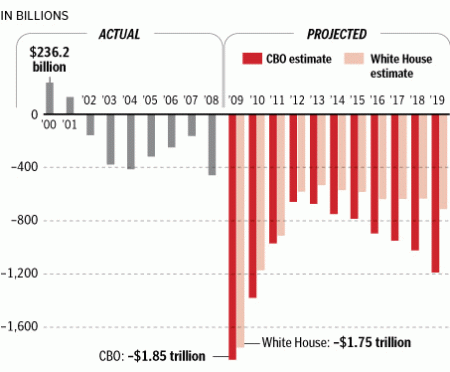
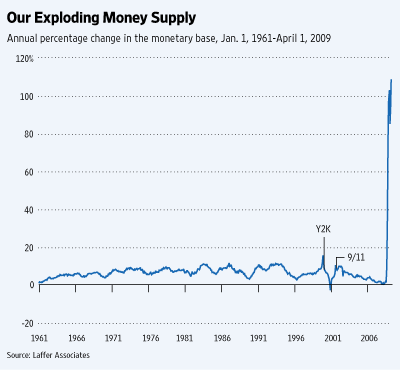
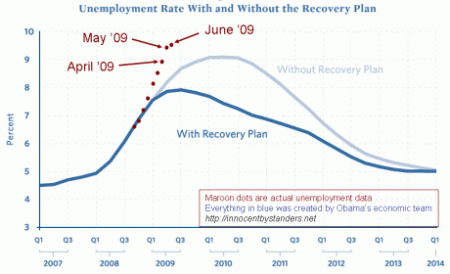
We’re in trouble, and our government is making things worse.
Leave a Comment » | Political | Permalink
Posted by K. Crary
The latest Rasmussen poll shows President Obama falling to earth:
Leave a Comment » | Political | Permalink
Posted by K. Crary
Byron York reports that Republicans are still demanding answers, and the White House is hinting that it may invoke executive privilege.
(Via Instapundit.) (Previous post.)
Leave a Comment » | Political | Permalink
Posted by K. Crary
The cap-and-trade bill will require private residences to satisfy energy efficiency standards set by the EPA. Existing residences will not be grandfathered, and must be retrofitted before a house can be sold or remodelled.
Leave a Comment » | Political | Permalink
Posted by K. Crary
Comedians who can’t find anything to make fun of in President Obama should check out the latest from the Onion. (Via Instapundit.)
Leave a Comment » | Political | Permalink
Posted by K. Crary
Last year’s financial bailout package was, strictly speaking, an investment. The federal government was going to buy up toxic assets, and some day sell them. That never happened, and instead the money was spend to buy equity in banks and bankrupt automobile companies. Still, TARP was an investment. To be sure, it was mostly a bad investment, but we will see some proceeds eventually. In the long run, it might even break even. If not, the cost will certainly be defrayed significantly from the original $700 billion. And all the proceeds go directly to reduce the national debt.
For Barney Frank (who happens to be one of the people most responsible for the financial crisis in the first place), repaying that money is unacceptable. Frank wants to take any TARP proceeds and spend it on his own priorities. In fact, he actually wants to use TARP proceeds to muck with the housing market some more. (No joke!)
Not paying off debts you were scheduled to pay off is the same thing as borrowing. So, what this is, is a stealthy liberal spending plan in the neighborhood of $700 billion (an amount that was considered enormous just one year ago). It should get public scrutiny commensurate with that.
(Via Power Line.)
Leave a Comment » | Political | Permalink
Posted by K. Crary
From this article, it sounds as though there is a very good chance of defeating the so-called health care “public option.” Without the federal government “competing” with private insurers, and inevitably driving most of them out of business, the prospect of “reform” is merely terrible.
(Via the Corner.)
POSTSCRIPT: You know you’re dealing with Orwellian terminology when you need three sets of scare quotes in two sentences.
Leave a Comment » | Political | Permalink
Posted by K. Crary
The Washington Post reports:
Sen. Daniel K. Inouye’s [D-HI] staff contacted federal regulators last fall to ask about the bailout application of an ailing Hawaii bank that he had helped to establish and where he has invested the bulk of his personal wealth.
The bank, Central Pacific Financial, was an unlikely candidate for a program designed by the Treasury Department to bolster healthy banks. The firm’s losses were depleting its capital reserves. Its primary regulator, the Federal Deposit Insurance Corp., already had decided that it didn’t meet the criteria for receiving a favorable recommendation and had forwarded the application to a council that reviewed marginal cases, according to agency documents.
Two weeks after the inquiry from Inouye’s office, Central Pacific announced that the Treasury would inject $135 million. . .
Inouye said he was not attempting to influence the outcome. . . Inouye reported ownership of Central Pacific shares worth $350,000 to $700,000, some held by his wife, at the end of 2007. The shares represented at least two-thirds of Inouye’s total reported assets.
(Via Hot Air.)
The FDIC won’t say why they changed their minds, but the timing is striking:
Internal FDIC e-mails obtained through the Freedom of Information Act show that Luong’s question was referred from San Francisco to FDIC headquarters in Washington. . . The internal e-mails show that the application had been forwarded to an inter-agency council headed by the Treasury Department that reviews cases in which a bank did not meet the criteria for a federal investment. . .
Shortly after the Inouye staffer’s phone call, the council approved Central Pacific’s application.
Despite smelling really bad, Inouye’s action does not violate the rules that Congress set for itself:
Such contacts by members and their staff do not violate the rules Congress has established to govern itself. “Congress has never been willing to adopt strong conflict-of-interest rules for its members, but for the most part, has left it up to each member to decide for themselves whether they have a potential conflict of interest,” said Fred Wertheimer, president of Democracy 21, a watchdog group.
The most similar known case comes from the House. Rep. Maxine Waters (D-Calif.) arranged a meeting between regulators and OneUnited of Massachusetts, a bank in which her husband held shares. Rep. Barney Frank (D-Mass.), who did not own shares in the company, subsequently inserted language into the bailout bill that effectively directed the Treasury to give special consideration to that bank.
There’s also this:
The crush of calls from Capitol Hill on behalf of specific applicants led the Treasury to announce earlier [this] year that it would start releasing a weekly list of congressional inquiries. It has yet to do so.
I understand. I’m sure it takes a long time to set that sort of thing up.
Leave a Comment » | Political | Permalink
Posted by K. Crary
This is a good example of why I voted for Hillary Clinton in the primary:
Secretary of State Hillary Rodham Clinton urged President Obama for two days to toughen his language on Iran before he did so, and then was surprised when he condemned Iran’s crackdown on demonstrators last week, administration officials say.
At his June 23 news conference, Mr. Obama said he was “appalled and outraged” by Iranian behavior and “strongly condemned” the violence against anti-government demonstrators. Up until then, Mr. Obama and other administration officials had taken a softer line, expressing “deep concern” about the situation and calling on Iran to “respect the dignity of its own people.”
Behind the scenes, the officials, who spoke on the condition that they not be named because they were discussing internal deliberations, said Mrs. Clinton had been advocating the stronger U.S. response, but the president resisted. When he finally took her advice, the aides said, he did so without informing her first. . .
“It was a happy surprise,” one administration official said. “It was echoing the line the secretary had been pushing for a couple of days.”
Another official said Mr. Obama apparently did not make the final decision to go ahead with the tougher stance until shortly before his remarks.
(Via Hot Air.)
Not only is President Obama not taking advice from Hillary Clinton, it seems they aren’t even talking. This strengthens the appearance that Clinton was nominated for political reasons, not because she holds the president’s confidence.
Leave a Comment » | Political | Permalink
Posted by K. Crary
The FDA is considering pulling cold medicines such as Nyquil off the market. It seems that some people use them incorrectly, taking too much and/or combining them with other acetaminophen products, resulting in an overdose. This kills about 20 people per year.
Cough syrup for toddlers is already banned, due to fears it can be misused. Its misuse killed about 3 children per year. Hundreds of public pools across the country are closing because municipalities cannot afford to retrofit them with drain covers that comply with the Virginia Graeme Baker act. Circulation entrapments kill about 1 person per year. (But one of them was the granddaughter of an important politician.)
Every death is a tragedy, of course. We need to ensure safety, at whatever the cost, right?
Then what about CAFE gas mileage standards, which kill 1300 people every year? If we’re going to curtail everyone’s lives to save a few people per year (or even just one), certainly CAFE standards need to go! Right?
Not at all. We’re tightening CAFE standards. Dramatically. From 27.5 mpg to 39 mpg. We can’t know how many additional people that will kill each year, but the number is surely in the hundreds at least.
Well, I suppose the government must have its priorities. Safety isn’t everything.
UPDATE: By a vote of 24-13, Nyquil and the like will remain on the market, assuming the FDA follows its panel’s recommendation.
Leave a Comment » | Political | Permalink
Posted by K. Crary
Oh, for crying out loud:
Q: How do you think conservative talk radio has affected the Legislature’s work?
A: The Republicans were essentially threatened and terrorized against voting for revenue. Now [some] are facing recalls. They operate under a terrorist threat: “You vote for revenue and your career is over.” I don’t know why we allow that kind of terrorism to exist. I guess it’s about free speech, but it’s extremely unfair.
Look, you legislative jackasses. Those seats aren’t yours, they’re ours. We’re allowed to turn you out of office if we don’t like what you’re doing.
Leave a Comment » | Political | Permalink
Posted by K. Crary
David Axelrod is refusing to rule out a middle-class tax hike. Is anyone honestly surprised by this? Of course President Obama will hike taxes on the middle-class (indeed, already has); that’s what Democrats always do.
One of the more tedious parts of election campaigns and early administrations is listening to the media take seriously farcical pledges like this (or sunlight-before-signing). At least that’s over.
UPDATE: The press openly laughed at the White House press secretary’s pathetic efforts to dodge a direct question about this.
UPDATE: Transcript of Gibbs’ efforts here. (Via Instapundit.)
Leave a Comment » | Political | Permalink
Posted by K. Crary
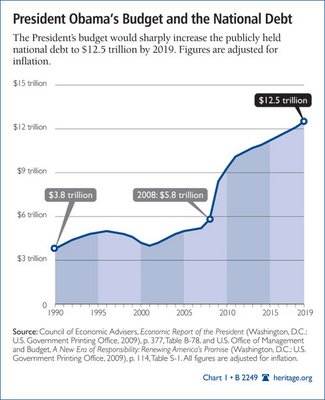
 Internet Scofflaw
You must be logged in to post a comment.