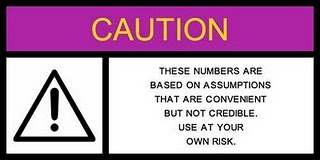
Greg Mankiw underscores something I keep saying: The Congressional Budget Office scores legislation statically, meaning that they assume the path of GDP is unchanged. But the path of GDP would not remain unchanged:
Recall that the bill raises taxes substantially. Some of these tax hikes are the explicit tax increases on capital income to pay for the insurance subsidies. Some of these tax hikes are the implicit marginal rate increases from the phase-out of the insurance subsidies as a person’s income rises. Both of these would be expected to reduce GDP growth. Indeed, to be very wonkish about it, these tax changes could have especially large GDP effects.
Also, we all know about the bogus “doc fix” problem in the CBO numbers, wherein the score assumes big future cuts in Medicare reimbursements that will never happen. Keith Hennessey points out that the reconciliation bill creates a new “doc fix” problem in Medicaid. Starting in 2015, the bill states that Medicaid reimbursements will be cut by $29 billion (over the remaining five years in the ten-year budget window). Obviously, that will never happen either.
The static scoring is simply how business is done at the CBO, despite the unrealism of it, but the new funding cliff in Medicaid is simply dishonest. (And remember, the Democrats needed every penny of purported savings in order to get their bill across the line where it can be considered in the Senate under reconciliation instructions.) Now that Congress has learned to rig CBO scores by including blatant lies, I think the CBO isn’t useful any more.
(Via Instapundit.) (Graphic above due to Greg Mankiw.)
 Internet Scofflaw
You must be logged in to post a comment.